
Elysium — Plane of Blessed Peace and Merciful Rest
Elysium — Plane of Blessed Peace and Merciful Rest
Elysium is the plane where the weary are healed, the righteous dead find joy, and goodness becomes a country so gentle that leaving it may be the hardest test of all.
- Plane Type: Outer Plane
- Moral Gravity: Pure Good / Neutral Good
- Common Names: Elysium, the Blessed Fields, the Isles of the Blessed, the Gentle Country, the Fields Beyond Sorrow, the Shore of Mercy
- Primary Function: Blessed afterlife, mercy, healing, refuge, holy rest, recovery after suffering, final peace for righteous souls
- Usual Arrival Point: A meadow beside a bright river, an island shore, a hospice doorway, a battlefield after the last wound stops hurting, or a garden gate opened by someone who forgave you.
Overview
Elysium is the plane of blessed peace.
It is not a wild realm of freedom, not a battlefield of heroic chaos, and not a shining court of perfect law. Elysium is goodness without cruelty, mercy without weakness, and rest without decay. It receives the righteous dead, shelters the wounded in spirit, and gives weary travellers a glimpse of existence after fear has lost its claim.
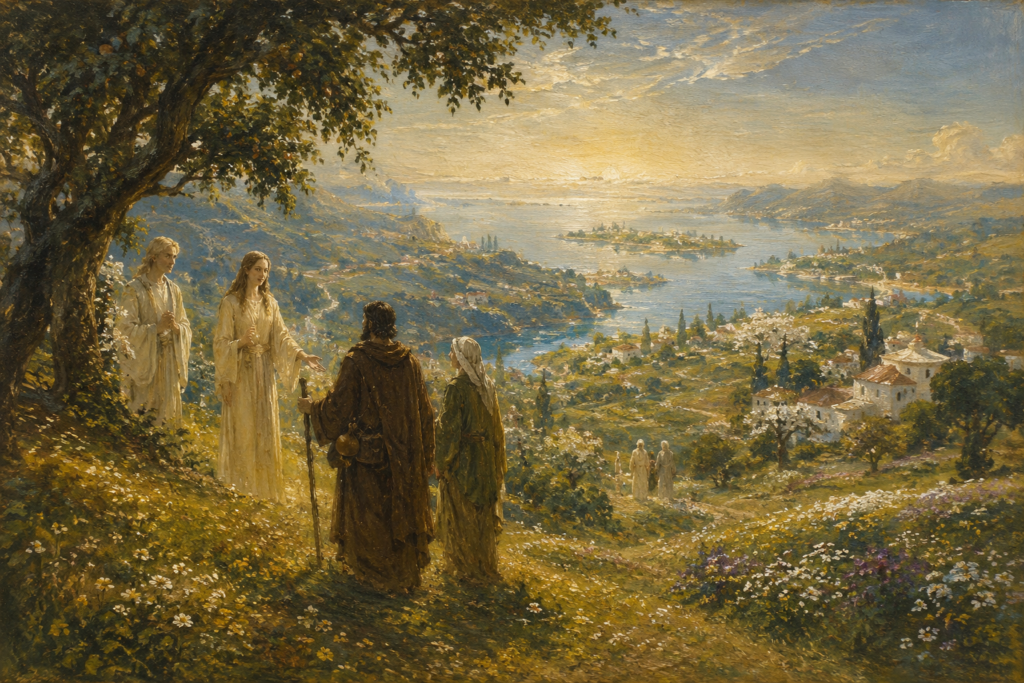
The plane appears gentle at first. Its meadows are bright but not harsh. Its rivers run clear. Its orchards carry fruit in every season. Its houses are open to guests. Its animals do not flee unless they are chased, and even then they seem more saddened than afraid. Those who arrive hungry are fed. Those who arrive wounded are tended. Those who arrive grieving are not told to stop grieving; they are given time.
That is Elysium’s beauty and its danger.
The plane does not usually attack intruders. It does not need to. It offers peace. It offers reunion. It offers forgiveness. It offers the chance to lay down weapons, vendettas, crowns, duties, grudges, ambitions, and names. Many visitors intend to rest for a single night and discover that a year has passed in the mortal world. Some never return, not because they are imprisoned, but because they are happy.
Elysium tests not whether a hero can survive suffering, but whether a hero can leave comfort when others still suffer elsewhere.
Cosmological Role
Elysium is the heartland of Good among the Outer Planes.
Where ordered heavens reward duty and judgement, Elysium restores compassion. Where heroic planes celebrate courage and contest, Elysium asks what victory was for. Where nature-planes honour the living world, Elysium honours the soul after pain has ended.
It is the resting country of the righteous dead, the refuge of the wrongfully harmed, the convalescent garden of saints, protectors, innocent victims, healers, martyrs, oath-keepers, and those whose goodness survived without needing a crown.
Elysium does not erase sorrow. It completes it. Mourning becomes memory. Pain becomes wisdom. Guilt becomes reparation where reparation is possible, and release where it is not. The plane does not pretend that evil never happened. It insists that evil does not get the final word.
In the campaign, Elysium is one of the safest Outer Planes to enter and one of the hardest to leave cleanly.
The Four Blessed Regions
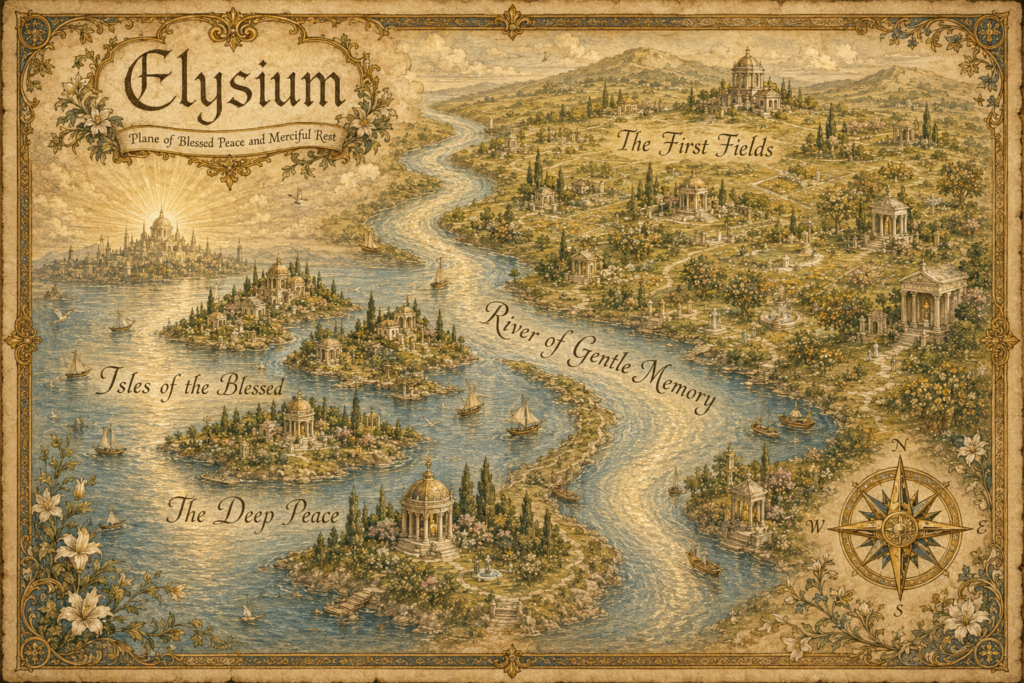
Elysium is usually described as four great regions rather than four strictly separated layers. Travellers may pass between them by walking, sailing, dreaming, dying, being forgiven, or being led by someone who has already found peace.
The First Fields

The First Fields are where most travellers arrive.
They are meadows, orchards, low hills, guest-houses, healing halls, clean streams, quiet shrines, and villages that look strangely familiar to each soul that sees them. A soldier may find a farmhouse from childhood. A plague nurse may find a warm ward with clean linen. A drowned sailor may wake on a sunlit shore with dry clothes and no terror of the sea.
The First Fields heal immediate wounds. Broken bones set. Burns cool. Starvation loosens its grip. Nightmares become dreams. The newly dead are met here by guides, kin, guardians, or quiet strangers who know how to sit beside grief without demanding speech.
The First Fields are the easiest part of Elysium to visit and the easiest to leave. Even here, however, time softens. A visitor who rests too deeply may forget the urgency that brought them.
The River of Gentle Memory

A broad river flows through Elysium, though it is not always found in the same place. It may appear as a stream through apple trees, a slow canal beside white houses, a silver estuary, or rainwater running through a battlefield where no corpses remain.
The River of Gentle Memory does not simply erase the past. More often, it changes the shape of memory. A mother remembers the child she lost without reliving the fever. A knight remembers the battle without hearing every scream. A murderer who truly repents remembers exactly enough to make amends and never enough to enjoy the crime.
This region is sacred to healers, confessors, mourners, and those who carry the dead home. It is also dangerous to investigators, oath-bound avengers, and heroes searching for a truth someone in Elysium has finally been allowed to stop carrying.
The Isles of the Blessed

Beyond the river lie islands and bright shores where the honoured dead live in joy. Some are literal islands in a shining sea. Others are hill-forts, groves, feast-halls, gardens, green courts, wrestling fields, libraries, workshops, nurseries, sanctuaries, and whole villages made from remembered goodness.
The Isles of the Blessed are not idle. The dead here garden, feast, compose songs, wrestle, race horses, debate, repair old wrongs, teach the newly arrived, and greet those who come after them. No one is forced to perform virtue as labour. Goodness here is not a tax. It is what remains when fear, hunger, humiliation, and ambition no longer bend the soul out of shape.
Heroes may be found here, but Elysium does not worship violence. A warrior is honoured for whom they protected, not for how many they killed. A ruler is honoured for justice, not splendour. A martyr is honoured for love, not suffering. A child who died kindly may be nearer the heart of Elysium than a king.
The Deep Peace

The Deep Peace is the most beautiful and most perilous region of Elysium.
Few living travellers reach it by accident. It appears as a shore beyond all storms, a garden after sunset, a house at the end of a lane, a sea without fear, a hill under endless morning, or a bed in a room where every loved voice is nearby. Here souls no longer argue with death. They no longer need witness. They no longer need victory. They are not gone, but they have passed beyond ordinary summons.
A soul in the Deep Peace may still answer a call of overwhelming love, cosmic duty, divine command, or unfinished mercy. It will not answer greed, necromancy, vanity, politics, or mere curiosity.
The Deep Peace is not a prison. It is final rest. Disturbing it is one of the gravest acts a mortal spellcaster, priest, or planar traveller can attempt.
Laws of the Plane
Mercy Is Stronger Than Violence
Violence is not impossible in Elysium, but violence has no native authority there. A sword can wound. A spell can burn. A monster can invade. Yet the plane itself favours protection, healing, restraint, truth, and reconciliation.
Aggressors feel the wrongness of their acts. The sensation is not guilt imposed from outside; it is the soul’s own moral weight becoming impossible to ignore.
Rest Cannot Be Stolen
Elysium protects the rest of the righteous dead. Summoning, binding, interrogation, forced resurrection, soul-theft, and necromantic compulsion all meet resistance here.
The more peaceful the soul, the harder it is to drag away.
Forgiveness Is Not Acquittal
Elysium offers mercy, but it does not falsify justice. A villain cannot simply enter the plane, speak soft words, and be washed clean. True repentance is possible, but it requires confession, repair, surrender, and transformation.
The plane may protect a repentant enemy from revenge, but it does not erase the victim’s truth.
Goodness Is Personal
Elysium does not reward titles, offices, alignments written on scrolls, or the appearance of holiness. It responds to actual mercy, courage, kindness, sacrifice, protection, and repentance.
A nameless midwife may pass deeper into Elysium than a famous paladin. A pagan hero, a village healer, a loyal hound, a murdered child, a just magistrate, and a stranger who gave away their last food may all be found here.
Peace Tests Duty
A visitor who has no urgent duty may remain safely for a long time. A visitor who does have a duty will eventually feel the plane ask a silent question:
Are you resting, or are you hiding?
Divine Powers and Sacred Realms
Elysium welcomes powers of mercy, healing, childbirth, refuge, holy grief, righteous rest, and gentle protection. Divine realms here tend to be hospices, gardens, warm thresholds, island sanctuaries, feast-fields, river-shrines, and houses where the dead are received with dignity.
Not every good deity belongs in Elysium. A war-god who protects the innocent may send honoured dead here, but their own hall may lie elsewhere. A judge-god may respect Elysium’s sanctuary without dwelling in its fields. Use Elysium for powers whose goodness is restorative rather than conquering.
Akna — The Warm Threshold
Akna’s realm is a house of safe birth, clean water, warm hands, and guarded doorways. It stands wherever fear gathers around childbirth, infancy, mothers, midwives, and families waiting through danger.
In Elysium, her presence is gentle but absolute. No predatory spirit, plague-shadow, or oathless dead thing may cross her threshold unchallenged.
Her realm is often reached from the First Fields or the River of Gentle Memory. Those who died in childbirth, those who protected children, and those who never had the chance to be held safely may find rest there.
Iacchus — Processions of the Blessed
Iacchus is honoured in Elysium where grief turns toward sacred joy. He does not need to rule a fixed realm here. His presence is a song heard at twilight, a torch seen across water, and a procession that arrives when sorrow is ready to move.
Mystery cults, initiates, ecstatic mourners, and those who seek sacred transformation may encounter his shrines near the River of Gentle Memory or on the shores of the Isles of the Blessed.
Other Powers
Other good-aligned powers may maintain guest-realms in Elysium, especially those concerned with mercy, peace, innocent death, healing, release from torment, sanctuary, or the protection of the dead.
Their realms should feel like places of care, not courts of conquest.
Inhabitants
The Blessed Dead
The most important inhabitants of Elysium are the blessed dead.
They are not generic petitioners to be harvested, traded, or used as planar scenery. They are souls at rest. Some remember their mortal lives clearly. Some remember them as one remembers a childhood home. Some have become more complete than they were in life. Some appear as they always wished to be. Others appear exactly as they were when they did their greatest good.
The blessed dead are persons. They have dignity, privacy, homes, kinship ties, and the right not to be disturbed.
Agathions
Agathions are among the most natural native servants of Elysium. They are not soldiers first. They are healers, guardians, guides, companions, teachers, mourners, watchers, and defenders of souls who have earned rest.
Avoral agathions may serve as sky-watchers over the First Fields. Cervinal and cervapral agathions walk groves, orchards, and pilgrim roads. Cetaceal agathions appear along shining rivers and the blessed sea. Chelonidal agathions guard slow crossings, quiet shrines, and places where time must be allowed to heal. Leonal agathions defend sanctuaries when gentleness is mistaken for weakness. Draconal agathions appear rarely, usually where a whole region of Elysium must be protected from invasion, soul-theft, or divine trespass.
Agathions should feel like compassionate powers with teeth, not soft background decoration.
Mercy-Spirits
Mercy-spirits are lesser native beings of Elysium. They may appear as nurses, lantern-bearers, white animals, soft-voiced warriors, river-guides, orchard-keepers, child-guardians, singers, ferrymen, hearth-tenders, or quiet presences sitting beside the newly dead.
They are not weak. A mercy-spirit may refuse a king, bar a necromancer, shame a celestial general, or stand unarmed before a demon and make it hesitate.
Use mercy-spirits when the scene needs Elysium itself to speak without requiring a major angel, deity, or named monster.
Angels
Angels visit Elysium as guardians, messengers, healers, and witnesses. They are less concerned with command here than with service. An angel in Elysium may carry water, mend a roof, stand beside a deathbed, or guard a soul from being dragged back into torment.
Seraphim, virtues, thrones, principalities, powers, planetars, solars, cherubim, and malakhim may all appear where their role fits the scene, but they should not make Elysium feel like a court of law or a military heaven. In this plane, even the mightiest angel lowers its voice.
Fallen angels rarely endure Elysium for long. The plane does not burn them at once. It gives them memory, and memory is often worse.
Celestial Animals
Animals in Elysium are often wiser than mortal beasts, though not all speak. A celestial dog may guide a lost child. A celestial stag or deer-like spirit may lead a penitent knight to a grave. A celestial eagle may carry a final message across the river. A celestial swan may appear where grief is becoming song. Celestial bees work in orchards that never fail. Celestial lions and dire lions guard sacred thresholds without cruelty.
Some animals are the blessed dead of faithful beasts. Others are native spirits of peace, protection, memory, and holy companionship.
Use celestial animals sparingly. They work best as guides, omens, guardians, or signs that the plane has noticed someone’s need.
Psychopomps and Threshold-Guides
Psychopomps are not usually native rulers of Elysium, but some serve at its borders, rivers, death-roads, and memory crossings. They guide souls who are still afraid, disputed, lost, wrongly claimed, or not yet ready to enter final rest.
Nosoi may appear near deathbeds, shrines, and records of the dead. Vanths may guard a soul from being seized by force. Catrina-like figures may appear where grief must become honour rather than despair. Yamaraj-like judges or guides may stand at rare thresholds where mercy and judgement must both be answered.
Psychopomps in Elysium should not turn the plane into a bureaucracy of death. They are crossing-keepers, not the heart of the plane.
Redeemed Spirits
A rare few beings in Elysium were not always good.
These souls are not displayed as trophies. They are protected because their repentance is real and their repair is ongoing. Some serve in gardens. Some watch thresholds. Some carry messages to the living world. Some spend ages learning how not to excuse themselves.
Their presence can create conflict. Victims may not be ready to forgive them. Avengers may consider Elysium’s protection intolerable. The plane does not force reconciliation. It protects the possibility of transformation.
Invaders and Predators
Elysium has enemies.
Fiends, oath-breakers, soul-thieves, grief-eaters, necromancers, false psychopomps, despair-spirits, and hunters of saintly relics all seek ways into the plane. Most cannot remain long unless protected by powerful magic, stolen innocence, legal loopholes, divine treachery, or the unresolved pain of a soul they have followed.
Undead that feed on grief, memory, guilt, or wrongful death are especially dangerous here because they attack what Elysium exists to heal. Fiends do not usually invade as armies; they enter as mourners, advocates, rescuers, penitents, or claimants with forged rights over the dead.
The plane’s gentleness should not be mistaken for poor defences.
Personhood, Sanctuary, and Law
Elysium treats souls as persons, not resources.
A blessed soul cannot be claimed as treasure. A dead hero cannot be seized as military property. A child’s ghost cannot be used as evidence without consent. A repentant enemy under Elysium’s protection cannot be murdered simply because someone still has a lawful warrant from the mortal world.
This does not mean Elysium ignores justice. It means mortal jurisdiction weakens when it crosses into final rest.
Sanctuary in Elysium is powerful but not automatic. A murderer who runs into the First Fields while still clutching the bloody knife has not gained holy protection. A soldier who sincerely surrenders after a life of cruelty may be held, judged, and forced into confession before any rest is offered. A tyrant who wishes only to avoid punishment finds no comfort here.
Elysium’s law is simple:
The wounded may rest. The dead may be honoured. The guilty may repent. The cruel may not rule.
Travel and Arrival
Travellers reach Elysium through holy gates, deathbed visions, river-crossings, blessed groves, mercy-shrines, divine summons, planar magic, or rare natural thresholds where grief has been answered by compassion.
Common arrivals include:
- a meadow after battle where no carrion birds come;
- a ferry crossing under a gold-white sky;
- a hospice door that opens onto impossible spring;
- a garden where a dead relative is waiting;
- a shore beyond storm;
- a quiet road only visible to those carrying the body of someone they loved;
- a ruined chapel where all the candles relight at once;
- a cradle-room where a child who never drew breath is laughing.
Elysium is easy to enter for the humble and difficult to enter for the exploitative. Magic can force a gate, but the plane remembers the method of arrival. Those who come by theft, coercion, or soul-binding find hospitality thin.
Leaving Elysium
Leaving Elysium is usually possible. It is not always easy.
The plane does not lock its gates. Instead, it removes the emotional poisons that make duty feel urgent. Fear softens. Rage cools. Shame loosens. Ambition becomes faintly embarrassing. Vengeance begins to look small. A visitor may still choose to leave, but they must choose with a clear heart.
Those who have living duties feel a pull outward. A mother with children still in danger, a knight under oath, a healer needed during plague, a ruler whose people are starving, or an adventurer carrying a warning may all feel the distant ache of unfinished responsibility.
Those who came only for rest may find no such pull.
Planar Effects
The Gentle Pull
Elysium encourages rest, trust, forgiveness, and surrender of needless burdens. This is not ordinary mind control. It is moral and emotional gravity. The plane makes bitterness harder to maintain.
Healing Weather
Rain in Elysium cools fever. Wind eases grief. Sunlight warms without burning. Night brings sleep without nightmares unless a soul is deliberately resisting truth.
Honest Memory
Lies become tiring in Elysium. Self-deception becomes fragile. A visitor can still lie, but maintaining a false identity, false grief, false repentance, or false innocence requires increasing effort.
Sacred Hospitality
Food and shelter are easy to find for those in honest need. Those who exploit hospitality find bread tasteless, water heavy, beds sleepless, and doors gently closed.
The Silence Around the Deep Peace
Divination aimed into the Deep Peace returns little. Not because nothing is there, but because some rest is holier than knowledge.
Mechanics Tabs
The rules below are mechanics compatible for different game editions.
Elysium 5.5e
Elysium Pathfinder 1e / 3.5e
Elysium 5.5e-Compatible Rules
Planar Trait: Blessed Rest
A creature that finishes a Long Rest in Elysium gains one of the following benefits of its choice.
| Benefit | Effect |
|---|---|
| Restored Body | The creature ends one disease or one level of Exhaustion. |
| Quiet Mind | The creature has Advantage on the next saving throw it makes against being Charmed or Frightened before its next Long Rest. |
| Gentle Renewal | The creature gains Temporary Hit Points equal to its Proficiency Bonus + its Wisdom modifier, minimum 1. |
| Clear Memory | The creature may recall one emotionally important memory without suffering magical fear, psychic damage, or compulsion attached to that memory. |
A creature cannot benefit from Blessed Rest again until it finishes a Long Rest outside Elysium or completes a meaningful act of mercy.
Planar Trait: The Gentle Pull
At the end of each Long Rest in Elysium, a living visitor with unfinished duties must make a Wisdom saving throw.
| Situation | DC |
|---|---|
| Ordinary visit with a clear reason to leave | 10 |
| Reunited with a dead loved one, offered a perfect home, or healed of deep trauma | 13 |
| No clear plan for leaving, or more than seven consecutive days in Elysium | 15 |
Reduce the DC by 2 if the visitor carries an urgent oath, active rescue mission, or time-sensitive duty to the living.
On a failed save, the visitor does not become controlled. Instead, they lose urgency. They will not willingly leave Elysium for the next 24 hours unless a companion uses an action to remind them of a specific living duty, endangered person, oath, or unfinished act of mercy.
A creature immune to being Charmed has Advantage on this saving throw, but immunity does not automatically negate the effect because the Gentle Pull is not ordinary enchantment.
Planar Trait: Peace Against Violence
When a creature starts combat in Elysium by attacking a non-hostile creature, violating sanctuary, or attempting to seize a soul, the aggressor must make a Charisma saving throw.
DC: 8 + the party’s Proficiency Bonus + the highest Wisdom modifier among the protected victims or guardians present.
On a failed save, the aggressor has Disadvantage on its first attack roll or spell attack before the end of its turn. If the creature instead forces a saving throw, one target of that effect has Advantage on the save.
Fiends, undead, and creatures that knowingly entered Elysium to steal, corrupt, bind, or devour souls make this save with Disadvantage.
Planar Trait: Rest Cannot Be Stolen
Magic that attempts to summon, bind, compel, interrogate, trap, or forcibly resurrect a blessed soul from Elysium must overcome the plane’s protection.
The caster makes a spellcasting ability check.
| Soul’s State | DC |
|---|---|
| Newly arrived, unsettled, or actively seeking contact | 14 |
| At peace in the First Fields | 17 |
| Dwelling among the Isles of the Blessed | 20 |
| Resting in the Deep Peace | 25 |
On a failed check, the spell fails and the caster takes Psychic damage equal to 2d8 + the spell’s level. If the spell has no level, use 2d8.
On a failure by 5 or more, a mercy-spirit, angelic guardian, ancestral protector, or other appropriate defender becomes aware of the attempt.
Planar Trait: Honest Memory
A creature that tells a deliberate lie about a grave moral matter while in Elysium must succeed on a Charisma saving throw or become unable to repeat that lie for 1 hour.
DC: 13, or 16 if the lie concerns murder, betrayal, false repentance, soul-theft, sanctuary, or the abuse of the dead.
This does not force the creature to tell the truth. It merely makes the lie fail in its mouth.
Optional Rule: Elysian Sanctuary
A creature that sincerely surrenders in Elysium and asks for mercy gains the effect of the Sanctuary spell until the end of its next turn.
This effect ends early if the creature attacks, casts a harmful spell, threatens a soul, attempts escape by deceit, or resumes hostile action.
A creature cannot exploit this rule repeatedly. Once a creature benefits from Elysian Sanctuary, it cannot do so again until it has made a genuine act of confession, repair, or protection.
Elysian Travel Complications
Roll or choose when the plane’s peace complicates the adventure.
| d8 | Complication |
|---|---|
| 1 | A dead loved one appears and asks the character to stay one more day. |
| 2 | A villain the party hates is under sanctuary and claims to be truly repentant. |
| 3 | The person the party came to rescue does not want to leave. |
| 4 | A memory needed for the quest has been softened so the soul can rest. |
| 5 | An angel refuses passage until the party explains who will be harmed by their mission. |
| 6 | A companion begins forgetting why the mortal world matters. |
| 7 | The only witness to a crime is a blessed child whom Elysium protects from distress. |
| 8 | A fiend has entered disguised as a mourner and is waiting for a soul to speak its true name. |
Elysium Pathfinder 1e / 3.5e-Compatible Rules
Planar Traits
- Gravity: Normal.
- Time: Normal, though subjective time may feel softened in regions of deep rest.
- Size: Immeasurable.
- Morphic: Divinely morphic in divine realms; otherwise mildly morphic in response to mercy, memory, and rest.
- Alignment: Strongly good-aligned.
- Magic: Healing, restoration, protection, and non-coercive mercy effects are strengthened at the GM’s discretion. Necromancy that binds, compels, traps, or disturbs peaceful souls is impeded.
Blessed Rest
A creature that rests for 8 hours in Elysium gains one of the following benefits.
| Benefit | Effect |
|---|---|
| Restored Body | Remove fatigue, or reduce exhaustion-style effects by one step if using a system that tracks them. |
| Quiet Mind | Gain a +2 morale bonus on the next saving throw against fear, charm, compulsion, or despair within 24 hours. |
| Gentle Renewal | Gain temporary hit points equal to character level, maximum 20. |
| Clear Memory | Revisit one painful memory without suffering magical fear, confusion, or compulsion attached to it. |
A creature cannot benefit from Blessed Rest more than once per day.
The Gentle Pull
After each full day spent in Elysium, a living visitor with unfinished duties must attempt a Will save.
| Situation | DC |
|---|---|
| Ordinary visit with a clear reason to leave | 12 |
| Reunited with a dead loved one, offered a perfect home, or healed of major trauma | 15 |
| No clear plan for leaving, or more than seven days in Elysium | 18 |
Apply a +2 bonus if the visitor carries a sacred oath, rescue mission, or urgent duty to the living.
On a failed save, the visitor loses the will to depart for 24 hours unless reminded of a specific duty, endangered person, oath, or unfinished mercy by an ally. This is a mind-affecting effect, but it is not hostile domination.
Peace Against Violence
A creature that initiates violence against a non-hostile being, violates sanctuary, or attempts to seize a soul must attempt a Will save.
DC: 15, or 18 for fiends, undead, soul-thieves, and knowingly hostile intruders.
On a failed save, the creature takes a –2 penalty on attack rolls, caster level checks, and saving throw DCs for harmful effects until the end of its next turn.
Rest Cannot Be Stolen
A caster attempting to summon, bind, question, trap, or forcibly return a blessed soul from Elysium must succeed at a caster level check.
| Soul’s State | DC |
|---|---|
| Newly arrived or unsettled | 18 |
| At peace in the First Fields | 22 |
| Dwelling among the Isles of the Blessed | 26 |
| Resting in the Deep Peace | 32 |
Failure means the spell fails. Failure by 5 or more alerts an appropriate guardian.
At the GM’s discretion, spells such as speak with dead, resurrection, true resurrection, trap the soul, binding, planar binding, miracle, or wish may be affected when used coercively or without consent.
Honest Memory
A creature that knowingly lies about a grave moral matter must attempt a Will save.
DC: 15, or 18 if the lie concerns murder, betrayal, false repentance, sanctuary, or soul-theft.
On a failed save, the creature cannot repeat that lie for 1 hour. This effect does not force truth; it prevents the lie from taking shape.
Elysian Sanctuary
A creature that sincerely surrenders and asks for mercy gains the effect of sanctuary for 1 round, caster level equal to its Hit Dice.
This protection ends immediately if the creature attacks, casts a harmful spell, attempts to flee through deceit, threatens a soul, or resumes hostile action.
Running Elysium at the Table
Elysium should not feel like a harmless reward screen. It should feel like a place so good that ordinary adventure motives begin to look crude.
Use Elysium when the story needs one of these pressures:
- the party must retrieve someone who has earned rest;
- the party must ask the dead for help without violating them;
- the party must protect a repentant enemy from revenge;
- the party must leave paradise to return to duty;
- the party must distinguish mercy from weakness;
- the party must face grief without turning it into a combat problem;
- a villain tries to exploit sanctuary, resurrection, or the language of forgiveness.
The central question of Elysium is not “Can the characters survive?” It is:
Can they remain good when goodness costs them what they want?
Tone
Elysium should be calm, bright, and emotionally dangerous. Avoid making every scene sentimental. Peace is stronger when it is specific.
A village kitchen with fresh bread is better than a generic glowing palace. A dead friend repairing a fishing net is better than a chorus of abstract spirits. A former enemy quietly sweeping a hospice floor is better than a speech about redemption.
Combat
Combat in Elysium should be rare but meaningful. When violence happens, it should feel like a violation.
Good combat uses include:
- fiends invading a sanctuary;
- a necromancer trying to seize a soul;
- bounty hunters ignoring Elysian protection;
- a grief-spirit corrupted by unresolved murder;
- a false healer harvesting memories;
- a celestial guardian testing whether the party’s mission is merciful or selfish.
Do not fill Elysium with random wilderness fights. The plane’s danger is moral, emotional, spiritual, and legal before it is tactical.
Failure States
Failure in Elysium should not always mean death.
Better failures include:
- the party stays too long and loses time in the mortal world;
- the rescued soul refuses to leave;
- the party violates sanctuary and loses divine trust;
- a dead witness is harmed by careless questioning;
- a villain claims mercy before the party is ready to handle it;
- a resurrection fails because the soul has found peace;
- the party returns with healing but without the answer they wanted.
Best Three Adventure Hooks
1. The Saint Who Refuses Resurrection
A plague-ravaged city needs its dead healer returned. The spell reaches Elysium, but the healer refuses. She has earned rest, and the souls she tends in the First Fields need her too.
The party must travel to Elysium and ask, not command. They may discover that the city does not need the healer’s body back. It needs her unfinished instructions, her hidden records, and the courage to continue without making a martyr serve forever.
2. Sanctuary for the Butcher
A hated warlord has fled into Elysium after surrendering at the moment of death. The families of his victims want him dragged out and judged. Elysium has not absolved him, but it has placed him under guarded repentance.
The party must decide whether justice requires removal, whether revenge is disguising itself as law, and whether the warlord’s confession can save the living from a larger crime.
3. One More Day
A companion finds a dead loved one in the Isles of the Blessed. The reunion is real. The love is real. The peace is real. The companion asks for one more day before returning to the mortal world.
Outside Elysium, a siege, plague, trial, or ritual deadline approaches. The party must choose how hard to pull someone away from the happiest moment of their existence.
Treasure and Gifts
Elysium rarely gives treasure in the ordinary sense. Gold taken from the plane becomes dull unless freely given. Stolen fruit rots. A cup lifted from a feast-hall becomes clay in a thief’s pack. A cloak given by a grateful soul remains warm for years.
Suitable Elysian rewards include:
| Gift | Use |
|---|---|
| Orchard Fruit | Feeds one creature for a day and grants Advantage or a +2 bonus on one save against fear or despair. |
| Mercy-Candle | Burns with steady light near the dying, the grieving, or the undead; cannot be used to harm. |
| White Shore Shell | Allows a grieving creature to sleep without nightmares once. |
| River-Washed Stone | Grants Advantage or a +2 bonus on one save against memory theft, forced confession, or psychic despair. |
| Bread of Welcome | Shared among up to six creatures; each regains a small amount of hit points or gains temporary hit points at the GM’s discretion. |
| Thread from a Blessed Garment | Used in resurrection or healing magic to show consent rather than compulsion. |
| Lantern of the Last Door | Reveals whether a soul is unwilling, unable, or forbidden to return. |
Do not let Elysian gifts become a magic-item shop. They should be personal, limited, and tied to mercy.
Historic and Mythic Context

Elysium, also called the Elysian Fields or the Isles of the Blessed, comes from Greek and later Greco-Roman traditions of a blessed afterlife. Ancient accounts vary. In some traditions, Elysium is a distant western paradise for favoured heroes. In others, it becomes a blessed region of the underworld for righteous souls, initiates, and the honoured dead.
Classical sources associate Elysium with perfect happiness, gentle weather, Oceanus, the Isles of the Blessed, heroic souls, and later moral or initiatory reward. The idea changes over time rather than appearing as one fixed doctrine.
- Theoi — Elysion / Elysium
- 1911 Encyclopaedia Britannica — Elysium
- Getty CONA Iconography Record — Elysium
In the campaign, Elysium is treated as a living Outer Plane rather than a single Greek afterlife location. The mythic material is used as the deep source-image: blessed fields, heroic rest, righteous peace, gentle weather, western islands, river-bound transition, and the possibility that final happiness may be difficult for the living to disturb.
This version centres Elysium on mercy, healing, holy rest, and pure Good rather than on chaos, whimsy, or wild freedom. Those themes belong better to other planes and regions. Elysium is the plane where suffering ends, not where passion rules.
Keep this reference growing
If this page helped with your reading or game, you can support its upkeep or explore the curated books.
Explore the Bookshop — epics, classics and stories behind imagined worlds.