
King Arthur Pendragon — High King of Camelot
Before Camlann in 537 CE, King Arthur rules Camelot and leads the Knights of the Round Table. He can unite rival lords against an invasion, but the oaths holding his court together can also lead to betrayal. Morgan le Fay plans to arm Sir Accolon with the real Excalibur while Arthur receives a false copy. A visitor seeking the king’s help may have to decide which of his advisers can be trusted.
At a Glance
- Role
- High King of Camelot; commander of the Round Table
- Identity
- Human; the Once and Future King
- Seat
- Camelot before 537 CE; carried to Avalon after Camlann, absent from ordinary Britain in 1454
- Court and rivals
- Morgan le Fay, Mordred and competing lords
- Current danger
- Accolon has the real Excalibur, while Arthur carries a false sword
- Family
- Guinevere is his wife; Morgan and Morgause are half-sisters
- Weapons
- Excalibur and its protective sheath; sometimes lance and dagger
- Sacred customs
- The old gods and sacred places of Britain in this campaign
- Encounter
- Legendary monarch, not an automatic enemy
What Is Happening Right Now?
Arthur has convened the Round Table after a messenger warned that Morgan le Fay will place the true Excalibur in Accolon‘s hands and leave Arthur with a false blade. Merlin advises him to test the sword in private; Mordred urges a public demonstration to humiliate the messenger. Meanwhile a second embassy waits outside the gates with King Matur’s ultimatum, while Sir Daniel is already riding towards the kingdom of Cluse. The king must decide which threat deserves his immediate command.
First Meeting
Arthur is seated beneath the standards of his sworn houses, wearing travel-scarred armour beneath a plain royal mantle. His attendants watch the doors rather than the guests. He rises when the characters enter, asks their names and their business, then sends away his flatterers when the first witness speaks of a crime committed by a noble. He offers no reward for a false accusation, even one that would be politically convenient.
Three Scenes Tonight
- The wrong sword: an armourer can see flaws in the false Excalibur but is terrified of naming the lady who commissioned it.
- The disputed oath: a witness from the house of Pellinore asks for sanctuary after hearing four Orkney knights arrange a private ambush.
- The giant’s herald: the ambassador from Cluse demands an answer before dawn and threatens to unleash a machine that can break an army.
Appearance and Manner
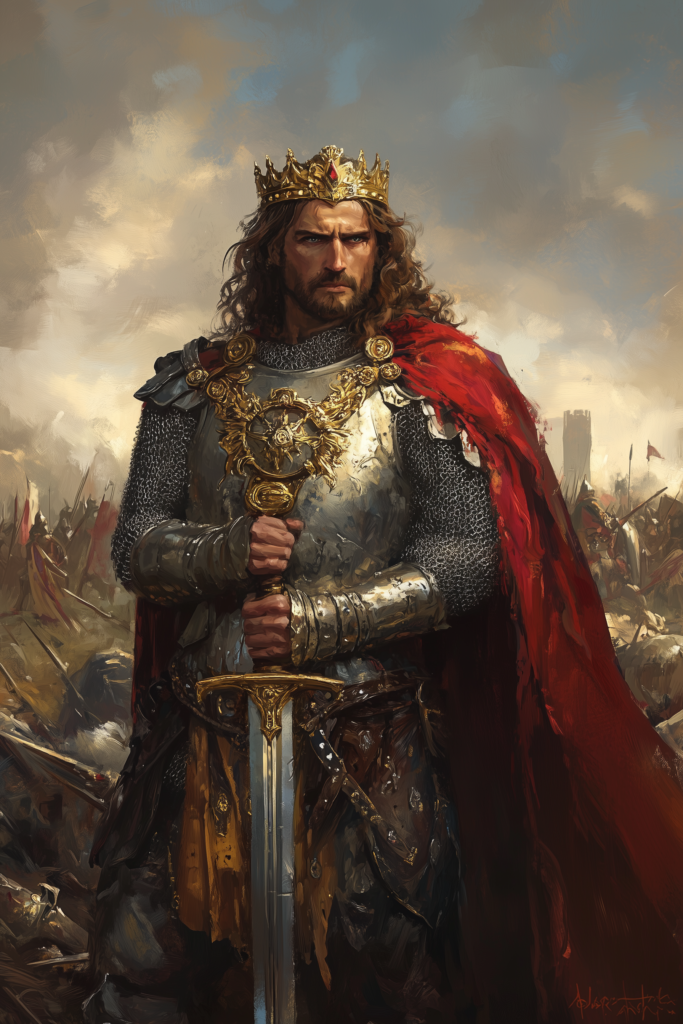
Arthur is an experienced soldier with a steady gaze, polished but worn armour and an instinct to stand between opposing claimants. He values plain testimony more than elegant speeches. The king is generous when a foe surrenders, but he can be severe when public trust is betrayed. His greatest weakness is the belief that an oath, once sworn, will always bind the person who made it.
Motivations, Pressure and Private Knowledge
- Ambition: sustain a kingdom where law restrains powerful families rather than merely recording their victories.
- Pressure: war beyond the borders, Orkney’s blood feud, the threat to Excalibur and rival claims upon the crown.
- Private knowledge: the sword’s sheath is as important as the blade; the wrong bearer could turn a fair duel into a trap.
- Flaw: Arthur can delay acting against men he loves, hoping friendship will settle a grievance that already needs judgement.
- Turning point: if reliable witnesses expose Morgan’s deception and the Orkney conspiracy, Arthur can preserve Camelot without a civil war.
Relationships and Allegiances
- Queen Guinevere: his wife and a capable ruler whose judgement is too often dismissed by competing lords.
- Merlin: trusted prophet, adviser and keeper of dangerous secrets.
- Sir Lancelot: mighty knight whose loyalty to the throne is complicated by personal bonds.
- Sir Gawain: nephew, champion and leader among the Orkney brothers.
- Sir Lamorak: exemplary warrior threatened by a private feud Arthur has struggled to settle.
- Morgan le Fay: rival enchantress whose scheme to substitute Excalibur could place the king’s life in a friend’s hands.
- Mordred: relative and political threat who understands how to turn royal justice into a factional grievance.
- Sir Daniel: champion riding to intercept Matur’s forces before the royal host can assemble.
Run the Encounter
Arthur will not punish a nobleman solely on a stranger’s accusation. The characters can prove their warning through the sword’s marks, the armourer’s testimony, the messenger’s seal and the records of the Round Table. The strongest intervention averts bloodshed and forces the court to hear those without powerful patrons. The king’s judgement shapes the realm, so a social encounter may matter more than a duel.
Five Encounters
- The forged sword: find the true Excalibur before Arthur enters a judicial duel with Accolon.
- The missing witness: a stablehand who saw the sword exchange vanishes under the protection of a powerful household.
- The hall of oaths: Gawain’s men demand leave to punish Lamorak; the characters must distinguish accusation from proven wrongdoing.
- The Cluse embassy: a giant herald arrives mounted on a camel, carrying the terms of King Matur’s demanded submission.
- The court at dawn: Arthur must hear Guinevere, Merlin and the surviving witnesses before his own advisers can act in his name.
Six Adventure Hooks
- The sheath of Excalibur is stolen while the sword itself remains in Arthur’s keeping.
- A knight accused of treason presents a letter sealed in Mordred’s name; the seal is genuine but the command may be forged.
- Merlin asks the party to carry a warning about the war at Camlann without letting the court treat prophecy as judgement.
- A courier from Blumenthal claims that Daniel has vanished inside the giant-guarded pass of Cluse.
- A young page overhears an Orkney conspiracy and must reach Arthur before her master sends her away.
- An envoy from the Lady of the Lake offers to test the king’s sword, but demands an oath that may offend the lords of Camelot.
Equipment and Royal Resources
Excalibur, its protective sheath, ceremonial crown, plate armour, shield, lance, a trained warhorse and the household guard of Camelot. Arthur commands heralds, judges, scouts and loyal knights, but that power depends on the credibility of his judgements. His sword is not permanently immune to theft or substitution, and the king cannot command every faction by speaking its name.
Arthur grew up in Sir Ector’s household and won his crown by drawing the sword from the stone. With Merlin’s counsel, he brought together lords who had fought each other for years. His knights still answer his call, but Guinevere, Lancelot, Morgan le Fay and Mordred each have interests that can divide the court. The stories of Camelot range from his first victories to the last battle at Camlann; the account below follows that wider legend.
King Arthur — Game Statistics
These statistics describe Arthur at the height of his reign and can also serve if he returns from Avalon. Excalibur and its protective sheath stand at the centre of the secret struggle once prepared by Morgan le Fay and Accolon; neither the sword’s sanctity nor the court’s loyalty makes Arthur invulnerable to a trusted hand.
King Arthur — D&D 2024
Medium Humanoid (Human), Lawful Good • campaign legendary monarch
Armor Class 20 (plate and shield); Initiative +2 (12); Hit Points 228 (24d10 + 96); Speed 30 ft.
Challenge 15 (13,000 XP; PB +5).
Saving Throws Str +10, Con +9, Wis +9, Cha +10; Skills Athletics +10, History +8, Insight +9, Persuasion +10; Senses passive Perception 14; Languages Brythonic, Latin and the court speech of Britain.
Traits
Legendary Resistance (3/Day). If Arthur fails a saving throw, he can choose to succeed instead.
Aura of Valor. Arthur and allies within 10 feet of him receive +1 AC and +1 on saving throws while he is conscious. These bonuses are not included in Arthur’s printed AC or saves; apply them once in play.
The Scabbard. While Arthur bears Excalibur’s true scabbard, the first attack that would deal Slashing or Piercing damage to him each round instead deals half damage. This protective effect is an optional SpiralWorlds adaptation; if Morgan has stolen the sheath, Arthur has no protection from it.
Actions
Multiattack. Arthur makes three attacks with Excalibur or his ordinary longsword.
Excalibur. Melee Attack Roll: +13 to hit, reach 5 ft., one target. Hit: 12 (1d8 + 8) Slashing plus 7 (2d6) Radiant damage. Arthur must wield the real sword. The damage assumes he also carries his shield. An ordinary longsword instead attacks at +10 and deals 9 (1d8 + 5) Slashing.
Royal Command (Recharge 5–6). Arthur chooses up to three enemies he can see within 30 feet who can hear him. Each makes a DC 18 Wisdom saving throw. On a failure the target is Charmed by Arthur until the end of its next turn. A creature immune to the Charmed condition is unaffected.
Inspiring Presence (1/Short Rest). Arthur and up to six allies within 30 feet that can hear him gain 10 temporary hit points and Advantage on saves against being Frightened for 1 minute.
Bonus Action
Defensive Stance. Arthur gains a +2 bonus to AC until the start of his next turn.
Reaction
Parry. Arthur adds 3 to his AC against one melee attack that would hit him; he must see his attacker and hold a weapon.
Legendary Actions
Arthur has three legendary-action uses, restoring them at the start of his turn. He takes one action after another creature’s turn. Sword Strike (1 Use): one Excalibur attack. Command Ally (1 Use): one ally within 30 feet can use its Reaction to make one weapon attack. Rally the Line (2 Uses): two allies within 30 feet each gain 10 temporary hit points.
Adventure Use
Arthur protects his household and confronts danger openly. In the plot against Accolon, Arthur begins the fight with a false sword and without the scabbard; use the ordinary longsword attack until he recovers Excalibur. His court and the named knights are more important than his hit-point total.
King Arthur — D&D 2014
Medium humanoid (human), Lawful Good • campaign legendary monarch
Armor Class 20 (plate and shield); Hit Points 228 (24d10 + 96); Speed 30 ft.
Challenge 15 (13,000 XP; PB +5).
Saving Throws Str +10, Con +9, Wis +9, Cha +10; Skills Athletics +10, History +8, Insight +9, Persuasion +10; Senses passive Perception 14; Languages Brythonic, Latin and the court speech of Britain.
Traits
Legendary Resistance (3/Day). If Arthur fails a saving throw, he can choose to succeed instead.
Aura of Valor. Arthur and allies within 10 feet of him receive +1 AC and +1 on saving throws while he is conscious. These bonuses are not included in Arthur’s printed AC or saves; apply them once in play.
The Scabbard. While Arthur bears Excalibur’s true scabbard, the first attack that would deal Slashing or Piercing damage to him each round instead deals half damage. This protective effect is an optional SpiralWorlds adaptation; if Morgan has stolen the sheath, Arthur has no protection from it.
Actions
Multiattack. Arthur makes three attacks with Excalibur or his ordinary longsword.
Excalibur. Melee Weapon Attack: +13 to hit, reach 5 ft., one target. Hit: 12 (1d8 + 8) Slashing plus 7 (2d6) Radiant damage. Arthur must wield the real sword. The damage assumes he also carries his shield. An ordinary longsword instead attacks at +10 and deals 9 (1d8 + 5) Slashing.
Royal Command (Recharge 5–6). Arthur chooses up to three enemies he can see within 30 feet who can hear him. Each makes a DC 18 Wisdom saving throw. On a failure the target is Charmed by Arthur until the end of its next turn. A creature immune to the Charmed condition is unaffected.
Inspiring Presence (1/Short Rest). Arthur and up to six allies within 30 feet that can hear him gain 10 temporary hit points and Advantage on saves against being Frightened for 1 minute.
Bonus Action
Defensive Stance. Arthur gains a +2 bonus to AC until the start of his next turn.
Reaction
Parry. Arthur adds 3 to his AC against one melee attack that would hit him; he must see his attacker and hold a weapon.
Legendary Actions
Arthur has three legendary-action uses, restoring them at the start of his turn. He takes one action after another creature’s turn. Sword Strike (1 Use): one Excalibur attack. Command Ally (1 Use): one ally within 30 feet can use its Reaction to make one weapon attack. Rally the Line (2 Uses): two allies within 30 feet each gain 10 temporary hit points.
Adventure Use
Arthur protects his household and confronts danger openly. In the plot against Accolon, Arthur begins the fight with a false sword and without the scabbard; use the ordinary longsword attack until he recovers Excalibur. His court and the named knights are more important than his hit-point total.
King Arthur — Pathfinder 1e
King Arthur Pendragon CR 19 (PC-class campaign NPC)
XP 204,800
Male human fighter 20
LG Medium humanoid (human); Init +6; Senses Perception +4
Defense
AC 36, touch 14, flat-footed 34 (+14 armor, +5 shield, +2 Dex, +3 natural armor, +2 deflection)
hp 190 (20d10 + 80); Fort +19, Ref +11, Will +13 (includes a +3 resistance cloak); Defensive abilities armor mastery (DR 5/— while in armor).
Offense
Speed 30 ft. in armor
Melee Excalibur +36/+31/+26/+21 (1d8+18 Slashing, 17–20/×3), when used as a +5 longsword; normal +5 magic sword damage without custom artifact effects.
Ranged composite longbow +22/+17/+12/+7 (1d8+5, ×3); Space 5 ft.; Reach 5 ft.
Tactics
Before Combat Arthur commands the line and seeks a fair challenge. During Combat he relies on the fighter’s Weapon Mastery and disciplined attacks instead of spellcasting. Morale he withdraws only to save his court or civilians.
Statistics
Str 20, Dex 14, Con 18, Int 16, Wis 18, Cha 20
Base Atk +20; CMB +25; CMD 37
Feats Weapon Focus (longsword), Greater Weapon Focus (longsword), Weapon Specialization (longsword), Greater Weapon Specialization (longsword), Improved Critical (longsword), Power Attack, Cleave, Great Cleave, Combat Reflexes, Improved Initiative, Shield Focus, Improved Shield Bash, Mounted Combat, Ride-By Attack, Spirited Charge, Leadership, Improved Bull Rush, Iron Will, Toughness, Step Up, Lunge, Critical Focus (22 feats including human and fighter bonus feats).
Skills Diplomacy +25, Intimidate +28, Knowledge (nobility) +23, Ride +23 (masterwork armor, fighter armor training and shield check penalties included); Languages Brythonic, Latin and the court speech of Britain
Combat gear full plate +5, heavy shield +3, ring of protection +2, amulet of natural armor +3, cloak of resistance +3, Excalibur as +5 longsword. The sheath is a separate campaign artifact.
Special Abilities
Bravery +5; Armor Training 4; Weapon Training (heavy blades) +4; Armor Mastery; Weapon Mastery (longsword). These class abilities follow Pathfinder 1e Fighter. The source-legend Excalibur and its scabbard can be treated as distinct custom artifacts; do not borrow the epic D&D 3.5e weapon’s level-draining powers.
King Arthur — D&D 3.5e, Epic
King Arthur Pendragon CR 29
Male human Fighter 26 / Cavalier 3, LG Medium humanoid
Init +8; Senses Spot +9
Defense
AC 22, touch 11, flat-footed 21 (original epic design’s masterwork plate and heavy steel shield)
hp 323 (original author’s epic campaign value; not a standard hit-point average)
Fort +25, Ref +17, Will +26
Offense
Speed 20 ft.
Melee Excalibur +46/+41/+36/+31 (1d8+17 plus 3d6 good damage and one negative level; threat 15–20/×2; enhanced on critical hits); or lance +32/+27/+22/+17 (1d8+5, ×3)
Space 5 ft.; Reach 5 ft.
Tactics
Mounted combat deadly charge (1/day), burst of speed, and +1 attack with sword or lance while mounted; these epic features are from the preserved author-permitted 3.5e adaptation, not Pathfinder rules. Morale he fights for Britain and withdraws to preserve civilians and knights rather than abandon the realm.
Statistics
Str 21, Dex 18, Con 20, Int 16, Wis 21, Cha 25
Base Atk +20; Epic Attack Bonus +5; Grapple +30; Skills Diplomacy +37, Ride +28, Knowledge (nobility) +16, Intimidate +15; Feats mounted combat, Combat Expertise, Leadership and epic longsword specialisation among others. This is a high-powered campaign adaptation; its listed feats and artifact abilities require the referee to verify the full original epic build before treating it as a strictly rules-as-written NPC.
Special Abilities
Excalibur is a bespoke greater artifact with holy damage, critical strike and disarm/sunder powers; the scabbard protects its lawful-good bearer from piercing and slashing wounds in this adaptation. This epic adaptation also recognises Cernwennan, Rhongomiant and Wigar as Arthurian equipment and remains separate from his other three rule builds. D&D 3.5 epic Fighter rules provide the underlying progression.
The Life of King Arthur
The Prophetic Birth and Claim to the Throne
Arthur’s story begins before he was even born. His father, Uther Pendragon, was the king of Britain and fell in love with Igraine, the wife of the Duke of Cornwall. With the help of the wizard Merlin, Uther was magically disguised as Igraine’s husband and conceived Arthur. However, Merlin, aware of the child’s great destiny, took Arthur away at birth, raising him in secret under the care of Sir Ector.
After Uther’s death, rival lords disputed the crown. Arthur proved his claim by drawing the sword from the stone. In Malory’s account, Excalibur is a different sword, given to Arthur later by the Lady of the Lake. He gained the throne, then had to win the support of lords who had fought for it themselves. This distinction matters when Morgan le Fay later gives the real Excalibur to Accolon.
The Rise of Camelot and the Knights of the Round Table
Arthur’s reign was defined by his vision of a just and noble kingdom. With Excalibur in hand and the counsel of Merlin, he established Camelot, a shining city representing the pinnacle of civilization and honor. To ensure fairness among his knights, he formed the Knights of the Round Table, a fellowship of warriors bound by chivalry, equality, and the pursuit of justice. Among them were legendary figures such as:
- Sir Lancelot – His greatest knight, yet also his greatest betrayer.
- Sir Gawain – A fiery warrior known for his honor and strength.
- Sir Galahad – A knight whose search for the Grail tests the ideals of the Round Table.
- Sir Percival – A seeker of wisdom and enlightenment.
- Sir Bedivere – Arthur’s most loyal companion, the one to return Excalibur to the Lady of the Lake.
Arthur’s rule brought an age of peace, but his ambitions extended beyond politics—he sought to create a land where might served right, where honor was the law, and where the world itself would be shaped by virtue.
Exploits and Trials
Throughout his reign, Arthur faced many trials, both external and personal:
- The Saxon Wars – Arthur led numerous campaigns to push back invading Saxon forces, establishing Britain’s dominance.
- The Grail Quest – Arthur’s knights search for a sacred vessel. Galahad and Percival undertake the quest, while Lancelot must confront the harm his divided loyalties have caused.
- The Betrayal of Lancelot and Guinevere – The love affair between Arthur’s wife, Queen Guinevere, and his most trusted knight, Lancelot, shattered the unity of Camelot. This betrayal led to civil war, as Arthur was torn between duty and personal heartbreak.
- Mordred’s Rebellion – Arthur’s own illegitimate son (or nephew in some versions), Mordred, rose against him, seizing Camelot in his absence. That rebellion culminated in the battle of Camlann in 537 CE. Arthur and Medraut fell, and the surviving traditions disagree about the king’s final fate; the SpiralWorlds account places his wounded body on the road to Avalon.
The Fall of Camelot and the Road to Avalon
Camlann was fought in 537 CE. Arthur and Medraut fell, and Arthur was carried to Avalon rather than conclusively dying. Camelot withdrew from ordinary geography behind crossings into the Fey World. Its vanished court is no longer an active kingdom in Britain in 1454, but its oaths, weapons and roads still carry power. A traveller who meets Arthur now has crossed an extraordinary boundary or witnessed a return not yet recognised by the mortal kingdoms.
The title Once and Future King remains both promise and warning. Arthur’s duty may outlast his reign, but no mortal kingdom in 1454 can claim that he sits openly on its throne. A road to Avalon, a returned knight or the discovery of Excalibur’s resting place may be the first evidence that the old king can come back.
The Character of King Arthur
Personality and Virtues
Arthur is the embodiment of the noble king—wise, just, and unwavering in his pursuit of righteousness. He believes in the power of order, chivalry, and the rule of law, standing against tyranny and chaos. He is deeply loyal, valuing camaraderie and trust, yet his adherence to duty often blinds him to the more personal, human struggles of those around him.
Fears and Flaws
Despite his greatness, Arthur is haunted by betrayal and the fragility of ideals. He fears that the dream of Camelot—his life’s work—may be doomed to fail. His trust in others, particularly in Guinevere and Lancelot, becomes his greatest weakness, and his commitment to justice sometimes makes him rigid and unable to compromise.
Another of Arthur’s fears is his own destiny—the weight of prophecy hangs over him, and though he strives for greatness, he knows he cannot escape fate.
Ambitions and Legacy
Arthur’s ultimate goal is a kingdom where honour and justice prevail, in which powerful households cannot terrorise their neighbours. He fights not for personal gain but to preserve the fragile alliances he has created. His challenge is to make those promises matter when his own friends and family are accused.
Conclusion
Arthur holds Camelot together through sworn loyalty, hard-won alliances and the fear of another war. Morgan’s plot against Excalibur, Mordred’s ambition and the bitter feuds of the Round Table threaten that peace. He will hear evidence from strangers when his courtiers will not. The characters who bring him truth now may determine whether Camelot survives the coming winter.
Sources and Artwork
- Sir Thomas Malory, Le Morte d’Arthur, Book I — Uther, Arthur’s upbringing, the sword in the stone and his alliance with Merlin.
- Malory, Le Morte d’Arthur, Volume I — Arthur’s early wars, Excalibur and Accolon’s deception.
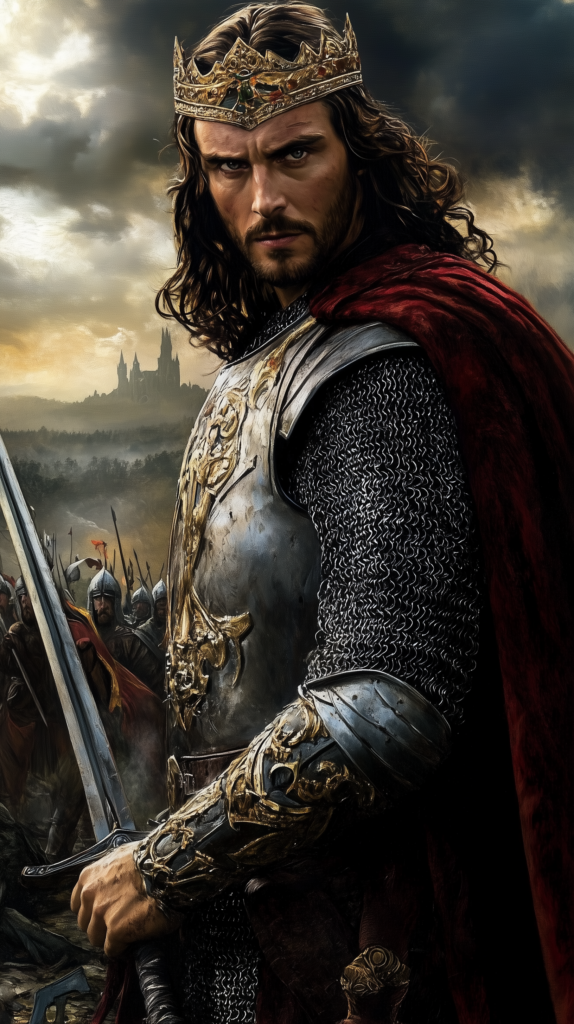
- Both existing painted King Arthur portraits are retained, together with three historic Arthurian illustrations by N. C. Wyeth, Howard Pyle and another artist represented in the site’s existing collection. The Camelot-era court incidents, five encounters, six hooks and RPG adaptations are original campaign material.
Screen and Video Interpretations
Additional portraits and historical Arthurian illustrations


Keep this reference growing
If this page helped with your reading or game, you can support its upkeep or explore the curated books.
Explore the Bookshop — epics, classics and stories behind imagined worlds.