
Sir Lamorak de Gales — The Gales Lion of the Round Table
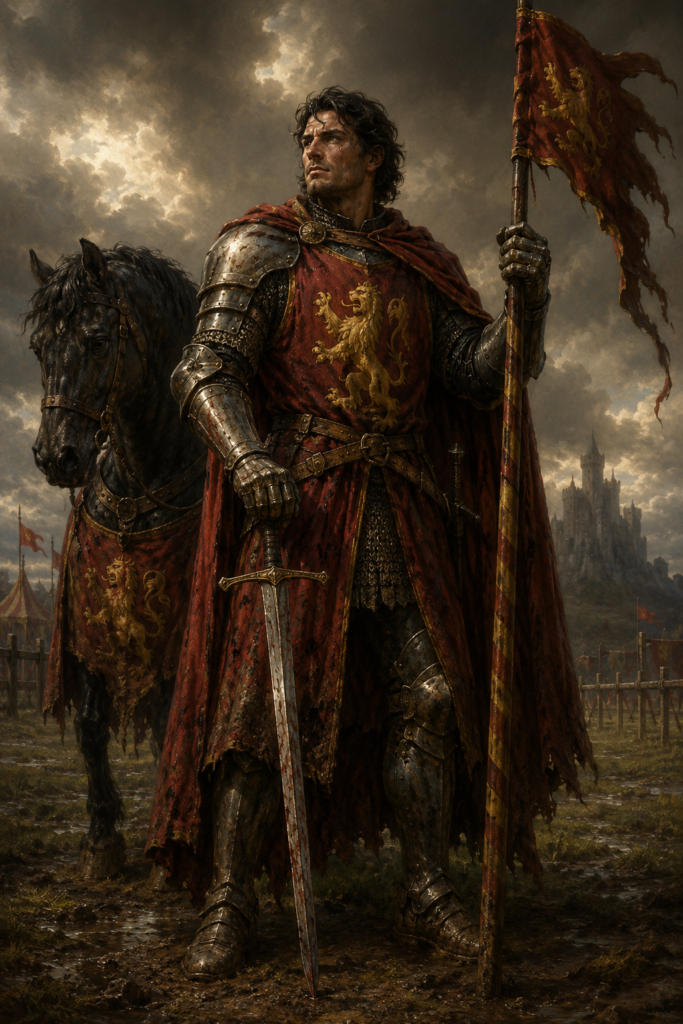
In the age of Arthur’s court before Camlann in 537 CE, Sir Lamorak de Gales has beaten thirty knights in the lists, yet four enemies now seek to murder him on a road where no herald will call the challenge. He is the son of King Pellinore, a champion of Arthur’s Round Table, and the lover of Morgause, Queen of Orkney. Her sons call that bond an insult to their father’s memory. A witness carries their plan toward Camelot. The characters can stop it before Lamorak leaves the tournament.
At a Glance
- Identity
- Sir Lamorak de Gales (Lamorak de Galis), the Gales Lion
- Nature
- Human; elite mortal knight and renowned tournament champion
- Allegiance
- King Arthur and the Round Table; house of Pellinore
- Home and movement
- Gales, Camelot, the tournament roads and lodgings of trusted companions
- Family
- King Pellinore, Percival, Aglovale, Sir Tor (raised in a cowherd household), and other kin named differently across the romances
- Significant bond
- Morgause, Queen of Orkney; an adult political and personal relationship
- Allies
- Palamedes, Dinadan, Tristram, Gareth, and Arthur’s peacekeepers
- Enemies
- Gawain, Agravain, Gaheris and Mordred
- Alignment
- Neutral Good: protects fair challengers and keeps oaths, but pride leads him towards unsafe confrontations
- Languages
- Brythonic, the courtly tongue of northern Britain and the speech of Gales
- Immediate danger
- A planned ambush after the tournament; a forged message meant to separate him from his retainers
What Is Happening Right Now?
Lamorak is preparing for another public contest. He knows that Morgause’s household is divided, but has not seen the order for four Orkney riders to meet beyond the wooded road. A squire claims a messenger stole a seal from the queen’s belongings. Gawain’s men are already arranging replacement horses for the planned pursuit. Gareth opposes treachery, but may be unable to restrain his brothers without witnesses. Lamorak refuses to flee merely because another knight threatens him: anyone who saves his life must find a way to preserve his honour as well.
First Meeting
Lamorak stands beside a sweating destrier after the lists, removing a bruised gauntlet. His armour carries fresh dents, and the court praises a victory that has made enemies of his hosts. He recognises the characters who defended a defeated servant. When they show him a warning, he asks one question: who will swear to its truth before Arthur?
Three Scenes Tonight
- The empty horse-line: a stable boy has been paid to move Lamorak’s spare mount out of reach; an Orkney signet is in the boy’s purse.
- The queen’s sealed letter: two couriers carry conflicting invitations in Morgause’s name. Only one bears the true private mark.
- The road after victory: four mounted figures wait beyond the trees, while a fifth knight rides the other way to summon Arthur’s officers.
Appearance and Manner
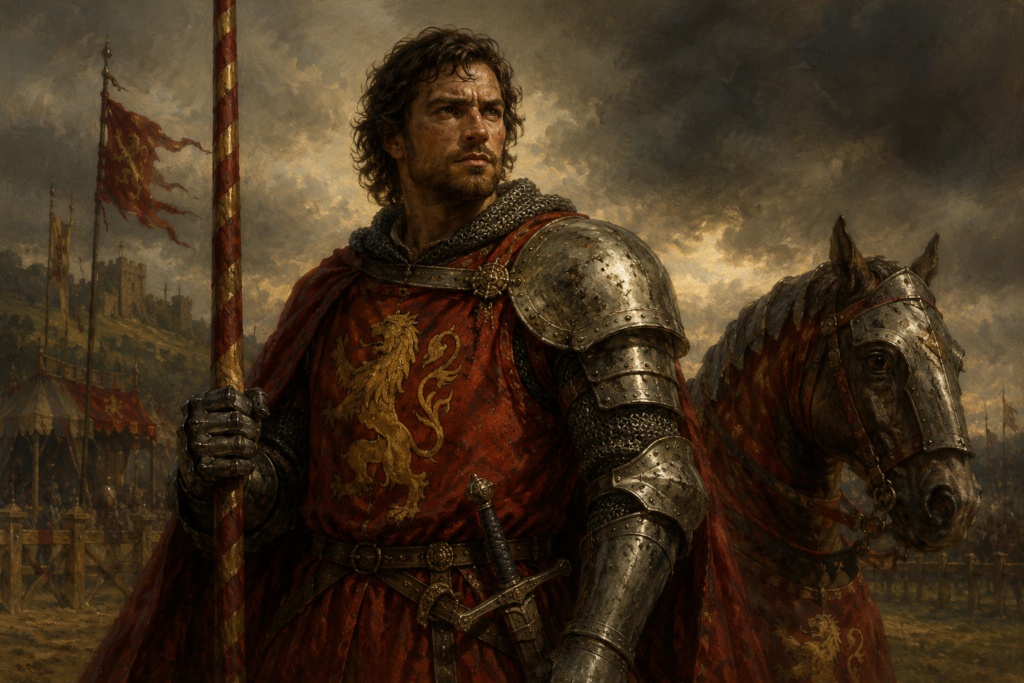
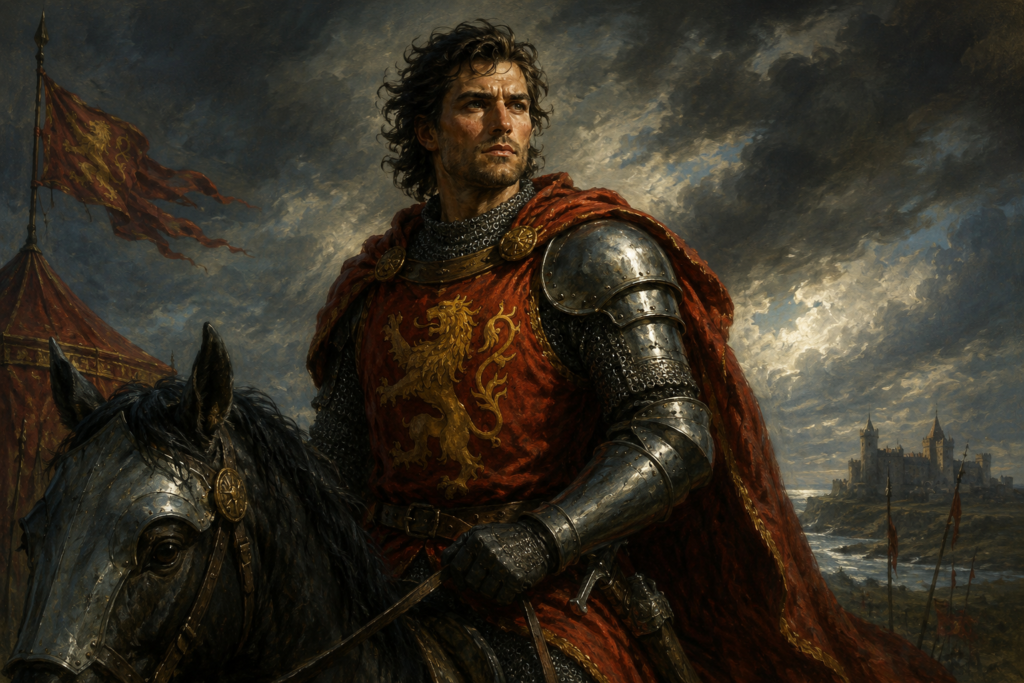
Lamorak is tall, broad-shouldered and weathered by the tourney ground. He wears fine but visibly repaired armour; his shield bears the marks of the house of Pellinore rather than an invented magical emblem. He listens intently to accusations, speaks plainly and never confuses a boastful challenger with a dangerous one. He does, however, give enemies more opportunities for an honourable fight than prudence allows.
Ambition, Pressure and Private Knowledge
- Ambition: make the Round Table an order whose promises protect more than noble reputation.
- Pressure: King Lot’s death binds the Orkney brothers to vengeance; Morgause’s relationship with Lamorak aggravates their hatred.
- Private knowledge: Lamorak has seen a sealed complaint against Gawain’s retainers, but concealed the names of the witnesses to spare them.
- Flaw: his courage becomes pride when he refuses to withdraw from an openly treacherous threat.
- Price of survival: he may have to leave the lists under another knight’s escort, testify publicly or let Morgause speak for herself.
Relationships and Allegiances
- King Arthur: his sovereign, able to proclaim a truce but not to erase years of private hatred.
- King Pellinore: Lamorak’s father, whose struggle with King Lot lies at the feud’s root.
- Queen Morgause: mother of the Orkney sons and Lamorak’s chosen companion; she is not Lamorak’s aunt.
- Sir Gawain: the principal Orkney adversary, whose greatness in other matters does not excuse this conspiracy.
- Sir Agravain: prepares rumours and hostile witnesses to make murder appear lawful.
- Sir Gaheris: capable of killing his own mother when family honour overwhelms justice.
- Sir Mordred: seeks to turn feud into a fracture within Arthur’s rule.
- Sir Gareth: brother of his enemies, but a living chance of mercy and honest testimony.
- Sir Palamedes: rival and admiring witness to Lamorak’s martial excellence; may be the first to discover the treachery.
- Sir Dinadan: uses wit to make the court confront its own hypocrisy.
- Sir Percival: brother whose grief can drive new hostilities unless the ambush is prevented.
Game Statistics
Sir Lamorak — D&D 2024
Medium Humanoid (Human), Neutral Good
Armor Class 20 (plate armour, shield); Initiative +3 (13); Hit Points 228 (24d8 + 120); Speed 30 ft.; Challenge 16 (15,000 XP; PB +5)
| STR | DEX | CON | INT | WIS | CHA |
|---|---|---|---|---|---|
| 22 (+6) | 16 (+3) | 20 (+5) | 13 (+1) | 16 (+3) | 18 (+4) |
Saving Throws Str +11, Con +10, Wis +8; Skills Animal Handling +8, Athletics +16, Insight +8, Intimidation +9, Perception +8, Persuasion +9; Senses Passive Perception 18; Languages Brythonic, northern court speech, Gales speech.
Traits
Gales Lion. Lamorak has Advantage on saving throws against the Charmed and Frightened conditions. Stand Against the Circle. While two or more hostile creatures are within 5 feet of Lamorak, he has Advantage on saving throws to avoid being knocked Prone.
Actions
Multiattack. Lamorak makes three Longsword attacks. The Lance attack is a separate one-attack action.
Longsword. Melee Attack Roll: +11, reach 5 ft. Hit: 19 (3d8 + 6) Slashing damage.
Shield Bash. Melee Attack Roll: +11, reach 5 ft. Hit: 13 (2d6 + 6) Bludgeoning damage; if the target is Large or smaller it must succeed on a DC 19 Strength saving throw or have the Prone condition.
Lance (Mounted Only). Melee Attack Roll: +11, reach 10 ft. Hit: 28 (4d10 + 6) Piercing damage, plus 9 (2d8) Piercing damage if his mount moved at least 20 feet in a straight line towards the target immediately before the attack. Lamorak makes only one Lance attack with this action.
Bonus Action
Rally the Worthy (Recharge 5–6). One ally Lamorak can see within 30 feet gains 15 Temporary Hit Points and can immediately end the Frightened condition on itself.
Reaction
Parry. Lamorak adds 4 to his AC against one melee attack that would hit him if he can see the attacker and holds his longsword.
Legendary Actions
Legendary Action Uses: 3. Lamorak can expend a use immediately after another creature’s turn. He regains all spent uses at the start of his turn.
- Advance. Lamorak moves up to half his Speed without provoking Opportunity Attacks.
- Answering Stroke. Lamorak makes one Longsword attack.
- Protect a Witness (Costs 2 Uses). One ally within 10 feet can move up to half its Speed without provoking Opportunity Attacks.
Tactics
Lamorak begins with a single mounted charge when there is room, then dismounts to face a declared opponent. Against an ambush, he retreats to protect wounded companions rather than chase a single fleeing rider. Credible proof of the trap allows a party to prevent combat entirely.
Sir Lamorak — D&D 2014
Medium humanoid (human), neutral good
Armor Class 20 (plate, shield); Hit Points 228 (24d8 + 120); Speed 30 ft.
| STR | DEX | CON | INT | WIS | CHA |
|---|---|---|---|---|---|
| 22 (+6) | 16 (+3) | 20 (+5) | 13 (+1) | 16 (+3) | 18 (+4) |
Saving Throws Str +11, Con +10, Wis +8; Skills Animal Handling +8, Athletics +16, Insight +8, Intimidation +9, Perception +8, Persuasion +9; Senses passive Perception 18; Languages Brythonic, northern court speech, Gales speech; Challenge 16 (15,000 XP).
Traits
Gales Lion. Lamorak has advantage on saving throws against being charmed or frightened. Stand Against the Circle. Lamorak has advantage on saving throws to resist being knocked prone while two or more enemies are within 5 feet of him.
Actions
Multiattack. Lamorak makes three longsword attacks; he cannot replace any of these attacks with a lance charge.
Longsword. Melee Weapon Attack: +11 to hit, reach 5 ft., one target. Hit: 19 (3d8 + 6) slashing damage.
Shield Bash. Melee Weapon Attack: +11 to hit, reach 5 ft., one creature. Hit: 13 (2d6 + 6) bludgeoning damage. The target makes a DC 19 Strength saving throw or is knocked prone if Large or smaller.
Lance (Mounted Only). Melee Weapon Attack: +11 to hit, reach 10 ft., one target. Hit: 32 (4d12 + 6) piercing damage, plus 9 (2d8) piercing damage after a straight 20-foot mounted approach. This is one attack, not part of Multiattack.
Bonus Actions
Rally the Worthy (Recharge 5–6). One ally within 30 feet who can hear Lamorak gains 15 temporary hit points and can immediately end a frightened condition affecting it.
Reactions
Parry. Lamorak adds 4 to his AC against one melee attack that would hit him, provided he can see the attacker and holds a melee weapon.
Legendary Actions
Lamorak can take 3 legendary actions, choosing from the options below, only one at the end of another creature’s turn. He regains spent actions at the start of his turn.
- Move. Lamorak moves up to half his speed without provoking opportunity attacks.
- Cut. Lamorak makes one longsword attack.
- Escort (Costs 2 Actions). One ally within 10 feet of Lamorak may move up to half its speed without provoking opportunity attacks.
Tactics
Lamorak challenges the most dangerous knight first, keeps sight of witnesses and refuses to abandon a dismounted ally. He is not a supernatural combatant and has no lair actions.
Sir Lamorak — Pathfinder 1e
CR 16; XP 76,800; Male human fighter 10/cavalier 6 (order of the sword); NG Medium humanoid (human); Init +7; Senses Perception +19.
Defense
AC 26, touch 14, flat-footed 22 (+9 full plate, +2 heavy steel shield, +3 Dex, +1 Shield Focus, +1 Dodge); hp 184 (16d10 + 80 plus 16 Toughness); Fort +17, Ref +8, Will +12 (includes Iron Will and By My Honor).
Offense
Speed 30 ft. (armour training); Melee masterwork longsword +28/+23/+18/+13 (1d8 + 11/17–20); Alternative masterwork lance +26 (1d8 + 8/×3; mounted charge +30, one attack only); Space/Reach 5 ft./5 ft.; Special Attacks cavalier challenge 2/day (+6 damage against challenged foe), spirited mounted charge.
Statistics
Str 24, Dex 16, Con 20, Int 13, Wis 16, Cha 18; Base Atk +16; CMB +23; CMD 37.
Feats Mounted Combat, Ride-By Attack, Spirited Charge, Power Attack, Weapon Focus (longsword), Weapon Specialization (longsword), Greater Weapon Focus (longsword), Improved Critical (longsword), Combat Reflexes, Improved Initiative, Iron Will, Toughness, Shield Focus, Dodge, Step Up, Quick Draw, Outflank (tactician bonus).
Skills Ride +22, Diplomacy +23, Handle Animal +23, Perception +19, Sense Motive +22, Intimidate +23; Languages Brythonic, northern court speech; Gear masterwork full plate, heavy steel shield, masterwork longsword, masterwork lance, horse, signet and sealed letters.
Special Abilities
Weapon Training (Ex): +2 heavy blades and +1 spears, already included in attacks and damage. Armour Training (Ex): permits Lamorak’s +3 Dexterity bonus in full plate and normal 30-foot speed. Challenge (Ex, 2/day): as a swift action he designates one visible foe; he deals +6 melee damage against that foe and takes a −2 AC penalty against others while the challenge lasts. Order of the Sword adds +2 morale on his attack rolls against the challenged foe while mounted (not included in the general weapon lines). Cavalier’s Charge (Ex): the mounted charge attack bonus is +4 rather than +2; the listed charge attack includes this adjustment. By My Honor (Ex): +2 morale to Will saves while he keeps his oath, included above.
Tactics
He calls one opponent out and uses one lance attack on the mounted charge. He dismounts to protect a fallen ally. When faced by four knights he uses the terrain and his allies; he does not gain D&D legendary actions or stack charging attacks into a full attack.
Sir Lamorak — D&D 3.5e
Male human fighter 16; Neutral Good Medium humanoid (human); CR 16; Init +7; Senses Listen +3, Spot +3.
Defense
AC 22, touch 12, flat-footed 20 (+8 full plate, +2 heavy steel shield, +1 Dex maximum, +1 Dodge); hp 168 (16d10 + 80); Fort +15, Ref +8, Will +10.
Offense
Speed 20 ft.; Melee masterwork longsword +26/+21/+16/+11 (1d8 + 11/17–20); Alternative masterwork lance +24 (1d8 + 7/×3; mounted charge attack +26, one attack only); Space/Reach 5 ft./5 ft.; Base Atk +16; Grp +23.
Statistics
Str 24, Dex 16, Con 20, Int 13, Wis 16, Cha 18; Skills Ride +22, Intimidate +23, Diplomacy +9, Spot +3, Listen +3; Languages Brythonic, northern court speech.
Feats Mounted Combat, Ride-By Attack, Spirited Charge, Power Attack, Weapon Focus (longsword), Weapon Specialization (longsword), Greater Weapon Focus (longsword), Greater Weapon Specialization (longsword), Improved Critical (longsword), Combat Reflexes, Improved Initiative, Iron Will, Dodge, Mobility, Cleave, Blind-Fight.
Possessions masterwork full plate, heavy steel shield, masterwork longsword, masterwork lance, riding horse, heraldic cloak and family signet.
Special Abilities and Tactics
Lamorak has no spellcasting, divine smite or automatic recovery. The full-attack line uses the four iterative attacks of a 16th-level fighter. His masterwork sword improves attack rolls but not damage; his Strength, Weapon Specialization and Greater Weapon Specialization account for the +11 damage. The listed lance attack is a single attack, with Spirited Charge multiplying damage only when its mounted-charge conditions are met. Unlike the Pathfinder version he does not have the cavalier class’s challenge or armour training.
Running Lamorak
Lamorak will face an open challenge, but an ambush is a moral and political crime, not a fair tournament encounter. Saving him without exposing the conspirators only postpones the danger. The strongest resolution makes surviving witnesses safe, gives Morgause her own voice, and forces Arthur to confront the feud. Lamorak may still reject protection; that refusal is his defining flaw, not a reason to dictate the players’ response.
Five Encounters
- The champion’s challenge: Lamorak tests a martial hero before a crowd and refuses to strike a surrendering opponent.
- The missing horses: a stable boy who saw Orkney retainers changing saddles seeks help before they silence him.
- The queen’s messenger: a courier carries both the true letter and a forgery inviting Lamorak to a lonely road.
- The false escort: armoured riders offer royal protection but cannot produce Arthur’s authenticated commission.
- The four against one: Gawain, Agravain, Gaheris and Mordred close in; Gareth rides to bring witnesses, and the characters decide whether to intervene.
Six Adventure Hooks
- A squire begs the party to identify the men who have been measuring the wooded approaches to Lamorak’s camp.
- Morgause sends a sealed warning that could cost her the trust of her sons if read in public.
- Percival offers a reward for proof that his brother’s enemies intend an unchivalrous attack.
- Dinadan claims a court ballad has been altered to make a planned killing sound like fair combat.
- Gareth demands escorts for witnesses who saw a forged Orkney commission carried out of a locked chest.
- Palamedes asks the party to race towards the forest where a group of riders are waiting for a lone champion.
Equipment and Resources
Masterwork longsword, lance, full plate, heavy shield, sturdy warhorse, tournament helm, heraldic cloak, signet of the house of Pellinore, letters from friends and a small retinue. His excellent weapons and armour are not automatically enchanted; his strength comes from training, an exceptional mount and the loyalty his honour has earned.
Lore and the Orkney Feud
Lamorak is one of the most formidable knights in the later Arthurian prose romances. Malory makes him a son of King Pellinore and an adversary of the house of Orkney. His relationship with Morgause, King Lot’s widow, intensifies a feud rooted in older deaths. Gaheris’s killing of Morgause precedes the brothers’ attack on Lamorak in the familiar tragedy. Palamedes later names Gawain, Agravain, Gaheris and Mordred as the four who killed Lamorak by treachery; the fifth brother Gareth took no part. Lamorak’s standing among knights such as Palamedes, Tristram and Lancelot is high, not merely a romantic plot convenience.
Morgause and Lamorak still live, and neither murder is inevitable. Witnesses disagree about the old grievances, while messengers move between the houses of Orkney and Pellinore. Even if one crime occurs, the next can still be prevented. Those who uncover the forged letters may keep Camelot from falling into open blood feud.
Other Portraits and Historical Art
Related People and Places
Arthurian characters · King Arthur · Pellinore · Gawain · Gaheris · Gareth · Agravain · Mordred · Palamedes · Dinadan · Percival
Sources and Artwork
- Malory, Le Morte d’Arthur, Book X, Chapter XLVI — Lamorak’s standing in the tournament.
- Malory, Book X, Chapter LIV — Palamedes’s account and Percival’s grief.
- Malory, Book X, Chapter LXIII — the four perpetrators and Gareth’s absence.
- Kate McClune, Gawain, in Heroes and Anti-Heroes in Medieval Romance — the treacherous killing as a defining action.
- Pathfinder 1e Cavalier — cavalier challenge and mounted-charge rules.
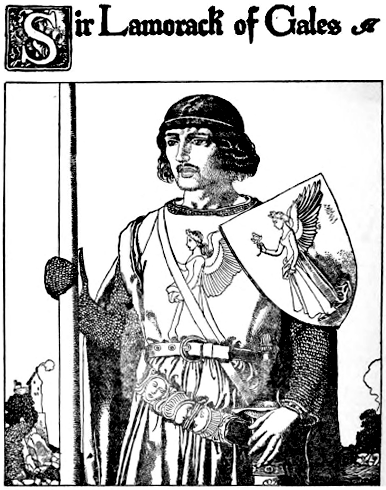
- Three existing painted Lamorak illustrations and the public-domain Howard Pyle picture are retained. Game statistics and encounters are unofficial original adaptations.
- The existing Jean-Claude Even heraldic illustration remains in the media library; if used again, credit the creator and CC BY-SA 4.0.
Keep this reference growing
If this page helped with your reading or game, you can support its upkeep or explore the curated books.
Explore the Bookshop — epics, classics and stories behind imagined worlds.