
Fey World — Faerie and the Otherworld
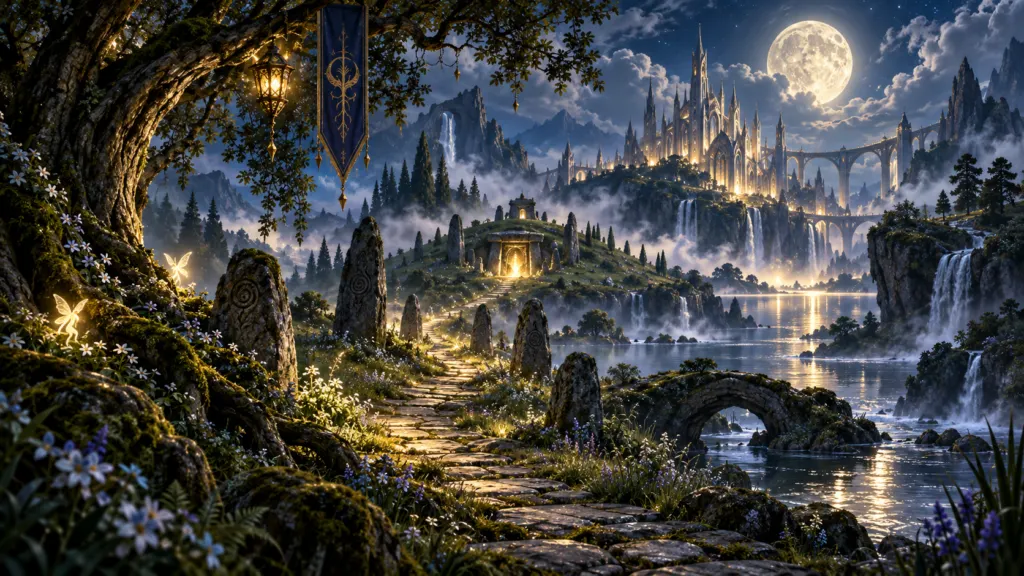
Five-second answer: the Fey World is an ancient coterminous reality of courts, wild realms, under-realms and supernatural roads. It is not an abandoned prototype Earth, not a Positive-Energy mirror and not one universal fairy kingdom. Its local laws are shaped by place, oath, season, story and recognised authority.
Planar Profile
- Classification: Coterminous reality / Otherworld
- Relationship to Earth: Overlapping, not a geographic copy
- Extent: Immeasurable
- Gravity: Usually normal; local realms may alter it
- Time: Erratic and locally dependent
- Morphic Nature: Strongest in deep Faerie
- Near Faerie: Annwn and other Earth-facing territories
- Deep Faerie: Ladinion and remote courtly realms
- Major Powers: Seelie, Unseelie, Wild Hunt and independent sovereigns
- Greatest Hazard: The return route no longer behaving as expected
What Is Happening Right Now?
Faerie in 1454 is politically alive, geographically unstable and deeply entangled with Earth. The Seelie and Unseelie Courts remain great centres of power without governing every fey. The Wild Hunt follows its own law. The Dark Host serves Unseelie authority, while the House of Ashes represents a more destructive current. Independent courts, old demesnes, giant powers, elven realms, under-realms and local guardians hold territories that may ignore the claims of the great courts entirely.
On Earth, crossings still open and close according to place, season, oath, lineage and forgotten agreements. A forest court may remember a treaty no mortal ruler has heard of; a barrow road may have changed allegiance; a gate closed for thousands of years can reopen with its obligations intact. Faerie does not need to invade Earth to become dangerous. A promise, hunting right, marriage, stolen child, broken boundary or neglected hospitality may be enough to bring two realities into conflict.
Cosmological Role
Faerie overlaps the Material world through breaches, ancient roads and places where reality wears thin, but it is neither a Positive-Energy reflection nor an abandoned draft of creation. Its forests, rivers, courts and under-realms are ancient territories in their own right. Some fey peoples have deep ancestral ties to the plane; others possess separate histories that must be established individually.
The Fey World belongs among realities coterminous with the Material world rather than among the elemental Inner Planes. It touches Earth without simply mirroring mortal geography. No single pantheon, archfey caste or creation story owns the whole plane.
Its oldest courts predate Earth. Their territories are established through oath, story, ritual, environment and recognised authority rather than through one divine act of creation. When inhabited worlds arise, new worldly courts and crossings develop around local seasons, peoples and sacred landscapes.
Faerie is fairy-tale logic made geographically real. A fey claim can overlap a god’s sanctuary, a mortal kingdom or an older planar road without making those powers identical. Landscapes answer to covenants, territorial power, season and remembered obligation; extraordinary things are possible, but almost nothing important is free.
Planar Traits
The Fey World has the following planar traits.
- Gravity: normal.
- Erratic Time: Time progresses faster in some territories and slower in others. Courtly authority, ancient routes, enclosed demesnes and the crossing used to enter or leave can all affect the difference. There is no single plane-wide conversion between Faerie and Earth.
- Realm: immeasurable.
- Highly Morphic: Deep Faerie can be altered by powerful realm-sovereigns and by local laws bound to story, oath, season and place. Earth-facing territories are often more stable.
- Heightened Vitality: Some regions intensify growth, healing or fertility, but this is a local property rather than a universal Positive Energy trait.
- Alignment: No universal alignment trait applies to the whole Fey World. Courts and individual realms can possess strong moral or metaphysical character without defining every territory.
- Magic: Regionally enhanced, impeded or wild. Deep realms and damaged crossings can be highly unstable, but the entire plane does not apply one automatic spell modifier.
Laws of Faerie
Time Is Local
No single exchange rate governs time between Earth and Faerie. Courts, maintained gates, deep realms and damaged crossings can all produce different results.
Distance Is Political
Invitation, hostility, oath, debt, taboo and recognised authority can alter how difficult a journey is. A road may be short for a sworn guest and effectively endless for an enemy.
Hospitality Has Weight
Food, shelter, gifts, names and promises can create real obligations. Accepting a favour without understanding its terms is one of the most reliable ways for mortals to become entangled in Faerie politics.
Names and Stories Matter
Titles, inherited oaths and repeated stories can acquire practical force because identity is part of how Faerie recognises rights and authority. This does not make every rhyme a spell; it makes remembered relationship part of the landscape.
Magic Is Responsive
Magic normally functions, but particular realms may favour, impede or distort specific traditions. Wild magic belongs to defined unstable places rather than the entire plane.
Death Is Not Uniform
Return, reincarnation and permanent death depend on the being and its realm. No creature gains a universal resurrection rule merely by being fey.
Gods, Archfey and Sovereigns
There is no single divine hierarchy for Faerie. Gods, archfey, world-spirits, ancestral powers and courtly sovereigns can all possess worshippers, sanctuaries, treaties or realms here. Some divine powers maintain close relationships with particular fey peoples; others are rivals or outsiders. Powerful archfey may be treated as gods by their followers without becoming a universal pantheon for the entire plane.
Some ancient fey sovereigns are powerful enough to grant magic, reshape demesnes and sustain cults on Earth. Older game sources often group such beings under the title “the Eldest.” SpiralWorlds keeps the useful idea of immensely old archfey, but treats them as individual powers and rulers rather than as replacements for the Celtic, Norse or other divine traditions that intersect Faerie.
Outsider Presence: Variable. Faerie has its own native peoples but is also crossed by elementals, divine servants, travellers and other planar beings where routes or treaties allow them.
Death and Return: Creature- and realm-specific. Some native fey re-form within their home territories; others reincarnate, return altered or die permanently. See Death and the Otherworld.
Courts and Powers
Faerie is not governed by one crown. The Seelie Court and Unseelie Court are major political centres, not governments of every fey. Independent archfey, houses, elven realms, giant courts, hunting hosts and local sovereigns hold territories whose laws may ignore both great courts.
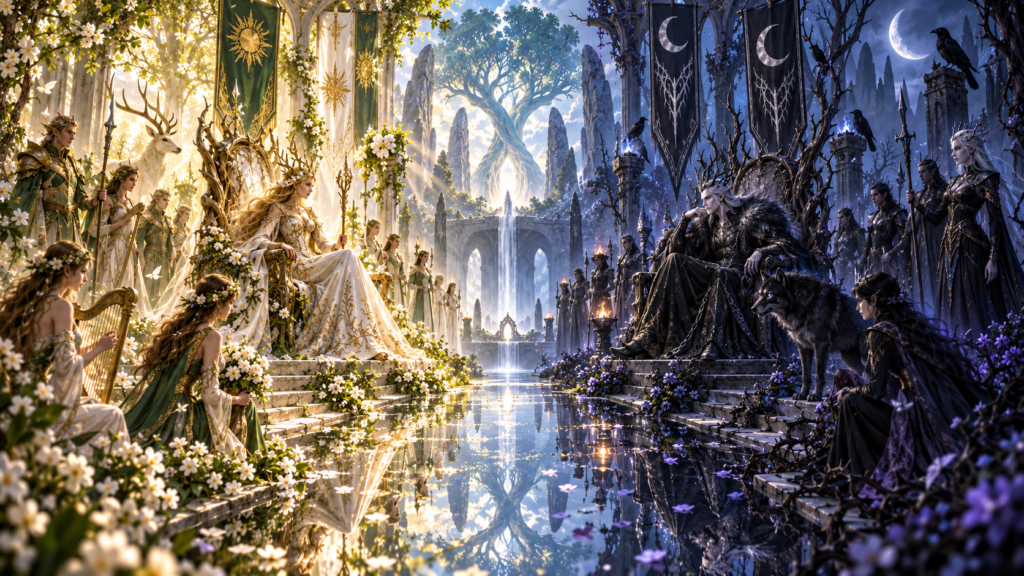
The Wild Hunt follows its own ancient law and may cooperate with a court without becoming that court’s army. The Dark Host is associated with elite Unseelie enforcement, while the House of Ashes represents a more destructive current whose ambitions can threaten Faerie’s wider cycle rather than merely win advantage within it.
Use the World Factions and Faerie court material for individual factions; the parent plane page establishes their relationship without turning every fey creature into a court subject.
Game Statistics
The setting is the same in every tab; the procedures below are written for the rules language of that edition.
D&D 5.5e / 2024-Compatible
Use these as SpiralWorlds 5.5e procedures, not as universal laws of Faerie.
- Reading a Crossing: A character can use the Study action with a DC 15 Intelligence (Arcana or Nature) check to examine a breach, fairy road or maintained gate. On a success, the character learns one useful fact: who controls the route, when it opens, whether time is distorted, or what condition governs the return. A known courtly gate normally needs no check.
- Following a Fey Road: When a route is unstable, one character leads with a DC 15 Wisdom (Survival) check. Advantage is appropriate when the party carries a recognised token, invitation or guide; disadvantage is appropriate after breaking a local taboo or oath. Failure means the party still reaches somewhere, but the GM introduces a wrong destination, time drift, obligation or hostile attention.
- Time Drift: Do not roll for every visit. The GM sets the effect from the specific route and realm. Maintained gates should be predictable; wild crossings may return the party minutes, days or years out of step with Earth.
- Fey Bargains: A bargain is binding because of the fiction first. When uncertainty matters, resolve deceit or interpretation with the appropriate Charisma-based checks; magic such as Zone of Truth does not erase deliberately ambiguous wording.
- Wild Regions: Only named unstable areas use magical surges or spell distortion. A normal spell works normally unless the realm says otherwise.
- Death and Return: Use normal 5.5e death and resurrection rules unless a creature, pact or realm has a specific return rule. Being Fey does not grant automatic resurrection.
D&D 5e / 2014
Use the normal 2014 ability-check framework, with Faerie’s local laws determining when a check is required.
- Reading a Crossing: A character examining a breach, fairy road or portal can make a DC 15 Intelligence (Arcana or Nature) check. Success reveals one useful property of the crossing: destination, controller, opening condition, time distortion or return condition.
- Following a Fey Road: A character guiding the party through unstable territory makes a DC 15 Wisdom (Survival) check. A recognised invitation, token or native guide can grant advantage; breaking a taboo, oath or condition can impose disadvantage.
- Failure: A failed navigation check should normally complicate travel rather than simply halt it. The party may arrive at the wrong place, lose or gain unexpected time, attract attention, or acquire an obligation.
- Time Drift: The DM determines the effect from the route and destination. Stable courtly gates should produce repeatable results; uncontrolled crossings may create severe differences between elapsed time in Faerie and on Earth.
- Fey Bargains: Use normal Charisma (Deception, Intimidation or Persuasion) and Wisdom (Insight) checks when the outcome is uncertain. Exact wording, hospitality and accepted gifts can matter independently of a successful check.
- Wild Magic: Apply spell distortion or magical surges only in a specifically unstable realm or crossing. Faerie as a whole does not alter every spell.
- Death and Return: Use normal 2014 death and resurrection rules unless a creature or realm has an explicit return rule. Fey type alone does not provide automatic restoration.
Pathfinder 1e
PF1e treats Faerie primarily through planar traits, Knowledge checks and caster-level mechanics.
- Planar Traits: Normal gravity; erratic time; immeasurable extent; highly morphic in deep Faerie; no universal alignment trait. Earth-facing regions are usually more stable than Ladinion.
- Identify a Route: Knowledge (planes) DC 20 identifies the nature of a crossing, its likely destination and whether it is controlled. Particularly old, disguised or damaged routes may be DC 25–30.
- Navigate Faerie: Survival DC 20 follows a known road or natural route through shifting terrain. A recognised invitation, court token or native guide can grant a +2 circumstance bonus; acting under a hostile taboo can impose a –2 penalty or worse.
- Unstable Magic: In a region specifically marked as magically unstable, a spellcaster must succeed at a caster level check (DC 20 + spell level) or the spell is lost with no effect. Do not apply this rule across the whole plane.
- Shaping a Demesne: A creature with recognised authority in a highly morphic realm can attempt a Charisma check to alter unattended terrain: DC 15 for a cosmetic or minor change, DC 20 for a substantial local change, and DC 25+ for major alteration. Characters without standing in the realm normally need a spell, pact or explicit permission before attempting this.
- Death and Return: Raise dead, resurrection and similar magic work only if the creature can actually leave or return to the realm under its own death rules. Some native fey re-form locally instead; others die normally.
D&D 3.5e
3.5e uses the classic planar-trait model, with skills and caster checks handling the mutable parts of the plane.
- Planar Traits: Normal gravity; erratic time; effectively infinite extent; highly morphic in deep Faerie; no plane-wide alignment trait. Individual demesnes can possess additional magic or alignment traits.
- Planar Knowledge: Knowledge (the planes) DC 20 recognises a stable crossing or identifies the general nature of a Faerie realm. DC 25 identifies a hidden condition, sovereign claim or unusual time trait associated with that route.
- Travel Through Mutable Terrain: Survival DC 20 prevents the party from becoming lost on a known road; DC 25 is appropriate in deep Faerie where the landscape itself is shifting. Courtly permission or a true native guide may reduce the DC by 5.
- Regional Spell Distortion: Where a realm specifically impedes ordinary magic, require a caster level check (DC 20 + spell level). Enhanced or wild-magic regions should state their own rule rather than using a plane-wide modifier.
- Morphic Shaping: In a realm that permits mortal shaping, use a Charisma check: DC 15 to reshape a small unattended natural feature, DC 20 to alter a room-, grove- or stream-sized area, and DC 25+ for changes large enough to affect an encounter site. Effects comparable to stone shape, wood shape, control water or move earth are useful benchmarks for scale.
- Death and Return: Use the normal 3.5e rules for death, raise dead, resurrection and planar travel unless the creature or realm explicitly replaces them. A fey creature is not automatically restored simply because it dies in Faerie.
Inhabitants of the Fey World
Many fey peoples have deep ancestral ties to the Fey World, but creature type alone does not prove one shared origin, and gnome origins belong to their own racial chronology rather than being inferred from older planar source material. Death and return are likewise species- and realm-specific. Some natives re-form within a home territory, some reincarnate or return altered, and others can die permanently.
Faerie is home to familiar fey such as satyrs, nymphs and dryads as well as stranger beings including lurkers in light, grodairs, ankous and countless local species. Older Faerie traditions also describe catastrophic creatures called the Tane — including jabberwocks, jubjub birds, bandersnatches and sards — as weapons associated with immensely powerful fey sovereigns. Their individual origins should be confirmed through their Bestiary audits rather than treated as one settled creation story.
Older stories place the legendary Leviathan among the most feared Tane. Treat that reputation as Faerie tradition rather than a definitive power ranking until Leviathan receives its own canon audit.
Features and Inhabitants
The Fey World is not one planetary copy of the Material universe. Earth-facing territories can echo familiar hills, rivers, forests and roads, while deeper Faerie follows symbolic, courtly and mythic geography instead. Mountains may be impossibly high, forests vast and colours unnaturally intense because individual realms exaggerate the character of place; this is a property of Faerie’s mutable nature, not evidence that the plane sits beside a universal Positive Energy source.
Faerie contains forests, marshes, mountains, plains, seas and stranger environments whose life reflects the history of each realm. Ordinary animals and plants may exist beside fey peoples, magical beasts, intelligent vegetation, dragons and creatures found nowhere on Earth. Some resemble mortal species altered by long residence; others have no mortal counterpart. Do not assume that every Earth creature has a Fey World duplicate or that more than half the plane belongs to one creature type. Build inhabitants from the ecology, court, climate and history of the territory being visited.
Life and death do not follow one rule throughout Faerie. Some native beings re-form within a bonded realm, some reincarnate, some return with altered memories or identities, and some die permanently. A protection tied to a particular court or demesne may fail elsewhere, including on Earth, but leaving Faerie does not automatically make every fey death final. These differences are important enough to be handled by species, realm and the dedicated Death and the Otherworld guide rather than by one plane-wide resurrection rule.
Build encounters from the territory rather than from a universal “Fey World monster list.” A Seelie woodland, Fomorian abyss, elven realm, Wild Hunt road and Ladinion trade city should not produce the same creatures. The Fey Bestiary supplies fey peoples and monsters, while giants, dragons, magical beasts, elementals, plants and rare undead should appear where the ecology, court or history gives them a reason to be there.
Archfey and Local Sovereigns
Large territories of the Fey World are held by ancient archfey, courtly houses and local sovereigns whose power can be absolute inside a demesne and negligible beyond it. Some are older than Earth and maintain cults, alliances or hereditary obligations on mortal worlds. Older game sources sometimes group such beings as “the Eldest,” but SpiralWorlds does not treat them as one universal pantheon. Individual rulers must be understood through their own realms, followers, bargains and histories.
The Celtic pantheons are distinct divine traditions whose gods can possess alliances, rivalries, sanctuaries and Otherworld associations of their own. They are not simply another name for the Eldest or for Faerie’s archfey.
Travel, Crossings and Return
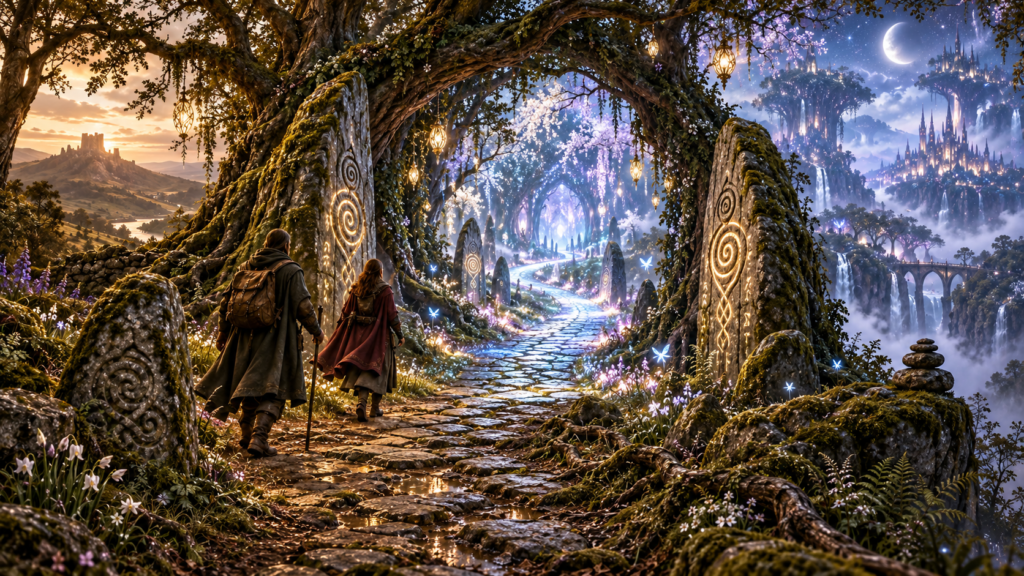
The Fey World overlaps Earth through breaches, ancient roads and maintained gates, but it does not copy mortal geography. Crossings gather where boundaries are already meaningful: old woods, springs, barrows, caves, standing stones, islands, river fords, inherited estates and places held by long ritual or covenant. A breach may appear as a mushroom ring, rainbow-sheened pool, tree arch, hollow hill or path visible only under particular conditions. Some are one-way. Others recognise only certain travellers, seasons, names or tokens. The safest journey therefore begins with the return condition: knowing how a gate opens is not the same as knowing how it will let you home.
Travel Consequences
When characters cross into Faerie, track four things: the route used, the authority that recognises their arrival, any obligation created by passage or hospitality, and the condition required for the return journey. Time can accelerate, lag or remain stable according to route and destination; there is no universal “one day here equals one week there” rule.
Encounters should follow the territory being visited rather than a universal planar table. Use A Faerie Campaign, Time and Travel in the Otherworld and the World Bestiary for deeper procedures and edition-specific options.
Explore Faerie
Connections to Other Planes
Yggdrasill is a living transitive plane and cosmic axis. Its rootways can reach Alfheim, Svartalfaheim and other fey territories without making the World Tree part of Faerie. Jotunheim belongs to the Ysgardian/Norse planar structure, while Muspellheim belongs to primordial Fire. Both can possess ancient routes into the Otherworld without becoming Fey World provinces. The Beastlands also has frequent points of contact through old forests, hunting grounds and animal sovereigns, but neither plane contains the other.
Major Realms and Otherworld Destinations
Faerie is not one kingdom but a web of courts, cities, wild territories, under-realms and Earth-facing refuges. The destinations below are useful campaign anchors because each has its own rulers, roads, dangers and relationship with the wider Otherworld.
Annwn is one of the great Earth-facing territories of Near Faerie. Its hills, waters and roads can correspond loosely with mortal landscapes without forming an exact mirror. A maintained portal may repeatedly arrive near the place to which it is bound, while backroads, courtly paths and supernatural routes can compress or expand distance. Travellers can therefore use Annwn to cross country quickly, but only when they understand which roads recognise them and whose authority those roads obey.
The Badlands
Beyond Annwn’s more recognisable landscapes lie regions planar cartographers call the Badlands: tundras of supernatural cold, heat-scoured wastes, storm seas and other hostile environments where ordinary measures of distance become unreliable. They are not empty space. They are difficult borderlands through which travellers can reach remote Otherworld territories when a recognised route, guide or shifting path allows it.
The Court of the Undying Season
The Harbingers of the Undying Season maintain a stronghold in a freezing tundra region of the Badlands, where secret redoubts preserve gardens of exquisite and lifeless beauty. Fey vampires and other undead can be found here in unusual numbers. The court is a major concentration of organised undeath in Faerie, but it is not the only territory in which undead can exist.
An oppressive Fomorian kingdom in the depths of Faerie, ruled through giant power, tribute and old territorial rights.
Bright-elven realm of Faerie; connected to Norse tradition without being inside Ysgard.
An immigrant Otherworld polity with strong Arthurian links and a history shaped by mortal arrivals into Faerie.
Arthurian court/refuge tied to unstable Otherworld crossings; not a primordial Fey realm.
A culturally distinct Otherworld destination reached through its own traditions, routes and sacred geography.
Falias, Findias, Gorias and Murias survive as lost Faerie sites whose relics, roads and old claims still influence later courts.
A Hellenic-linked garden realm where divine myth, fey geography and the guardianship of Ladon meet.
A major Ladinion nexus where roads, courts and living magic converge around one of deep Faerie’s most important crossings.
An established Faerie territory and trade sphere connected to wider courtly and planar commerce.
A Firbolg kingdom with long-standing ties to the Wild Hunt and to the shifting politics of deep Faerie.
Deep Fey realm of Svartálfar, Dökkálfar, Duergar enclaves, under-courts and forge-cities.
Boundary island where Faerie brushes the Sea of Thought, Land of Dreams and other routes.
An ancient tower-site in deep Faerie whose surviving ruins, gates and traditions are older than the mortal stories later attached to them.
Connected but Separate
- Hyperborea appears in several mortal and Otherworld traditions and should be treated as a distinct northern mystery rather than a routine Faerie province.
- Jotunheim belongs to the Ysgardian/Norse planar structure, though ancient roads can reach it from Faerie.
- Lemuria is a hidden Material-world realm rather than a Fey World province.
- Muspellheim belongs to primordial Fire and connects to Faerie only through routes, forge-trade and mythic crossings.
- Thousand Flame Coalition is a political power, not a realm.
Ladinion — Deep Faerie
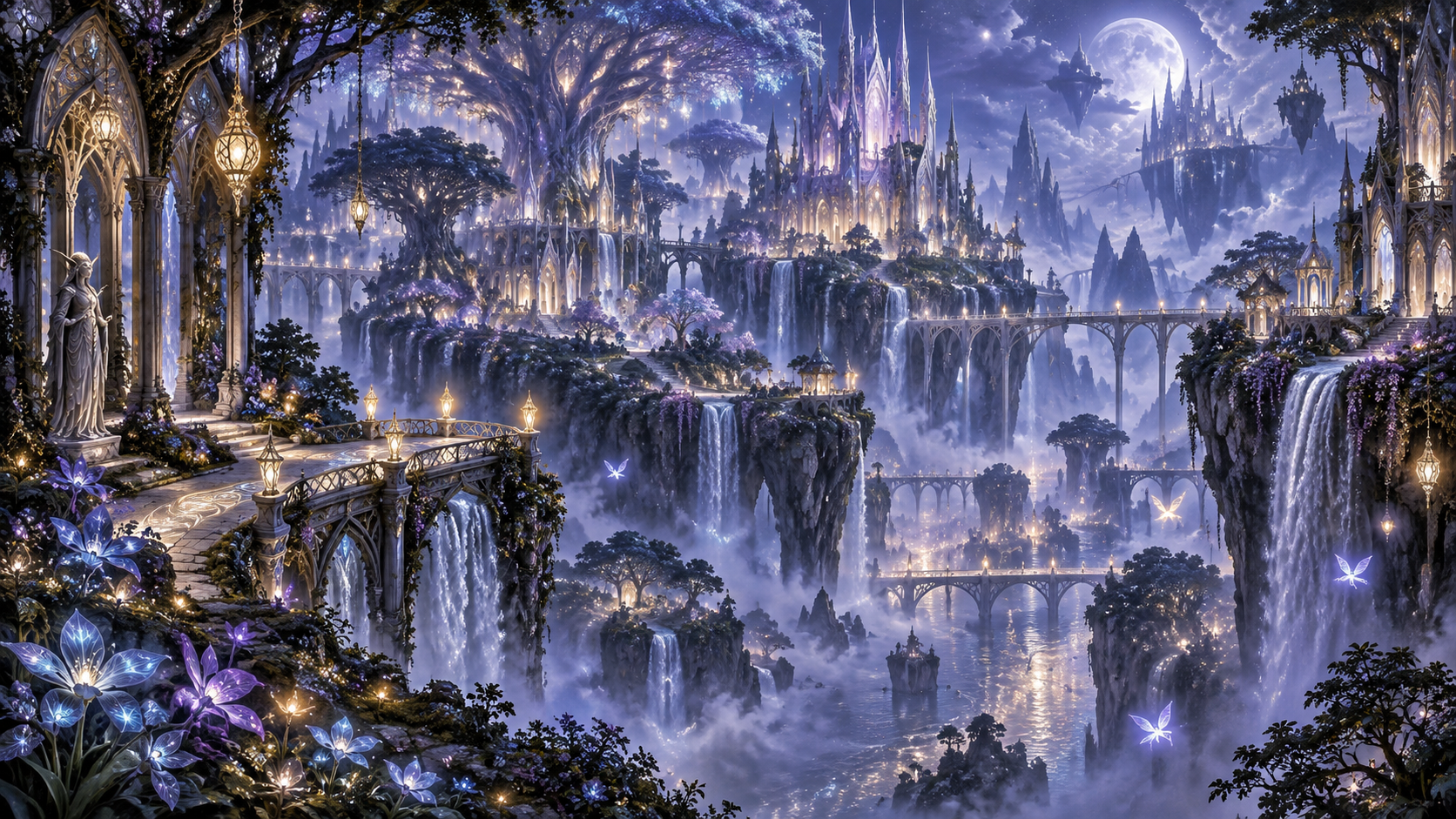
Ladinion is Deep Faerie: farther from Earth-facing territories such as Annwn, more mutable, and more responsive to powerful courts, ancient covenants and the plane’s own shifting logic. Stable cities, roads and landmarks exist, but they are anchors inside a geography that cannot be treated as one fixed terrestrial map. Local maps work because particular powers keep routes recognisable—not because Ladinion possesses a universal north or one permanent continental layout.
Ecology of Faerie
Faerie’s ecology is in most ways a more magical, extreme version of mortal nature. The difference is greatest in Ladinion, where primal magic is at its strongest; Annwn, on the other hand, is bound closely to Terra’s bounties and dangers.
Faerie does not run universally faster or slower than Earth. Local time can accelerate, lag or remain stable according to realm and route. What is more consistent is intensity: weather can be more dramatic, colours more vivid, emotions sharper and wilderness less restrained. Powerful magical beasts and dangerous plants thrive in many territories, but their distribution should follow the ecology and history of the individual realm rather than a single plane-wide rule.
Faerie and Earth influence one another most strongly where a crossing, covenant, lineage or sacred landscape binds them together. Change on one side can produce consequences on the other, but the relationship is local rather than an automatic law connecting every place to a mortal counterpart. Powerful Otherworld factions therefore cultivate Earthly allies, protect old groves and bloodlines, or attack an enemy’s anchors because those specific relationships can strengthen or weaken a claim in Faerie.
Ecology and Campaign Resources
Faerie Friends
A Faerie Friend is a mortal or outsider publicly vouched for by a recognised fey patron, household, court or community. The status is social and supernatural rather than a universal rules template: it can open doors, identify the bearer as someone who understands fey obligations, and make allies or enemies take them more seriously. It normally follows a significant service, a formal bond or long residence in Faerie. Traditional periods such as a year and a day, three years or seven years may matter to individual courts without becoming a plane-wide requirement.
Giants in Faerie
Firbolgs and Fomorians have established histories in several Faerie realms, but their origins and political roles must be taken from their own Bestiary and realm canon rather than inferred simply from being giants.
Video Resources
These external videos are retained as comparative D&D Feywild background, not as authorities for SpiralWorlds canon.
Running the Fey World
A strong Faerie adventure begins with a concrete objective and a crossing whose rules matter. “Find the missing child,” “win winter passage through an Unseelie road,” or “recover the oath that keeps a village outside the Hunt” gives the plane something to react to. Simply wandering through a strange forest usually does not.
Five Decisions Before Play
- Objective: What must the characters actually accomplish?
- Route: Which breach, gate, rootway or invitation gets them there?
- Arrival: Whose territory do they enter, and under what apparent right?
- Authority: Who claims the place, who actually controls it and who disputes that claim?
- Return: What condition must still be true for the party to get home?
Make Faerie strange through a few strong consequences rather than constant randomness. A road obeys hospitality. A river remembers names. A court cannot refuse a correctly delivered gift. An orchard fruits only for people who have never lied within it. Such laws make the plane coherent enough to learn and dangerous enough to matter.
Adventure Hooks
- The Grandmother’s Gate: a village crossing still recognises a treaty signed three generations ago, but the mortal family named in it no longer controls the land.
- The Road That Returned: a crossing closed since prehistory opens beneath a newly cleared road; the beings beyond believe only a few seasons have passed.
- The Hunt’s Quarry: the Wild Hunt crosses Earth pursuing something that has taken mortal refuge. Protecting it may be compassionate, catastrophic or both.
- The Missing Week: a two-hour negotiation ends with the party returning weeks late. The gatekeeper insists the route worked exactly as requested.
- The Frozen Season: an Undying Season faction is turning a living forest into flawless deathless stillness, alarming both Seelie and Unseelie rivals.
Deep History
Before Earth
The Fey World is already ancient before the Solar System forms. Enduring fey courts exist within the older cosmos, where archfey establish territories through oath, personality, ritual, story and their relationship with the realm itself. Later divine and mortal powers can ally with these courts, rival them or inherit claims younger than the fey rights beneath them.
Jurassic Resurgence
During the Middle Jurassic, fey peoples and realms are not created. Immense forests, springs, ravines and wild waters instead strengthen old relationships between Earth and territories beyond it. Crossings that had weakened or closed open again, and ancient courts regain access to parts of terrestrial wilderness.
This is a resurgence, not the birth of one worldwide fey civilisation. Different forests, valleys and waters answer to different courts, peoples and traditions, while immense regions remain outside fey rule. Their magic exists alongside genuine Jurassic animals, plants, climates and ecosystems rather than replacing them.
Cretaceous Continuity and Catastrophe
Fey wildernesses continue through the Cretaceous wherever strong ecological anchors endure. Chicxulub does not become harmless because magic exists: wildernesses burn or wither, settlements disappear and routes close. Some fey territories survive because they are already hidden, protected or beyond the worst destruction.
Later Earth and 1454
Courts retreat, move, divide or establish new local covenants as climate, forests and peoples change. By 1454 the mortal world therefore inherits layers of old Faerie history at once: a court beside a medieval forest may be politically young while the road into its territory is prehistoric, and a crossing closed for millennia can reopen with its obligations intact.
Historical and Mythic Context
SpiralWorlds draws on several traditions without treating them as one interchangeable mythology. Welsh material contributes Annwn, including its associations with Arawn and later Gwyn ap Nudd. Irish and broader Gaelic traditions possess their own Otherworld names, rulers and landscapes; they should not simply be relabelled Annwn.
Old Norse material contributes Álfheimr and traditions of light and dark elves. SpiralWorlds adapts these into Alfheim and Svartalfaheim as Fey World realms while keeping Jotunheim, Muspellheim and the other separately established Norse territories in their correct planes.
Later fairy folklore contributes hollow hills, fairy roads, dangerous hospitality, altered time, gifts, music, seasonal crossings and the difficulty of returning home. Modern fantasy RPGs often gather similar ideas under the term Feywild. SpiralWorlds retains that term for reader recognition and search discovery, but the setting’s Fey World / Faerie / Otherworld cosmology is its own continuity.
Sources and Further Reading
- Toward Earth and Beyond — pre-Earth cosmology and ancient fey courts.
- Jurassic — Age of Giants — reopening of ancient Earth–Faerie crossings.
- The Cretaceous Flowering World — continuity and catastrophe.
- Celtic Pantheons — distinct divine traditions and Otherworld relationships.
- Transitive Planes — Yggdrasill and the great planar routes.
- The Mabinogion — public-domain English edition.
- The Prose Edda — public-domain translation resources.
Rules and Licensing
The D&D 5.5e / 2024-compatible rules language on this page is a SpiralWorlds summary using terminology available through System Reference Document 5.2.1, licensed under Creative Commons Attribution 4.0. Pathfinder 1e and D&D 3.5e mechanics are summarised in original wording; legacy Open Game Content remains subject to the licence attached to its relevant source material and child rules pages.
Earlier versions of this article drew on Pathfinder-era material historically credited as PZO1140 and on Fey Magic: Dreaming the Reverie. Those sources remain part of the page’s publication history, but imported setting assumptions do not control SpiralWorlds cosmology. The 1454 campaign material, deep-time chronology, court relationships, adventure hooks, explanatory prose, page design and editorial interpretation are SpiralWorlds material.
Explore: Planes of Existence · Transitive Planes · World Factions · World Bestiary · Celtic Pantheons
Keep this reference growing
If this page helped with your reading or game, you can support its upkeep or explore the curated books.
Explore the Bookshop — epics, classics and stories behind imagined worlds.