
Monster, Nymph, Spirit of the Sacred Place
Nymph, Spirit of the Sacred Place
Beauty made local and dangerous, a nymph is the living will of spring, grove, river, stone, or fertile ground wearing mortal shape to entice, reward, judge, and destroy.
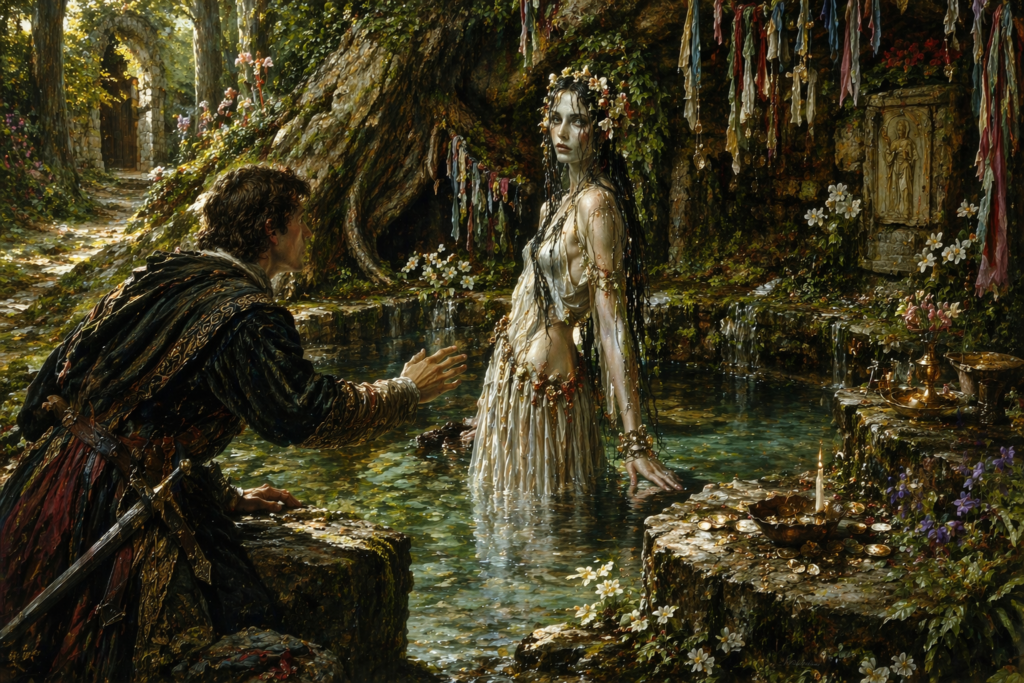
Nymphs are supernatural inhabitants of living places: springs that never freeze, pools that hold the moon too clearly, groves that resist the axe, river-bends where the rash vanish, and high meadows where desire begins to blur into surrender. A nymph is the soul, mood, and appetite of such a place made manifest. She is not separate from her domain. She is its face, its welcome, and often its punishment.
Though many nymphs appear graceful, youthful, and almost human, there is always something in them that belongs more to water, bark, bloom, dusk, wind, or stone than to mortal flesh. They do not merely inhabit beauty. They are beauty concentrated until it becomes power. To meet one is to discover that the loveliest places in the world are not passive, and that enchantment often stands very close to danger.
Some nymphs reward reverence, restraint, and proper offerings. Others are vain, hungry, territorial, or cruel. Many are all of these at once. They charm wanderers, cloud judgment, conceal paths, bless fertility, call beasts, stir obsession, and destroy those who try to possess what should only be approached with caution. Their wrath is seldom loud. It comes as fascination, longing, confusion, fever, misstep, drowning, or the slow ruin of a mind that cannot let go.
A village may honor its spring-lady, willow-wife, or lady of the pool with flowers, ribbons, milk, or prayer. Yet the same villagers warn their children never to answer singing from the reeds, never to sleep beside certain waters, and never to boast of claiming what belongs to the hidden powers of the land. That is the true nature of a nymph: not a pleasant ornament of the landscape, but a local supernatural power wearing beauty as both sign and weapon.
Appearance
A nymph most often appears as a striking woman in the first bloom of adulthood, but the resemblance to humanity is never complete. Her beauty is always shaped by her domain rather than by any general ideal.
A river nymph may have hair that shifts like current even in still air, eyes bright as water under sun, and skin touched with silver or pale green undertones. A tree nymph may seem tall and still as a young trunk, with bark-fine markings at her wrists and throat, leaf-shadow in her hair, and a poise that feels rooted rather than calm. A nymph of stone or high places may appear colder, paler, and more severe, with sculpted features and a weight of presence that makes living flesh seem brief and soft by comparison.
Even in her fairest shape, something always gives the truth away. Water may refuse to cling to her. Flowers turn subtly toward her. Birds fall silent when her temper shifts. Reflections sharpen, delay, or blur in her presence. Footprints may fill with clear water, sprout shoots, or vanish as though the ground itself had chosen not to remember her passing. Her voice can be soft, but it is never merely soft. It carries distance, command, memory, and the quiet certainty of something that does not think of itself as mortal prey.
When a nymph reveals more of her true nature, the human semblance does not collapse into ugliness so much as deepen into something impossible and perilous. Hair becomes streaming weed, blossom, moss, wind-blown leaves, or trailing roots. Fingers lengthen like reeds or pale roots in water. Eyes shine like moonlit pools or sunlight through branches. Skin may gleam damp as carved marble, white as petals, green as fresh growth, or pale as stone worn smooth beneath a current. The change should never feel like a beast-form. It is the place itself becoming personal, intimate, and suddenly threatening.
Habitat
Nymphs are found where landscape has become presence: where water, tree, stone, meadow, or fertile ground is not merely useful or beautiful, but already feared, honored, bargained with, or approached under taboo. They do not arise evenly across the wilderness. They belong to particular places where sanctity, memory, desire, and danger have gathered so densely that the land has become personal.
That makes springs, wells, sacred pools, river fords, grove-shrines, cave mouths, cliff meadows, orchards, and old untouched stands of timber their natural homes. A nymph belongs where people already know, even if only half-consciously, that they should lower their voices, leave an offering, or ask leave before taking what is there. She is strongest where human need and supernatural claim press directly against one another: the spring a village depends upon but does not fully own, the ford crossed by merchants and soldiers beneath an old warning, the grove no one cuts except in famine, the mountain basin where shepherds water their flocks but never sleep.
The Hellenic world is one of their great strongholds. There they belong naturally to bright springs, laurel groves, shaded ravines, reed-fringed streams, sea-cliff fountains, and high lonely pastures where beauty and danger stand close together.
But they are no less at home in older sacred landscapes elsewhere: in Celtic wells and rivers where ribbons and milk are still left in hope or fear; in Germanic woodlands where ancient trees and hidden pools carry a reputation older than the nearest church or hall; in Slavic marsh margins, willow-banks, and forest springs where song, mist, and drowning are never far apart; and in the Balkans and Anatolia, where mountain water, cave shrines, and fertile valleys still seem only partly mastered by priest, emperor, or law.
Not all nymphs belong to wilderness in the crude sense. Some are tied to cultivated beauty maintained under long ritual care: olive groves, orchards older than any living family, vineyard springs, temple gardens, and secluded meadows where marriages are blessed and fertility is entreated. These nymphs are no less dangerous for their association with fruitfulness and order. They guard what ripens. They punish desecration, theft, and possessive desire. A place made lovely by generations of reverence can produce a nymph just as surely as a lonely ravine.
Their presence is often known before it is seen. Water runs clearer than it should. Fruit swells richly while neighboring land struggles. Animals hesitate at a boundary. Flowers open out of season. Young men return silent and fevered from a riverside. A woodcutter’s blade splits upon a tree no one had been warned against. Songs are heard where no singer stands. Offerings left at a spring vanish by dawn. Nymph-haunted places are rarely unknown to those who live nearby. They survive in prohibitions, shrines, marriage warnings, local rites, and stories told to keep the reckless from mistaking beauty for permission.
A nymph’s domain is also the seat of her power. Within it she is watchful, assured, and difficult to escape or deceive. Beyond it she may weaken, grow restless, or seem incomplete, as though some vital part of her remains behind in the place itself. For that reason, nymphs work best not as wandering encounters but as local supernatural powers: named presences of a spring, a grove, a ford, a pool, a cliff meadow, a cave basin, or an orchard around which human life has learned to bend without ever truly mastering what dwells there.
Nymph 5.5
Nymph 5.0
Nymph, Pathfinder
Nymph 3.5
Nymph
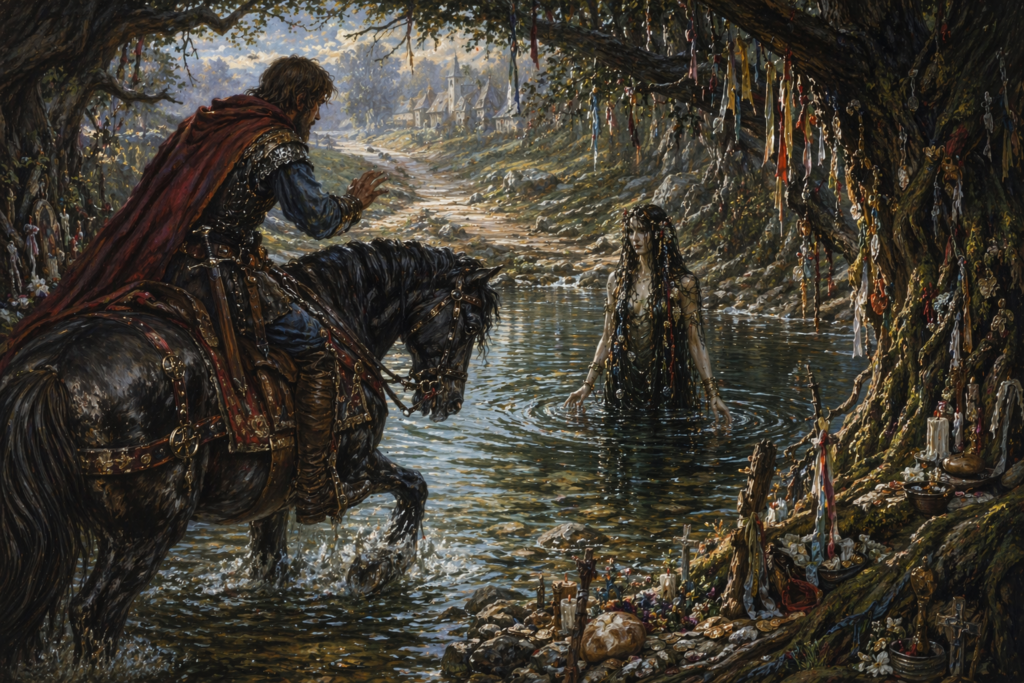
Medium Fey, usually neutral
Armor Class 15
Hit Points 110 (13d8 + 52)
Speed 30 ft., swim 30 ft.
| STR | DEX | CON | INT | WIS | CHA |
|---|---|---|---|---|---|
| 12 (+1) | 18 (+4) | 18 (+4) | 14 (+2) | 16 (+3) | 22 (+6) |
Saving Throws Dex +8, Wis +7, Cha +10
Skills Insight +7, Nature +6, Perception +7, Persuasion +10, Stealth +8
Damage Resistances cold; bludgeoning, piercing, and slashing from nonmagical attacks
Condition Immunities charmed
Senses darkvision 60 ft., passive Perception 17
Languages Common, Elvish, Sylvan, plus one regional language
Challenge 8 (3,900 XP)
Proficiency Bonus +3
Traits
Bound to a Place. Each nymph is mystically bound to a natural site such as a spring, pool, river bend, grove, sacred tree, cave mouth, or cliff meadow. While within 1 mile of that place, the nymph has advantage on Wisdom (Perception), Wisdom (Insight), and Charisma checks, and can’t be surprised except while incapacitated.
Fey Grace. The nymph ignores difficult terrain caused by plants, roots, mud, rubble, shallow water, and undergrowth.
Supernatural Beauty. A creature that starts its turn within 30 feet of the nymph and can see her must succeed on a DC 18 Wisdom saving throw or have disadvantage on attack rolls against the nymph until the start of its next turn. A creature that succeeds on this save is immune to this trait for 24 hours.
Magic Resistance. The nymph has advantage on saving throws against spells and other magical effects.
Innate Spellcasting. The nymph’s spellcasting ability is Charisma (spell save DC 18, +10 to hit with spell attacks). She requires no material components and can innately cast the following spells:
At will: druidcraft, minor illusion
3/day each: charm person, entangle, hold person, invisibility, misty step, suggestion
1/day each: dominate person, hallucinatory terrain
Actions
Multiattack. The nymph makes two Enthralling Touch attacks.
Enthralling Touch. Melee Spell Attack: +10 to hit, reach 5 ft., one creature. Hit: 18 (3d8 + 5) psychic damage, and the target must succeed on a DC 18 Wisdom saving throw or be charmed until the end of the nymph’s next turn. While charmed in this way, the target’s speed is halved.
Beguiling Gaze (Recharge 5–6). One creature the nymph can see within 60 feet must make a DC 18 Wisdom saving throw. On a failed save, the target is charmed for 1 minute. While charmed in this way, the target is incapacitated, and on each of its turns it uses as much of its movement as it can to move by the safest available route toward the nymph. The effect ends early if the target takes damage, if the nymph commands it to do something obviously self-destructive, or if another creature uses an action to shake the target free.
Wrath of the Place (1/Day). The nymph calls on the force of her domain. Choose one of the following effects:
- Grasping Roots. Plants and roots erupt in a 20-foot square centered on a point the nymph can see within 90 feet. The area becomes difficult terrain for 1 minute. Each creature in that area must succeed on a DC 18 Strength saving throw or be restrained. A restrained creature can repeat the save at the end of each of its turns, ending the effect on itself on a success.
- Drowning Pull. Water surges in a 20-foot-radius sphere centered on a point the nymph can see within 90 feet. Each creature in the area must make a DC 18 Strength saving throw. On a failed save, a creature takes 27 (6d8) bludgeoning damage, is pulled up to 20 feet toward the center, and is knocked prone. On a successful save, it takes half as much damage only.
- Blinding Bloom. Light, pollen, petals, motes, or glittering spray fill a 20-foot-radius sphere centered on a point the nymph can see within 90 feet. Creatures of the nymph’s choice in the area must succeed on a DC 18 Constitution saving throw or be blinded until the end of the nymph’s next turn.
Bonus Actions
Recede into Beauty. The nymph magically veils herself until the start of her next turn. Until then, areas of light foliage, drifting spray, falling petals, reeds, shadow, or similar natural concealment within 30 feet of her count as heavily obscured for her alone. She can then move up to half her speed without provoking opportunity attacks.
Reactions
Punish Desecration. When a creature within 30 feet of the nymph damages a tree, spring, shrine, standing stone, or similar natural or sacred feature in the nymph’s domain, the nymph imposes disadvantage on the triggering roll. If that act dealt damage, the creature also takes 7 (2d6) psychic damage.
Treasure
A nymph rarely hoards treasure like a mortal, but wealth gathers where she is feared, loved, or propitiated. Her domain may contain 250 gp in mixed coin, 900 gp worth of jewelry, silver vessels, carved ivory, or gold ornaments, 2d4 art objects worth 100 gp each, and 1d4 minor to moderate magic items or sacred curios tied to beauty, fertility, water, moonlight, orchards, or groves. Suitable finds include a driftglobe, decanter of endless water, periapt of health, ring of water walking, cloak of elvenkind, pipes of haunting, or a regional relic left as an offering.
Supernatural Nature
A nymph is the personality of a place condensed into human form. Her beauty is part of the danger, but never the whole of it. She rewards reverence, punishes desecration, and blurs the line between desire, fear, worship, and trespass.
Nymphs belong among the powers to whom people leave offerings and about whom they lower their voices. They are spoken of with attraction, caution, gratitude, resentment, and dread all at once. A village may praise the lady of the spring for clear water and easy births, yet still warn children never to answer singing after dusk.
A shepherd may swear a grove-spirit saved him from wolves, while another insists the same being lured his brother to drowning. That doubleness is essential. A nymph is not good or evil in the blunt mortal sense. She is relational. What she gives or takes depends on conduct, custom, trespass, desire, and the health of the bond between people and place.
She is strongest when she is not reduced to a fight. Her real force lies in taboo, invitation, fascination, memory, and consequence. Men vanish near her pool. Marriages prosper when offerings are renewed. A hunting lord returns diminished after mocking a riverside shrine. A grove grows fruitful again only after the old rites are restored. A nymph is not merely encountered. She is felt in the customs, silences, fears, and habits that gather around her domain long before anyone sees her face.
Local Impact
A nymph alters the emotional and social climate around her. Springs become pilgrimage sites. Woods acquire taboos. Fords become places where travelers leave ribbons, coins, bread, or prayer before crossing. Marriages may be blessed or blighted depending on whether old rites are kept. Children are warned away from certain pools. Herdsmen take the long road rather than camp beside a singing stream. Even when unseen, the nymph bends local behavior around herself.
Where a nymph is honored, the effects may seem wholly beneficial at first: clear water, fertile orchards, easy lambing, healthy vines, beautiful children, reconciled lovers, and a strange sense that a place is watched but not hostile. Yet even these blessings are rarely unconditional. They endure only while custom, restraint, and reverence survive. When the bond is broken, the damage often begins quietly. Obsession replaces courtship. Desire curdles into jealousy. Work is neglected. Animals vanish. Drownings are called accidents because no one wishes to say more. Young men return silent, fevered, and changed. Young women dream of a voice in the reeds. Quarrels spread through a village with no visible cause.
For that reason, a nymph’s true impact is rarely measured only in bodies or treasure. She changes custom, memory, fertility, caution, and the moral atmosphere of a district. A place haunted by a nymph is not simply more dangerous. It is more charged. People behave differently there, speak differently there, and teach their children differently there.
Using Nymphs in a Campaign
A nymph works best as a local supernatural power rather than a wandering encounter. She is strongest in sacred grove adventures, river-crossing bargains, taboo-breaking stories, disputes between settlers and older powers, and enchantment-heavy scenarios where force is possible but never the only answer.
She also benefits from ambiguity. The party may hear of a saintly guardian and discover drownings at her ford, or be warned of a devourer of men only to learn that she is punishing repeated sacrilege. That uncertainty gives her weight. A nymph becomes memorable when the party must decide whether they are dealing with a predator, a guardian, an offended power, or all three at once.
Why Nymphs Work
Nymphs work because they bind beauty to consequence. They turn a lovely place into a meaningful one. A spring, grove, ford, orchard, or meadow ceases to be background scenery and becomes morally charged ground: a place of temptation, reverence, danger, custom, and memory.
They also work because they stand exactly where desire meets prohibition. People want what the nymph’s place offers—water, fertility, shelter, beauty, blessing, possession, intimacy, prestige—but reaching for it wrongly has a cost. That gives the creature pressure before combat even begins. The question is not only whether the players can defeat her. It is whether they understand what kind of place they are standing in, what has been broken there, and what price is being asked.
Used well, a nymph makes the landscape feel inhabited in the deepest sense. The grove is not scenery. The spring is not scenery. The river bend is not scenery. Each is a presence with memory, appetite, and will. That is why nymphs endure. They let the world itself become personal.
Nymph
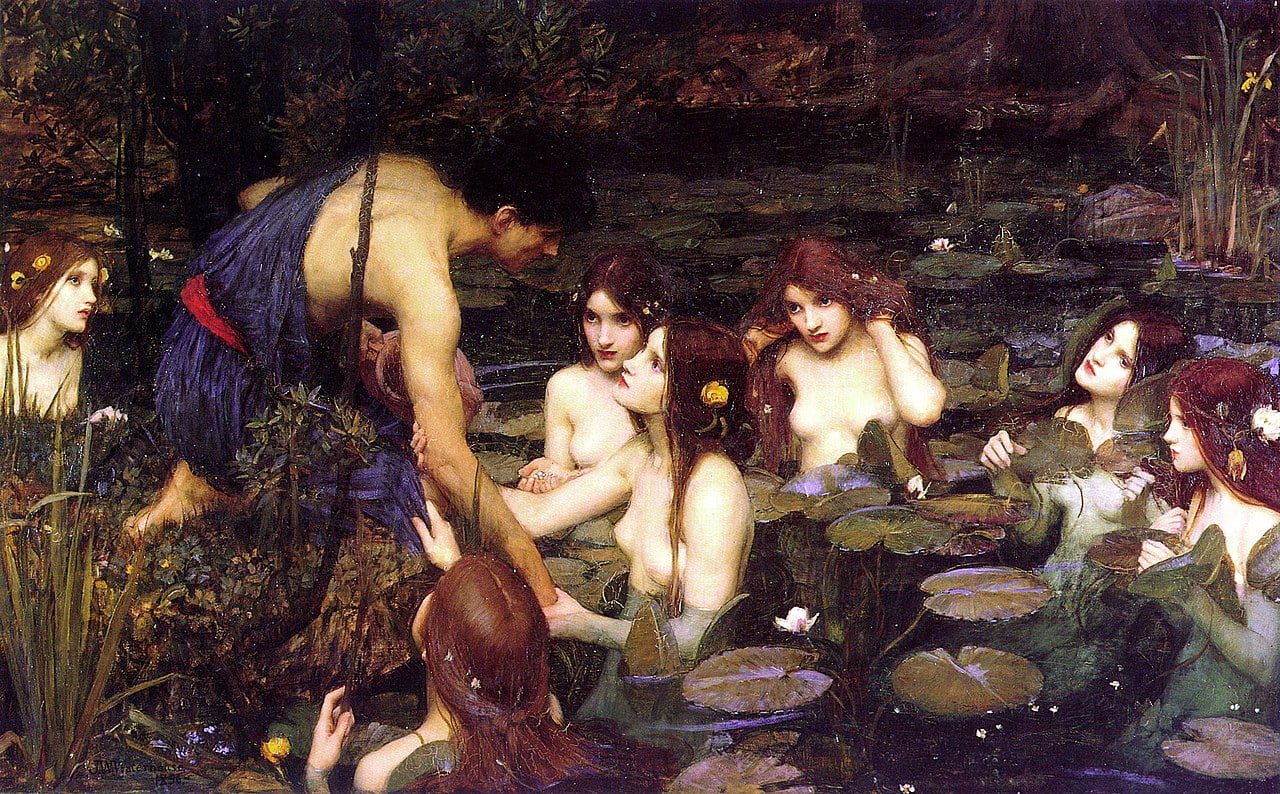
A nymph is a member of a large class of female nature entities, either bound to a particular location or landform or joining the retinue of a god, such as Dionysus, Hermes, or Pan or a goddess, generally Artemis. Nymphs were the frequent target of lusty satyrs.
Nymphs are personifications of the creative and fostering activities of nature, most often identified with the life-giving outflow of springs.
The home of the nymphs is on mountains and in groves, by springs and rivers, in valleys and cool grottoes. They are frequently associated with the superior divinities: the huntress Artemis; the prophetic Apollo; the reveller and god of wine, Dionysus; and with rustic gods such as Pan and Hermes (as the god of shepherds).
The symbolic marriage with a nymph of a patriarchal leader is repeated endlessly clearly such a union lent authority to the archaic king and to his line.
Nymph
Medium fey, neutral good
Armor Class: 14 Hit Points: 60 (8d8 + 24)
| STR | DEX | CON | INT | WIS | CHA |
|---|---|---|---|---|---|
| 10 (+0) | 18 (+4) | 16 (+3) | 14 (+2) | 16 (+3) | 20 (+5) |
Skills: Perception +5, Stealth +8 Senses: Darkvision 60 ft., passive Perception 15
Speed: 30 ft.
Actions:
- Shortbow. Ranged Weapon Attack: +6 to hit, range 80/320 ft., one target. Hit: 7 (1d6 + 4) piercing damage.
- Charm. The nymph targets one humanoid or beast it can see within 30 feet of it. If the target can see the nymph, it must succeed on a DC 15 Wisdom saving throw or be magically charmed. The charmed creature regards the nymph as a trusted friend to be heeded and protected. Although the target isn’t under the nymph’s control, it takes the nymph’s requests or actions in the most favorable way it can.
Abilities:
- Innate Spellcasting. The nymph’s innate spellcasting ability is Charisma (spell save DC 15). It can innately cast the following spells, requiring no material components:
- At will: Druidcraft
- 3/day each: Entangle, Goodberry
- 1/day each: Barkskin, Cure Wounds, Pass without Trace, Spike Growth
Challenge Rating: 3 (700 XP)
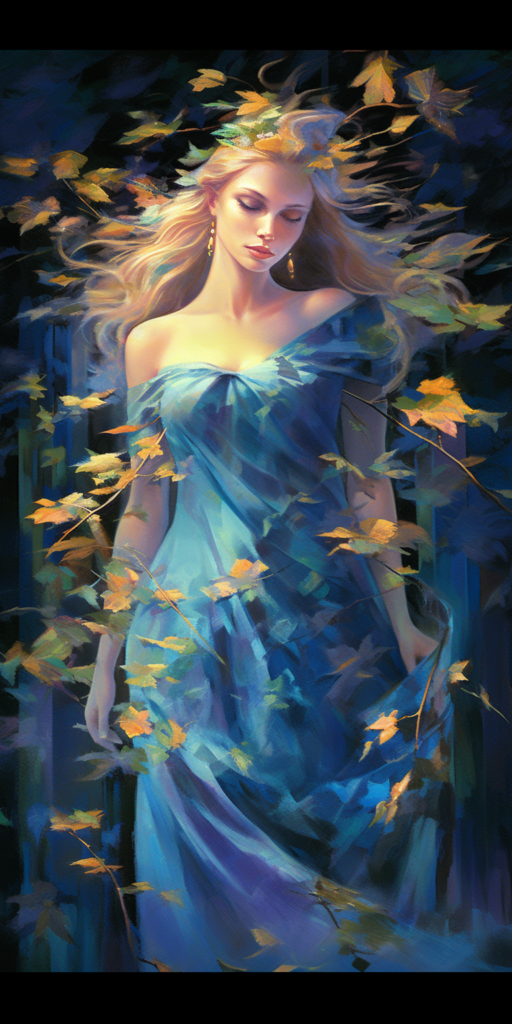
Physical Description: The nymph is a graceful and alluring creature, resembling a young humanoid with delicate features and flowing, ethereal hair. Her skin shimmers with an otherworldly glow, and her eyes glisten with an enchanting radiance. She is dressed in a gown woven from leaves and adorned with flowers, exuding an aura of natural beauty. With every movement, she emanates an air of elegance and mystery, captivating all who gaze upon her.
Nymph
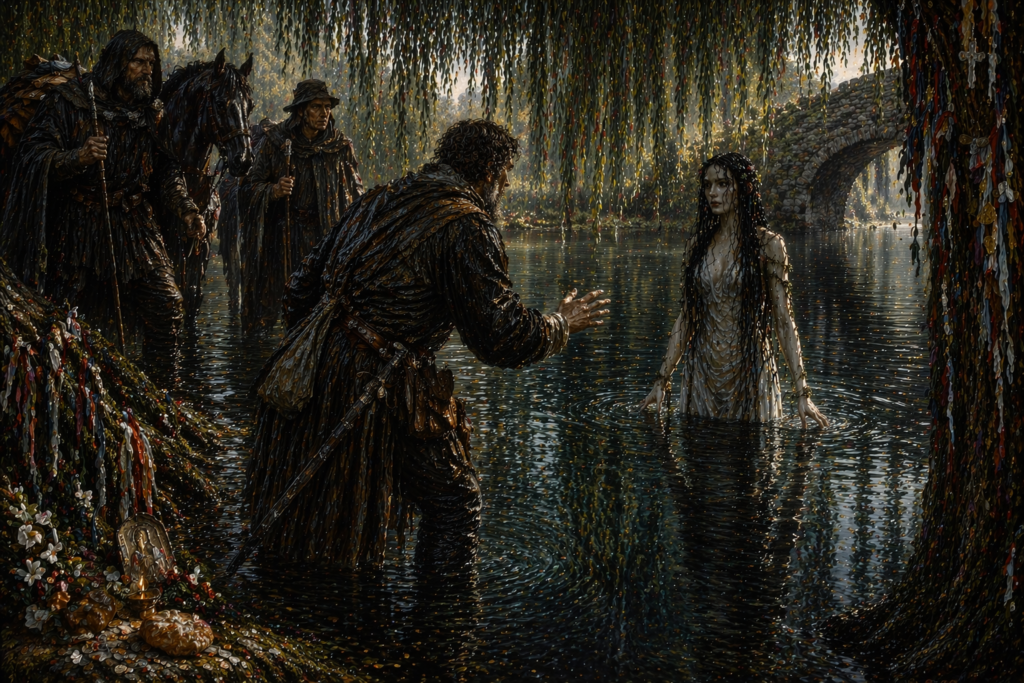
This impossibly lovely woman seems woven from the spirit of spring, grove, river, stone, or fertile ground itself; every movement suggests grace, but the place around her watches through her eyes.
Nymph
Medium Fey
Hit Dice: 14d6+56 (105 hp)
Initiative: +8
Speed: 30 ft. (6 squares), swim 30 ft.
Armor Class: 22 (+4 Dex, +7 natural, +1 dodge), touch 15, flat-footed 18
Base Attack/Grapple: +7/+8
Attack: Touch +11 melee (enthralling touch)
Full Attack: 2 touches +11 melee (enthralling touch)
Space/Reach: 5 ft./5 ft.
Special Attacks: Beguiling gaze, enthralling touch, spell-like abilities, wrath of the place
Special Qualities: Bound to a place, damage reduction 10/cold iron, darkvision 60 ft., fey grace, low-light vision, recede into beauty, spell resistance 19, immunity to charm effects
Saves: Fort +8, Ref +13, Will +13
Abilities: Str 12, Dex 18, Con 18, Int 14, Wis 16, Cha 23
Skills: Bluff +23, Diplomacy +25, Escape Artist +21, Hide +21, Knowledge (nature) +19, Listen +20, Move Silently +21, Sense Motive +20, Spot +20, Swim +18
Feats: Dodge, Great Fortitude, Improved Initiative, Iron Will, Lightning Reflexes, Weapon Finesse
Environment: Sacred springs, secluded pools, river fords, grove-shrines, cliff meadows, orchards, cave mouths, and other spiritually charged natural places
Organization: Solitary
Challenge Rating: 8
Treasure: Standard plus offerings
Alignment: Usually neutral
Advancement: 15–21 HD (Medium)
Level Adjustment: —
Combat
A nymph avoids direct violence when she can. She prefers to disorient intruders, separate the irreverent from the cautious, and let the pressure of her domain do much of the fighting for her. She uses concealment, enchantment, and terrain to break an enemy’s will before closing to touch range.
Special Attacks
Beguiling Gaze (Su): As a standard action, a nymph can fix her gaze on a single creature within 60 feet. The target must succeed on a DC 21 Will save or be affected as though by charm monster for 1 minute. A creature affected by this ability is also staggered and, on its turn, moves toward the nymph by the safest available route, though it never takes obviously self-destructive actions. The effect ends immediately if the creature takes damage from the nymph or any of her allies. This is a mind-affecting charm effect. The save DC is Charisma-based.
Enthralling Touch (Su): A nymph’s touch attack deals 3d6 points of nonlethal damage. A creature struck by this attack must succeed on a DC 21 Will save or be charmed for 1 round. A creature charmed in this way has its speed halved for the duration. This is a mind-affecting charm effect. The save DC is Charisma-based.
- Spell-Like Abilities: Caster level 10th. Save DCs are Charisma-based.
- At will—ghost sound, minor image
- 3/day each—charm person (DC 17), entangle (DC 16), hold person (DC 18), invisibility, suggestion (DC 18)
- 1/day each—deep slumber (DC 18), dominate person (DC 21), hallucinatory terrain (DC 20)
- Within her own domain, a nymph can also use speak with animals and speak with plants at will.
Wrath of the Place (Su): Once per day as a standard action, a nymph may call upon the force of her domain, choosing one of the following effects. The save DC for each effect is 21 and is Charisma-based.
Grasping Roots: Plants, roots, or reeds erupt in a 20-foot-square area within 90 feet. Creatures in the area are affected as though by entangle for 10 rounds.
Drowning Pull: Surging water fills a 20-foot-radius spread within 90 feet. Creatures in the area take 6d8 points of bludgeoning damage and are pulled up to 20 feet toward the center. A successful Reflex save halves the damage and negates the pull. This ability requires nearby water, heavy spray, or saturated ground.
Blinding Bloom: Light, pollen, petals, glittering moisture, or similar matter fills a 20-foot-radius spread within 90 feet. Creatures of the nymph’s choice in the area are blinded for 1 round on a failed Fortitude save.
Special Qualities
Bound to a Place (Su): Every nymph is mystically joined to a particular spring, grove, pool, ford, sacred tree, cliff meadow, orchard, or similar site. While within 1 mile of that place, the nymph gains a +2 circumstance bonus on Listen, Sense Motive, Spot, and Charisma-based skill checks, and cannot be surprised unless helpless.
Fey Grace (Ex): A nymph moves through undergrowth, roots, mud, rubble, shallow water, and similar natural difficult terrain at normal speed and without taking damage or suffering any other impairment.
Recede into Beauty (Su): As a swift action, a nymph may veil herself in drifting petals, reeds, light spray, shadow, or foliage until the start of her next turn. During this time, she gains concealment and may move up to half her speed without provoking attacks of opportunity.
Skills
A nymph has a +8 racial bonus on Diplomacy, Hide, Listen, Move Silently, Spot, and Swim checks. She can always choose to take 10 on Swim checks, even if distracted or endangered, and can use the run action while swimming in a straight line.
Supernatural Nature
A nymph is the personality of a place condensed into human form. Her beauty is part of the danger, but never the whole of it. She rewards reverence, punishes desecration, and blurs the line between desire, fear, worship, and trespass.
Nymphs belong among the powers to whom people leave offerings and about whom they lower their voices. They are spoken of with attraction, caution, gratitude, resentment, and dread all at once. A village may praise the lady of the spring for clear water and easy births, yet still warn children never to answer singing after dusk. A shepherd may swear a grove-spirit saved him from wolves, while another insists the same being lured his brother to drowning. That doubleness is essential. A nymph is not good or evil in the blunt mortal sense. She is relational. What she gives or takes depends on conduct, custom, trespass, desire, and the health of the bond between people and place.
She is strongest when she is not reduced to a fight. Her real force lies in taboo, invitation, fascination, memory, and consequence. Men vanish near her pool. Marriages prosper when offerings are renewed. A hunting lord returns diminished after mocking a riverside shrine. A grove grows fruitful again only after the old rites are restored. A nymph is not merely encountered. She is felt in the customs, silences, fears, and habits that gather around her domain long before anyone sees her face.
Local Impact
A nymph alters the emotional and social climate around her. Springs become pilgrimage sites. Woods acquire taboos. Fords become places where travelers leave ribbons, coins, bread, or prayer before crossing. Marriages may be blessed or blighted depending on whether old rites are kept. Children are warned away from certain pools. Herdsmen take the long road rather than camp beside a singing stream. Even when unseen, the nymph bends local behavior around herself.
Where a nymph is honored, the effects may seem wholly beneficial at first: clear water, fertile orchards, easy lambing, healthy vines, beautiful children, reconciled lovers, and a strange sense that a place is watched but not hostile. Yet even these blessings are rarely unconditional. They endure only while custom, restraint, and reverence survive. When the bond is broken, the damage often begins quietly. Obsession replaces courtship. Desire curdles into jealousy. Work is neglected. Animals vanish. Drownings are called accidents because no one wishes to say more. Young men return silent, fevered, and changed. Young women dream of a voice in the reeds. Quarrels spread through a village with no visible cause.
For that reason, a nymph’s true impact is rarely measured only in bodies or treasure. She changes custom, memory, fertility, caution, and the moral atmosphere of a district. A place haunted by a nymph is not simply more dangerous. It is more charged. People behave differently there, speak differently there, and teach their children differently there.
Why Nymphs Work
Nymphs work because they bind beauty to consequence. They turn a lovely place into a meaningful one. A spring, grove, ford, orchard, or meadow ceases to be background scenery and becomes morally charged ground: a place of temptation, reverence, danger, custom, and memory.
They also work because they stand exactly where desire meets prohibition. People want what the nymph’s place offers—water, fertility, shelter, beauty, blessing, possession, intimacy, prestige—but reaching for it wrongly has a cost. That gives the creature pressure before combat even begins. The question is not only whether the players can defeat her. It is whether they understand what kind of place they are standing in, what has been broken there, and what price is being asked.
Used well, a nymph makes the landscape feel inhabited in the deepest sense. The grove is not scenery. The spring is not scenery. The river bend is not scenery. Each is a presence with memory, appetite, and will. That is why nymphs endure. They let the world itself become personal.
Nymph
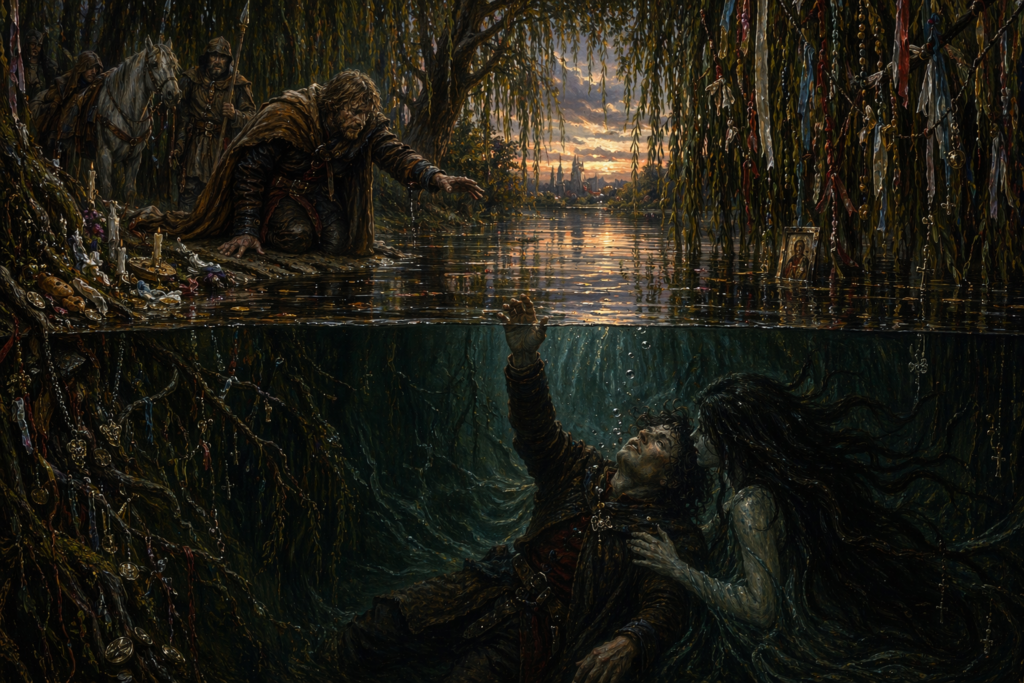
This impossibly lovely woman seems woven from the spirit of spring, grove, river, stone, or fertile ground itself; every movement suggests grace, but the place around her watches through her eyes.
XP 4,800
Nymph CR 8
N Medium fey
Init +8; Senses darkvision 60 ft., low-light vision; Perception +16
Defense
AC 22, touch 15, flat-footed 18 (+4 Dex, +7 natural, +1 dodge)
hp 105 (14d6+56)
Fort +8, Ref +13, Will +13
DR 10/cold iron
Immune charm effects
SR 19
Offense
Speed 30 ft., swim 30 ft.
Melee 2 touches +11 touch (enthralling touch)
Special Attacks beguiling gaze, enthralling touch, wrath of the place
Spell-Like Abilities (CL 10th; concentration +16)
Constant—speak with animals, speak with plants
At will—ghost sound, minor image
3/day each—charm person (DC 17), entangle (DC 16), hold person (DC 18), invisibility, suggestion (DC 18), vanish
1/day each—deep slumber (DC 18), dominate person (DC 21), hallucinatory terrain (DC 20)
Statistics
Str 12, Dex 18, Con 18, Int 14, Wis 16, Cha 23
Base Atk +7; CMB +8; CMD 23
Feats Dodge, Great Fortitude, Improved Initiative, Iron Will, Lightning Reflexes, Skill Focus (Diplomacy), Weapon Finesse
Skills Bluff +20, Diplomacy +26, Escape Artist +13, Knowledge (nature) +16, Perception +16, Sense Motive +16, Stealth +17, Survival +10, Swim +15
Languages Common, Elven, Sylvan, plus one regional language
SQ bound to a place, fey grace, recede into beauty
Ecology
Environment sacred springs, secluded pools, river fords, grove-shrines, cliff meadows, orchards, cave mouths, and other spiritually charged natural places
Organization solitary
Treasure standard plus offerings (fine jewelry, silver vessels, gold ornaments, carved ivory, votive objects, and minor magic items tied to beauty, fertility, water, orchards, moonlight, or groves)
Special Abilities
Beguiling Gaze (Su) As a standard action, a nymph fixes her gaze on one creature within 60 feet. The target must succeed at a DC 21 Will save or be charmed for 1 minute. A creature charmed in this way is also staggered and on its turn moves toward the nymph by the safest available route, though it never takes obviously self-destructive actions. The effect ends immediately if the creature takes damage from the nymph or any of her allies. This is a mind-affecting charm effect. The save DC is Charisma-based.
Bound to a Place (Su) Every nymph is mystically joined to a particular spring, grove, pool, ford, sacred tree, cliff meadow, orchard, or similar site. While within 1 mile of that place, the nymph gains a +2 circumstance bonus on Perception, Sense Motive, and Charisma-based skill checks, and cannot be surprised unless helpless.
Enthralling Touch (Su) A nymph’s touch is a melee touch attack that deals 3d6 points of nonlethal damage. A creature struck by this attack must succeed at a DC 21 Will save or be charmed for 1 round. A creature charmed in this way has its speed halved for the duration. This is a mind-affecting charm effect. The save DC is Charisma-based.
Fey Grace (Ex) A nymph moves through undergrowth, roots, mud, rubble, shallow water, and similar natural difficult terrain at normal speed and without taking damage or suffering any other impairment.
Recede into Beauty (Su) As a swift action, a nymph veils herself in drifting petals, reeds, light spray, shadow, or foliage until the start of her next turn. During this time, she gains concealment and may move up to half her speed without provoking attacks of opportunity.
Wrath of the Place (Su) Once per day as a standard action, a nymph may call upon the force of her domain, choosing one of the following effects. The save DC for each effect is 21 and is Charisma-based.
Grasping Roots: Plants, roots, or reeds erupt in a 20-foot-square area within 90 feet. Creatures in the area are affected as by entangle for 10 rounds.
Drowning Pull: Surging water fills a 20-foot-radius spread within 90 feet. Creatures in the area take 6d8 points of bludgeoning damage and are pulled up to 20 feet toward the center; a successful Reflex save halves the damage and negates the pull. This effect requires nearby water, heavy spray, or saturated ground.
Blinding Bloom: Light, pollen, petals, glittering moisture, or similar matter fills a 20-foot-radius spread within 90 feet. Creatures of the nymph’s choice in the area are blinded for 1 round on a failed Fortitude save.
Supernatural Nature
A nymph is the personality of a place condensed into human form. Her beauty is part of the danger, but never the whole of it. She rewards reverence, punishes desecration, and blurs the line between desire, fear, worship, and trespass.
Nymphs belong among the powers to whom people leave offerings and about whom they lower their voices. They are spoken of with attraction, caution, gratitude, resentment, and dread all at once. A village may praise the lady of the spring for clear water and easy births, yet still warn children never to answer singing after dusk. A shepherd may swear a grove-spirit saved him from wolves, while another insists the same being lured his brother to drowning. That doubleness is essential. A nymph is not good or evil in the blunt mortal sense. She is relational. What she gives or takes depends on conduct, custom, trespass, desire, and the health of the bond between people and place.
She is strongest when she is not reduced to a fight. Her real force lies in taboo, invitation, fascination, memory, and consequence. Men vanish near her pool. Marriages prosper when offerings are renewed. A hunting lord returns diminished after mocking a riverside shrine. A grove grows fruitful again only after the old rites are restored. A nymph is not merely encountered. She is felt in the customs, silences, fears, and habits that gather around her domain long before anyone sees her face.
Local Impact
A nymph alters the emotional and social climate around her. Springs become pilgrimage sites. Woods acquire taboos. Fords become places where travelers leave ribbons, coins, bread, or prayer before crossing. Marriages may be blessed or blighted depending on whether old rites are kept. Children are warned away from certain pools. Herdsmen take the long road rather than camp beside a singing stream. Even when unseen, the nymph bends local behavior around herself.
Where a nymph is honored, the effects may seem wholly beneficial at first: clear water, fertile orchards, easy lambing, healthy vines, beautiful children, reconciled lovers, and a strange sense that a place is watched but not hostile. Yet even these blessings are rarely unconditional. They endure only while custom, restraint, and reverence survive. When the bond is broken, the damage often begins quietly. Obsession replaces courtship. Desire curdles into jealousy. Work is neglected. Animals vanish. Drownings are called accidents because no one wishes to say more. Young men return silent, fevered, and changed. Young women dream of a voice in the reeds. Quarrels spread through a village with no visible cause.
For that reason, a nymph’s true impact is rarely measured only in bodies or treasure. She changes custom, memory, fertility, caution, and the moral atmosphere of a district. A place haunted by a nymph is not simply more dangerous. It is more charged. People behave differently there, speak differently there, and teach their children differently there.
Why Nymphs Work
Nymphs work because they bind beauty to consequence. They turn a lovely place into a meaningful one. A spring, grove, ford, orchard, or meadow ceases to be background scenery and becomes morally charged ground: a place of temptation, reverence, danger, custom, and memory.
They also work because they stand exactly where desire meets prohibition. People want what the nymph’s place offers—water, fertility, shelter, beauty, blessing, possession, intimacy, prestige—but reaching for it wrongly has a cost. That gives the creature pressure before combat even begins. The question is not only whether the players can defeat her. It is whether they understand what kind of place they are standing in, what has been broken there, and what price is being asked.
Used well, a nymph makes the landscape feel inhabited in the deepest sense. The grove is not scenery. The spring is not scenery. The river bend is not scenery. Each is a presence with memory, appetite, and will. That is why nymphs endure. They let the world itself become personal.
Nymph classifications
The different species of nymph are sometimes distinguished according to the different spheres of nature with which they were connected.
Land Nymphs
Alseids (glens, groves) One of a group of nymphs that preside over mountain vales glens and groves where herds graze. They like to scare travelers, they are attendants of satyrs
- Napaeae (mountain valleys, glens)
- Auloniads (pastures)
- Leimakids (meadows)
- Oreads (mountains, grottoes)
- Minthe (mint)
- Hesperides (garden)
Water Nymphs
- Helead (fen)
- Oceanids (daughters of Oceanus and Tethys, any water, usually salty)
- Nereids (daughters of Nereus, the Mediterranean Sea)
- Naiads (usually fresh water)
- Crinaeae (fountains)
- Limnades or Limnatides (lakes)
- Pegaeae (springs) A type of nymph one group of them dwelled in the spring of Pegae, and were responsible for the kidnapping of Hylas.
- Potameides (rivers)
- Eleionomae (marshes)
Wood Nymphs
- Hamadryads (trees)
- Dryads (oak tree)
- Meliae (manna-ash tree)
- Leuce (white poplar tree)
- Epimeliad (apple tree)
Other
- “Corycian Nymphs” (Classical Muses)
- Lampades (underworld)
Keep this reference growing
If this page helped with your reading or game, you can support its upkeep or explore the curated books.
Explore the Bookshop — epics, classics and stories behind imagined worlds.