
Touched Creature Template
CREATURE TEMPLATE · OTHERWORLD
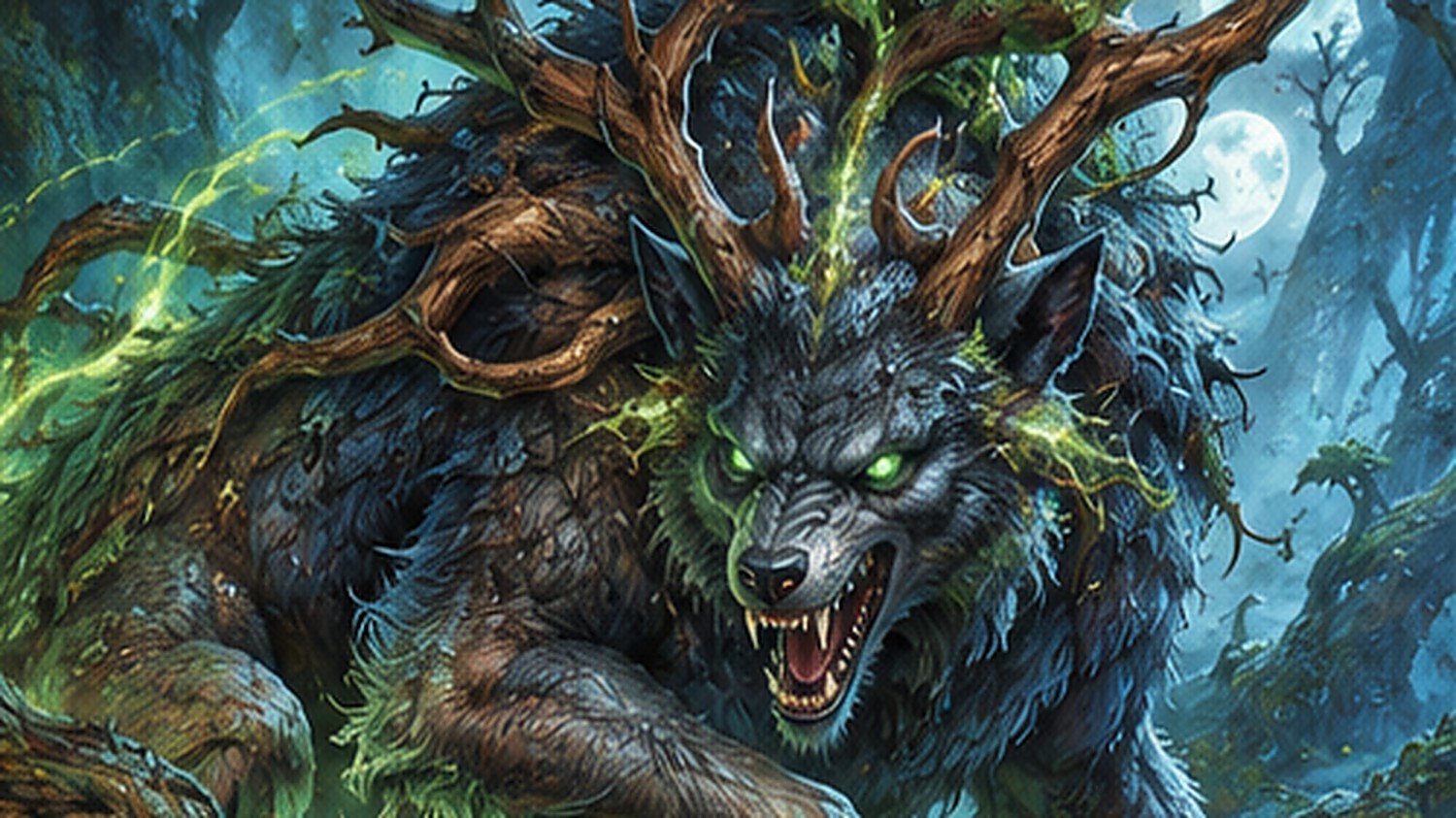
A wolf waits on the road ahead. Its tracks come out of the wood, but none lead into it. As the travellers draw near, it steps into a patch of brambles that coils across the path at its approach. The animal watches from the far side instead of attacking.
Some creatures live so close to the Otherworld that they become part of it. A touched creature still resembles the wolf, stag, giant or other being it once was, but can carry a little of that realm’s magic into an encounter. It need not be evil, friendly or even willing to fight. Its instincts still matter.
Use this template to change an existing stat block, not to invent an unrelated monster. The rules below show what changes, what stays the same and how those changes affect play. The painted example is just one possible appearance.
How to Apply the Template
- Choose a base creature with a complete stat block. A touched creature is not a standalone species.
- Pick one rules edition below. Keep the base creature’s attacks and movement; add only the changes in that panel.
- Select magic with care. Eligibility, spells per day and save DCs depend on the edition. A low-HD creature should not suddenly become a high-level spellcaster without a difficulty check.
- Finish the stat block. Adjust type-dependent statistics where required, set a provisional CR, and run the creature using its normal actions.
Monster Template Rules — Four Editions
Choose a tab; the sections are separate rules sets, not cumulative upgrades. The original material is from a 2002 D&D 3.0-era third-party book. The 3.5e panel preserves its distinctive rules in converted terminology; 2024, 2014 and Pathfinder 1e are explicitly original adaptations. The worked wolf examples below use edition-specific source monsters.
Touched Creature — D&D 2024
Original conversion. Not an official 2024 monster template. The base creature supplies the statistics; this section states every change.
Apply the Template
- Eligible base
- GM-approved living Beast, Dragon, Elemental, Giant, Humanoid, Monstrosity or Plant. Other creature types only by deliberate ruling.
- Size, type, HP, AC, speed, attacks
- Unchanged. Do not rename the type Fey automatically. Keep existing actions, traits and attack bonuses.
- Ability scores
- Intelligence becomes 8 if lower. Other scores stay the same.
- Senses and protection
- Darkvision 60 feet if absent, modelling the original low-light vision. Fire resistance; no extra benefit if already resistant. Fire resistance can be strong at low CR.
- Otherworld Magic
- If Wisdom or Charisma is above 10, choose one spell for every four Hit Dice, minimum one. Each selected spell is a Magic action using its normal spellcasting rules and casting time. Charisma is the spellcasting ability; save DC = 8 + proficiency bonus + Charisma modifier. Give most choices one use per day. Suggested lighter choices: Dancing Lights (1/day), Entangle (3/day), self-only Invisibility (3/day). Use the chosen spell’s normal concentration and duration. Confusion and Dimension Door are high-impact options; reserve them for creatures that can support them.
- Challenge
- Calculate from the finished monster’s defence, control and actual attacks. The old +1/+2/+3 by Hit Dice is not a 2024 CR calculation.
Worked Monster: Touched Wolf (2024)
Medium Beast, Unaligned · original example · CR 1/2* (100 XP; PB +2, provisional)
AC 12; Initiative +2 (12); HP 11 (2d8 + 2); Speed 40 ft.
| STR | DEX | CON | INT | WIS | CHA |
|---|---|---|---|---|---|
| 14 (+2) | 15 (+2) | 12 (+1) | 8 (−1) | 12 (+1) | 6 (−2) |
Skills Perception +5, Stealth +4. Damage Resistance fire. Senses Darkvision 60 ft., Passive Perception 15. Languages None.
Pack Tactics. Advantage on attack rolls when an ally is within 5 feet of the target and isn’t Incapacitated.
Actions
Bite. Melee Attack Roll: +4, reach 5 ft. Hit: 5 (1d6 + 2) Piercing damage. A Medium or smaller target has the Prone condition.
Otherworld Magic (3/day). The wolf casts Entangle with its Magic action (Charisma; spell save DC 8; concentration, up to 1 minute). This is its only selected template spell; it cannot attack with Bite during the same action.
Basis: 2024 SRD Wolf, with Intelligence, resistance and spell added. *The new CR is an untested estimate; the unmodified 2024 Wolf is CR 1/4.
Touched Creature — D&D 2014
Original conversion. Use the 2014 monster rules, not the 2024 wolf attack or automatic-Prone wording.
Apply the Template
- Base creature
- Keep its size, type, Hit Dice, HP, armour, movement, skills, attacks and traits. Raise Intelligence to 8 if lower; other scores do not change.
- Otherworld sight
- Give Darkvision 60 feet if absent, in place of the older low-light vision. Keep any better existing sense.
- Defence
- Add resistance to fire damage as an optional house conversion of fire resistance 5; this is not a one-for-one numerical replacement.
- Innate Spellcasting
- If Wisdom or Charisma exceeds 10, choose one spell-like ability for each four Hit Dice (minimum one in total). Charisma is the spellcasting ability; DC = 8 + proficiency bonus + Charisma modifier. For low-CR examples, Entangle (3/day), self-only Invisibility (3/day), or Dancing Lights (1/day) are possible. Spellcasting uses the spell’s regular action and concentration; do not award a free attack too.
- Challenge
- Recalculate or playtest CR. The old printed Hit-Dice modifier does not directly work in 2014 rules.
Worked Monster: Touched Wolf (2014)
Medium Beast, Unaligned · original example · CR 1/2* (100 XP, provisional)
AC 13 (natural armour); HP 11 (2d8 + 2); Speed 40 ft.
| STR | DEX | CON | INT | WIS | CHA |
|---|---|---|---|---|---|
| 12 (+1) | 15 (+2) | 12 (+1) | 8 (−1) | 12 (+1) | 6 (−2) |
Skills Perception +3, Stealth +4; Damage Resistance fire; Senses Darkvision 60 ft., Passive Perception 13; Languages None.
Keen Hearing and Smell. Advantage on Wisdom (Perception) checks that depend on either sense.
Pack Tactics. Advantage on an attack roll against a creature if an ally is within 5 ft. of it and isn’t incapacitated.
Actions
Bite. Melee Weapon Attack: +4 to hit, reach 5 ft., one target. Hit: 7 (2d4 + 2) piercing damage. On a creature hit, the target makes a DC 11 Strength save or falls prone.
Innate Spellcasting (3/day). The wolf casts Entangle (Charisma; spell save DC 8; concentration, up to 1 minute) as an action instead of biting.
Basis: 2014 SRD Wolf with the template changes. *New CR is untested; unmodified 2014 Wolf is CR 1/4.
Touched Creature — Pathfinder 1e
Original conversion of an older third-party template; not an official Paizo template.
Apply the Template
- Eligible
- An animal, dragon, elemental, giant, humanoid, magical beast, monstrous humanoid, plant or vermin (GM decision for unusual cases). Normal size, speed, natural attacks and special attacks remain unless affected by a type change.
- Type and Hit Dice
- An animal becomes a magical beast. For this conversion, recalculate type-dependent Hit Die size (d10), base attack bonus, saves and skills as needed; don’t merely change the label. Other original types remain unchanged.
- Ability scores, senses
- Intelligence becomes at least 8. Add low-light vision if missing, fire resistance 5, DR 5/magic and spell resistance equal to twice Hit Dice (maximum 25). For a low-HD creature SR may offer almost no protection.
- Spell-like abilities
- Only if Wisdom or Charisma exceeds 10: one choice for each four Hit Dice, minimum one. Standard caster level = Hit Dice in this conversion. DC = 10 + spell level + Charisma modifier. Choose from the original spell list reproduced in the 3.5e panel below, with those per-day uses. Powerful selections require CR review.
- Challenge
- Use +1 CR at 1–3 HD, +2 at 4–7 HD and +3 at 8+ HD only as a starting guide from the older source; verify the resulting Pathfinder encounter.
Worked Monster: Touched Wolf (PF1e)
N Medium magical beast · CR 2* (600 XP, provisional)
Initiative +2; Senses low-light vision, scent; Perception +8.
Defence AC 14, touch 12, flat-footed 12 (+2 Dex, +2 natural); HP 15 (2d10 + 4); Fort +5, Ref +5, Will +1; fire resistance 5, DR 5/magic, SR 4.
Offence Speed 50 ft.; bite +3 (1d6 + 1 plus trip); spell-like entangle 3/day (CL 2nd, save DC 9). No extra bite on a turn when using a standard-action spell-like ability.
| STR | DEX | CON | INT | WIS | CHA |
|---|---|---|---|---|---|
| 13 (+1) | 15 (+2) | 15 (+2) | 8 (−1) | 12 (+1) | 6 (−2) |
Statistics BAB +2; CMB +3; CMD 15 (19 vs trip); Feat Skill Focus (Perception); Skills Perception +8, Stealth +6, Survival +1 (+5 tracking by scent).
Basis: PF1e Wolf with animal-to-magical-beast adjustments made explicit. Existing wolf skill choices are retained as an illustrative GM conversion. *New CR is estimated from the old source’s +1 HD band and has not been playtested.
Touched Creature — D&D 3.5e
Source-derived 3.5e conversion. The Quintessential Druid (2002) supplied the original D&D 3.0-era concept and options. Its older DR 5/+1 becomes DR 5/magic in this modernised rendering. These are not official 3.5e Wizards of the Coast rules.
Applying the Template
- Eligible base creature
- Animal, dragon, elemental, giant, humanoid, magical beast, monstrous humanoid, plant or vermin. The 2002 source also names the obsolete 3.0 beast category; use the creature’s 3.5e type.
- Size, attacks and other traits
- Same as the base creature. An animal becomes a magical beast; any type-dependent changes must be resolved consistently under your chosen 3.5e template rules.
- Abilities
- Intelligence becomes at least 8. All other scores stay unchanged. Saves, existing skills, feats, alignment, treasure, organisation and advancement follow the base creature except for consequences of a change of type.
- Special qualities
- Low-light vision; fire resistance 5; DR 5/magic (conversion of 5/+1); spell resistance = 2 × HD, maximum 25.
- Spell-like choices
- Only creatures with Wisdom or Charisma above 10 gain one option per four Hit Dice (minimum one). The original list, including individual usage limits, is below. Save DC = 10 + spell level + Charisma modifier. Use caster level = the creature’s HD as a 3.5e conversion convention where otherwise unspecified.
- CR adjustment
- Base CR +1 (1–3 HD), +2 (4–7 HD), +3 (8+ HD). This preserves the source’s stated bands as a starting point, not a guarantee that each option is balanced.
Original Spell-Like Ability Choices
- Confusion — 1/day
- Dancing Lights — 1/day
- Detect Good, law, evil or chaos — 1/day; choose an appropriate alignment detection
- Dimension Door — 1/day
- Entangle — 3/day
- Invisibility (self only) — 3/day
- Ventriloquism — 3/day
Important: the source allows a powerful spell on a low-HD creature. As GM, review the choice before using it; Confusion and Dimension Door can change a low-level fight radically.
Worked Monster: Touched Wolf (3.5e)
Medium magical beast, Neutral · CR 2* (source +1 CR band; untested).
Hit Dice 2d10 + 4 (15 hp). Initiative +2. Speed 50 ft. (10 squares). AC 14, touch 12, flat-footed 12. BAB/Grapple +2/+3.
Attack/Full Attack bite +4 melee (1d6 + 1), plus trip; Space/Reach 5 ft./5 ft.
| STR | DEX | CON | INT | WIS | CHA |
|---|---|---|---|---|---|
| 13 (+1) | 15 (+2) | 15 (+2) | 8 (−1) | 12 (+1) | 6 (−2) |
Saving Throws Fort +5, Ref +5, Will +1. Qualities scent, low-light vision, fire resistance 5, DR 5/magic, SR 4. Skills Hide +2, Listen +3, Move Silently +3, Spot +3, Survival +1 (+5 when tracking by scent). Feats Track (bonus), Weapon Focus (bite).
Trip (Ex). On a bite hit, the wolf may attempt to trip (+1 Strength check) without a separate touch attack or provoking an attack of opportunity. A failed attempt cannot be used to trip the wolf in return.
Spell-Like Ability entangle 3/day (CL 2nd, save DC 9). The wolf qualifies because Wisdom is 12, despite Charisma 6. It has only one choice at 2 HD.
3.5e Wolf base statistics from the SRD; magical-beast HD/BAB and 2002 template conversion applied. *Example CR is provisional.
Running a Touched Creature
The most useful clue is the one that would be impossible for an ordinary animal. A wolf stops at a stream, watches its reflection move on without it, then looks back to see whether anyone noticed. The party can follow, retreat or test the creature’s intentions.
What Does It Want?
- A guide: it wants someone to leave a dangerous crossing before nightfall. Following it earns safe passage; attacking it shuts that route.
- A guardian: it keeps hunters away from a place where the boundary is weak. It warns first, uses its magic to separate intruders, then flees to protect what it guards.
- A lure: it imitates an ordinary pet or wild animal, drawing travellers towards the wrong path. Tracks stop abruptly where it steps into the Otherworld.
One Encounter, Three Turns
Before initiative: give a visible clue—unusual silence, footsteps that do not match the creature’s gait, or an impossible reflection. First turn: if attacked, it uses entangle from cover and tries to break the party’s line of advance. Second turn: it uses ordinary movement or a natural attack, keeping a way out. Third turn: if the party is stronger, it retreats to an established crossing. It does not gain a bonus spell and attack in the same action unless the chosen rules explicitly allow that.
Practical Counterplay
Do not rely on damage as the only answer. Track the creature’s route, watch its chosen spell’s use limits, disperse to avoid being held together by entangle, or bargain over the place it guards. Resistance to fire does not make it fireproof; damage reduction can be overcome as stated in its edition. A trapped touched creature is still an intelligent decision-maker—even if it cannot speak.
Using Touched Creatures in the World
The Fey World and Otherworld is the most natural source for these creatures. Their presence can signal an active crossing rather than a random monster nest. Choose an existing animal or monster from the Bestiary and change its behaviour first: a wary territorial hound feels different from a hungry wolf, even before either uses magic. A touched creature might bring travellers to a crossing, guard a bargain, or escape through a place that ordinary hunters cannot follow.
Rules Sources and Credits
Original concept and source-era features: Robin O. Duke, The Quintessential Druid (Mongoose Publishing, 2002), as credited by this page’s earlier rules reference. The printed material predates D&D 3.5e; the third-party template is not an official Wizards of the Coast or Paizo monster. The later-edition conversions and worked examples here are original additions, not material from that book.
Base-creature comparison: D&D 2024 Basic Rules Wolf; D&D 2014 Basic Rules Wolf; Pathfinder 1e Wolf; D&D 3.5 SRD Wolf. Each touched example adds original conversions and provisional CRs.
Keep this reference growing
If this page helped with your reading or game, you can support its upkeep or explore the curated books.
Explore the Bookshop — epics, classics and stories behind imagined worlds.