
Elemental Plane of Fire — The Eternal Furnace
The Eternal Furnace
The Elemental Plane of Fire is an immeasurable elemental reality where heat becomes law, flame becomes landscape, and every unprotected thing is tested by burning truth.
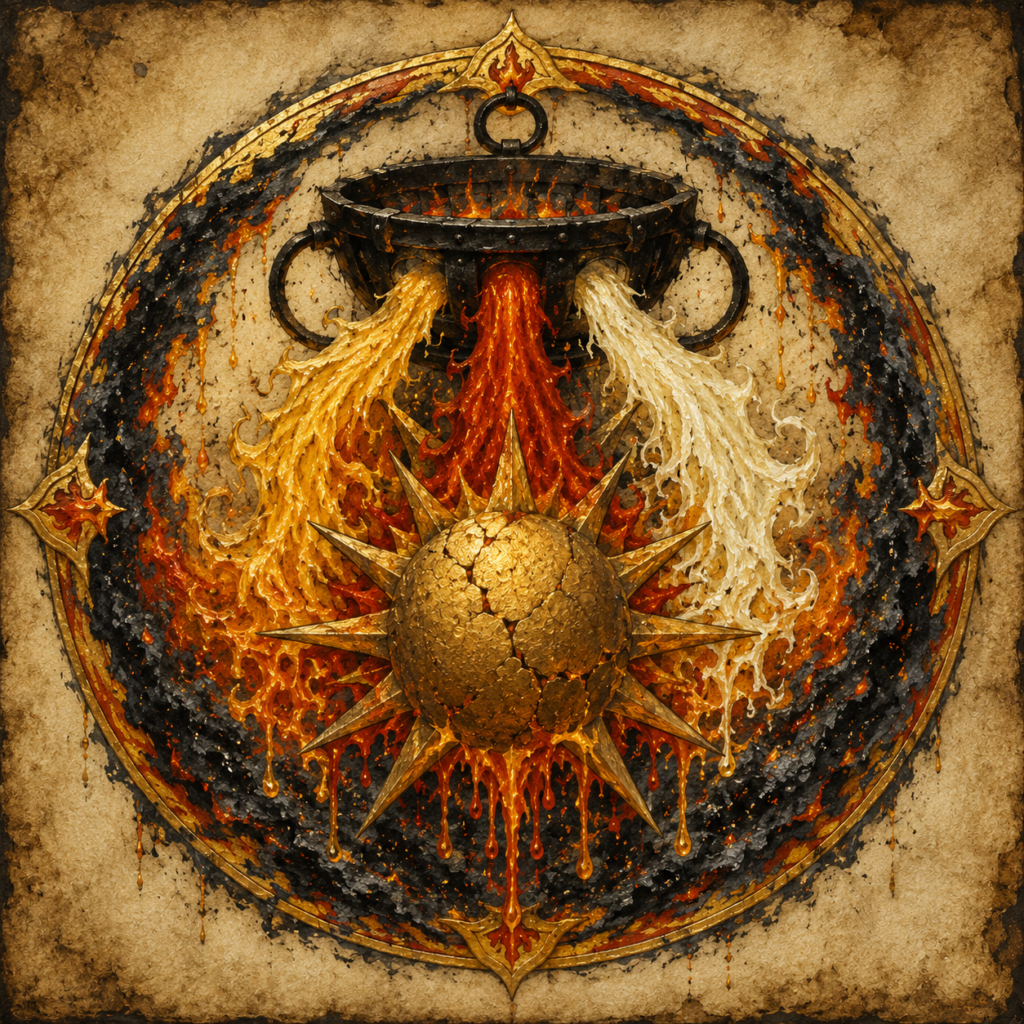
Overview
The Elemental Plane of Fire is an immeasurable furnace-world of burning oceans, ash-dark skies, molten rivers, brass cities, cinder wastes, glass storms, volcanic mountains and forge-realms older than mortal civilisation.
Fire here is not merely something that deals damage. It is terrain, weather, industry, appetite, sacred ordeal, military power and law. It tempers iron, hardens clay, purifies metal, consumes forests, lights hearths, carries signals and transforms everything that remains within it long enough.
Every traveller eventually learns that fire also means ownership, pressure, ritual, proof and debt. A flame may be someone’s property. A brazier may witness a contract. A cool chamber may be protected by a treaty. A road may remain solid only because the power controlling it allows the heat to pass elsewhere.
No universal throne governs the plane. Efreeti houses dominate wealthy territories of brass, contract and tribute. Azer clans defend ancestral forges where craft and oath carry greater authority than noble titles. Salamanders serve as soldiers, smiths, raiders and mercenaries. Magmins gather around molten pools, while fire mephits construct absurd but dangerous courts from gossip, imitation and stolen law.
Fire elementals move through the Eternal Furnace like weather that has learned intent. Toward Earth, molten elemental powers grind through basalt and magma. Around Muspellheim, established fire giant holds command old military roads and volcanic fortresses.
The plane is magnificent in the same way a newly drawn sword can be magnificent. Skies burn copper, violet, red and white. Mountains glow from their interiors. Cities shine like crowns through firestorms. Black bridges span rivers of liquid metal. Caravans cross ash deserts beneath domes of disciplined blue flame.
Cosmological Role
The Elemental Plane of Fire belongs to the deepest elemental structure of the Inner Planes. It is one of the primal realities from which heat, combustion and flame enter later creation.
Fire is older than mortal civilisation and older than the later divine kingdoms established across the wider cosmos. Gods can enter the plane, build shrines, maintain realms, bargain with its inhabitants and claim territory. They can become tremendously powerful within Fire. None created the plane, and no god owns Fire itself.
Its borders are transitions rather than walls. Toward the Elemental Plane of Air , flame stretches into smoke, cinder winds and burning storms. Toward Earth , heat becomes magma, basalt, slag, ore and volcanic pressure. Toward Water , the elements clash through boiling rain, steam, scalding fog, explosive pressure and rapidly forming glass.
On the Material Plane, the Eternal Furnace reveals itself through volcanoes, sacred hearths, alchemical furnaces, forest fires, lightning-struck trees, funeral pyres, geothermal wounds and exceptional acts of smithcraft.
What the Plane Feels Like
The First Sensation: Pressure
Arrival feels like opening the door of an enormous furnace. Heat presses against skin and lungs. Metal becomes painful to touch. Leather stiffens. Wax runs. Food dries. Ink and delicate materials can fail. Water abruptly becomes treasure.
The Second Sensation: Movement
Fire has currents here and heat has tides. Ash can fall sideways or climb against gravity. Sparks travel in migrating swarms. A harmless black-glass road can soften when a thermal current changes. A cinder field can become a low lake of blue flame before travellers have time to relocate their camp.
The Third Sensation: Attention
Fire often appears to notice. A mortal hearth-flame may bend toward its distant place of origin. A sacred torch may brighten near a gate. An old forge-hammer can ring without being struck. Native inhabitants read visitors by the workmanship of their protection, the water they carry, the metal they wear and the flames that refuse to burn them.
Noise and Silence
The plane is deafening near its great settlements. Flame Seas roar. Brass markets hammer, bargain and shout. Azer forges beat with disciplined rhythm. Magmin pools hiss and erupt.
The deeper Cinder Plains can be unnervingly quiet. There a traveller may hear only their breathing, the movement of their equipment and the faint crackle of ash settling across the road.
Major Regions of the Eternal Furnace
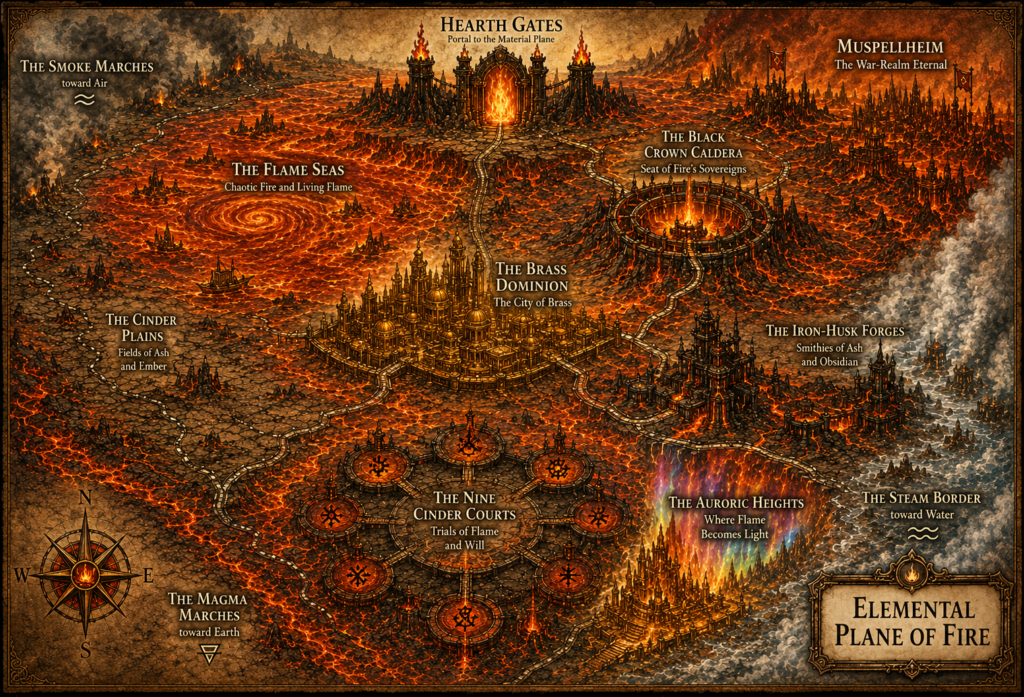
The regions below are major destinations known to planar travellers. Their political borders and routes change with conquest, eruption, elemental pressure and the movement of great firestorms.
The Hearth Gates
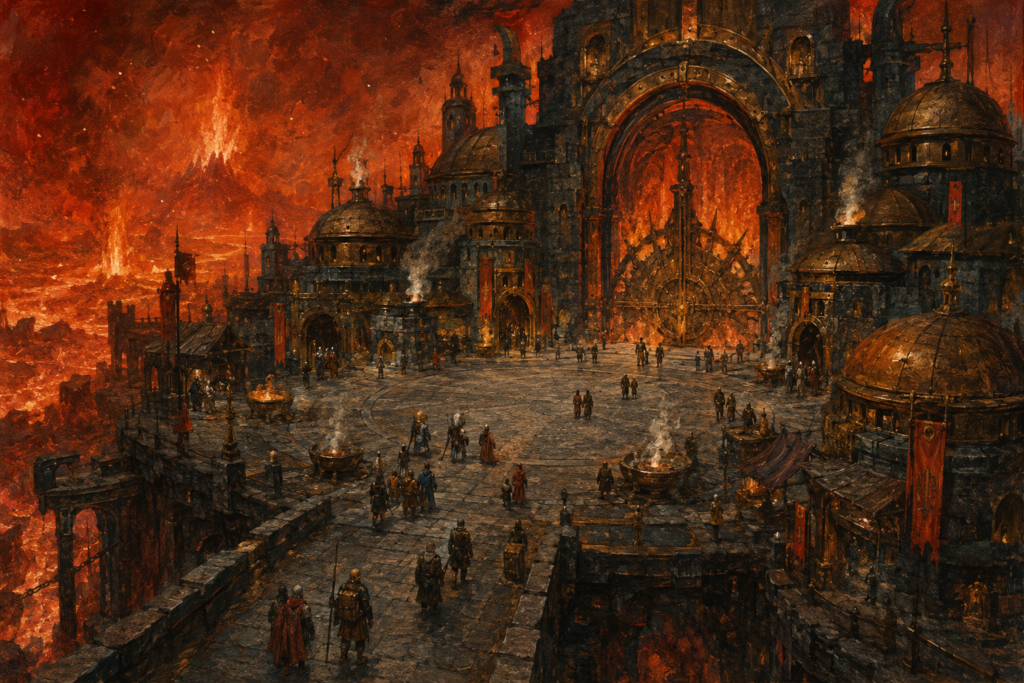
The Hearth Gates are the safest known arrival points for mortal travellers: fortress markets, circular plazas, basalt causeways, guarded furnace doors and treaty-stations built around unusually stable portals.
Every gate belongs to somebody. An efreeti house, azer wardens, a salamander captain, giant oath-line, mortal college or ancient treaty controls its protection.
Travellers can obtain guides, interpreters, water, cooling wards, sealed containers, maps and papers here, but payment may involve craftsmanship, secrets, rare fuel, metal, favours, names or promises as readily as coin.
The Flame Seas
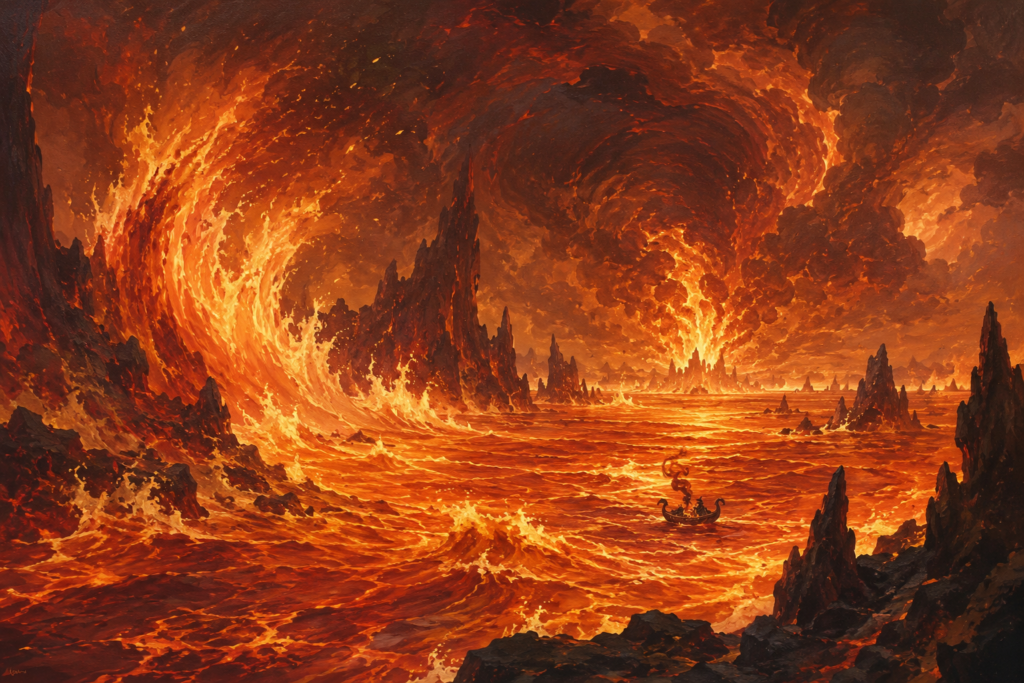
The Flame Seas are vast bodies of liquid fire and molten radiance. Some roll like conventional oceans. Others rise in vertical sheets, twist into pillars or break against obsidian cliffs in storms of sparks.
Fire elementals cross them without vessels. Efreeti fleets use fire-built ships, and salamander raiders exploit stable ridges and temporary crusts. Storms reshape coasts, destroy fortresses and sometimes expose things buried beneath the fire for ages.
New islands of slag can form in a night and disappear in the next great thermal tide.
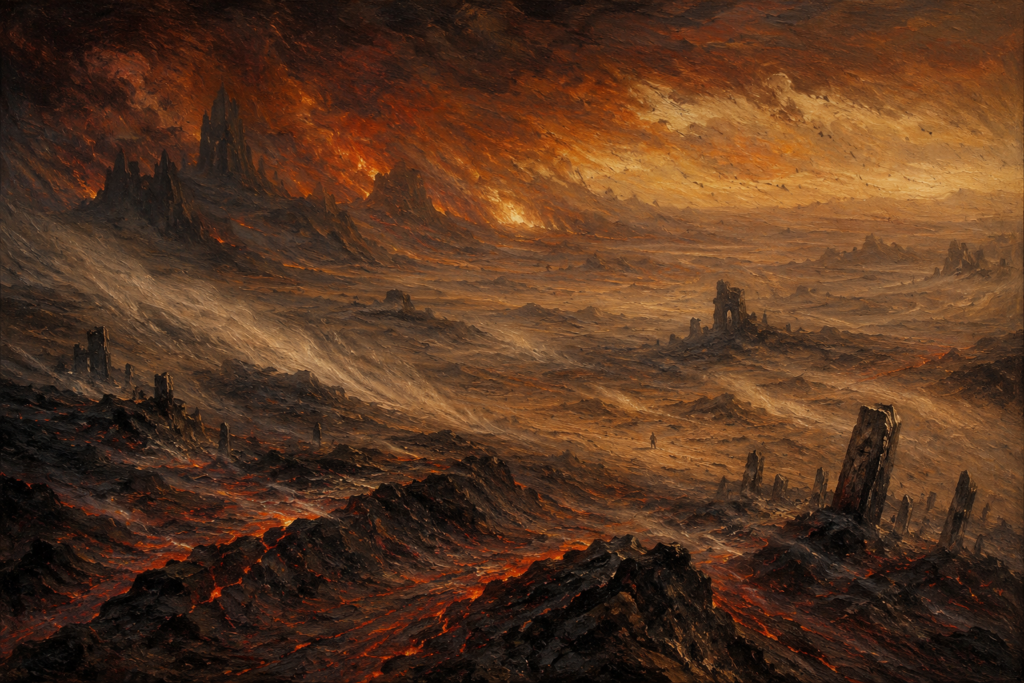
The Cinder Plains
The Cinder Plains are wastes of ash, ember flats, black dunes, brittle charcoal and glass scars where earlier firestorms burned with extraordinary uniformity.
The terrain hides sinkholes, buried coals, invisible heat pockets and forgotten roads. Ash storms can erase a caravan route while simultaneously uncovering an ancient ruin.
Exiles, pilgrims and fugitives favour the plains because settled powers find them difficult to control. Some Fire cultures also use long crossings as tests of discipline and oath.
Fire-readers claim old ash retains traces of what was destroyed there, making ancient burn-fields valuable to investigators and diviners.
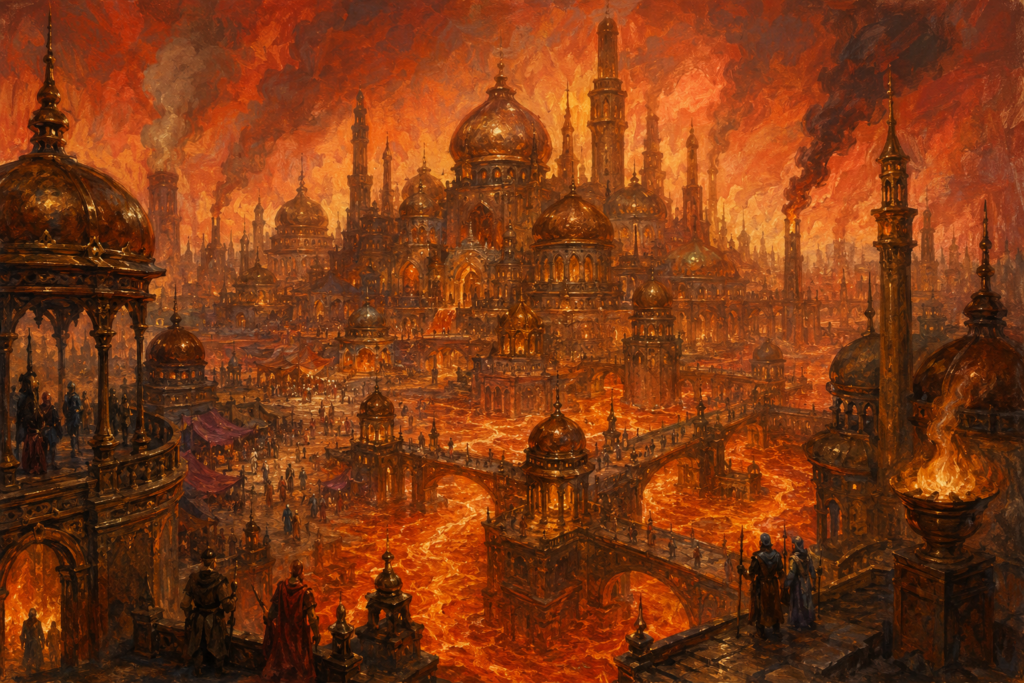
The Brass Dominion
The Brass Dominion is the greatest concentration of efreeti power known to mortal travellers: metal cities, contract courts, pleasure palaces, embassies, water vaults, slave-forges, military foundries and heavily taxed roads.
At its heart stands the City of Brass, the most famous efreeti metropolis in the plane. Its towers, markets, furnace-palaces, archives and protected gardens make it one of the few places in Fire where a prepared outsider can purchase almost anything.
The City of Brass is not the capital of the Elemental Plane of Fire itself. It is the dominant city of a vast efreeti sphere of power within a reality much larger than any empire.
Efreeti society turns control into authority. Doors, roads, shade, water, labour, debts, rescue rights and legal status may all belong to someone. The Dominion is useful because it is organised and dangerous for precisely the same reason.
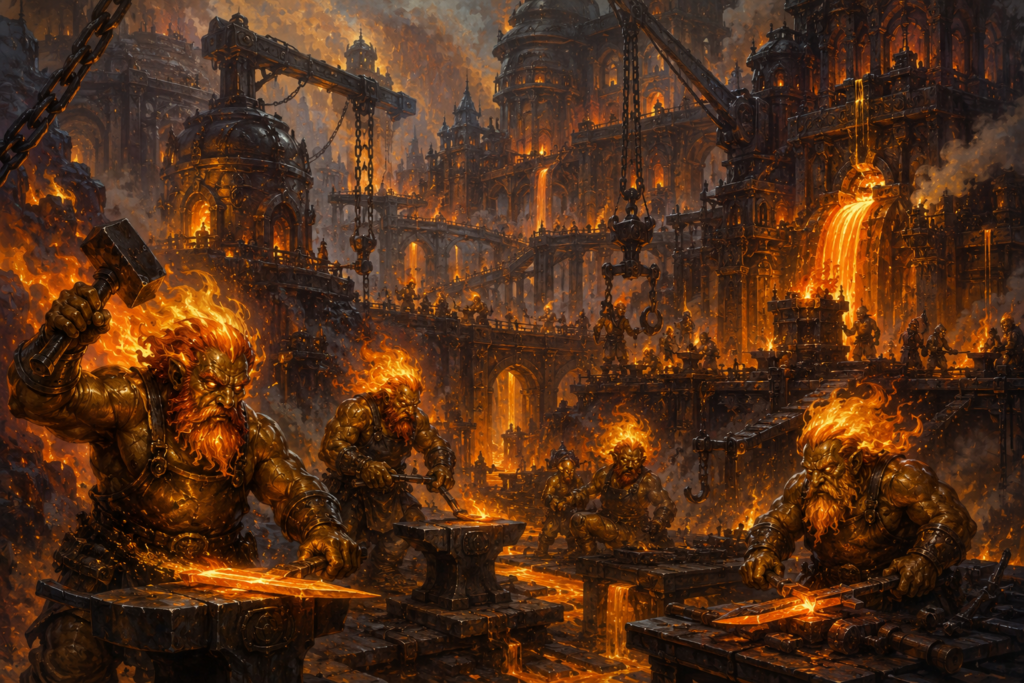
The Iron-Husk Forges
The Iron-Husk Forges are ancestral strongholds of the azers , built where the character of Fire begins to lean toward Earth.
A great azer forge can simultaneously function as home, workshop, archive, shrine, court and fortress. Craft preserves memory. An anvil can witness an oath. A pattern hammered into ceremonial metal can preserve lineage or treaty.
Some holds remain fiercely independent; others owe taxes, service or old debts to efreeti houses, salamander companies or neighbouring giant powers.
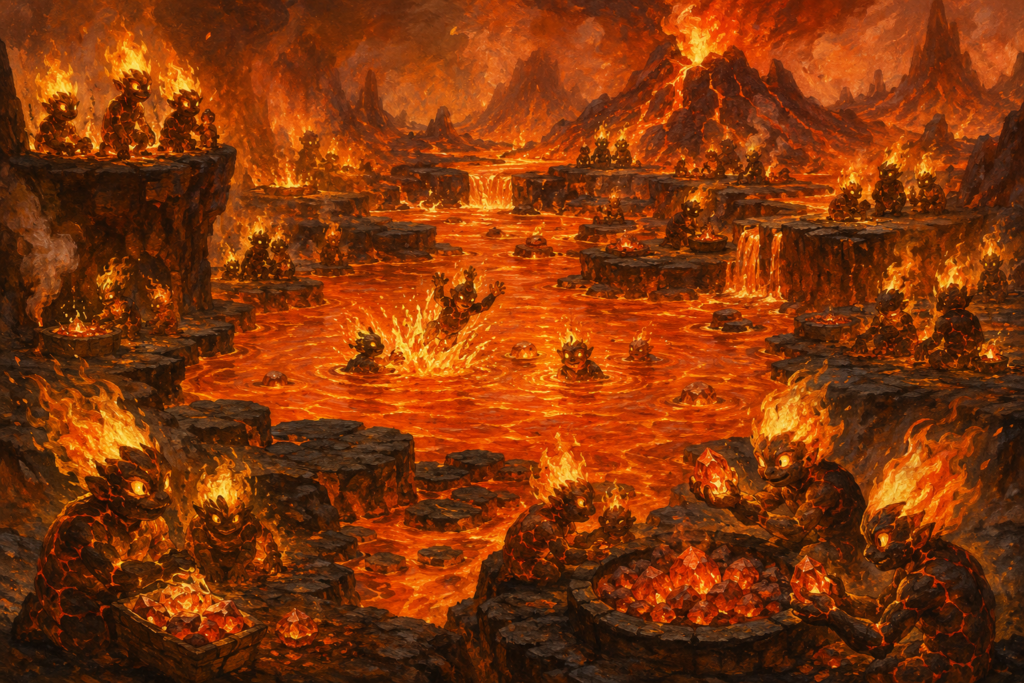
The Magmin Pools
The Magmin Pools form around chains of shallow molten basins, bubbling caves and thermal channels occupied by communities of magmins.
Their customs appear chaotic to outsiders but govern shared heat, communal embers, safe crusts and access to particular pools. Elders may possess intimate knowledge of local eruptions and routes beneath the surrounding plains.
The pools frequently lie above useful minerals or stable thermal tunnels, making apparently minor communities important to far greater powers.
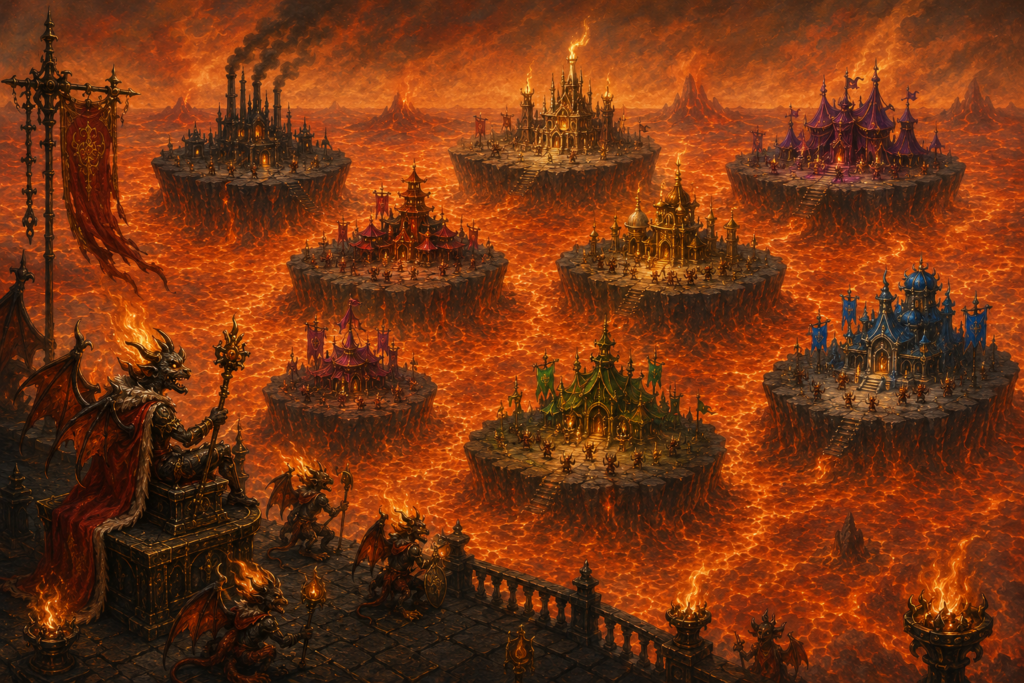
The Nine Cinder Courts
The Nine Cinder Courts are notorious fire mephit principalities raised from hot smoke, cracked glass, red lightning and basalt platforms.
Their rulers imitate efreeti legalism, azer ceremony, giant titles and mortal court etiquette while understanding none of them completely. The result is ridiculous law backed by genuine guards, prisons, grudges and portal keys.
The courts claim overlapping powers over smoke, sparks, ash, scorching, boasting, insult, theft and crown-right. They are also excellent sources of gossip because mephit messengers move everywhere respectable diplomats prefer not to.
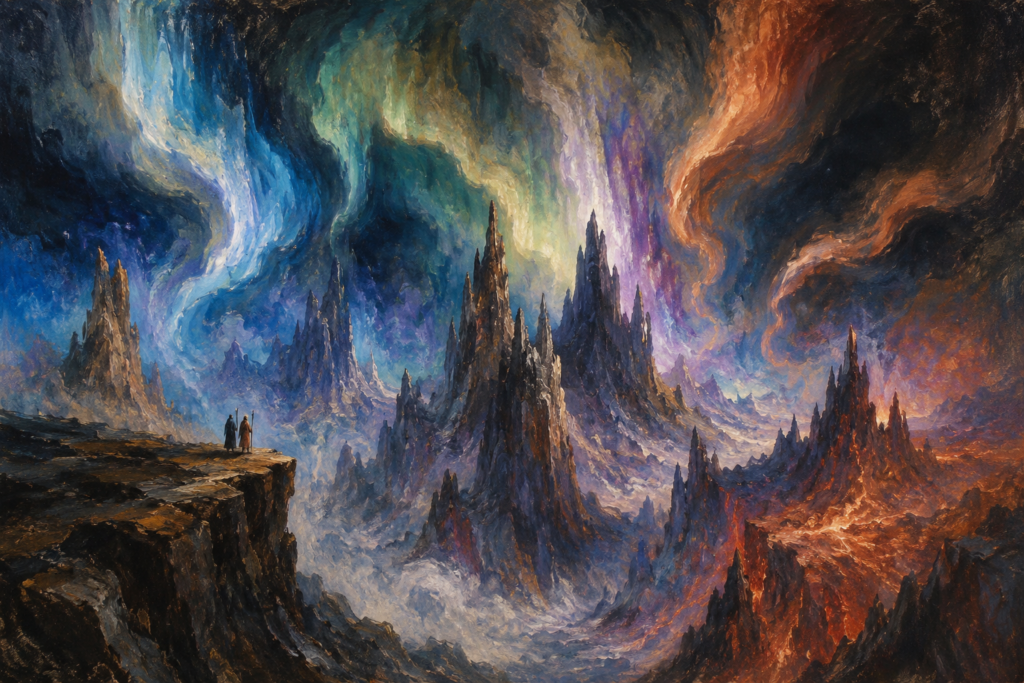
The Auroric Heights
Across the Auroric Heights, coloured fire moves through the sky in curtains of blue, green, white, copper, violet and black. Mountains and suspended ridges rise into those flames.
Some displays are weather. Others are omens or the visible edge of an elemental intelligence too great to communicate through ordinary language.
Pilgrims seek transformation here. A passage through a particular aurora may heal, scar, bless, blind or mark the traveller. Efreeti authority becomes unreliable in these heights because the fire increasingly answers only to itself.
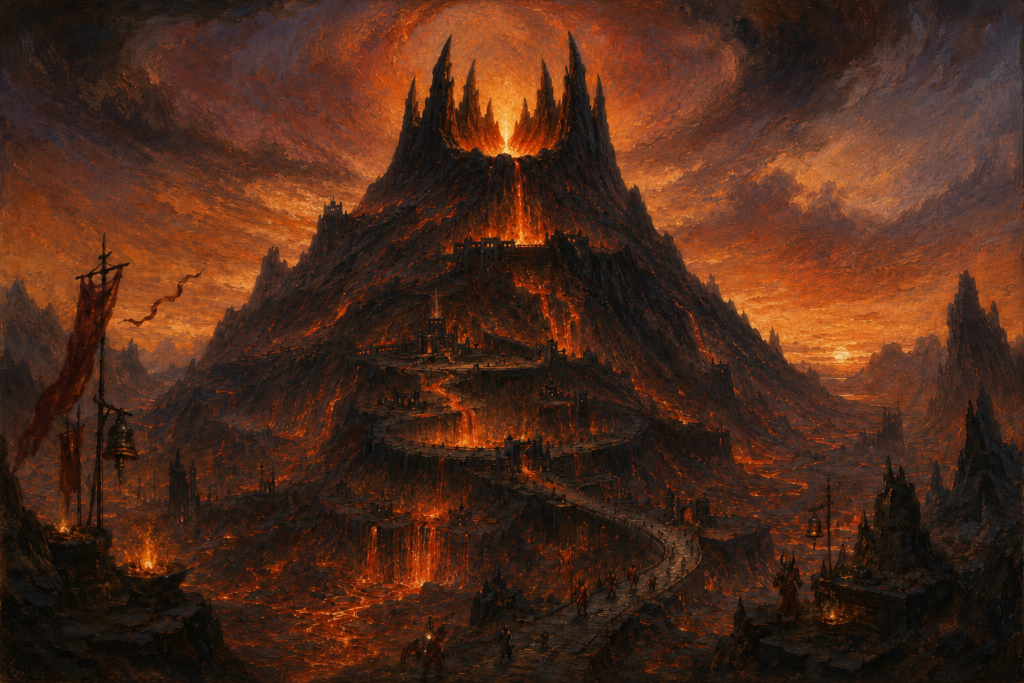
The Black Crown Caldera
The Black Crown is an enormous sacred volcano rising from obsidian, lava rivers and ash gardens. Settlements cling to the lower approaches and compete over pilgrimage, mineral, prophecy and descent-rights.
Azer smiths seek exceptional ores from sealed vents. Salamander companies duel across black terraces. Magmin communities gather around thermal pools near the base. Volcanic priests and travellers climb toward places where the plane appears to remember its oldest eruptions.
Shrines and sacred fires associated with Pele can be encountered among its volcanic cults, particularly where new stone is still being born from lava. These presences do not make the Black Crown her exclusive realm.
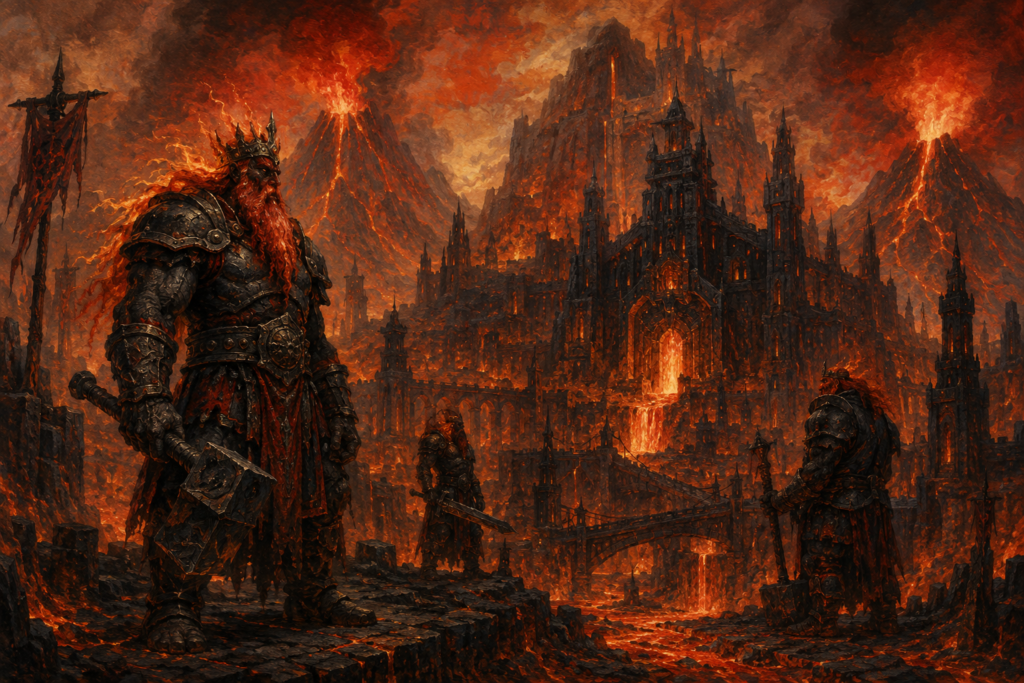
Muspellheim
Muspellheim is a great mythic realm of giant fortresses, forge-war roads, mustering grounds and ancient prophecy. Here fire is understood as military power, oath and the terrible possibility of cosmic ending.
Fire giants maintain one of their strongest planar presences here. They are not primordial elementals simply because they endure flame. Their position in Fire rests upon old settlement, lineage, military strength and giant tradition.
Their roads are designed for armies. Basalt bridges span lava trenches, enormous markers commemorate campaigns, and abandoned strongholds remain sealed behind doors built for giant hands.
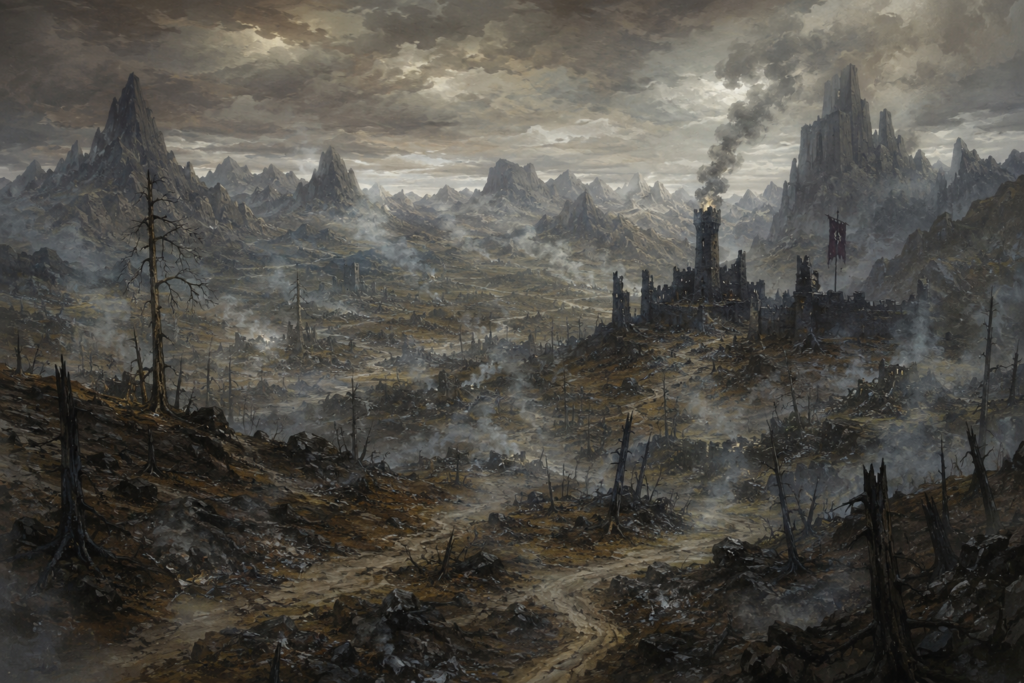
The Smoke Marches
Toward Air , open flame thins into choking cloud, red wind, ash, ember cyclones and shifting smoke banks.
The principal dangers are often breath and direction rather than direct burning. Vision collapses, landmarks disappear and sound travels unpredictably.
Exiles, smugglers, raiders and hidden communities use the Marches because conventional authorities struggle to control terrain that can vanish inside a moving cloud.
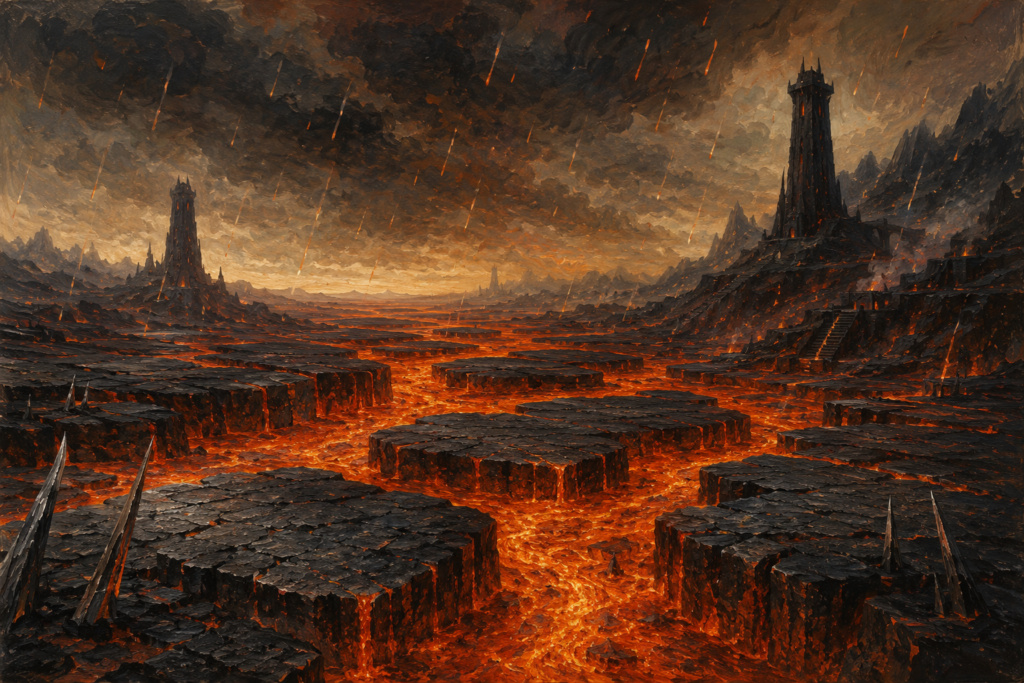
The Magma Marches
Toward Earth , Fire becomes heavier and increasingly mineral. Lava rivers divide black stone, basalt plates drift through molten fields and rare ores emerge from violent pressure zones.
Azers, salamanders, elemental powers, giant strongholds and mining interests contest crossings and mineral deposits. A newly opened magma channel can make an insignificant fortress strategically vital overnight.
Some cooled basalt doors lead into deep territories of Earth, but no crossing remains reliable forever.
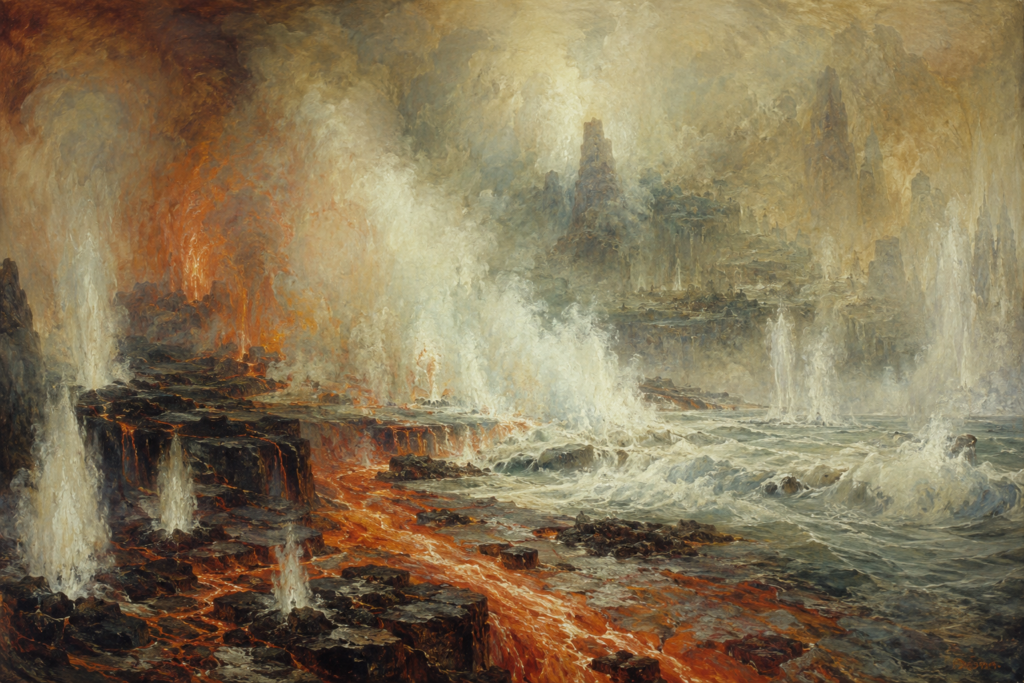
The Steam Border
Where Fire approaches Water , the landscape becomes a violent frontier of steam, boiling rain, scalding fog, explosive geysers and sudden pressure changes.
Heat is only one danger. Travellers can be blinded, drowned, thrown by pressure or cut by newly formed glass. A creature fully protected from flame can still die here through simple overconfidence.
The region is nevertheless commercially important. Water becomes extraordinarily valuable deeper in Fire, while forge-products and fire-born materials travel in the opposite direction.
Laws of the Plane
The Eternal Furnace follows principles older than mortal law. Some are physical, some magical, some symbolic, and Fire’s peoples have built their customs around all of them.
Fire Hungers
Flame seeks fuel, air, space and movement. That appetite shapes geography as readily as behaviour.
Heat Has Rank
Control of heat conveys status. Efreeti make it property, azers make it craft-right and giant rulers turn it into military authority.
Shelter Belongs to Someone
A breathable chamber, cool road, safe bridge or protected water vault almost always has an owner, guardian or price.
Water Is Wealth
Water can be medicine, trade good, sacrament, insult, weapon or strategic resource depending upon where it is used.
Oaths Burn
Promises witnessed by recognised flame can acquire supernatural weight. Broken fire-oaths may leave evidence long after the words themselves are forgotten.
Ash Remembers
Destruction does not guarantee oblivion. Skilled readers can sometimes recover traces of a person, structure, spell or oath from what its burning left behind.
Divine Powers and Sacred Presences
The plane predates the later gods and divine courts that establish presences within it. Fire’s oldest sacred powers are elemental. Later deities can maintain shrines, courts, roads, ordeals and territories without becoming creators of the plane.
Elemental Lords of Fire
The greatest native powers embody combustion, eruption, radiance, ash, fuel, heat and transformation. Some rule territory; others behave more like living laws of nature.
Pele
Pele has an established divine connection to the Elemental Plane of Fire. Her sacred presence is especially appropriate to volcanic fire, fresh lava, destruction that creates new land and the dangerous beauty of an active eruption.
Forge Powers
Divine smiths, craft patrons and sanctified forge-keepers seek temperatures, living coals and materials available nowhere else. Many maintain shrines or oath-furnaces rather than enormous realms.
Hearth Powers
Fire also shelters. Household spirits and sacred hearth traditions maintain protected flames around some Hearth Gates, proving that the element can preserve life as readily as consume it.
Volcanic and Wildfire Powers
Some sacred powers identify with particular calderas, flame rivers, ash gardens or moving firestorms instead of constructing conventional divine courts.
Muspellheim’s War-Fire
Giant traditions invest Muspellheim with prophecy, oath, warfare and world-burning fire. Its sacred identity is mythic and military rather than universal sovereignty over the plane.
Inhabitants
Efreeti
Efreeti are among the most influential civilised powers in Fire. Their houses command cities, estates, roads, military forces, slaves, contracts and trade. They prefer hierarchy, ownership and enforceable obligation to random destruction.
An efreeti patron can provide protection, transport, guides, rare magic and entry into forbidden territory. The price of accepting such help is often more dangerous than the original problem.
Azers
Azers are fire-born smiths, oath-workers and fortress keepers. Their culture places enormous value on discipline, craft and memory. A forge can function as household, legal witness and ancestral institution.
Many free azer holds oppose efreeti domination, while others remain bound through old treaty, debt, defeat or necessity.
Fire Elementals
Fire elementals range from instinctive manifestations of flame to ancient intelligences with names, loyalties, memories and territories. One may be a natural disaster; another may be a sovereign being whose anger creates political consequences across several regions.
Magma Elementals
Where Fire approaches Earth, elemental beings may embody molten stone, pressure and volcanic transformation rather than pure flame. Some remain associated with one ridge or lava basin for centuries.
Salamanders
Salamanders appear as hunters, smiths, soldiers, raiders, guards, slavers and mercenaries. Some serve efreeti houses, others maintain independent companies, and still others work beside azer clans under difficult contracts.
Magmins
Magmins organise themselves around molten pools, communal embers, local custom and exuberant destruction. They are easily underestimated, but their knowledge of thermal routes and unstable lava regions can make them invaluable guides.
Fire Mephits
Fire mephits are couriers, gossips, spies, thieves, heralds and self-declared nobles. They hear rumours rapidly and repeat them with an unreliable mixture of truth, misunderstanding and theatrical invention.
Fire Giants
Fire giants maintain powerful settlements around Muspellheim, forge-war roads and volcanic fortresses. Their position in the plane comes from long settlement, giant tradition and military power rather than elemental origin.
The movement of a large fire giant host can alter regional politics before any battle occurs. Smaller powers must decide whether to resist, hide, pay tribute or negotiate.
Mortal Travellers
Smiths, envoys, scholars, treasure hunters, priests, mercenaries, prisoners and adventurers enter Fire for reasons that justify the risk. Most survive by borrowing somebody else’s shelter, route or protection. That also means somebody else may be able to withdraw it.
Personhood, Law and Consequence
The Elemental Plane of Fire is dangerous, but many of its inhabitants are persons rather than encounter scenery. Local law determines who has rights, what surrender means and what consequences follow violence.
Efreeti Law
Efreeti courts frequently connect legal personhood to rank, contract, freedom and ownership. A recognised envoy may possess extensive protection while an enslaved being is treated by the same court as property. Other peoples need not accept that law merely because efreeti judges enforce it.
Azer Law
Azer customs emphasise clan, craft, oath, guest-right, forge-right and debt. A stranger formally admitted beneath a forge roof may gain protection stronger than wealth alone could purchase.
Magmin Communities
Magmin personhood is recognised through local kinship, shared heat, pool-right and elder custom. Their rules can appear comic or chaotic to strangers while remaining entirely serious to those who live by them.
Giant Law
Fire giant society commonly recognises lineage, rank, military duty, craft, strength and oath. A defeated enemy who surrendered according to recognised custom may receive better treatment than an ally branded as an oath-breaker.
Elemental Personhood
A mindless burst of elemental fire is not the same thing as an ancient named elemental guarding a sacred furnace. Age, intelligence, memory and local recognition determine whether violence is treated as survival, hunting, sacrilege or murder.
Surrender
Surrender has greatest force when it is witnessed and marked through a recognised act. A weapon laid across an anvil, an extinguished personal flame, a shield lowered in a giant oath-field or an agreement spoken before a brazier may all establish formal submission.
Efreeti may convert surrender into ransom, negotiation, contract or enslavement. Azers place more weight on witness and oath. Salamander companies follow their own military codes. Intelligent elementals may understand surrender through withdrawal, offering, extinguished hostility or the yielding of territory.
Travel and Arrival
Controlled entry is considerably safer than random planar transport. A traveller arriving without a known route can appear above a Flame Sea, inside a smoke bank, beneath iron rain, on unstable glass or directly inside a jurisdiction that considers unlicensed arrival a crime.
Fire protection alone is insufficient. Successful expeditions also prepare breathable air, water, equipment protection, navigation, language, diplomacy and a secure method of rest.
Common Travel Methods
- Hearth Gate Passage: the safest common approach, usually requiring payment, permission, sponsorship or recognised documents.
- Volcanic Descent: a direct but unstable crossing through an exceptional eruption, volcanic vent or supernatural magma chamber.
- Forge Breach: a crossing formed around a magical forge, relic furnace or smithing rite capable of weakening the boundary between worlds.
- Efreeti Summons: reliable but legally dangerous. The wording of the agreement can determine whether the arriving traveller is treated as guest, servant, debtor or prisoner.
- Azer Road: fortified routes connecting forge-holds, slag gates and basalt bridges. Safer than the wilderness when the traveller has earned access.
- Muspellheim War-Road: giant military routes that appear when war, prophecy or old oaths align with the mortal world.
- Wildfire Scar: a temporary crossing created when supernatural fire burns deeply enough to weaken a planar boundary.
Quick Rules Reference
- Unprotected creatures begin suffering from heat exposure rapidly once they leave protected territory.
- Fire resistance and immunity do not solve smoke, suffocation, pressure, unstable footing, thirst or navigation.
- Water is valuable, scarce in many regions and politically sensitive.
- Unprotected metal equipment can become dangerously hot.
- Paper, wax, leather, wood, food and vulnerable spell components may require protection.
- Safe shelter is generally owned, guarded, taxed or maintained by magic.
- Fire-aspected magic becomes stronger in some deeply aligned regions.
- Water or cold magic can face supernatural resistance or social consequences in particular territories.
- Roads can soften, vanish, ignite, move or change political ownership.
- A knowledgeable local guide may be more useful than another magic item.
Game Mechanics
Use these rules when the plane itself is an active challenge. Protected settlements and deliberately cooled shelters can suppress most environmental effects.
5.5e-Compatible Rules
Planar Baseline
- Gravity: normal unless a region says otherwise.
- Time: normal.
- Scale: effectively immeasurable.
- Dominant Nature: strongly fire-aligned.
Maps show routes and relative territories rather than the complete dimensions of the plane.
Heat Exposure
At the end of each hour spent travelling outside a safe zone, an unprotected creature makes a Constitution saving throw. Shorter intervals are appropriate during unusually intense exposure.
| Typical Region | DC | Example Exposure |
|---|---|---|
| Mild | 10 | Hearth Gate outskirts, cooled roads, mild cinder country |
| Hot | 13 | Cinder Plains, basalt roads, exposed forge territory |
| Severe | 16 | Flame Sea coasts, magma fields, firestorm conditions |
| Extreme | 19 | Deep Flame Seas, active calderas, Muspellheim war-forges |
On a failed save, use fire damage appropriate to the region, or impose 1 level of Exhaustion when prolonged dehydration and fatigue matter more than immediate burning.
- Mild exposure: 2d6 fire damage.
- Severe exposure: 4d6 fire damage.
- Extreme exposure: 8d6 fire damage.
- White fire or deep furnace: 10d10 fire damage.
A creature with Fire Resistance has Advantage on the saving throw and applies its resistance normally.
A creature with Fire Immunity automatically succeeds against heat exposure but still requires breathable air, secure footing, water and rest.
A creature wearing unprotected heavy metal armour has Disadvantage on saves against ambient heat.
Direct Planar Fire
- Mild planar flame: 2d6 fire damage.
- Severe flame or burning ground: 4d6 fire damage.
- Flame Sea surge or magma splash: 8d6 fire damage.
- White fire, deep furnace or lava immersion: 10d10 fire damage or more.
A creature fully immersed in lava, magma or liquid elemental fire normally takes the appropriate damage at the start of each of its turns until it escapes.
Smoke, Ash and Breath
Fire immunity does not prevent suffocation.
In smoke-heavy territory, breathing creatures make a Constitution saving throw every 10 minutes. In severe smoke, check once each minute.
- Ordinary dense smoke: DC 13.
- Dangerous smoke: DC 16.
- Extreme Smoke Marches or magical cinderstorm: DC 19.
On a failed save, the creature is Poisoned until it spends 10 minutes breathing clean air. If it is already Poisoned by smoke when it fails again, it instead gains 1 level of Exhaustion.
Cinderstorms
A cinderstorm Heavily Obscures the area, muffles sound and makes exposed terrain dangerous.
- Wisdom (Survival) checks made to navigate are at Disadvantage.
- Ranged attacks beyond normal range are impossible.
- A creature without eye protection that fails a DC 13 Constitution saving throw is Blinded until the start of its next turn.
- Exposed creatures take 2d6 fire damage every 10 minutes.
- Severe cinderstorms increase this to 4d6 and can knock creatures Prone.
Lava, Magma and Flame Seas
A creature immersed in lava, magma, liquid fire or a Flame Sea takes 10d10 fire damage at the start of each turn. A creature struck only by a large wave or splash takes 8d6 fire damage.
Fire immunity prevents the fire damage but does not prevent sinking, suffocation, movement by currents or entrapment in cooling slag.
Optional Planar Pressure: Water and Cold Magic
Use this rule only in strongly fire-dominant regions, sacred fire courts, major furnaces or locations where elemental opposition is important to the encounter.
In ordinary regions, water and cold spells function normally.
In a strongly fire-dominant location, a creature casting a spell that creates water, deals cold damage or substantially suppresses flame must make a spellcasting ability check against DC 10 + the spell’s level.
On a failure, the spell can fizzle, convert much of its effect into steam, or operate at reduced effect as appropriate to the scene.
Fire-Aspected Magic
In a strongly fire-dominant region, once per turn when a creature casts a spell that deals fire damage, it can treat one of the spell’s damage dice as though it rolled its maximum value.
Protected Shelter
A protected shelter creates breathable air and survivable heat. The protection can be architectural, magical, elemental, contractual or natural.
- Basic shelter: enough protection for a small group to complete a Long Rest.
- Strong shelter: protects a caravan, hall or substantial travelling party.
- Major shelter: sustains a fortress, market or city district.
Fire Infusion Boons
A Fire Infusion is a story reward for surviving a great ordeal, completing a pact, undergoing a ritual or receiving the favour of a significant Fire power.
Lesser Fire Infusion. The creature gains Resistance to fire damage. Once per Long Rest, it can add 1d6 fire damage to one damaging weapon attack or spell.
Greater Fire Infusion. The creature gains Resistance to fire damage. If it already has Fire Resistance, it instead gains Advantage on saving throws against fire effects and ignores the first 5 fire damage it would otherwise take each round. Once per Long Rest, it can cast burning hands without expending a spell slot.
Sovereign Fire Infusion. The creature gains Immunity to fire damage. Once per Long Rest, it can cast fireball or wall of fire without expending a spell slot.
Pathfinder 1e / 3.5e-Compatible Rules
Planar Traits
- Gravity: Normal.
- Time: Normal.
- Size: Immeasurable.
- Structure: Lasting.
- Elemental Trait: Fire-dominant.
- Alignment: Mildly neutral overall; individual regions vary.
- Magic: Fire spells are enhanced in many regions. Water spells are impeded in strongly fire-dominant territory.
Fire-Dominant Conditions
| Region | Environmental Fire Damage |
|---|---|
| Mild fire-dominant territory | 1d6 points per minute |
| Severe fire-dominant territory | 3d10 points per round |
| Extreme furnace / Flame Sea | Up to 10d10 points per round |
Fire resistance and immunity operate normally. Fire immunity does not prevent suffocation, pressure, sinking, falling, thirst or other non-fire hazards.
Heat and Exhaustion
Where heat is dangerous without dealing immediate fire damage, use a Fortitude save DC 15, increasing the DC by +1 for each previous check during the same period of exposure.
Enhanced Fire Magic
Spells and spell-like abilities with the fire descriptor are enhanced in strongly fire-dominant regions. Treat them as though affected by Empower Spell without increasing the spell slot or casting time.
Impeded Water Magic
Spells and spell-like abilities with the water descriptor are impeded in strongly fire-dominant regions.
The caster must succeed on the appropriate Spellcraft, concentration or caster-level check used by the ruleset at the table against DC 15 + the spell’s level.
On a failure, the spell is lost without effect.
Cold spells are not automatically impeded unless they also possess the water descriptor or a specific region explicitly suppresses cold magic.
Smoke and Ash
In moderate smoke, breathing creatures make a Fortitude save DC 15 every 10 minutes. In heavy smoke, make the check each minute.
On a failed save, the creature becomes sickened. A creature already sickened by smoke becomes fatigued instead. Exceptionally dense or magical smoke can also produce blindness, choking or nonlethal damage.
Lava and Flame Seas
A creature within 10 feet of exposed lava or comparable liquid fire can take 2d6 points of fire damage per round.
Direct contact or immersion deals 20d6 points of fire damage per round.
Fire Infusion
A Fire Infusion follows an ordeal, pact, ritual or significant period of exposure rather than ordinary planar travel.
Basic Fire Infusion: fire resistance 5; once per day add +1d6 fire damage to one melee attack, ranged attack or damaging spell.
Improved Fire Infusion: fire resistance 10; once per day use burning hands as a spell-like ability using character level as caster level.
Greater Fire Infusion: fire resistance 20. A creature that already possesses fire resistance 20 or better instead gains immunity to nonmagical fire. Once per day it can use wall of fire . At 15th level or higher, the boon can instead grant delayed blast fireball .
Running the Plane
The Elemental Plane of Fire works best when flame is more than a damage number. Use it as weather, currency, witness, weapon, shelter, proof, appetite and law.
The party’s first challenge is survival. The second is dependence: somebody owns the water, shelter, road, guide, permit or ward they require. The third is consequence: Fire societies remember contracts, craft, oath and insult.
Build Each Scene Around Three Questions
- What keeps this place from consuming the travellers?
- Who controls the shelter, water, route, heat or contract?
- What changes when the fire moves?
Practical Sources of Adventure
- a forge accessible only during one particular firestorm;
- a prisoner classified as legal property by a brass court;
- a volcanic portal opening beneath an Earthly settlement;
- an azer rebellion asking outsiders for deniable assistance;
- a fire giant war-road appearing inside the wrong volcano;
- a sacred flame on Earth suddenly dying;
- an efreeti contract claiming something nobody believed could be owned;
- a god-marked relic hidden beyond a Flame Sea.
Keep the environment moving around the characters. Bridges soften. Ash buries tracks. Water runs low. A protected room becomes unsafe after its patron withdraws permission. A route becomes taxable. A guide reveals that relatives are enslaved. A magmin accident collapses a thermal tunnel. An ancient elemental recognises a flame the wizard brought from home.
Adventure Hooks
The Contract That Burns
An efreeti court produces an ancient agreement claiming legal ownership of the smoke rising from every forge in a mortal city.
The claim seems ridiculous until the city’s hearths begin to burn blue, smiths find their cooling techniques failing and every chimney exhales the same brass-house sigil.
If the contract is recognised, the city’s forges become planar assets and its smiths vulnerable to efreeti seizure. The characters must prove fraud, buy back the rights or trace the agreement to the ruler who first signed it.
The Iron-Husk Rebellion
A hammer-shaped ember arrives through a mortal forge carrying a message from a free azer fortress.
The Brass Dominion has rediscovered an old road to the stronghold. The defenders can break their remaining obligations only if seven contract chains are recovered before the invading army arrives.
The characters must cross the Magma Marches, enter an occupied foundry and decide which rebel leaders can be trusted. Some have already promised terrible things in exchange for freedom.
The Road to Muspellheim
A fire giant war-road opens inside a mortal volcano. Weapons heated near it improve, but spoken oaths begin to mark the bodies of those who swear them.
Fire giant envoys soon emerge demanding passage, tribute and the return of an ancient weapon buried beneath a royal armoury, hill-fort or other important mortal stronghold.
Beyond the portal, Muspellheim is preparing for a war that has not yet reached Earth—and nobody agrees whether the reopening of the road is a mobilisation, a warning or the fulfilment of prophecy.
Historical and Mythological Context
Fire is one of humanity’s oldest transformative powers: warmth, light, hearth, danger, sacrifice, craft, purification, signal, weapon, judgement and ruin. The Eternal Furnace brings those different meanings together without treating any single historical tradition as the literal origin of the plane.
Elemental Philosophy
Ancient Mediterranean philosophers used fire as one of the fundamental constituents or principles of physical reality. Empedocles is particularly important to the later four-element tradition. This provides a historical model for imagining fire not merely as a phenomenon but as a fundamental mode of matter and change.
Agni and Sacred Fire
Vedic traditions surrounding Agni express fire through sacrifice, household ritual, divine mediation and sacred presence. This is the gentler but no less powerful face of Fire represented by Hearth Gates, ritual flames and oaths witnessed before a brazier.
Hephaestus and Vulcan
Hephaestus and Vulcan associate fire with metallurgy, furnace-work, invention and volcanic danger. Those mythic relationships echo through the Iron-Husk Forges and the many cultures that define themselves by their mastery of heat.
Muspelheim and World-Burning Fire
Norse traditions give fire an apocalyptic dimension through Muspelheim, Surtr and the fiery powers associated with Ragnarök. In the campaign, Muspellheim becomes a great giant realm within the Elemental Plane of Fire rather than a separate fundamental plane.
Wuxing and Transformation
The Chinese wuxing tradition treats Fire as part of a dynamic cycle of phases and transformations rather than merely one inert substance. That idea suits the elemental borders, where Fire becomes smoke, magma, steam and new material states.
Pele
Hawaiian traditions surrounding Pele express volcanic fire as destruction and creation together. Lava destroys existing landscapes while simultaneously building new land. That duality informs Pele’s sacred presence within the Eternal Furnace.
Kagutsuchi
Japanese mythology gives divine fire another character through Kagutsuchi, whose birth itself brings catastrophic consequence. The myth reinforces a recurring truth of the plane: fire can be sacred, necessary and creative without ever becoming safe.
The City of Brass
The City of Brass draws upon the older Arabic wonder-tale inheritance of jinn, impossible metal cities, magnificent courts, dangerous wealth and hidden marvels.
The campaign develops that inheritance into a politically organised efreeti metropolis of trade, contracts, water vaults, embassies, slave-forges and dangerous law.
Taken together, these traditions reveal why the Elemental Plane of Fire should never be reduced to an endless damage field. It is philosophical element, sacred hearth, divine messenger, forge, volcano, war-fire, empire, borderland and living transformation.
A brazier can remember a promise. A forge can preserve a grievance. A bridge can belong to a distant court. A mephit can turn a joke into treason. A lava plain can be young land still deciding what shape it will become.
Video Guides
These external videos provide gaming lore and inspiration. They do not override SpiralWorlds planar canon.
A concise introduction to the City of Brass and its role in elemental fantasy.
A wider look at genies, elemental powers and the City of Brass.
A broader gaming treatment of the Elemental Plane of Fire.
Related SpiralWorlds Entries
Keep this reference growing
If this page helped with your reading or game, you can support its upkeep or explore the curated books.
Explore the Bookshop — epics, classics and stories behind imagined worlds.