
SpiralWorlds Cosmology
Energy Planes — Positive Energy and Negative Energy
Positive and Negative Energy are two of reality’s oldest cosmic pressures: one drives incarnation, growth, repair and renewal; the other drives release, dissolution, depletion and unmaking. Neither is inherently good or evil, and both can kill an unprotected traveller.
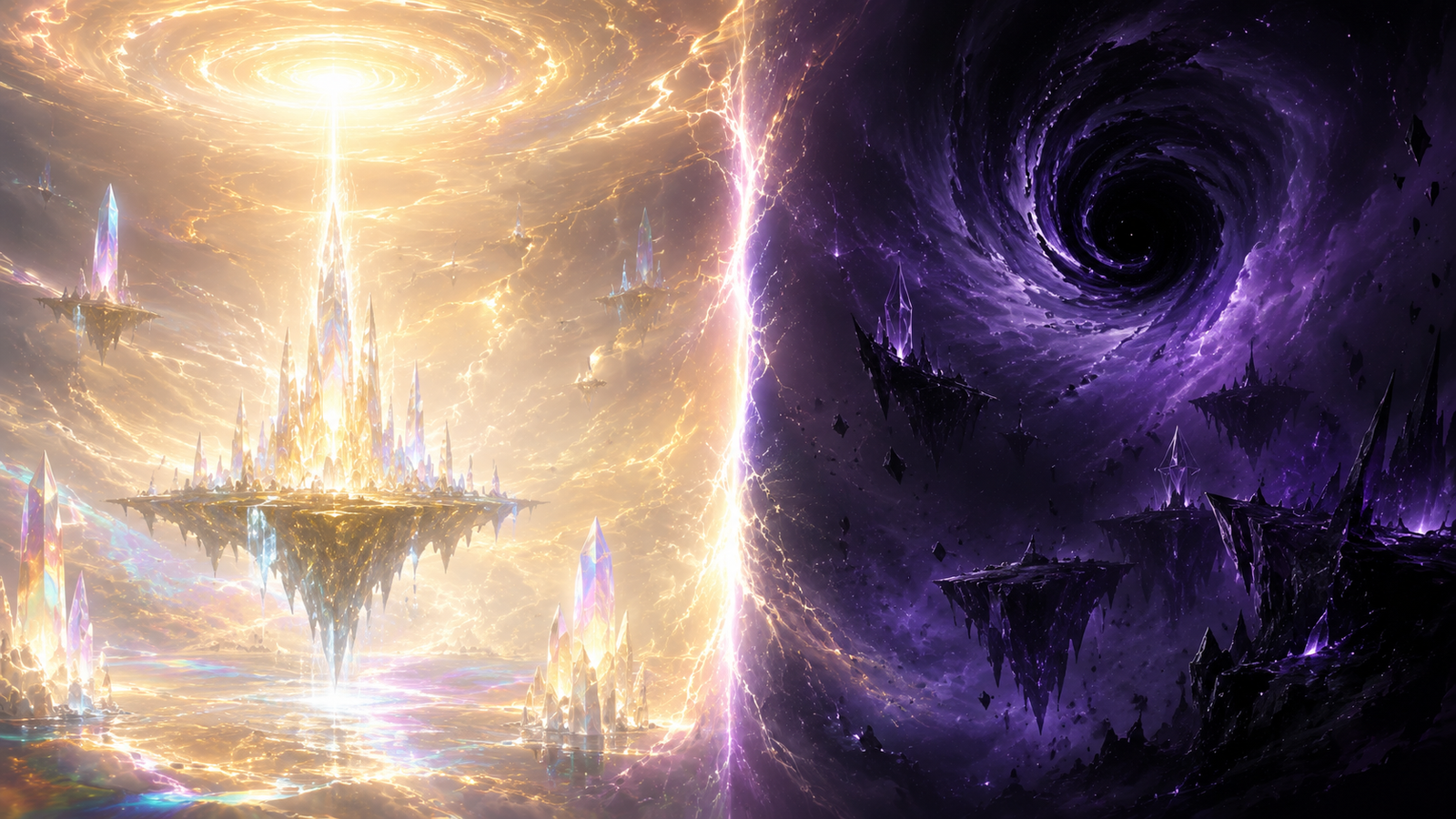
Quick Reference
Positive and Negative Energy at a Glance
Positive Energy
- Becoming
- Incarnation and vitality
- Growth and multiplication
- Repair and healing
- Renewal and fertility
- Lethal overgrowth and overload
- Destabilises many undead
- Not inherently Good
Negative Energy
- Release
- Depletion and cessation
- Dissolution and decay
- Entropy and unmaking
- Life drain
- Lethal depletion and negation
- Can sustain many undead without belonging to them
- Not inherently Evil
The essential distinction: Positive Energy is not a reward for virtue and Negative Energy is not punishment for wickedness. A tyrant can be healed by Positive Energy. A saint can be destroyed by too much of it. Negative Energy ends and releases, but evil beings can exploit that function without defining what the plane itself means.
The Two Cosmic Poles
Positive Energy Plane
Life Without Limit
The Positive Energy Plane is an infinite radiance of generative force. It feeds incarnation, healing, fertility, restoration and the animating spark of life, but it has no instinct for moderation.
Exposed travellers first feel healthier. Pain eases, wounds close and senses sharpen. Then the same process becomes dangerous. Flesh grows past its limits, vitality accumulates faster than a mortal body can contain it and healing becomes overload.
Survivable regions include refraction isles, jyoti crystal cities, protected sanctuaries, soul-orchard approaches and carefully controlled star-gates.
Explore the Positive Energy PlaneNegative Energy Plane
The Void of Entropy
The Negative Energy Plane is the cosmic pressure of depletion, dissolution and release. It strips heat, vitality, structure and eventually identity from things that remain exposed to it.
It is not an underworld and it is not where the dead are meant to go. Undead and necromancers exploit its power, but the Void predates necromancy and can ultimately unmake the unliving as readily as the living.
The Near Dark, warded anchors, dead-world fragments and entropy-crystal outskirts provide the most plausible destinations for prepared mortal expeditions.
Explore the Negative Energy PlaneCosmological Role
The Energy Planes are cosmic infrastructure, not divine kingdoms. Gods may draw upon them, guard breaches, fear their misuse or build temporary holdings near them. No later god created or owns either source.
In SpiralWorlds cosmology, existence first develops an ancient polarity of becoming and release. From the Great Collision emerge the Energy Planes as primal anchors: Positive drives incarnation, accumulation and renewal; Negative receives dissolution, exhaustion and the end of processes that cannot continue forever.
The Elemental Planes give substance its fundamental forms. The Material Plane lets energy and substance become bodies, oceans, forests, fires, kingdoms, wounds, graves and histories. Negative Energy receives the pressure of endings; Positive Energy keeps new becoming possible.
Positive Energy → Elemental Substance → Material Life and Change → Death, Decay and Release → Negative Energy
This is not a simple conveyor belt through which every soul is mechanically processed. Souls, afterlives, divine judgement, reincarnation, ghosts and underworlds have their own laws. The Energy Planes describe fundamental cosmic pressures, not the entire spiritual history of a person.
Life, Death, Undeath and Negation
The old habit of treating Positive Energy as “life” and Negative Energy as “undeath” hides several important distinctions.
Life
Life is embodied existence: a living creature sustained by matter, vitality, identity and whatever spiritual laws govern its kind.
Death
Death is the end of bodily life and, in many traditions, the beginning of another passage involving soul, judgement, memory, burial, ancestry or reincarnation.
Undeath
Undeath is a supernatural interruption, transformation, animation or refusal of ordinary death. Negative Energy may power it, but that does not make undeath the natural purpose of the Negative Energy Plane.
Negation
Negation is the Void’s deeper pressure: reduction, depletion and unmaking without judgement, hatred or concern for what the thing once meant.
This distinction is central to Necromancy. Necromancy can manipulate life force, corpses, spirits, death and undeath without making all of those things identical.
Older rules traditions also connect these forces strongly to the Cleric, particularly through healing, turning, rebuking and channelled energy. SpiralWorlds does not require every healing spell or divine miracle to mean a god literally opens a conduit to one of these planes. The Energy Planes remain deeper cosmological sources rather than property belonging to one class or pantheon.
Death is a passage. Undeath is an interruption. Negation is the Void. A ghost that falls into the Negative Energy Plane may need rescue rather than destruction, and a death god may oppose a Void breach precisely because lawful death is not the same thing as erasure.
Native Peoples and Planar Claims
Neither Energy Plane should be treated as an empty battery waiting for spellcasters to exploit. Both have native interests that can turn planar travel into diplomacy, trespass, theft or war.
Jyoti
Jyoti are the principal native guardians of the Positive Energy Plane. Radiant and phoenix-like, they inhabit living crystal cities, guard star-gates, protect soul-orchards and quarantine relics that are too dangerous to enter later worlds.
Their beautiful realms are not celestial heavens and the jyoti are not gentle angelic hosts. They are territorial, suspicious and extremely protective of pre-incarnate souls and the infrastructure of creation.
Sceaduinar
Sceaduinar are the principal true people of the Negative Energy Plane, arising from entropy-crystal formations in the deep Void.
They hate life because it bears the spark of creation, but they also hate undeath as stolen movement imposed on what should have ended. Their existence prevents the Negative Energy Plane from becoming merely an “undead plane.”
The hostility between jyoti and sceaduinar is one of the major hidden conflicts of the Energy Planes, but it should not be reduced to Good versus Evil. It is a struggle between beings adapted to radically opposed cosmic principles.
Travel, Arrival and Survival
Plane Shift solves the problem of crossing between planes. It does not solve the problem of arriving somewhere survivable.
The Planar Campaigns guide covers expedition planning in greater depth. Energy-plane journeys should be treated as high-pressure expeditions with prepared entry points, limited exposure and a known return route.
| Question | Positive Energy Plane | Negative Energy Plane |
|---|---|---|
| Primary danger | Excess vitality, blinding radiance and positive overload. | Life drain, necrotic exposure, exhaustion and eventual unmaking. |
| Best arrival | Refraction isle, jyoti gate-court, crystal shelf or warded sanctuary. | Warded anchor, Near Dark site, dead-world fragment or controlled entropy-crystal outskirts. |
| Breathing | Exposed radiance is usually airless; safe pockets may provide atmosphere. | Ordinary breathable conditions cannot be assumed; warded anchors provide survivable reality pockets. |
| Light | Overwhelming radiance; light itself acts as environmental pressure. | Light is swallowed or suppressed as travellers move deeper into the Void. |
| Healing | Strengthened, but excess healing contributes to lethal overcharge. | Impeded outside stable protection. |
| Undead | Usually damaged, destabilised or unable to recover normally. | Many survive better than living creatures but are not universally safe, especially in deeper regions. |
| Soul danger | Interference with pre-incarnate souls or reckless resurrection can trigger jyoti intervention. | Souls can be trapped, misdirected or endangered by deep negation. |
| Return plan | Keyed gate, star-gate permission, planar focus or sanctuary route. | Warded anchor, keyed portal, soul-tether and reliable planar exit. |
Arrival Is Already an Encounter
Before an Energy Plane expedition begins, answer four questions:
- What keeps the party alive during the first minute?
- Where is the nearest sanctuary or controlled region?
- What local native power considers that arrival site its territory?
- What event or resource forces the party to leave before its protection fails?
Energy Planes Mechanics
These rules answer the immediate question: what changes when a creature physically enters one of the Energy Planes? Detailed regions, hazards and adventure procedures remain on the two child-plane guides.
5.5e-Compatible Energy Plane Rules
The current SRD provides the modern rules framework but does not publish a complete Positive/Negative energy-plane hazard system. The procedures here are SpiralWorlds-compatible rules inherited from the detailed Positive and Negative Energy Plane entries.
Positive Energy — Minor Dominance
- At the start of its turn, a living creature with at least 1 hit point regains hit points equal to its Proficiency Bonus if it is below its hit point maximum.
- If already at full hit points, it gains 1d6 temporary hit points instead. These are positive overcharge.
- Undead and creatures primarily animated by negative energy take radiant damage equal to twice the party’s Proficiency Bonus at the start of their turns.
Positive Energy — Major Dominance
- At the start of its turn, a living creature with at least 1 hit point regains 10 hit points if below maximum.
- A creature already at maximum instead gains 10 temporary hit points as positive overcharge.
- At positive overcharge equal to at least half the creature’s hit point maximum, it makes a DC 15 Constitution saving throw at the end of each turn. Failure blinds it until the end of its next turn and gives it one level of Exhaustion from radiant overload.
- At positive overcharge equal to or greater than its hit point maximum, it instead makes a DC 20 Constitution saving throw at the end of each turn. Failure causes radiant rupture.
- Radiant rupture reduces the creature to 0 hit points and it begins dying normally. If already at 0 hit points, or if the saving throw was failed by 5 or more, the creature dies.
When a creature first enters exposed major radiance, use the detailed Positive Energy Plane rule for blinding brilliance: DC 15 Constitution.
See the complete Positive Energy Plane entry for healing magic, resurrection, protection, undead exposure and pre-incarnate soul contact.
Negative Energy — Exposure Bands
A living creature without suitable planar protection, a stable warded anchor or another specific defence uses the following exposure procedure.
| Region | Save Interval | Save | Failed Save |
|---|---|---|---|
| Near Dark | 1 hour | DC 14 Constitution | 10 necrotic damage and 1 Exhaustion. |
| Deep Void | 10 minutes | DC 18 Constitution | 21 necrotic damage and 1 Exhaustion. |
| Still Heart | 1 round | DC 22 Constitution | 45 necrotic damage, 1 Exhaustion and soul risk. |
On a successful Void exposure save, the creature takes half damage and gains no Exhaustion from that exposure.
Healing in the Void
Outside a warded anchor, when a spell or magical feature restores hit points to a living creature, the caster makes a DC 15 spellcasting ability check. On success the healing works normally. On failure it restores only half the normal hit points.
See the complete Negative Energy Plane entry for light suppression, resurrection instability, undead benefits, gravewinds, ward stability and soul-danger procedures.
Rules Authority
These two sets of procedures are not universal rules for every campaign cosmology. They are the SpiralWorlds 5.5e-compatible implementation of the two Energy Planes and should be used consistently with the corresponding child entries.
Pathfinder 1e Energy-Dominant Traits
Pathfinder uses explicit minor and major positive-dominant and negative-dominant planar traits.
| Trait | Pathfinder 1e Effect |
|---|---|
| Minor Positive-Dominant | All creatures gain fast healing 2. |
| Major Positive-Dominant | On entry, a creature makes a DC 15 Fortitude save or is blinded for 10 rounds. Creatures gain fast healing 5. A creature at full normal hit points gains 5 temporary hit points each round. |
| Positive Overload | Once temporary hit points from major positive dominance exceed the creature’s normal hit point total, it makes a DC 20 Fortitude save each round. Failure kills the creature in a burst of energy. |
| Minor Negative-Dominant | Living creatures take 1d6 damage each round. A creature reduced to 0 hit points or lower crumbles to ash. |
| Major Negative-Dominant | Each round a creature makes a DC 25 Fortitude save or gains one negative level. If its negative levels equal its current levels or Hit Dice, it dies and becomes a wraith under the classic planar rule. |
| Death Ward | Protects a traveller from the damage and energy drain of negative-dominant planar traits. |
Positive Energy Plane Magic
Positive-energy spells and spell-like abilities are enhanced. Pathfinder’s plane-specific rule gives class abilities using positive energy—such as channel positive energy—a +4 bonus to the save DC. Negative-energy magic is impeded.
Negative Energy Plane Magic
Negative-energy spells and spell-like abilities are enhanced. Class abilities using negative energy gain a +4 bonus to the save DC. Positive-energy magic, including cure spells, is impeded.
Characters on the Negative Energy Plane also take a –10 penalty on saving throws to remove negative levels bestowed by energy drain.
Impeded Magic
Under the Pathfinder planar rule, casting an impeded spell requires a concentration check, DC 20 + spell level. Failure means the spell does not function but the prepared spell or spell slot is still lost.
D&D 3.5e Energy-Dominant Traits
The 3.5 SRD uses the classic minor and major positive-/negative-dominant planar traits. The environmental core resembles Pathfinder, but the plane-specific enhanced magic rules are different.
| Trait | D&D 3.5e Effect |
|---|---|
| Minor Positive-Dominant | Creatures gain fast healing 2. |
| Major Positive-Dominant | DC 15 Fortitude or blinded for 10 rounds; fast healing 5; creatures already at full hit points gain 5 temporary hit points each round. |
| Positive Overload | Once temporary hit points from the plane exceed the creature’s normal hit point total, it makes a DC 20 Fortitude save each round. Failure kills the creature. |
| Minor Negative-Dominant | Living creatures take 1d6 damage each round. |
| Major Negative-Dominant | DC 25 Fortitude each round or gain one negative level. Accumulating negative levels equal to the creature’s levels or Hit Dice kills it. |
Positive Energy Plane Magic
Spells and spell-like abilities using positive energy, including cure spells, are maximized without requiring higher-level spell slots.
Class abilities that use positive energy, such as turning and destroying undead, gain a +10 bonus on the roll to determine Hit Dice affected.
Negative-energy magic, including inflict spells, is impeded.
Negative Energy Plane Magic
Spells and spell-like abilities using negative energy are maximized without requiring higher-level spell slots.
Rebuking and controlling undead gains a +10 bonus on the roll to determine Hit Dice affected.
Positive-energy magic, including cure spells, is impeded. Characters also take a –10 penalty on Fortitude saves made to remove negative levels bestowed by an energy drain attack.
Keep the Editions Separate
Do not replace the 3.5e maximization and turning/rebuking bonuses with Pathfinder’s later +4 channel-energy save DC rule. They are different mechanics.
Running Energy-Plane Adventures
Both planes work best as short, purposeful expeditions rather than ordinary wilderness maps.
Use Positive Energy for Excess
The dramatic question is rarely “can the party find healing?” It is “how much life can a mortal body, kingdom or ecosystem safely contain?”
- A healing spring will not stop healing.
- A ruler tries to seize a jyoti star-gate.
- A plague cure becomes runaway growth.
- A pre-incarnate soul has been stolen for a royal bloodline.
- An undead witness must cross a plane that rejects its continued existence.
Use Negative Energy for Loss
The dramatic question is not merely “how many undead are here?” It is “what will disappear if the party cannot protect it?”
- A ghost must be rescued before its memory is erased.
- A lich is harvesting entropy crystals.
- A black-star gate is opening above a city.
- A dead-world ruin contains records from an erased civilisation.
- Sceaduinar attack an undead engine because it violates proper ending.
Do not run either plane as a colour filter over a normal dungeon. Positive Energy should create pressure through uncontrolled vitality; Negative Energy should create pressure through depletion, failing protection and the danger of losing things that cannot simply be healed back.
Historical and Scientific Context
The Positive and Negative Energy Planes are fantasy roleplaying concepts, not historical religious places and not descriptions of real physical energies.
Older European philosophy and science sometimes used vitalist models in which life appeared to require a distinctive organising or animating principle beyond ordinary mechanical explanation. Those ideas provide a useful historical comparison for fantasy “life force,” but modern biology does not require a Positive Energy Plane to explain living processes.
Negative Energy is likewise sometimes compared metaphorically with entropy: the irreversible loss of usable order described in thermodynamics and statistical mechanics. The comparison can be evocative, but the Void’s life drain, soul-danger and necromantic uses are fantasy metaphysics, not literal physics.
Useful background: Stanford Encyclopedia of Philosophy — Cell Biology and Stanford Encyclopedia of Philosophy — Boltzmann and Statistical Mechanics .
Energy Planes Across Game Editions
Published fantasy cosmologies have moved the Positive and Negative Planes around the cosmological diagram and changed how strongly they are tied to healing, necromancy, undead and the Elemental Planes.
SpiralWorlds keeps a stable setting decision: Positive and Negative are the two primal Energy Planes associated with the older Inner cosmological order. They predate the later Astral and divine structures and remain cosmic infrastructure rather than moral afterlives.
The mechanics tabs above then use the rules appropriate to each supported edition rather than rewriting the setting every time a rulebook redraws the cosmological map.
The current 5.5e System Reference Document supplies the modern rules framework but omits the older Planes of Existence appendix. SpiralWorlds therefore labels its current-edition Energy Plane procedures as compatible setting mechanics rather than presenting them as official SRD planar rules.
Selected External Video Guide
One external overview is enough for this hub. It provides Pathfinder cosmology context without replacing the SpiralWorlds setting material above.
Pathfinder Planar Guide: Inner Sphere Part 2 — MythKeeper
External gaming context covering the positive and negative regions of Pathfinder’s Inner Sphere. This video does not define SpiralWorlds canon.
Sources and Licensing
SpiralWorlds Setting Sources
- Positive Energy Plane
- Negative Energy Plane
- Elemental Planes
- Planar Campaigns
- Planes of Existence
- Necromancy
5.5e Rules Framework
The current fifth-edition-compatible mechanics on this page are original SpiralWorlds procedures built for use with the SRD 5.2.1 rules framework and inherited from the finished Positive and Negative Energy Plane pages.
Reference: System Reference Document v5.2.1 .
SRD 5.2.1 material is released under the Creative Commons Attribution 4.0 International licence.
Pathfinder First Edition
Pathfinder’s positive-dominant, negative-dominant, enhanced magic and impeded magic rules are derived from the Pathfinder planar rules.
Reference: Pathfinder Planar Adventures .
D&D 3.5e
The 3.5e Energy Plane traits, environmental effects and plane-specific enhanced/impeded magic rules are derived from the Revised System Reference Document.
Reference: Revised System Reference Document — Planes .
Open Game Content Identification
The Pathfinder 1e and D&D 3.5e rules-derived mechanics in their labelled mechanics tabs are Open Game Content to the extent that they derive from Open Game Content identified in their source documents.
SpiralWorlds setting lore, Great Collision chronology, the Positive/Negative cosmic-cycle model, original prose, original 5.5e-compatible procedures, page architecture and artwork are not designated Open Game Content except where a rule element necessarily derives from an identified Open Game Content source.
Open Game License v1.0a & Section 15 Copyright Notices
OPEN GAME LICENSE Version 1.0a
The following text is the property of Wizards of the Coast, Inc. and is Copyright 2000 Wizards of the Coast, Inc (“Wizards”). All Rights Reserved.
1. Definitions: (a) “Contributors” means the copyright and/or trademark owners who have contributed Open Game Content; (b) “Derivative Material” means copyrighted material including derivative works and translations (including into other computer languages), potation, modification, correction, addition, extension, upgrade, improvement, compilation, abridgment or other form in which an existing work may be recast, transformed or adapted; (c) “Distribute” means to reproduce, license, rent, lease, sell, broadcast, publicly display, transmit or otherwise distribute; (d) “Open Game Content” means the game mechanic and includes the methods, procedures, processes and routines to the extent such content does not embody the Product Identity and is an enhancement over the prior art and any additional content clearly identified as Open Game Content by the Contributor, and means any work covered by this License, including translations and derivative works under copyright law, but specifically excludes Product Identity. (e) “Product Identity” means product and product line names, logos and identifying marks including trade dress; artifacts; creatures characters; stories, storylines, plots, thematic elements, dialogue, incidents, language, artwork, symbols, designs, depictions, likenesses, formats, poses, concepts, themes and graphic, photographic and other visual or audio representations; names and descriptions of characters, spells, enchantments, personalities, teams, personas, likenesses and special abilities; places, locations, environments, creatures, equipment, magical or supernatural abilities or effects, logos, symbols, or graphic designs; and any other trademark or registered trademark clearly identified as Product identity by the owner of the Product Identity, and which specifically excludes the Open Game Content; (f) “Trademark” means the logos, names, mark, sign, motto, designs that are used by a Contributor to identify itself or its products or the associated products contributed to the Open Game License by the Contributor; (g) “Use”, “Used” or “Using” means to use, Distribute, copy, edit, format, modify, translate and otherwise create Derivative Material of Open Game Content. (h) “You” or “Your” means the licensee in terms of this agreement.
2. The License: This License applies to any Open Game Content that contains a notice indicating that the Open Game Content may only be Used under and in terms of this License. You must affix such a notice to any Open Game Content that you Use. No terms may be added to or subtracted from this License except as described by the License itself. No other terms or conditions may be applied to any Open Game Content distributed using this License.
3. Offer and Acceptance: By Using the Open Game Content You indicate Your acceptance of the terms of this License.
4. Grant and Consideration: In consideration for agreeing to use this License, the Contributors grant You a perpetual, worldwide, royalty-free, non-exclusive license with the exact terms of this License to Use, the Open Game Content.
5. Representation of Authority to Contribute: If You are contributing original material as Open Game Content, You represent that Your Contributions are Your original creation and/or You have sufficient rights to grant the rights conveyed by this License.
6. Notice of License Copyright: You must update the COPYRIGHT NOTICE portion of this License to include the exact text of the COPYRIGHT NOTICE of any Open Game Content You are copying, modifying or distributing, and You must add the title, the copyright date, and the copyright holder’s name to the COPYRIGHT NOTICE of any original Open Game Content you Distribute.
7. Use of Product Identity: You agree not to Use any Product Identity, including as an indication as to compatibility, except as expressly licensed in another, independent Agreement with the owner of each element of that Product Identity. You agree not to indicate compatibility or co-adaptability with any Trademark or Registered Trademark in conjunction with a work containing Open Game Content except as expressly licensed in another, independent Agreement with the owner of such Trademark or Registered Trademark. The use of any Product Identity in Open Game Content does not constitute a challenge to the ownership of that Product Identity. The owner of any Product Identity used in Open Game Content shall retain all rights, title and interest in and to that Product Identity.
8. Identification: If you distribute Open Game Content You must clearly indicate which portions of the work that you are distributing are Open Game Content.
9. Updating the License: Wizards or its designated Agents may publish updated versions of this License. You may use any authorized version of this License to copy, modify and distribute any Open Game Content originally distributed under any version of this License.
10. Copy of this License: You MUST include a copy of this License with every copy of the Open Game Content You Distribute.
11. Use of Contributor Credits: You may not market or advertise the Open Game Content using the name of any Contributor unless You have written permission from the Contributor to do so.
12. Inability to Comply: If it is impossible for You to comply with any of the terms of this License with respect to some or all of the Open Game Content due to statute, judicial order, or governmental regulation then You may not Use any Open Game Material so affected.
13. Termination: This License will terminate automatically if You fail to comply with all terms herein and fail to cure such breach within 30 days of becoming aware of the breach. All sublicenses shall survive the termination of this License.
14. Reformation: If any provision of this License is held to be unenforceable, such provision shall be reformed only to the extent necessary to make it enforceable.
15. COPYRIGHT NOTICE
Open Game License v 1.0a Copyright 2000, Wizards of the Coast, Inc.
System Reference Document Copyright 2000-2003, Wizards of the Coast, Inc.; Authors Jonathan Tweet, Monte Cook, Skip Williams, Rich Baker, Andy Collins, David Noonan, Rich Redman, Bruce R. Cordell, John D. Rateliff, Thomas Reid, James Wyatt, based on original material by E. Gary Gygax and Dave Arneson.
Pathfinder Roleplaying Game Core Rulebook Copyright 2009, Paizo Publishing, LLC; Author: Jason Bulmahn, based on material by Jonathan Tweet, Monte Cook, and Skip Williams.
Pathfinder Roleplaying Game Reference Document Copyright 2011, Paizo Publishing, LLC; Author: Paizo Publishing, LLC.
Energy Planes. Copyright 2026, SpiralWorlds.
END OF LICENSE
Continue Exploring
Keep this reference growing
If this page helped with your reading or game, you can support its upkeep or explore the curated books.
Explore the Bookshop — epics, classics and stories behind imagined worlds.