
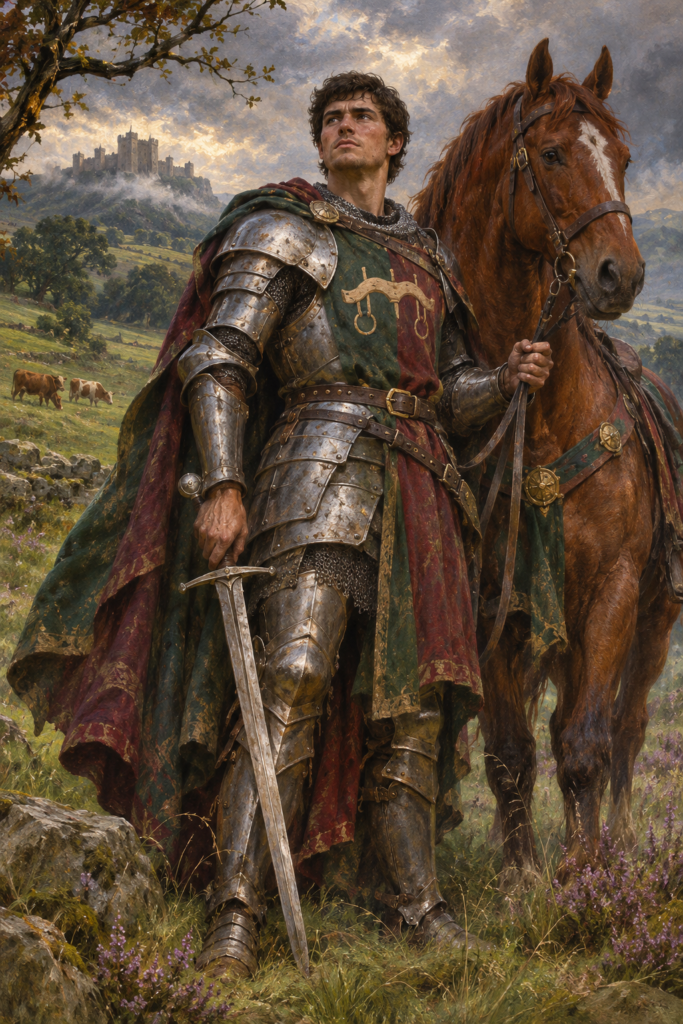
Sir Tor was raised among cowherds and made a knight by Arthur, before the court learned that King Pellinore was his birth father. Tonight a squire from his old home arrives at Camelot with a bloodied hunting-hound collar and an order bearing a forged royal seal. Armed riders claiming to serve Pellinore are taking pasture and livestock from families too poor to challenge them. Tor rides to protect the people who brought him up. The characters may expose the fraud—or watch the Orkney feud draw an innocent household into war.
At a Glance
- Identity
- Sir Tor, son of King Pellinore, raised by Aries the cowherd and his wife
- Nature
- Human, mortal knight of Arthur’s Round Table
- Allegiance
- Arthur’s peace; the household that raised him; the responsibilities of Pellinore’s family
- Family
- Aries and his wife, his adoptive parents; King Pellinore, his birth father; Lamorak and Percival of Pellinore’s wider house
- Home
- Camelot and the western British pastures where he grew up
- Alignment
- Lawful Good — rank brings obligations, not permission to abuse common folk
- Languages
- Brythonic and Norse
- Mount
- Trained chestnut warhorse, steady among cattle and hunting hounds
- Immediate threat
- A forged royal order authorises armed men to seize the cowherd’s pasture
What Is Happening Right Now?
A young squire has escaped riders wearing Pellinore’s colours. He brings a torn brachet collar, a forged document and a warning: the horses will return tomorrow to drive Aries’s family from their land. Some court officers assume the matter beneath their notice. Tor sees an attempt to force an old noble grievance upon a powerless family. Pellinore himself has not authorised the seizure, but proving that before blood is shed will require more than Tor’s word.
First Meeting
Tor stands in the outer stable yard, fixing a damaged girth with his own hands. He wears plain but sound armour, and an ox-yoke emblem painted on his shield honours his adoptive home; it is his personal device, not an attested coat of arms. He welcomes a stranger who knows horses, and turns cold when a noble calls his mother’s testimony worthless. He will explain the danger, then ask the party who can be trusted to stand witness.
Three Scenes Tonight
- The broken collar: the metal clasp comes from a smith in Camelot, not the remote pasture where the supposed warrant was served.
- The seal-bearer: a herald has two versions of the same order, each claiming to bear Pellinore’s authority.
- The crossing: armed pursuers block a narrow bridge and demand custody of the witness before he reaches Tor’s family.
Appearance and Manner
Tor is broad-shouldered, dark-haired and less ceremonious than many Round Table knights. He keeps his weapons clean, the saddle properly fitted and his horse calm. His strength shows most clearly in the way he treats the frightened. A courtly insult rarely disturbs him; a threat to the woman who raised him is another matter. His formal manners are newly learned, but his courage is not.
Ambition, Pressure and Private Knowledge
- Ambition: be judged by deeds rather than by the blood of Pellinore.
- Pressure: Gawain and the Orkney sons resent Pellinore for King Lot’s death, making Tor a potential target.
- Private knowledge: Tor remembers the unusual clasp of the brachet he recovered during his first great errand.
- Flaw: he accepts personal challenges even when a false nobleman has staged one to lure him away from witnesses.
- Private loyalty: he calls Aries father without hesitation. His birth has not cancelled years of care.
- Possible change: he may learn that lawful testimony wins more lasting safety than a duel against a disposable hired knight.
Relationships and Allegiances
- King Arthur: personally granted Tor knighthood after the young man asked for it.
- King Pellinore: birth father, proud of his son but troubled when Tor refuses to excuse his treatment of Tor’s mother.
- Aries the cowherd: Tor’s adoptive father and a living connection to farming communities ignored at court.
- Tor’s mother: survived a coercive encounter with Pellinore; her suffering cannot be annulled by a royal genealogy.
- Sir Lamorak: fellow member of Pellinore’s family; his conflict with Orkney may pull Tor into danger.
- Sir Percival: another kinsman, now bound for a different kind of quest.
- Sir Gaheris: a knight Tor respects, despite the household feud that may make them enemies.
- Merlin: publicly disclosed Tor’s parentage and still knows more of the past than he says.
Game Statistics
Tor is a disciplined mortal knight with excellent horsemanship. He makes a single lance attack on a mounted charge, then fights with a sword and shield. He has no innate spellcasting, mythic abilities or lair effects.
Sir Tor — D&D 2024
Medium Humanoid (Human), Lawful Good
Armor Class 20 (plate armor, shield); Initiative +1 (11); Hit Points 120 (16d8 + 48); Speed 30 ft.; Challenge 6 (2,300 XP; PB +3)
| STR | DEX | CON | INT | WIS | CHA |
|---|---|---|---|---|---|
| 18 (+4) | 12 (+1) | 16 (+3) | 11 (+0) | 14 (+2) | 12 (+1) |
Saving Throws Str +7, Con +6, Wis +5; Skills Animal Handling +5, Athletics +7, Insight +5, Perception +5; Senses Passive Perception 15; Languages Brythonic, Norse.
Traits
Pasture-Born. Tor has Advantage on Wisdom (Animal Handling) checks concerning horses, cattle or hunting hounds. Shield the Innocent. Tor has Advantage on saving throws against the Frightened condition while a wounded ally he can see has fewer than half its Hit Points remaining.
Actions
Multiattack. Tor makes three Longsword attacks, or two Longsword attacks and one Shield Bash. The Lance is a separate, single-attack action.
Longsword. Melee Attack Roll: +7, reach 5 ft. Hit: 11 (2d6 + 4) Slashing damage.
Shield Bash. Melee Attack Roll: +7, reach 5 ft. Hit: 8 (1d8 + 4) Bludgeoning damage; a Large or smaller target must succeed on a DC 15 Strength saving throw or have the Prone condition.
Lance (Mounted Only). Melee Attack Roll: +7, reach 10 ft. Hit: 9 (1d10 + 4) Piercing damage, plus 9 (2d8) Piercing damage if his mount travelled at least 20 feet straight toward the target immediately before the attack. This action allows only one Lance attack.
Bonus Action
Call the Escort (Recharge 5–6). One ally Tor can see within 30 feet gains 10 Temporary Hit Points.
Reaction
Parry. Tor adds 3 to his AC against one melee attack that would hit him, if he can see the attacker and holds a melee weapon.
Tactics
He gives a single mounted charge on an open road, then dismounts to protect the witness. If the enemy yields, Tor arrests rather than kills.
Sir Tor — D&D 2014
Medium humanoid (human), lawful good
Armor Class 20 (plate, shield); Hit Points 120 (16d8 + 48); Speed 30 ft.
| STR | DEX | CON | INT | WIS | CHA |
|---|---|---|---|---|---|
| 18 (+4) | 12 (+1) | 16 (+3) | 11 (+0) | 14 (+2) | 12 (+1) |
Saving Throws Str +7, Con +6, Wis +5; Skills Animal Handling +5, Athletics +7, Insight +5, Perception +5; Senses passive Perception 15; Languages Brythonic, Norse; Challenge 6 (2,300 XP).
Traits
Pasture-Born. Tor has advantage on Wisdom (Animal Handling) checks made to tend horses, cattle or hunting hounds. Shield the Innocent. He has advantage on saving throws against being frightened while he can see a wounded ally with fewer than half its hit points.
Actions
Multiattack. Tor makes three longsword attacks, replacing one with a shield bash if he chooses. He cannot use the lance as part of this multiattack.
Longsword. Melee Weapon Attack: +7 to hit, reach 5 ft., one target. Hit: 11 (2d6 + 4) slashing damage.
Shield Bash. Melee Weapon Attack: +7 to hit, reach 5 ft., one Large or smaller creature. Hit: 8 (1d8 + 4) bludgeoning damage; DC 15 Strength saving throw or knocked prone.
Lance (Mounted Only). Melee Weapon Attack: +7 to hit, reach 10 ft., one target. Hit: 10 (1d12 + 4) piercing damage, plus 9 (2d8) after a straight 20-foot mounted approach. This is a single attack.
Bonus Actions
Rally (Recharge 5–6). One ally within 30 feet who can see Tor gains 10 temporary hit points.
Reactions
Parry. Tor adds 3 to his AC against one melee attack that would hit him if he can see the attacker and holds a melee weapon.
Tactics
He shields the witness, follows the bearer of the forged seal and demands the lawful arrest of any surrendering foe.
Sir Tor — Pathfinder 1e
CR 8; XP 4,800; Male human fighter 9; LG Medium humanoid (human); Init +5; Senses Perception +2.
Defense
AC 24, touch 12, flat-footed 22 (+10 armor, +2 shield, +1 Dex, +1 Dodge); hp 86 (9d10 + 27 plus 9 Toughness); Fort +9, Ref +4, Will +7; Defensive Abilities bravery +2 against fear.
Offense
Speed 30 ft. (armor training); Melee +1 longsword +18/+13 (1d8 + 10/19–20); Alternative lance +15 (1d8 + 6/×3; one mounted charge attack at +17); Space/Reach 5 ft./5 ft.
Statistics
Str 20, Dex 12, Con 16, Int 10, Wis 14, Cha 12; Base Atk +9; CMB +14; CMD 26.
Feats Weapon Focus (longsword), Weapon Specialization (longsword), Mounted Combat, Ride-By Attack, Spirited Charge, Improved Initiative, Iron Will, Toughness, Power Attack, Dodge, Quick Draw.
Skills Ride +13, Handle Animal +13, Intimidate +13, Perception +2; Languages Brythonic, Norse.
Gear +1 full plate, heavy steel shield, +1 longsword, lance, warhorse, brachet collar, and a simple homespun token.
Special Abilities and Tactics
Weapon Training (Ex): +2 with heavy blades and +1 with spears; those bonuses are included in attacks and damage. Armor Training (Ex): he retains normal 30-foot speed and a +1 Dexterity bonus in full plate. He makes one attack with his lance while charging, rather than a full attack; he uses longsword iteratives after stopping.
Sir Tor — D&D 3.5e
Male human fighter 9; Lawful Good Medium humanoid (human); CR 9; Init +5; Senses Listen +2, Spot +2.
Defense
AC 23, touch 12, flat-footed 21 (+9 armor, +2 shield, +1 Dex, +1 Dodge); hp 80 (9d10 + 27 plus 3 Toughness); Fort +9, Ref +4, Will +7.
Offense
Speed 20 ft.; Melee +1 longsword +16/+11 (1d8 + 8/19–20); Alternative lance +14 (1d8 + 5/×3; one mounted charge attack at +16); Space/Reach 5 ft./5 ft.; Base Atk +9; Grp +14.
Statistics
Str 20, Dex 12, Con 16, Int 10, Wis 14, Cha 12; Skills Ride +13, Handle Animal +13, Intimidate +13, Spot +2, Listen +2.
Feats Weapon Focus (longsword), Weapon Specialization (longsword), Mounted Combat, Ride-By Attack, Spirited Charge, Improved Initiative, Iron Will, Toughness, Power Attack, Dodge; Languages Brythonic, Norse.
Special Abilities and Tactics
His +1 longsword’s attack and damage include its enchantment, Weapon Focus, Weapon Specialization and Strength. His lance is a single attack with charge and spirited-charge modifiers as appropriate; a charge cannot be combined with the full iterative longsword attack.
Possessions +1 full plate, heavy steel shield, +1 longsword, lance, chestnut warhorse, a brachet collar and a plain household token.
Run the Encounter
The forged royal writ is a test of whom Arthur’s law actually protects. Arresting a hired rider is easy; proving the forgery without a witness may be much harder. Tor refuses to abandon Aries’s people, but the characters can convince him to defend them with testimony rather than a private duel. A captured hound and the smith who made its clasp can expose the real patron.
Five Encounters
- The courtly challenge: a herald asks whether a cowherd’s son deserves a Round Table seat; Tor refuses to disown Aries.
- The stolen brachet: the missing hound can identify its former handler among the mercenaries holding it.
- The false royal rider: a mounted knight demands pasture using a forged writ and a stolen seal.
- The bridge of witnesses: Tor holds a narrow crossing while the characters escort a frightened farmhand away from pursuers.
- The hearing at Camelot: Aries and Tor’s mother testify before men who claim that humble birth makes their evidence worthless.
Six Adventure Hooks
- A farmhand carries a brachet collar bearing the seal of a noble house that denies owning a hunting hound.
- A false warrant orders Tor’s mother to leave her pasture; the genuine steward has disappeared.
- King Pellinore asks the party to recover the stolen seal without spreading an accusation against innocent herders.
- Gawain offers to help investigate the case but demands an accounting for King Lot’s death in return.
- A knight claims to have found proof that Tor’s adoption was unlawful; the parchment is an obvious forgery to anyone who knows Aries.
- Percival asks the characters to carry a reconciliation offer between rival branches of Pellinore’s household before a tourney turns violent.
Equipment and Resources
Plate armour, a shield with a personal ox-yoke token, longsword, lance, trained chestnut warhorse, saddle bags, hunting brachet’s collar, and a modest purse. Tor can call on both Camelot’s protection and the trust of rural people. His token is a newly designed personal device, not a historically verified coat of arms.
Lore, Sources and Timeline
In Malory’s Le Morte d’Arthur, Aries the cowherd takes Tor to Arthur’s court on a thin mare and asks that the young man be knighted. Arthur grants the request; Merlin discloses that Tor was born to Pellinore and the woman whom Aries married. The story records a coercive encounter involving Pellinore. Tor objects when the revelation dishonours his mother, while Aries remains the man who raised him. Pellinore later acknowledges Tor, and Gawain’s feud with the house of Pellinore begins to threaten the court.
Sir Tor also serves in Arthur’s three quests after the wedding feast, riding in pursuit of a stolen brachet. In the site’s living 1454, those earlier adventures belong to his past. The new forged warrant and land seizure threaten the household he has never ceased to regard as family. He can resolve the present affair without denying either his origins or his duty to Arthur’s peace.
Related People and Places
Arthurian characters · Arthur · Pellinore · Lamorak · Percival · Gawain · Gaheris · Merlin
Sources and Artwork
- Malory, Book III, Chapter III — Tor’s upbringing, knighting and parentage.
- Malory, Book III, Chapter IV — Pellinore acknowledges Tor; Orkney resentment.
- Malory, Book III, Chapter V — the three quests and Tor’s pursuit of the brachet.
- Malory, Book III, Chapters IX–XI — Tor’s adventures.
- New original painted Sir Tor illustration created for this entry. The visual device, recent investigation, equipment variations and the four RPG stat blocks are original campaign adaptations.
Keep this reference growing
If this page helped with your reading or game, you can support its upkeep or explore the curated books.
Explore the Bookshop — epics, classics and stories behind imagined worlds.