

School of energy and magical projection
Evocation
Elemental force, light, sound and controlled destruction
Evocation gives magical power an immediate, perceptible form: flame, lightning, bitter cold, radiance, thunder, force, walls and precisely shaped fields of energy.
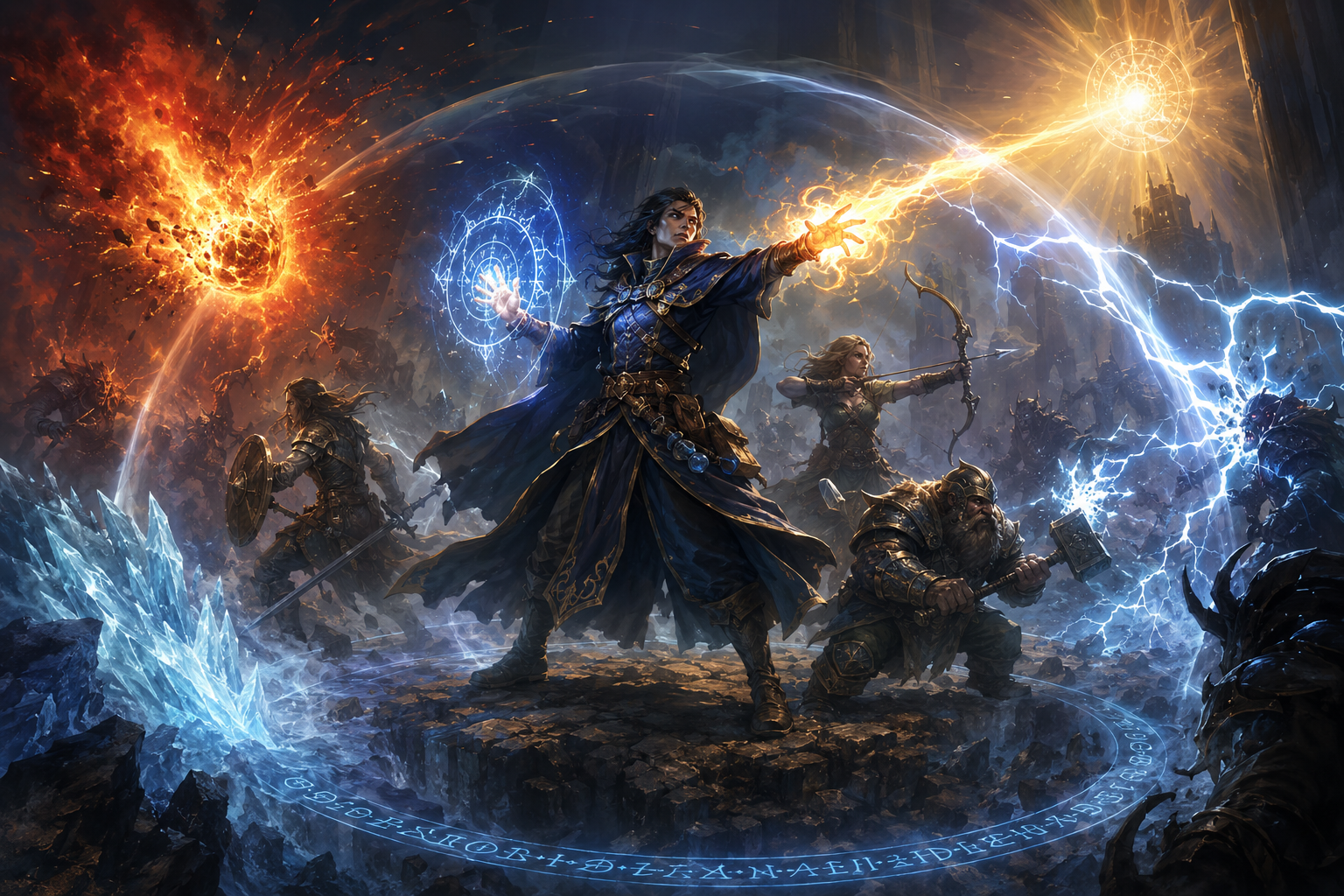
Evocation is the magic of manifestation. It takes supernatural power and makes it present as heat, light, cold, sound, motion, pressure or another energetic effect that creatures can see, hear, feel or suffer.
The school is famous for destructive spells, but destruction is only one of its uses. Evocation can illuminate darkness, launch unerring force, establish a wall, create shelter, carry a voice, punish a formation or turn a narrow approach into ground no enemy can safely cross.
Its boundaries change between rules systems. This reference presents D&D 5.5e/2024 first, followed by Pathfinder First Edition and D&D 3.5e, without importing one edition’s classifications or specialist abilities into another.
Immediate magical power
What Evocation Does
An Evocation makes magical energy act upon the world. The effect may be instantaneous or sustained, destructive or protective, tightly directed or spread across an area.
A bolt places power along a line. A cone releases it outward from an origin. A sphere fills a volume. A missile selects one or more legal targets. A wall keeps shaping the battlefield after the caster’s action has ended. A light spell changes what can be seen without necessarily harming anyone.
The school therefore rewards spatial judgement. An evoker must understand not only how much power a spell releases, but where it begins, what blocks it, which creatures or objects it can affect and what remains after it resolves.
The Evoker’s Questions
- What is the spell’s legal target or point of origin?
- What shape and dimensions does the effect use?
- Does the spell require an attack roll or saving throw?
- Which damage type or other effect actually applies?
- Do cover or solid obstructions interrupt the effect?
- Are allies, objects or structures inside the area?
- Is the effect instantaneous, sustained or concentrated?
- Can the active spell be countered, dispelled or suppressed?
Eight recurring practices
The Major Forms of Evocation
Individual spells may combine several forms, and particular editions may classify the same effect differently.
Elemental Release
Fire, cold, lightning and acid are among the school’s most recognisable expressions. The spell determines whether the energy appears as a touch, ray, bolt, burst, storm or persistent hazard.
Force and Projection
Force effects turn magic into direct pressure, impact or an invisible boundary. They include unerring darts, defensive structures and effects that cannot be understood as ordinary flame, frost or electricity.
Light, Radiance and Darkness
Evocation can create illumination, brilliant flashes, dazzling radiance and, in some editions, magical darkness. Light level and damage are separate: a bright spell need not burn, and a damaging spell need not illuminate a large area.
Sound and Vibration
Thunder, sonic force, shattering resonance and magically projected voices transform vibration into an active supernatural effect. Loudness alone does not define the rules; the spell states its range, targets and consequences.
Missiles, Rays and Bolts
Directed Evocations focus power on selected creatures, objects or paths. Some use spell attacks, some allow saving throws and some strike without either. Similar imagery does not create a shared resolution method.
Bursts, Spheres and Emanations
These spells dominate a volume rather than a single target. Their point of origin, radius and interaction with obstructions determine who is inside the effect.
Lines, Cones and Directed Fields
Geometry becomes tactics. A line rewards alignment, a cone rewards position near the origin and a directed field can divide movement or punish a chosen approach.
Walls, Storms and Cataclysms
Higher magic can sustain elemental walls, control violent weather or release force on the scale of fortresses and landscapes. Such effects should retain their exact duration, concentration and environmental rules.
Power without indiscriminate blasting
Evocation Is More Than Damage
Damage is central to the school, but it is not its definition. Evocation also creates light, force barriers, shelter, communication, controlled movement of energy and spaces that creatures cannot safely enter or cross.
Control
A wall or persistent field can separate enemies, protect an approach, divide a formation or buy time without dealing its greatest possible damage.
Protection
Force and carefully sculpted areas can preserve allies, create shelter or make hostile movement costly. Protection remains spell-specific rather than a universal Evocation property.
Utility
Light, signals, projected sound and precisely controlled force allow Evocation to solve exploration and communication problems as well as combat encounters.
A spell may flash, roar, frost the air or leave a dramatic trail without gaining blindness, deafness, concealment, forced movement, ignition or structural damage. Apply only the consequences granted by the spell and the active edition’s general rules.
Keep the systems separate
Edition Reference
The school’s shared identity is stable, but spell classifications, specialist features, damage terms and area rules are not interchangeable.
D&D 5.5e / 2024
Current Evocation includes elemental attacks, force, radiant or thunderous effects, light, walls and several spells whose older versions belonged to another school.
The 2024 Wizard subclass is the Evoker. Its features improve access to Evocation spells, make damaging cantrips more dependable, create safe pockets within suitable Evocations, improve a damage roll and allow dangerous overchannelled power.
Those subclass features belong to an Evoker of the required level. They are not properties of every Evocation spell or every spellcaster.
Pathfinder First Edition
Pathfinder defines Evocation as the manipulation of magical energy or an unseen source of power to produce an effect, often spectacular and often damaging.
The core Evocation specialist school grants intense spells, a force missile and an elemental wall. Alternate schools can replace those powers. These are Pathfinder wizard abilities, not edition-neutral rules.
Energy descriptors, caster level, Reflex or Fortitude saves and Spell Resistance frequently matter in ways that do not exist in the 2024 rules.
D&D 3.5e
D&D 3.5e describes Evocation as manipulating energy or drawing on unseen power to produce a desired result—effectively creating an energetic effect from nothing.
A specialist wizard gains additional prepared spells from the chosen school but gives up access to prohibited schools. This specialist structure is not the 2024 Evoker subclass.
Descriptors, caster-level scaling, Reflex saves, ranged touch attacks, object hardness and Spell Resistance must be resolved under 3.5e procedures.
Acid Splash is an Evocation in the 2024 rules but a Conjuration (Creation) spell in Pathfinder 1e and D&D 3.5e. The spell’s current school must be taken from the edition being played, not inferred from its damage type or remembered from another ruleset.
Geometry, targets and consequences
Evocation Rules at the Table
School is not damage type
Evocation is a magical classification. Fire, cold, lightning, acid, force, radiant and thunder are damage types or descriptors used by particular rulesets. A spell can deal one of those damage types without belonging to Evocation, and an Evocation can exist without dealing damage.
Area shape is part of the spell
Do not replace a line with a cone, flatten a sphere into a circle or treat a wall as though it filled every nearby space. Establish the point of origin, dimensions and included locations before rolling attacks, saves or damage.
| Form | What to establish | Common mistake |
|---|---|---|
| Missile or ray | Legal target, visibility, range, attack procedure and cover. | Assuming a visible projectile can strike any named object or body part. |
| Line | Origin, direction, length, width and blocking obstructions. | Treating nearby creatures outside the line as affected. |
| Cone | Origin, direction, maximum length and widening footprint. | Positioning it like a sphere centred at range. |
| Sphere or burst | Centre or origin, radius, vertical volume and obstructions. | Measuring only a flat circle on the floor. |
| Emanation | Origin creature or object, distance, movement and exclusions. | Assuming every emanation remains fixed after its origin moves. |
| Wall or field | Permitted shape, length, height, thickness, duration and crossing effects. | Treating the wall as universal cover or an automatic cage. |
Range is not area
Range determines where a target or point of origin may be selected. Area determines what is affected after that origin is chosen. A spell with a long range may still have a small burst, while a spell with a range of Self may project a long line or large cone.
Cover and a clear path still matter
Use the active edition’s targeting and area rules. In the 2024 rules, a caster generally needs a clear path to a target, and Total Cover can block a location from an area when every straight line from the point of origin is obstructed. Legacy editions use their own line-of-effect and cover procedures.
Objects are not automatically creatures
A spell that affects creatures does not automatically affect doors, weapons, carried equipment or buildings. A spell damages objects, ignites combustibles or melts material only when its text or the edition’s applicable object rules allow it. Worn and carried objects are often treated differently from unattended objects.
Instantaneous damage cannot usually be dispelled afterward
Countermagic may interrupt an Evocation while it is being cast. Once an instantaneous blast has resolved, there is normally no continuing spell for Dispel Magic to end. A wall, storm or other ongoing Evocation may remain a valid target only if its spell text and the edition’s dispelling rules permit it.
Resistance, immunity and vulnerability are not interchangeable
Use the exact damage type, descriptor and defensive rule. Resistance reduces or modifies damage according to the edition; immunity prevents only what it names; vulnerability increases damage only where the rules say it does. Pathfinder and 3.5e Spell Resistance is a separate check and must not be imported into D&D 2024.
Concentration and duration govern persistent power
A sustained field is not permanent merely because it remains after the casting action. Check concentration, duration, movement and ending conditions. Suppression may pause an effect without extending its remaining duration.
Sculpt Spells is specific
The 2024 Evoker’s Sculpt Spells feature protects a limited number of creatures the caster can see when an Evocation affects them and uses saving throws in the required way. It does not remove terrain, objects, structures, smoke, sound or every non-damage consequence, and it does not allow allies to be excluded from unrelated spells.
Resolve each Evocation from its own target, area, components, attack or save, duration, damage, object language and exceptions. The school explains the spell’s magical family; it does not replace the spell description.
Training and discipline
The Evoker
An evoker studies power in measurable forms. Distance, angle, resistance, pressure, material failure, heat, illumination and timing are not abstractions: they decide whether a spell saves a company or destroys the wrong room.
Calculation
The evoker reads formations, elevations, choke points and lines of retreat before deciding where the spell begins.
Restraint
Mastery includes choosing not to cast. Captives, allies, archives, unstable roofs and volatile stores can make a smaller spell the stronger decision.
Adaptation
Different enemies demand different saves, damage types, ranges and areas. An evoker who prepares only one answer becomes predictable.
2024 Evoker progression
| Wizard level | Feature | Practical identity |
|---|---|---|
| 3 | Evocation Savant | Adds suitable Evocation spells to the spellbook as the Wizard’s spell access grows. |
| 3 | Potent Cantrip | Damaging cantrips still deal reduced damage when their attack misses or their target succeeds on its save. |
| 6 | Sculpt Spells | Creates limited safe pockets for visible creatures inside qualifying Evocations. |
| 10 | Empowered Evocation | Adds Intelligence to one damage roll of a Wizard Evocation spell. |
| 14 | Overchannel | Maximises qualifying spell damage, with escalating personal danger when repeatedly used before a Long Rest. |
This progression is specific to the 2024 Evoker. Consult the complete current feature text before applying its limits and consequences.
Adventuring and battle
Evocation in Play
Break formations
Bursts and lines punish enemies who occupy the same space too efficiently. The threat alone can force a disciplined formation to spread out.
Control approaches
Walls and persistent hazards decide which routes remain usable, buying time or separating a dangerous enemy from support.
Exploit weaknesses
Correct damage type and saving throw matter more than raw dice when a creature resists the obvious attack.
Finish reliably
Directed force or broad areas can remove wounded enemies who would otherwise remain capable of acting.
Protect the company
Force barriers, shelter and careful geometry preserve allies while denying the enemy a clean path.
Change the scene
Fire, broken objects, damaged terrain, light and thunder can have consequences beyond hit points—but only where the rules and fiction support them.
At the table
- Mark the actual area before resolving creatures one by one.
- Check which allies, captives and neutral creatures are included.
- Choose targets before rolling when the spell requires it.
- Apply cover, line of effect and obstruction rules from the active edition.
- Resolve resistance, immunity, vulnerability and Spell Resistance separately.
- Read object and ignition language rather than assuming collateral damage.
- Track concentration and duration for every wall, storm or field.
- Let the environment remember conspicuous magical violence.
Worldbuilding consequences
Evocation in the World
Where Evocation is real, architecture, law, warfare and public behaviour adapt to the possibility that one trained caster can project destructive power across a meaningful distance.
Military doctrine
Troops spread their formations, protect officers, build layered positions and treat a visible spellcaster as artillery, saboteur and command target at once.
Architecture
Important halls avoid unnecessary crowding. Archives, powder stores, treasuries and timber roofs are separated, compartmentalised or protected by mundane and magical means.
Urban law
Cities may license battle magic, restrict casting near markets and docks, investigate scorch patterns and punish reckless magical endangerment even when no death occurs.
Industry
Controlled heat, cold, light and force can transform foundries, mines, signalling and construction—provided the spells are reliable enough and their costs do not exceed ordinary labour.
Education
Responsible colleges use stone ranges, marked geometry, resistant targets and strict procedures. Students learn safe failure before spectacular success.
Fear and prestige
An evoker may be honoured as a defender or feared as a person who can turn a street, chamber or gatehouse into a weapon with little warning.
Curated SpiralWorlds paths
Representative Evocation Magic
These verified internal pages demonstrate different expressions of the school without turning this article into a duplicate spell catalogue.
Acid Splash
An Evocation in D&D 2024 but a Conjuration (Creation) spell in Pathfinder 1e and D&D 3.5e.
Open spell → Light and utilityDancing Lights
Mobile illumination demonstrating that Evocation can shape visible energy without functioning as a battle spell.
Open spell → Flash and impairmentFlare
A compact burst of light whose exact effect and classification must remain tied to its edition.
Open spell → Directed forceMagic Missile
Unerring force darts with edition-specific scaling, targets and defensive interactions.
Open spell → Sphere and fireFireball
The iconic explosive Evocation: powerful area damage, precise placement and serious collateral consequences.
Open spell → Line and lightningLightning Bolt
A directed line that rewards alignment and careful reading of cover, barriers and object interactions.
Open spell → Cone and coldCone of Cold
A broad release from the caster whose usefulness depends on origin, facing and the widening geometry of a cone.
Open spell → Primary and secondary targetsChain Lightning
Electrical power distributed through a target network rather than a simple line or burst.
Open spell → Force and controlWall of Force
A defining non-damaging Evocation that controls space through a persistent magical boundary.
Open spell →For broader navigation, explore the Sorcerer and Wizard spell collection or return to the Magic reference.
Language before the game school
Historical and Occult Development
Historical evocation did not mean a formal school of elemental battle magic. The word comes through Latin language associated with calling forth. English uses it for the act of evoking—bringing a memory, image, response or presence to mind—and it has also been used for the calling of a spirit.
Fantasy roleplaying games transformed that language into a technical category for magic that brings energy or force into active expression. This is a modern game taxonomy, not evidence that historical ritual specialists organised their practices into the same eight schools.
Power made visible
Mythological Parallels
Myth repeatedly imagines authority as a visible, projected force: the thunderbolt thrown from heaven, the divine weapon that cannot be resisted, the sun’s punishing radiance and the storm answering a god’s command.
Zeus and the thunderbolt
Greek art commonly identifies Zeus through the thunderbolt held or brandished as a weapon. The parallel is one of imagery: distant authority becomes immediate destructive force.
Indra and the vajra
Indra, the Vedic storm deity, bears the vajra or thunderbolt. Later traditions gave the symbol further meanings, but its irresistible, luminous force provides a powerful parallel for directed magical energy.
Thor and the hammer
Thor’s hammer joins thunder, protection and violent power in one divine emblem. It suggests an evoker who is not merely an attacker, but a defender whose force is terrifying because it is directed against a threat.
These are thematic parallels, not claims that mythological figures cast tabletop spells or belonged to a fantasy game’s school of magic.
Adventure consequences
Campaign Hooks
- A royal evocation range has been sabotaged so that every practice spell strikes several feet from its intended origin.
- An ancient wall of force still divides a ruined fortress, but no surviving record explains what it was built to contain.
- A city bans fire magic after a devastating blaze, forcing licensed evokers to prove that their cold, force and light spells are legally distinct.
- A battlefield bears perfectly circular zones where stone has fused into glass, each centred on a marker that predates the war.
- A military college’s safest graduate has disappeared with research on shaping protective voids inside destructive spells.
- A succession of lightning strikes follows one travelling noble, hitting enemies, witnesses and eventually allies with impossible precision.
- A guild sells permanent illumination to wealthy districts while poorer streets remain dark, creating a political struggle over magical infrastructure.
- An evoker accused of destroying an archive insists the spell could not have damaged the carried documents described by the witnesses.
Selected legacy media
Further Viewing
The strongest two videos from the former page are retained as lightweight external thumbnail links. They are supplementary commentary, not rules authority.

Rules authority and reuse
Rules Sources and Licensing
Current rules
Pathfinder 1e Sources
D&D 3.5e Sources
SRD 5.2.1 attribution: This work includes material from the System Reference Document 5.2.1 (“SRD 5.2.1”) by Wizards of the Coast LLC, available at D&D Beyond. The SRD 5.2.1 is licensed under the Creative Commons Attribution 4.0 International License.
The Pathfinder First Edition and D&D 3.5e rules are summarised in original wording. Their linked rules and licence pages identify the underlying sources and applicable notices. Always confirm the active edition and complete individual spell description before applying a mechanic.
Keep this reference growing
If this page helped with your reading or game, you can support its upkeep or explore the curated books.
Explore the Bookshop — epics, classics and stories behind imagined worlds.