
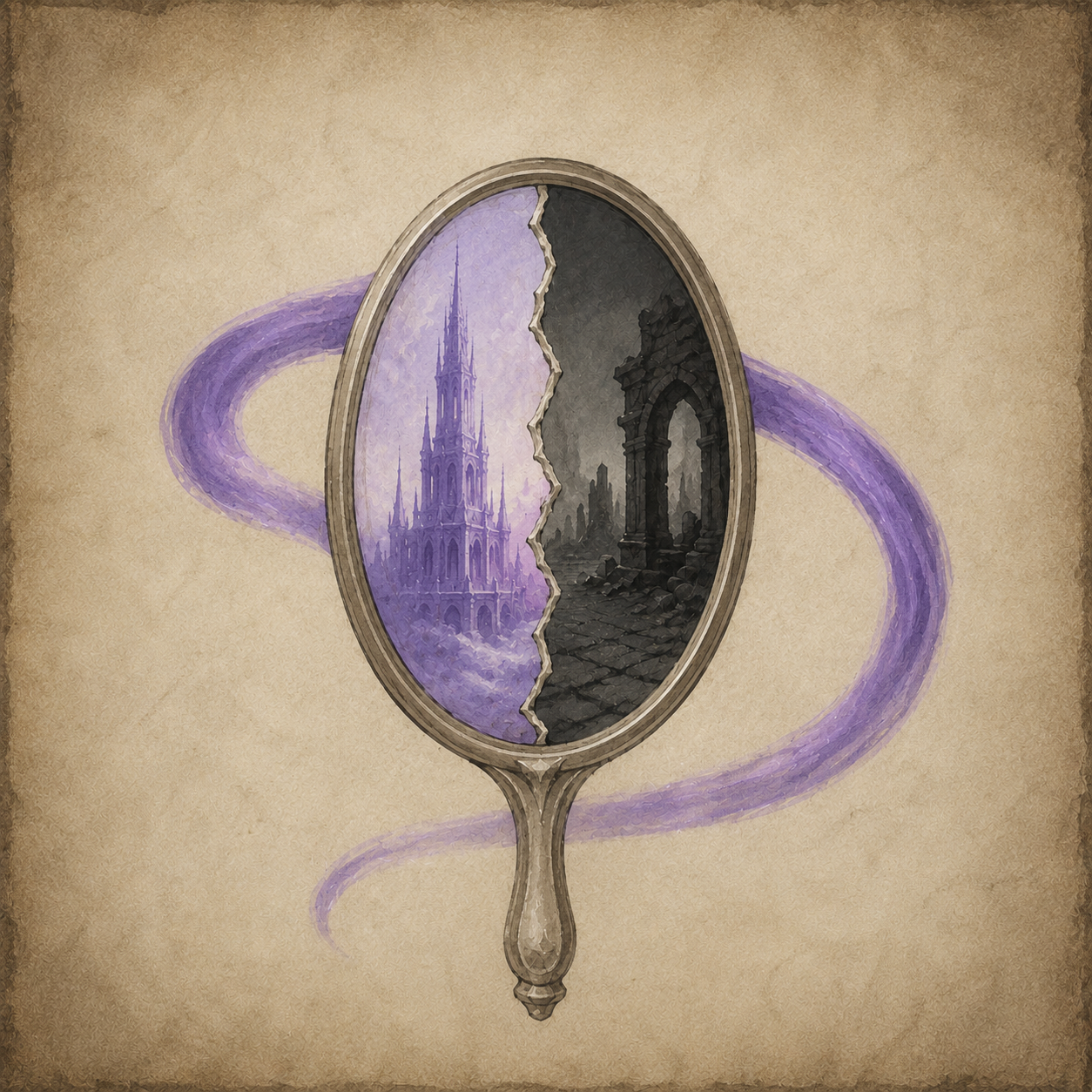
School of deceptive perception
Illusion
False images, altered senses, concealment, phantasms and shadow
Illusion magic controls what creatures perceive. It creates false sensations, changes the apparent qualities of real subjects, hides what is present, plants experiences within the mind and sometimes gives imagination a measure of physical reality.
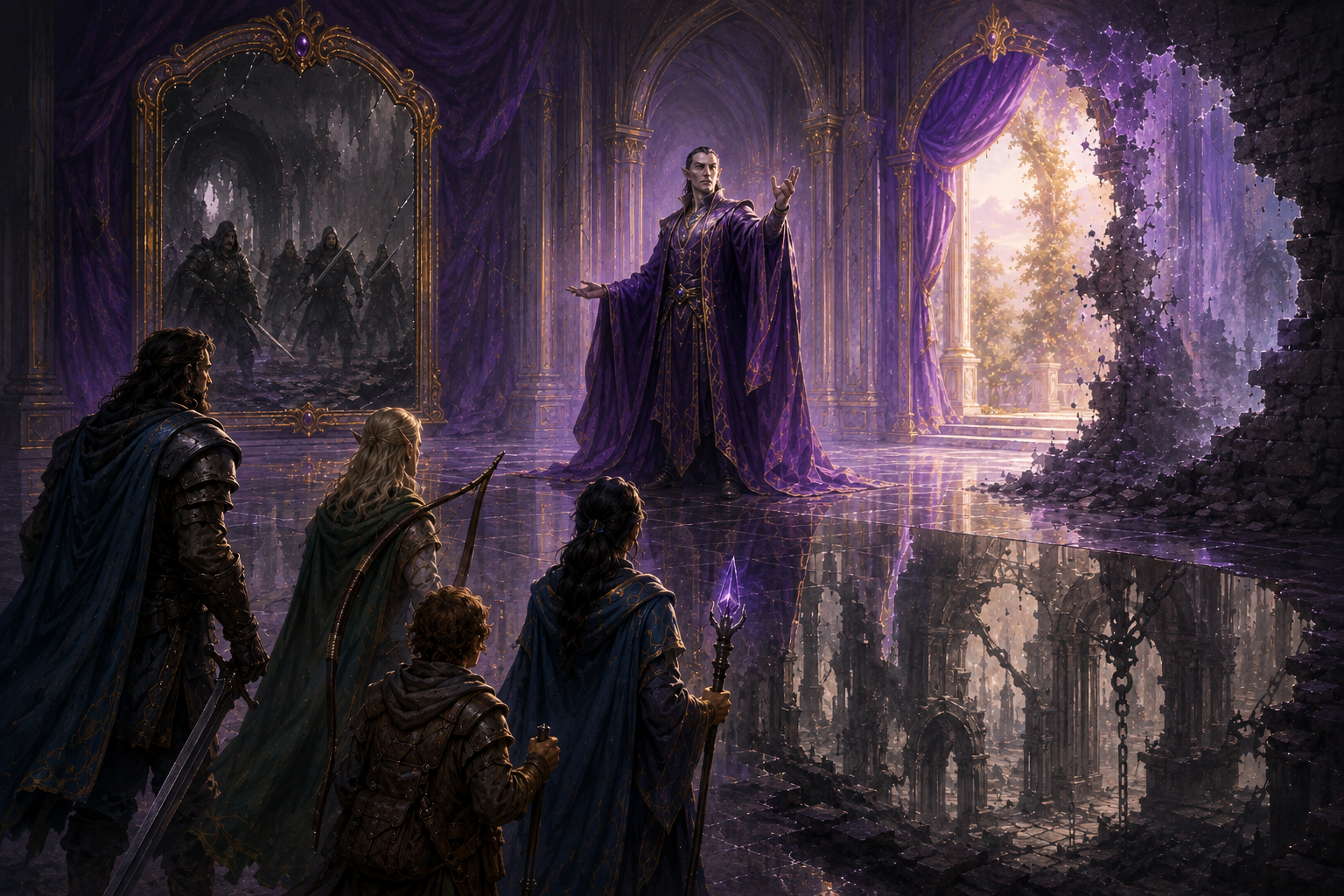
Illusion is the magic of controlled uncertainty. Its defining question is not simply “what has appeared?” but “what does each observer believe is present, and which part of that belief can the world contradict?”
Perception made uncertain
What Illusion Does
Illusion changes the information upon which creatures act. It may place a false phenomenon into a scene, alter how an existing subject is sensed, remove a creature from ordinary sight or create an experience that exists only inside a particular mind.
A painted wall may appear to contain a doorway. A ruined chamber may seem to be a royal court. A thief may appear to be a guard, or seem not to be present at all. A voice may come from the wrong corridor. One victim may see a trusted relic where every other witness sees a worthless object.
The school is therefore broader than visible images. An illusion may address sight, sound, smell, temperature, texture, apparent magical qualities or a private mental impression. The senses included—and the limits of the deception—come from the individual spell.
Illusion creates evidence, not obedience
A guard may reasonably flee from an illusory fire, but the spell does not automatically compel that reaction. Illusion changes what the guard perceives. Enchantment directly influences thought, emotion or behaviour.
The illusionist’s questions
- Which creatures perceive the effect?
- Which senses does the spell deceive?
- Is the phenomenon public, private or attached to a real subject?
- What happens when matter contradicts the appearance?
- Does the spell permit examination, interaction or disbelief?
- What remains after one observer recognises the deception?
- Is any part of the effect physically or quasi-real?
Six practical traditions
The Major Forms of Illusion
These broad forms describe how illusion functions in play. Pathfinder 1e and D&D 3.5e also use formal legacy subschools, detailed in the edition reference below.
False Images and Sounds
The spell introduces a phenomenon that is not physically present: a creature, object, voice, wall, procession, flame or landscape. Observers normally perceive the same constructed effect.
Altered Appearance
The spell changes how an existing creature, object or place seems. It may create a disguise, conceal age or injury, falsify material or make one real subject resemble another.
Concealment and Invisibility
The subject remains present but is removed from ordinary sight or another named sense. Concealment is not silence, intangibility or automatic immunity to every method of detection.
Phantasms and Private Perception
The experience exists primarily within an affected mind. Different creatures may perceive different realities, while an uninvolved witness may see no external image at all.
Patterns and Sensory Compulsion
A visible display does more than deceive the senses: perceiving it produces a mental or behavioural consequence defined by the spell. This legacy category is normally mind-affecting.
Shadow and Quasi-Reality
Some traditions shape extradimensional shadow into manifestations that are only partly unreal. These effects may produce genuine consequences even when their origin is recognised.
Current rules first
Edition Reference
Do not move terminology or disbelief procedures from one rules system into another. Identify the active edition and then read the exact spell.
D&D 5.5e / 2024
Every spell supplies its own procedure
The current rules retain Illusion as a spell school, but they do not impose one universal disbelief procedure upon every spell in the school. Each spell defines its own image, senses, saving throw, ability check, duration, concentration requirement and ending conditions.
- Do not invent an Investigation check merely because an effect is an Illusion.
- Do not grant an automatic saving throw unless the spell or another applicable rule calls for one.
- An image, disguise, pattern and invisibility effect may use entirely different mechanics.
- Sight-dependent targeting, the Invisible condition and special senses must be resolved through their own current rules.
- Physical interaction matters when the spell says it matters or when resulting evidence changes what the creatures know.
Do not import legacy “Will disbelief”
Pathfinder 1e and D&D 3.5e provide school-wide legacy guidance for interacting with illusions. That procedure is not a substitute for the wording of a 2024 spell.
Legacy d20 system
Pathfinder First Edition
Pathfinder divides Illusion into five formal subschools: Figment, Glamer, Pattern, Phantasm and Shadow.
- Figment: creates a false sensory phenomenon that those perceiving it generally perceive in the same way.
- Glamer: alters the sensory qualities of an existing subject or makes that subject seem absent.
- Pattern: creates a perceptible display that also affects the minds of those caught by it.
- Phantasm: creates a personalised mental impression, normally perceptible only to the caster and affected subjects.
- Shadow: draws upon extradimensional energy to create something partly real.
Creatures usually do not receive a disbelief save against a figment or glamer merely for noticing it. Careful study, meaningful interaction or direct contradiction may provide the required opportunity. A creature faced with conclusive proof does not need a saving throw to understand that the effect is false.
If an observer successfully disbelieves an illusion and communicates that conclusion, the Pathfinder general rule grants other observers an edition-specific opportunity and bonus. Individual spell wording still takes priority.
Legacy d20 system
D&D 3.5e
D&D 3.5e uses the same five broad subschools: Figment, Glamer, Pattern, Phantasm and Shadow.
The general rules connect disbelief to careful study, interaction and proof. A successful save reveals the deception, although a figment or phantasm may remain visible as a translucent outline. Communicated disbelief can grant other observers the legacy edition’s stated opportunity and bonus.
Figments and glamers are not physically substantial merely because they look convincing. They cannot normally support weight, provide nutrition, protect against weather or directly damage creatures and objects. Shadow effects are the important exception because the subschool can create partially real consequences.
Keep Pathfinder and 3.5e separate
The two systems share much of their underlying terminology, but their classes, skills, spell lists and individual spell wording can differ. Resolve the spell from the correct ruleset.
Practical adjudication
Running Illusions at the Table
Illusions work best when players can reason from evidence. State what the characters perceive, track what the spell actually includes and let interaction expose contradictions without treating every illusion as either perfect or useless.
1. Establish the senses
Determine whether the spell creates sight, sound, scent, temperature, texture or another defined sensation. Do not add senses the spell does not provide.
2. Identify the observers
Decide whether everyone perceives the same phenomenon, the effect alters a real subject or the experience exists only within selected minds.
3. Separate appearance from substance
A convincing wall may obstruct ordinary vision without becoming a physical wall. An illusory bridge does not support weight unless the spell expressly gives it substance.
4. Track interaction and proof
Touching empty space, seeing an arrow pass through a creature or watching a flame fail to affect its surroundings may create edition-specific opportunities to recognise the deception.
5. Let creatures act on belief
A creature that believes an illusion should make reasonable decisions using the false information available to it. Illusion does not dictate one compulsory reaction unless the spell says so.
6. Preserve individual knowledge
One creature recognising the illusion does not necessarily end the spell or grant identical perception to everyone else. Apply the active edition’s communication rule.
7. Resolve special senses precisely
Blindsight, truesight, tremorsense and similar abilities do not all gather the same information. Read the sense and spell together rather than using “special senses” as one universal answer.
8. Apply concentration and duration
Illusion does not excuse ordinary spell limits. Track concentration, range, movement, line of effect, ending triggers and dispelling exactly as written.
The essential ruling principle
Describe the false evidence faithfully, then let creatures test it through the procedures their edition and spell actually provide.
| Situation | What illusion may change | What it does not automatically change |
|---|---|---|
| Illusory wall | What ordinary sight appears to show. | Physical passage, cover, hardness or structural support. |
| Magical disguise | Apparent features, clothing, voice or other named qualities. | Anatomy, mass, statistics or physical capabilities. |
| Invisibility | Whether the subject can be seen through ordinary sight. | Sound, scent, footprints, physical presence or every special sense. |
| Illusory fire | Apparent flame, light, heat or sound when supplied by the spell. | Ignition, damage or real consumption of fuel unless stated. |
| Phantasm | The affected subject’s private mental experience. | What uninvolved witnesses perceive in the physical scene. |
| Shadow effect | A deceptive manifestation with edition-defined quasi-reality. | Unlimited reality beyond the percentages, saves or limits of the spell. |
Related but distinct
Illusion and the Other Schools
Several schools can produce similar appearances. Their methods and consequences remain different.
Illusion and Enchantment
Illusion supplies false sensory evidence. Enchantment directly influences thought, emotion, allegiance or behaviour.
Illusion and Transmutation
Illusion changes appearance or perception. Transmutation changes the actual properties, form or function of matter and living bodies.
Illusion and Conjuration
Illusion produces deceptive or quasi-real manifestations. Conjuration brings creatures, objects, matter or travellers into a new place.
Illusion and Divination
Divination gathers information. Illusion falsifies, masks or rearranges information, but it does not automatically defeat every divinatory method.
Illusion and Abjuration
An illusion may conceal a doorway; an Abjuration may actually seal it. Apparent protection and magical prohibition are not the same defence.
Illusion and Mundane Deception
Disguise, camouflage, ventriloquism, false architecture and stage machinery may achieve similar ends without creating a magical effect that can be detected or dispelled.
Training and practice
The Illusionist
An illusionist wins by controlling interpretation. The best practitioners understand attention, expectation, architecture, witnesses and the difference between what a creature sees and what it assumes that sight must mean.
Adventuring role
Illusionists conceal allies, create false threats, disguise movement, divide attention, falsify terrain, protect information and force enemies to spend time investigating the wrong answer.
Preparation and observation
A convincing deception is built from context. An illusionist studies local uniforms, architecture, language, weather, sound and habitual behaviour. A false guard is more credible when the caster knows how the real guards stand, speak and respond to authority.
Control of attention
The school is strongest when the visible illusion supports a larger misdirection. A phantom army draws the eye while scouts cross another road. A false door invites inspection while the real passage remains ordinary and ignored.
Restraint
A small deception consistent with the surroundings is often stronger than a spectacular one. The illusionist does not need everyone to believe forever—only long enough for the wrong decision to become important.
Rare magic and uncertain testimony
Illusion in the World
Most people will never knowingly witness a true magical illusion. They are more familiar with disguises, false documents, painted scenery, ventriloquism and ordinary lies. When genuine illusion magic does appear, it is difficult to prove and often remembered as a haunting, curse, marvel or act of witchcraft.
Courts and Identity
Rulers usually establish identity through heraldry, seals, recognised attendants, family knowledge and personal reputation. Only the richest or most threatened courts retain a trusted magician capable of examining suspected deception.
Trade and Fraud
Merchants fear false weights, altered seals and disguised goods far more often than magical glamour. Stories of illusionists passing stones as jewels persist, but most such crimes are ordinary fraud blamed upon sorcery.
War and Espionage
A rare illusionist may conceal scouts, imitate a signal or make a small force appear larger. Such magic cannot routinely reshape a battlefield and is usually employed for one brief deception rather than as a standard instrument of war.
Performance and Spectacle
Most performers use masks, mirrors, painted scenery, hidden mechanisms and sleight of hand. Genuine illusion magic is an expensive wonder associated with wealthy patrons, travelling sorcerers and exceptional court entertainments.
Crime and Investigation
Investigators begin with footprints, witnesses, weapons, motives and physical evidence. Illusion is suspected only when accounts conflict in ways that ordinary fear, darkness or dishonesty cannot explain.
Fear, Law and Folklore
Few laws describe illusion magic precisely. A deceptive spell may be judged as fraud, trespass, impersonation, witchcraft or assault, depending upon its effects and the customs of the local authority.
Illusion remains exceptional
The existence of illusion magic does not make every society permanently suspicious of its own senses. It becomes important when a particular illusionist, enchanted place or unexplained event gives people a reason to believe that appearances cannot be trusted.
Curated SpiralWorlds paths
Representative Illusion Magic
This selection demonstrates different branches of the school without turning the article into a duplicate spell catalogue.
Greater Invisibility
Sustained unseen activity that continues while the subject acts, attacks and repositions.
Glamer and figmentMislead
The caster becomes invisible while an illusory double leaves in a different direction.
Projected presenceProject Image
A false body becomes a remote point of sight, speech and magical origination.
Private phantasmDeceptive Object
One selected victim perceives a false item while other witnesses continue to see the truth.
Auditory glamerCloak of Silence
A legacy sensory effect that changes how sounds surrounding a moving subject reach other listeners.
False magical evidenceUndetectable Aura
A legacy glamer that masks or falsifies the magical information presented by an object.
For broader navigation, explore the Magic reference or the Sorcerer and Wizard spell collection .
Art, performance and perception
Historical and Occult Development
Fantasy Illusion is a game category, not evidence that historical artists or performers cast literal spells. Its imagery nevertheless draws upon long traditions of visual deception, theatrical machinery, mirrors, disguise and deliberate control of attention.
Trompe-l’œil: Deceiving the Eye
Trompe-l’œil painting uses realistic representation to make a flat surface appear to contain physical depth, objects or openings. Its success depends upon temporarily confusing representation with the space occupied by the viewer.
The Metropolitan Museum of Art: Cubism and the Trompe-l’Oeil Tradition
Mirrors, Multiplication and Theatrical Space
Theatres have used mirrors, gauze, glass, lighting, painted scenery and mechanical effects to multiply performers, create apparent depth and make figures appear, vanish or become ghostlike. These are practical technologies of staged perception rather than supernatural events.
Victoria and Albert Museum: The Story of Pantomime
Misdirection and the Spectator
Stage magic does not merely hide a mechanism. It manages expectation, attention and memory so that the spectator constructs the wrong explanation from genuine observations. That principle closely resembles the fantasy illusionist’s most important skill.
Wellcome Collection: Smoke and Mirrors—The Psychology of Magic
Mirrors and Uncertain Identity
Mirrors carry a persistent narrative tension: they may confirm an identity, contradict it, reveal what others cannot see or offer an image that appears detached from the physical person before it. Fantasy Illusion turns that symbolic uncertainty into a working form of magic.
Narrative precedents
Mythological and Literary Parallels
Stories across many traditions use deceptive appearance to test judgement, loyalty and identity. These motifs are imaginative parallels rather than a universal historical system of Illusion magic.
Glamoured Strangers
A guest appears beautiful, harmless or familiar until a condition, reflection, name or broken prohibition reveals another nature.
False Palaces and Enchanted Landscapes
A magnificent court, feast or refuge may vanish at dawn, collapse when challenged or conceal wilderness, ruin or captivity beneath it.
Doubles and Borrowed Identities
An image, shadow or impostor speaks with another person’s face, creating uncertainty about testimony, authority and guilt.
Phantom Hosts
Armies, hunts, processions or supernatural gatherings may appear vast enough to redirect travellers or terrify an enemy without holding ordinary physical substance.
Dream Prisons
A victim experiences a personalised world that witnesses cannot fully enter, making rescue depend upon understanding the captive’s perception.
Shadows Made Substantial
Imagination or reflected darkness gains enough reality to harm, carry or imitate matter while remaining incomplete and unstable.
The school in the setting
Illusion in SpiralWorlds
True illusionists are uncommon, and most communities have no reliable way to distinguish their work from fraud, superstition, dream or mistaken testimony.
A ruler who has reason to fear magical impersonation may consult a trusted wizard, astrologer or court scholar, but ordinary courts still rely upon seals, witnesses, heraldry and personal recognition. Even wealthy nobles cannot assume that a specialist in illusion is available when needed.
Most known illusionists work alone, serve a single patron or conceal their abilities behind more familiar professions. They may travel as performers, painters, spies, confidence tricksters, tutors or antiquarians. A practitioner who openly demonstrates genuine magical deception risks attracting fear, prosecution or unwanted patronage.
When illusion magic appears in an investigation, it rarely explains everything. Witnesses may be lying, frightened or confused; poor light and ordinary disguise remain more common than sorcery. The possibility of illusion becomes important only when physical evidence and honest testimony refuse to agree.
Campaign hooks
- A ruined bridge appears intact to everyone except one frightened child.
- Three honest witnesses describe three different murder weapons.
- A travelling painter’s portraits begin showing their subjects standing in places they have never visited.
- A local lord insists that the stranger wearing his face is the impostor.
- A magnificent manor appears beside an old road, although no building stood there the previous evening.
- An ambassador’s reflection has stopped copying their movements.
Preserved from the earlier page
Further Viewing
The two useful videos from the original Illusion page are retained as lightweight linked thumbnails rather than embedded players.

Rules and licensing
Rules Sources and Licensing
Confirm the edition and individual spell description before applying a mechanic in play.
D&D 5.5e / 2024
Pathfinder First Edition
This work includes material from the System Reference Document 5.2.1 (“SRD 5.2.1”) by Wizards of the Coast LLC, available through D&D Beyond. The SRD 5.2.1 is licensed under the Creative Commons Attribution 4.0 International Licence.
Pathfinder 1e and D&D 3.5e rules are summarised in original wording. The linked rules and licence pages identify the underlying sources and applicable notices.
Keep this reference growing
If this page helped with your reading or game, you can support its upkeep or explore the curated books.
Explore the Bookshop — epics, classics and stories behind imagined worlds.