
Evocation cantrip · light magic · visual disruption
Flare Spell
A needle-bright spark opens before a creature’s eyes, stealing its focus at the instant when accuracy matters most.
Quick Rules Reference
Spell Mechanics
Select the rules version used by the campaign. Edition-specific mechanics and terminology remain strictly separate.
Flare — D&D 5.5e / 2024
SpiralWorlds conversion: Flare is not an official 2024 spell. This balanced conversion preserves the older cantrip’s visual-disruption role without imposing the much stronger Blinded condition.
- Level
- Evocation cantrip
- Casting Time
- 1 Action
- Range
- 60 feet
- Components
- V
- Duration
- Instantaneous
- Saving Throw
- Constitution
- Target
- One creature you can see
- Concentration
- No
- Spell Lists
- Bard, Druid, Sorcerer, Wizard
Effect
You create a needle-bright burst of light directly before one creature you can see within range. The target must make a Constitution saving throw.
On a failed save, the target has Disadvantage on the next attack roll it makes before the end of its next turn.
A creature that cannot see the burst is unaffected. This includes a creature with no functioning visual sense and a creature whose view of the burst is completely blocked.
2024 Design Boundary
Flare does not give the target the Blinded condition, deal damage, reveal Invisible creatures or create continuing illumination. Its entire mechanical effect is the penalty to one attack roll.
Flare — Pathfinder 1e
- School
- Evocation [light]
- Level
- Arcanist 0, Bard 0, Druid 0, Hunter 0, Magus 0, Medium 0, Mesmerist 0, Occultist 0, Psychic 0, Skald 0, Sorcerer 0, Wizard 0
- Casting Time
- 1 standard action
- Components
- V
- Range
- Close (25 ft. + 5 ft./2 levels)
- Effect
- Burst of light
- Duration
- Instantaneous
- Saving Throw
- Fortitude negates
- Spell Resistance
- Yes
Effect
You create a burst of light in front of one creature within range. Unless the creature succeeds at a Fortitude save, it is dazzled for 1 minute.
A dazzled creature takes a –1 penalty on attack rolls and sight-based Perception checks.
Sightless creatures and creatures already dazzled are unaffected.
Pathfinder Rules Note
The magical burst is instantaneous, but the dazzled condition remains for the stated minute. Because the spell itself is no longer ongoing, the resulting condition cannot normally be removed with Dispel Magic.
Flare — D&D 3.5e
- School
- Evocation [Light]
- Level
- Bard 0, Druid 0, Sorcerer/Wizard 0
- Casting Time
- 1 standard action
- Components
- V
- Range
- Close (25 ft. + 5 ft./2 levels)
- Effect
- Burst of light
- Duration
- Instantaneous
- Saving Throw
- Fortitude negates
- Spell Resistance
- Yes
Effect
You create a burst of light directly before one creature within range. Unless the creature succeeds at a Fortitude save, it is dazzled for 1 minute.
A dazzled creature takes a –1 penalty on attack rolls, Search checks and Spot checks.
Sightless creatures and creatures already dazzled are unaffected.
D&D 3.5e Rules Note
Repeated castings do not stack or renew the condition because a creature already dazzled is expressly unaffected. Spell Resistance is checked before the Fortitude save.
Overview
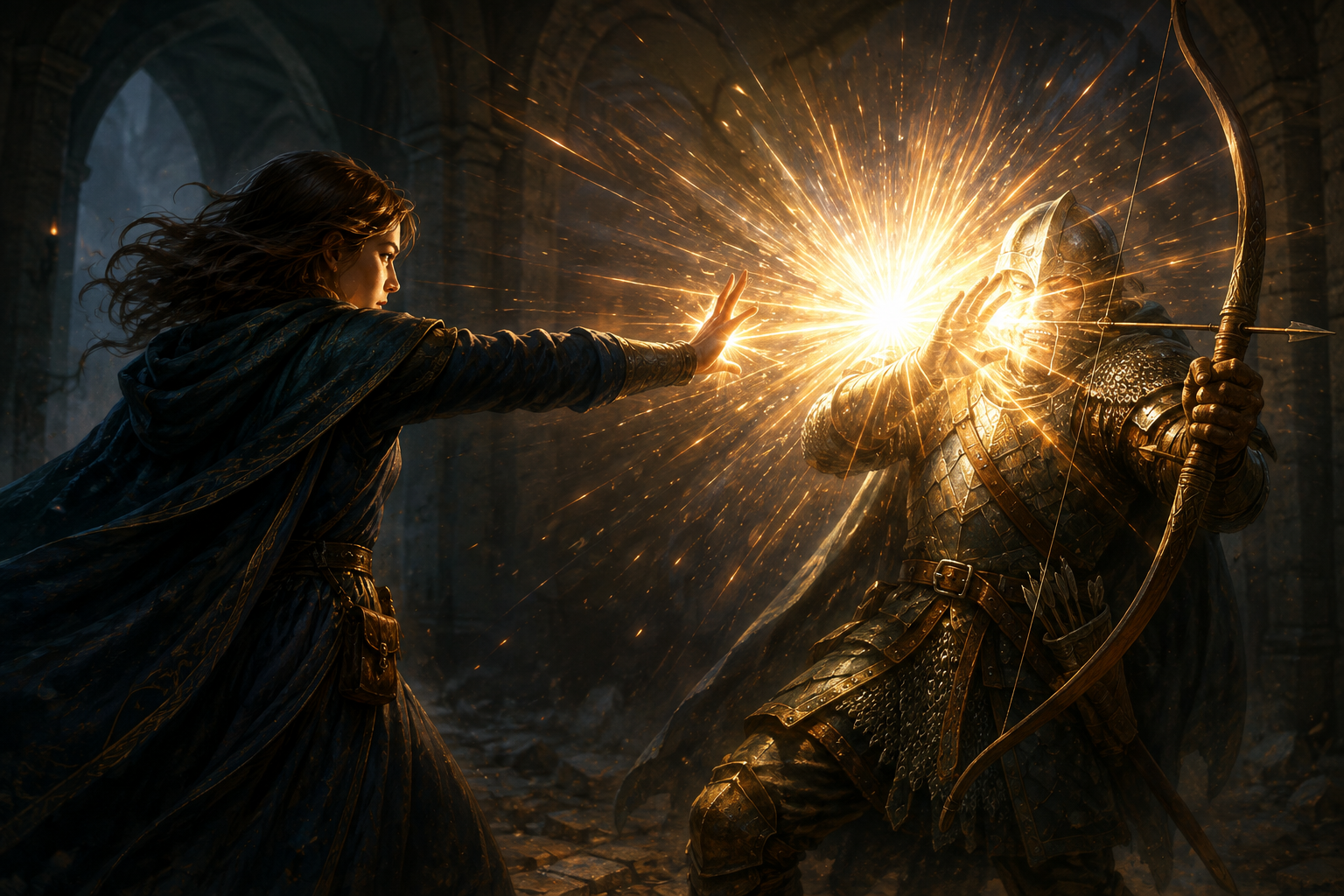
Flare is a minor combat spell built around timing rather than damage. The caster creates a sudden point of concentrated light immediately before one creature, forcing it to blink, recoil or lose visual focus.
In D&D 5.5e/2024 play, the spell disrupts the target’s next attack. In Pathfinder 1e and D&D 3.5e, it imposes the dazzled condition for one minute. In every version, the spell depends upon the target possessing functional sight and perceiving the flash.
Flare creates no lasting illumination, deals no fire or radiant damage and does not impose full blindness. Its value lies in spoiling one precise attack or applying a small but persistent accuracy penalty without spending a spell slot.
Rules Clarifications and Edge Cases
- One creature only: Flare is not an area spell. Nearby creatures are not affected merely because they can see the flash.
- The target must perceive the burst: A sightless creature, a creature whose vision is completely blocked or a creature without functioning visual organs is unaffected.
- Blindsight and other nonvisual senses: A creature that perceives its surroundings without sight is unaffected unless it also has a functioning visual sense that perceives the burst.
- Magical darkness: When Darkness or another effect prevents the target from seeing the burst, Flare cannot visually disrupt that creature. Flare does not create continuing light capable of illuminating the darkened area.
- Total cover: The burst cannot pass through a solid wall, closed door or other total barrier.
- Closing the eyes: The spell does not grant a special reaction allowing every target to close its eyes after casting begins. The saving throw already represents blinking, flinching, turning away or resisting the overstimulation.
- No damage: Flare deals no fire, radiant or other damage. It cannot ignite an object.
- Not sunlight: The burst is magical light rather than true sunlight. It does not automatically activate traits or weaknesses requiring sunlight.
- Not a persistent light source: Flare cannot illuminate a room for exploration. Use Light or Dancing Lights for sustained illumination.
- Constructs and undead: Flare is not inherently mind-affecting. A construct, undead creature or other unusual creature can be affected when it possesses functional sight and lacks a specific immunity.
- Multiple eyes: A creature with several eyes makes one saving throw. Extra eyes do not create immunity or require multiple saves.
- Repeated casting in Pathfinder 1e and D&D 3.5e: A creature already dazzled is unaffected, so the penalty does not stack and the one-minute period is not restarted.
- Repeated casting in the 2024 conversion: Multiple sources of Disadvantage do not combine. A later casting matters only after the earlier attack penalty has been used or expired.
- Spell Resistance: Pathfinder 1e and D&D 3.5e apply Spell Resistance. A creature protected by resistance makes the Fortitude save only if the caster first overcomes that resistance.
- Dispel Magic: Once Flare has resolved, Dispel Magic has no ongoing spell to end.
- Countering the casting: Counterspell or an edition-appropriate counterspelling method can stop Flare before the burst occurs.
Best Uses
Spoil One Dangerous Attack
In the 2024 conversion, target an enemy whose next attack could decide the encounter: a giant, mounted knight, hidden sniper or spellcaster preparing an attack-roll spell.
Protect an Exposed Ally
Use the flash to reduce the chance that an injured, restrained or isolated companion is struck before reaching safety.
Disrupt Ranged Enemies
Archers and crossbowmen often lose more from one spoiled shot than enemies relying on numerous low-value attacks.
Interfere with Watchmen
A well-timed flash may ruin a sentry’s immediate aim or create a brief opening across a watched courtyard, bridge or alley.
Create a Brief Signal
Where line of sight is clear, the visible flash can serve as a simple prearranged signal without granting long-range communication.
Apply Nonlethal Pressure
Flare disrupts without directly injuring its target, making it useful where the caster wants control without immediate bloodshed.
Tactics
- Cast before the target acts. The 2024 effect expires at the end of the target’s next turn, so timing matters.
- Choose quality over quantity. One powerful attack is a better target than the first strike in a long sequence of minor attacks.
- Check the enemy’s action. The 2024 conversion penalises an attack roll. It does not hinder an effect that requires only a saving throw.
- Check the creature’s senses. Do not waste the action against a blind ooze, eyeless burrower or enemy that cannot see through surrounding magical darkness.
- Exploit the older-edition duration. In Pathfinder 1e and D&D 3.5e, the small penalty persists for one minute and may affect several rounds.
- Preserve stronger magic. Flare is most valuable when a minor loss of accuracy is sufficient and a spell slot would be wasteful.
Counters and Limitations
Successful Saving Throw
A successful Constitution or Fortitude save prevents the mechanical effect completely.
No Functional Sight
A creature that cannot visually perceive the flash is unaffected.
Blocked Vision
Total cover, opaque barriers and effects that make the burst impossible to see prevent it from functioning.
Multiple Attacks
The 2024 conversion affects only the next attack roll. Later attacks during the same turn are made normally.
Saving-Throw Abilities
Breath weapons and other abilities that require saving throws rather than attack rolls remain unaffected.
Spell Resistance
Pathfinder 1e and D&D 3.5e creatures with Spell Resistance possess an additional defence before the saving throw.
Related Light and Vision Spells
DM Guidance
Describe Flare as a sharp interruption rather than prolonged blindness. The target may blink hard, recoil, lose an arrow’s flight, swing early or see a pale afterimage crossing the battlefield.
Keep the spell narrow. It does not reveal Invisible creatures, expose illusions, ignite objects, reproduce sunlight or illuminate a chamber. It also does not automatically frighten animals or cause a crowd to panic.
The 2024 conversion is deliberately weaker than the Blinded condition. Do not expand its penalty to every attack, sight-based check and action. Its purpose is to spoil one attack while preserving the value of stronger sensory-control spells.
In Pathfinder 1e and D&D 3.5e, dazzled is a minor condition rather than a dramatic disable. Apply the exact edition-specific penalties and do not substitute blindness.
Flare in the World
Because Flare is a cantrip, it appears wherever basic magical training exists. Apprentice mages practise it to master the placement and timing of evoked light. Performers use harmless variants as punctuation, while guards and battle-mages value its ability to spoil a shot without setting a building alight.
Its nonlethal reputation does not make it harmless. A sudden flash beside a roof edge, bridge or stair can contribute to a fatal mistake. Cast during an arrest, negotiation, ceremony or crowded procession, it may be treated as an assault even when it inflicts no direct injury.
Some cities regulate Flare alongside smoke magic, magical noise and other effects capable of disrupting watches, courts and public gatherings. Professional sentries may use shaded observation posts, visored helms or paired observers when hostile spellcasters are expected.
Adventure Hooks
The Missed Bell
A watchman claims a magical flash caused him to miss the signal that would have closed the city gates. Investigators must determine whether Flare enabled an invasion or merely excuses treason.
White Sparks in the Gallery
During a royal procession, several tiny flashes cross an upper gallery. Nobody is injured, but every archer on one side of the hall loses aim simultaneously.
The Apprentice’s Duel
A supposedly harmless contest ends when one combatant falls from a tower stair immediately after being struck by Flare.
The Blind Watch
Robberies occur only at posts guarded by veterans trained to resist ordinary distraction. Each survivor remembers the same impossible white afterimage.
Historical and Occult Development
Flare belongs to a long history of using light for warning, command, spectacle and disorientation. Beacon fires, signal lamps and reflected sunlight allow small changes in brightness to seize attention across great distances when their timing and direction are controlled.
The heliograph turns reflected sunlight into coded flashes. Fireworks apply sudden light on a larger scale, combining brilliance, sound and motion for celebration, signalling and public display. Flare is the magical reduction of the same principle: not a continuing flame, but one precisely placed instant of overwhelming brightness.
Occult systems frequently associate light with revelation, intellect, authority and exposure. Flare twists that symbolism into an aggressive act. Illumination arrives too quickly and too close to reveal truth; it overwhelms the observer before understanding becomes possible.
For historical context, see the Science History Institute’s history of fireworks and the National Museums Scotland heliograph collection entry.
Mythological Parallels
Solar divinities frequently unite light with sight, knowledge and unavoidable witness. Helios is both the sun and a divine observer whose rays look across the world. In that tradition, hostile light is more than brightness: it is the force of being suddenly exposed to an inescapable gaze.
The Japanese account of Amaterasu’s emergence from the heavenly cave also treats reflected brilliance as a power capable of arresting attention. A mirror and the spectacle outside the cave draw the hidden sun goddess toward the entrance, restoring light to the world.
Flare reduces these vast mythic ideas to a cantrip-sized event. For one instant, the caster commands light strongly enough to dominate a creature’s sight and interrupt its certainty.
For further context, see Theoi’s classical source collection for Helios and Nippon.com’s account of Amaterasu and the Cave of Heaven.
Rules Sources and Attribution
- D&D 5.5e/2024: The mechanics presented here are an original SpiralWorlds conversion and are not an official Wizards of the Coast spell.
- Pathfinder 1e: Pathfinder Roleplaying Game Core Rulebook, page 284. The Archives of Nethys Flare entry was used to verify the spell lists and rules fields.
- D&D 3.5e: The Hypertext d20 SRD Flare entry was used to verify the original mechanics.
- 2024 balance comparison: The limited next-attack penalty was checked against the current Vicious Mockery and Starry Wisp cantrips.
Pathfinder 1e and D&D 3.5e rules material on this page includes Open Game Content used under the Open Game License version 1.0a. Product names and trademarks remain the property of their respective owners.
Keep this reference growing
If this page helped with your reading or game, you can support its upkeep or explore the curated books.
Explore the Bookshop — epics, classics and stories behind imagined worlds.