
Games Master Reference · Treasure & Rewards
Treasure — Hoards, Coins, Gems, Valuables & Rewards
Treasure is more than a number written in gold pieces. It is coinage, jewels, weapons, curiosities, trade goods, heirlooms, stolen property, relics and the physical evidence of people and powers that existed before the characters arrived.
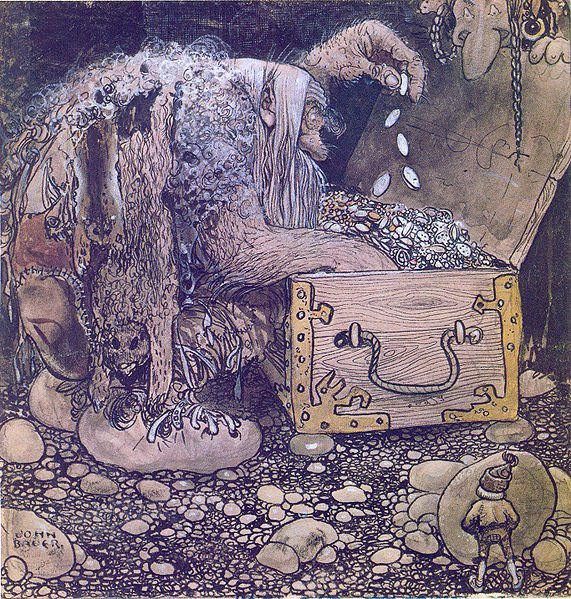
A good hoard answers three questions: what is it worth, who owned it, and what happens when somebody else takes it?
Game Mechanics
Treasure by Rules Edition
Choose the rules edition used at your table.
D&D 5.5e Treasure
Use Challenge Rating to establish a substantial hoard’s monetary value and number of magic items, then choose treasure appropriate to the creature, lair and circumstances in which it was found.
Random Treasure Hoard
| Challenge Rating | Monetary Treasure | Magic Items |
|---|---|---|
| CR 0–4 | 2d4 × 100 gp | 1d4 − 1 |
| CR 5–10 | 8d10 × 100 gp | 1d3 |
| CR 11–16 | 8d8 × 1,000 gp | 1d4 |
| CR 17+ | 6d10 × 10,000 gp | 1d6 |
Treasure Themes
Arcana
Scrolls, magical writings, ritual objects, arcane tools and objects associated with spellcraft or supernatural study.
Armaments
Weapons, armour, shields and other objects associated with warriors, guards, arsenals and martial power.
Implements
Useful magical tools and equipment associated with exploration, craft, specialised work and practical activity.
Relics
Objects associated with ancestry, devotion, ceremony, tradition, spiritual authority or ancient supernatural importance.
Building a Hoard
- Decide whether the discovery is carried wealth, a small cache or a substantial hoard.
- Use the encounter or creature CR to establish the monetary component.
- Determine the number of magic items.
- Choose magic-item rarity appropriate to the characters’ level.
- Choose a treasure theme appropriate to the creature or location.
- Convert part of the monetary value into coins, gems, art objects, trade goods or other valuables.
Pathfinder 1e Treasure
Treasure value depends on party level and advancement speed. Use the creature’s treasure entry and the nature of the encounter to determine how much wealth is present and what form it takes.
Treasure Values per Encounter
| Average Party Level | Slow | Medium | Fast |
|---|---|---|---|
| 1 | 170 gp | 260 gp | 400 gp |
| 2 | 350 gp | 550 gp | 800 gp |
| 3 | 550 gp | 800 gp | 1,200 gp |
| 4 | 750 gp | 1,150 gp | 1,700 gp |
| 5 | 1,000 gp | 1,550 gp | 2,300 gp |
| 6 | 1,350 gp | 2,000 gp | 3,000 gp |
| 7 | 1,750 gp | 2,600 gp | 3,900 gp |
| 8 | 2,200 gp | 3,350 gp | 5,000 gp |
| 9 | 2,850 gp | 4,250 gp | 6,400 gp |
| 10 | 3,650 gp | 5,450 gp | 8,200 gp |
| 11 | 4,650 gp | 7,000 gp | 10,500 gp |
| 12 | 6,000 gp | 9,000 gp | 13,500 gp |
| 13 | 7,750 gp | 11,600 gp | 17,500 gp |
| 14 | 10,000 gp | 15,000 gp | 22,000 gp |
| 15 | 13,000 gp | 19,500 gp | 29,000 gp |
| 16 | 16,500 gp | 25,000 gp | 38,000 gp |
| 17 | 22,000 gp | 32,000 gp | 48,000 gp |
| 18 | 28,000 gp | 41,000 gp | 62,000 gp |
| 19 | 35,000 gp | 53,000 gp | 79,000 gp |
| 20+ | 44,000 gp | 67,000 gp | 100,000 gp |
Creature Treasure
None
No normal treasure.
Incidental
50% of base treasure value.
Standard
Normal base treasure value.
Double
Twice the base treasure value.
Triple
Three times the base treasure value.
NPC Gear
Use the appropriate NPC gear value.
Treasure Types
| Type | Treasure | Typical Use |
|---|---|---|
| A | Coins | Cash and stored currency. |
| B | Coins & Gems | Portable valuables and gemstones. |
| C | Art Objects | Fine craft and precious display pieces. |
| D | Coins & Small Objects | Portable wealth and small magical objects. |
| E | Armour & Weapons | Armouries and martial caches. |
| F | Combatant Gear | Equipment suited to warriors. |
| G | Spellcaster Gear | Equipment suited to magical opponents. |
| H | Lair Treasure | A mixed accumulation of valuables. |
| I | Treasure Hoard | A large cache representing several rewards. |
D&D 3.5e Treasure
Generate treasure from the creature’s Challenge Rating or the encounter’s Encounter Level, using separate rolls for coins, goods and items.
How to Resolve Treasure
- Determine treasure level. Use the creature’s Challenge Rating or the encounter’s Encounter Level.
- Roll Coins. Use the Coins column on the appropriate treasure-level row.
- Roll Goods. Resolve gems and art objects on the tables below.
- Roll Items. Resolve mundane results on the Mundane Items tables below.
- Resolve magic items. If the result is minor, medium or major, roll on Random Magic Item Generation.
- Determine the item. Follow the appropriate category table for armour, weapons, potions, rings, rods, scrolls, staffs, wands or wondrous items.
- Appraise uncertain valuables. Use Appraise where a character does not automatically know an object’s value.
- Recover the treasure. Account for coin weight, bulk and transport.
- Realise the value. Determine what can be spent directly and what must be sold or exchanged.
Monster Treasure
Standard
Roll once for Coins, once for Goods and once for Items on the appropriate row.
None
The creature normally accumulates no treasure of its own.
Nonstandard
The creature’s entry changes the normal mix of coins, goods or items.
Fractional Coins
Generate coins normally, then divide the result by the fraction stated.
Percentage Goods or Items
Roll the stated percentage first. On a success, generate that category normally.
Double Goods or Items
Roll twice on that category.
Treasure Values per Encounter
| Encounter Level | Treasure | Encounter Level | Treasure |
|---|---|---|---|
| 1 | 300 gp | 11 | 7,500 gp |
| 2 | 600 gp | 12 | 9,800 gp |
| 3 | 900 gp | 13 | 13,000 gp |
| 4 | 1,200 gp | 14 | 17,000 gp |
| 5 | 1,600 gp | 15 | 22,000 gp |
| 6 | 2,000 gp | 16 | 28,000 gp |
| 7 | 2,600 gp | 17 | 36,000 gp |
| 8 | 3,400 gp | 18 | 47,000 gp |
| 9 | 4,500 gp | 19 | 61,000 gp |
| 10 | 5,800 gp | 20 | 80,000 gp |
Average Treasure Results
| Type | Average Value |
|---|---|
| Gem | 275 gp |
| Art object | 1,100 gp |
| Mundane item | 350 gp |
| Minor magic item | 1,000 gp |
| Medium magic item | 10,000 gp |
| Major magic item | 40,000 gp |
Random Magic Item Generation
When the treasure table produces a minor, medium or major magic item, roll again to determine its category.
| Minor | Medium | Major | Category |
|---|---|---|---|
| 01–04 | 01–10 | 01–10 | Armour & Shields |
| 05–09 | 11–20 | 11–20 | Weapons |
| 10–44 | 21–30 | 21–25 | Potions & Oils |
| 45–46 | 31–40 | 26–35 | Rings |
| — | 41–50 | 36–45 | Rods |
| 47–81 | 51–65 | 46–55 | Scrolls |
| — | 66–68 | 56–75 | Staffs |
| 82–91 | 69–83 | 76–80 | Wands |
| 92–100 | 84–100 | 81–100 | Wondrous Items |
Found Magic Items
Armour & Weapon Size
For randomly generated armour and weapons: 01–30 Small, 31–90 Medium, 91–100 another size.
Cursed Items
A randomly generated magic item has a 5% chance of being cursed.
Charged Items
For a randomly found item with a normal maximum of 50 charges, roll d% and divide by 2, rounding down to a minimum of 1.
Using the Item
See Magic Item Basics & Creation for identification, activation and general magic-item rules.
Treasure Levels 1–10
| Level | d% | Coins | d% | Goods | d% | Items |
|---|---|---|---|---|---|---|
| 1st | 01–14 | — | 01–90 | — | 01–71 | — |
| 15–29 | 1d6 × 1,000 cp | 91–95 | 1 gem | 72–95 | 1 mundane | |
| 30–52 | 1d8 × 100 sp | 96–100 | 1 art object | 96–100 | 1 minor | |
| 53–95 | 2d8 × 10 gp | |||||
| 96–100 | 1d4 × 10 pp | |||||
| 2nd | 01–13 | — | 01–81 | — | 01–49 | — |
| 14–23 | 1d10 × 1,000 cp | 82–95 | 1d3 gems | 50–85 | 1 mundane | |
| 24–43 | 2d10 × 100 sp | 96–100 | 1d3 art objects | 86–100 | 1 minor | |
| 44–95 | 4d10 × 10 gp | |||||
| 96–100 | 2d8 × 10 pp | |||||
| 3rd | 01–11 | — | 01–77 | — | 01–49 | — |
| 12–21 | 2d10 × 1,000 cp | 78–95 | 1d3 gems | 50–79 | 1d3 mundane | |
| 22–41 | 4d8 × 100 sp | 96–100 | 1d3 art objects | 80–100 | 1 minor | |
| 42–95 | 1d4 × 100 gp | |||||
| 96–100 | 1d10 × 10 pp | |||||
| 4th | 01–11 | — | 01–70 | — | 01–42 | — |
| 12–21 | 3d10 × 1,000 cp | 71–95 | 1d4 gems | 43–62 | 1d4 mundane | |
| 22–41 | 4d12 × 1,000 sp | 96–100 | 1d3 art objects | 63–100 | 1 minor | |
| 42–95 | 1d6 × 100 gp | |||||
| 96–100 | 1d8 × 10 pp | |||||
| 5th | 01–10 | — | 01–60 | — | 01–57 | — |
| 11–19 | 1d4 × 10,000 cp | 61–95 | 1d4 gems | 58–67 | 1d4 mundane | |
| 20–38 | 1d6 × 1,000 sp | 96–100 | 1d4 art objects | 68–100 | 1d3 minor | |
| 39–95 | 1d8 × 100 gp | |||||
| 96–100 | 1d10 × 10 pp | |||||
| 6th | 01–10 | — | 01–56 | — | 01–54 | — |
| 11–18 | 1d6 × 10,000 cp | 57–92 | 1d4 gems | 55–59 | 1d4 mundane | |
| 19–37 | 1d8 × 1,000 sp | 93–100 | 1d4 art objects | 60–99 | 1d3 minor | |
| 38–95 | 1d10 × 100 gp | 100 | 1 medium | |||
| 96–100 | 1d12 × 10 pp | |||||
| 7th | 01–11 | — | 01–48 | — | 01–51 | — |
| 12–18 | 1d10 × 10,000 cp | 49–88 | 1d4 gems | 52–97 | 1d3 minor | |
| 19–35 | 1d12 × 1,000 sp | 89–100 | 1d4 art objects | 98–100 | 1 medium | |
| 36–93 | 2d6 × 100 gp | |||||
| 94–100 | 3d4 × 10 pp | |||||
| 8th | 01–10 | — | 01–45 | — | 01–48 | — |
| 11–15 | 1d12 × 10,000 cp | 46–85 | 1d6 gems | 49–96 | 1d4 minor | |
| 16–29 | 2d6 × 1,000 sp | 86–100 | 1d4 art objects | 97–100 | 1 medium | |
| 30–87 | 2d8 × 100 gp | |||||
| 88–100 | 3d6 × 10 pp | |||||
| 9th | 01–10 | — | 01–40 | — | 01–43 | — |
| 11–15 | 2d6 × 10,000 cp | 41–80 | 1d8 gems | 44–91 | 1d4 minor | |
| 16–29 | 2d8 × 1,000 sp | 81–100 | 1d4 art objects | 92–100 | 1 medium | |
| 30–85 | 5d4 × 100 gp | |||||
| 86–100 | 2d12 × 10 pp | |||||
| 10th | 01–10 | — | 01–35 | — | 01–40 | — |
| 11–24 | 2d10 × 1,000 sp | 36–79 | 1d8 gems | 41–88 | 1d4 minor | |
| 25–79 | 6d4 × 100 gp | 80–100 | 1d6 art objects | 89–99 | 1 medium | |
| 80–100 | 5d6 × 10 pp | 100 | 1 major |
Treasure Levels 11–20
| Level | d% | Coins | d% | Goods | d% | Items |
|---|---|---|---|---|---|---|
| 11th | 01–08 | — | 01–24 | — | 01–31 | — |
| 09–14 | 3d10 × 1,000 sp | 25–74 | 1d10 gems | 32–84 | 1d4 minor | |
| 15–75 | 4d8 × 100 gp | 75–100 | 1d6 art objects | 85–98 | 1 medium | |
| 76–100 | 4d10 × 10 pp | 99–100 | 1 major | |||
| 12th | 01–08 | — | 01–17 | — | 01–27 | — |
| 09–14 | 3d12 × 1,000 sp | 18–70 | 1d10 gems | 28–82 | 1d6 minor | |
| 15–75 | 1d4 × 1,000 gp | 71–100 | 1d8 art objects | 83–97 | 1 medium | |
| 76–100 | 1d4 × 100 pp | 98–100 | 1 major | |||
| 13th | 01–08 | — | 01–11 | — | 01–19 | — |
| 09–75 | 1d4 × 1,000 gp | 12–66 | 1d12 gems | 20–73 | 1d6 minor | |
| 76–100 | 1d10 × 100 pp | 67–100 | 1d10 art objects | 74–95 | 1 medium | |
| 96–100 | 1 major | |||||
| 14th | 01–08 | — | 01–11 | — | 01–19 | — |
| 09–75 | 1d6 × 1,000 gp | 12–66 | 2d8 gems | 20–58 | 1d6 minor | |
| 76–100 | 1d12 × 100 pp | 67–100 | 2d6 art objects | 59–92 | 1 medium | |
| 93–100 | 1 major | |||||
| 15th | 01–03 | — | 01–09 | — | 01–11 | — |
| 04–74 | 1d8 × 1,000 gp | 10–65 | 2d10 gems | 12–46 | 1d10 minor | |
| 75–100 | 3d4 × 100 pp | 66–100 | 2d8 art objects | 47–90 | 1 medium | |
| 91–100 | 1 major | |||||
| 16th | 01–03 | — | 01–07 | — | 01–40 | — |
| 04–74 | 1d12 × 1,000 gp | 08–64 | 4d6 gems | 41–46 | 1d10 minor | |
| 75–100 | 3d4 × 100 pp | 65–100 | 2d10 art objects | 47–90 | 1d3 medium | |
| 91–100 | 1 major | |||||
| 17th | 01–03 | — | 01–04 | — | 01–33 | — |
| 04–68 | 3d4 × 1,000 gp | 05–63 | 4d8 gems | 34–83 | 1d3 medium | |
| 69–100 | 2d10 × 100 pp | 64–100 | 3d8 art objects | 84–100 | 1 major | |
| 18th | 01–02 | — | 01–04 | — | 01–24 | — |
| 03–65 | 3d6 × 1,000 gp | 05–54 | 3d12 gems | 25–80 | 1d4 medium | |
| 66–100 | 5d4 × 100 pp | 55–100 | 3d10 art objects | 81–100 | 1 major | |
| 19th | 01–02 | — | 01–03 | — | 01–04 | — |
| 03–65 | 3d8 × 1,000 gp | 04–50 | 6d6 gems | 05–70 | 1d4 medium | |
| 66–100 | 3d10 × 100 pp | 51–100 | 6d6 art objects | 71–100 | 1 major | |
| 20th | 01–02 | — | 01–02 | — | 01–25 | — |
| 03–65 | 4d8 × 1,000 gp | 03–38 | 4d10 gems | 26–65 | 1d4 medium | |
| 66–100 | 4d10 × 100 pp | 39–100 | 7d6 art objects | 66–100 | 1d3 major |
Epic Treasure — Levels 21–30
For treasure above 20th level, use the 20th-level row and add the indicated number of major magic items.
| Treasure Level | Additional Major Magic Items |
|---|---|
| 21st | +1 |
| 22nd | +2 |
| 23rd | +4 |
| 24th | +6 |
| 25th | +9 |
| 26th | +12 |
| 27th | +17 |
| 28th | +23 |
| 29th | +31 |
| 30th | +42 |
Gems
| d% | Value | Average | Examples |
|---|---|---|---|
| 01–25 | 4d4 gp | 10 gp | Agate; azurite; blue quartz; hematite; lapis lazuli; malachite; obsidian; rhodochrosite; tiger eye; turquoise; freshwater pearl. |
| 26–50 | 2d4 × 10 gp | 50 gp | Bloodstone; carnelian; chalcedony; chrysoprase; citrine; iolite; jasper; moonstone; onyx; peridot; rock crystal; sard; sardonyx; quartz; zircon. |
| 51–70 | 4d4 × 10 gp | 100 gp | Amber; amethyst; chrysoberyl; coral; garnet; jade; jet; fine pearl; spinel; tourmaline. |
| 71–90 | 2d4 × 100 gp | 500 gp | Alexandrite; aquamarine; violet garnet; black pearl; deep blue spinel; golden yellow topaz. |
| 91–99 | 4d4 × 100 gp | 1,000 gp | Emerald; opal; blue sapphire; fine corundum; star sapphire; star ruby. |
| 100 | 2d4 × 1,000 gp | 5,000 gp | Exceptional emerald; diamond; jacinth. |
Art Objects
| d% | Value | Average | Examples |
|---|---|---|---|
| 01–10 | 1d10 × 10 gp | 55 gp | Silver ewer; carved figure; finely worked gold bracelet. |
| 11–25 | 3d6 × 10 gp | 105 gp | Cloth-of-gold vestments; jewelled mask; silver chalice. |
| 26–40 | 1d6 × 100 gp | 350 gp | Fine tapestry; decorated brass vessel. |
| 41–50 | 1d10 × 100 gp | 550 gp | Silver comb with moonstones; ceremonial sword. |
| 51–60 | 2d6 × 100 gp | 700 gp | Carved harp; solid gold idol. |
| 61–70 | 3d6 × 100 gp | 1,050 gp | Gold comb; jewelled stopper; ceremonial electrum dagger. |
| 71–80 | 4d6 × 100 gp | 1,400 gp | Gemmed eyepatch; fire-opal pendant; old masterpiece painting. |
| 81–85 | 5d6 × 100 gp | 1,750 gp | Jewelled mantle; sapphire pendant. |
| 86–90 | 1d4 × 1,000 gp | 2,500 gp | Jewelled glove; anklet; gold music box. |
| 91–95 | 1d6 × 1,000 gp | 3,500 gp | Golden circlet; fine pearl necklace. |
| 96–99 | 2d4 × 1,000 gp | 5,000 gp | Jewelled crown; electrum ring. |
| 100 | 2d6 × 1,000 gp | 7,000 gp | Gold and ruby ring; emerald-set gold cup. |
Appraising Treasure
When a character does not know what a valuable object is worth, use Appraise.
| Object | DC | Result |
|---|---|---|
| Common or well-known object | DC 12 | Success determines its value. Failure gives an estimate between 50% and 150% of its actual value. |
| Rare or exotic object | DC 15, 20 or higher | Success determines its value. Failure provides no reliable estimate. |
Time
Appraising an object takes 1 minute.
Magnifying Glass
A magnifying glass grants a +2 circumstance bonus when appraising gems and other small or highly detailed objects.
Merchant’s Scale
A merchant’s scale grants a +2 circumstance bonus when appraising objects valued by weight.
Using Both
The two bonuses stack when both tools are relevant to the object being appraised.
Mundane Items
| d% | Category |
|---|---|
| 01–17 | Alchemical Item |
| 18–50 | Armour |
| 51–83 | Weapons |
| 84–100 | Tools & Gear |
Alchemical Items
| 01–12 | Alchemist’s fire — 1d4 flasks, 20 gp each |
| 13–24 | Acid — 2d4 flasks, 10 gp each |
| 25–36 | Smokesticks — 1d4 sticks, 20 gp each |
| 37–48 | Holy water — 1d4 flasks, 25 gp each |
| 49–62 | Antitoxin — 1d4 doses, 50 gp each |
| 63–74 | Everburning torch |
| 75–88 | Tanglefoot bags — 1d4 bags, 50 gp each |
| 89–100 | Thunderstones — 1d4 stones, 30 gp each |
Armour
Roll d% for armour size: 01–10 Small; 11–100 Medium.
| 01–12 | Chain shirt — 100 gp |
| 13–18 | Masterwork studded leather — 175 gp |
| 19–26 | Breastplate — 200 gp |
| 27–34 | Banded mail — 250 gp |
| 35–54 | Half-plate — 600 gp |
| 55–80 | Full plate — 1,500 gp |
| 81–90 | Darkwood shield |
| 91–100 | Masterwork shield |
Darkwood Shield
| 01–50 | Darkwood buckler — 205 gp |
| 51–100 | Darkwood shield — 257 gp |
Masterwork Shield
| 01–17 | Masterwork buckler — 165 gp |
| 18–40 | Masterwork light wooden shield — 153 gp |
| 41–60 | Masterwork light steel shield — 159 gp |
| 61–83 | Masterwork heavy wooden shield — 157 gp |
| 84–100 | Masterwork heavy steel shield — 170 gp |
Weapons
| 01–50 | Masterwork common melee weapon |
| 51–70 | Masterwork uncommon weapon |
| 71–100 | Masterwork common ranged weapon |
Tools & Gear
| 01–03 | Backpack, empty | 2 gp |
| 04–06 | Crowbar | 2 gp |
| 07–11 | Lantern, bullseye | 12 gp |
| 12–16 | Lock, simple | 20 gp |
| 17–21 | Lock, average | 40 gp |
| 22–28 | Lock, good | 80 gp |
| 29–35 | Lock, superior | 150 gp |
| 36–40 | Manacles, masterwork | 50 gp |
| 41–43 | Mirror, small steel | 10 gp |
| 44–46 | Silk rope, 50 ft. | 10 gp |
| 47–53 | Spyglass | 1,000 gp |
| 54–58 | Artisan’s tools, masterwork | 55 gp |
| 59–63 | Climber’s kit | 80 gp |
| 64–68 | Disguise kit | 50 gp |
| 69–73 | Healer’s kit | 50 gp |
| 74–77 | Holy symbol, silver | 25 gp |
| 78–81 | Hourglass | 25 gp |
| 82–88 | Magnifying glass | 100 gp |
| 89–95 | Musical instrument, masterwork | 100 gp |
| 96–100 | Thieves’ tools, masterwork | 100 gp |
Recovering & Selling Treasure
| Coins | Weight |
|---|---|
| 500 | 10 lb. |
| 1,000 | 20 lb. |
| 5,000 | 100 lb. |
| 10,000 | 200 lb. |
| 25,000 | 500 lb. |
Ordinary Loot
Ordinary equipment can generally be sold for half its listed price.
Trade Goods
Trade goods can normally be exchanged at their full listed value.
See Wealth & Money for currency, trade goods and selling recovered valuables.
Setting Layer
Treasure in SpiralWorlds
A treasure should reveal something about the person, creature, culture or catastrophe that placed it there.
Treasure by Origin
Noble Household
Plate, jewellery, costly cloth, riding gear, arms, correspondence, account books and inherited pieces.
Merchant or Guild
Mixed coin, trade bars, weights, spices, dyes, cloth, metal stock, tools, samples and contracts.
Royal Treasury
Bullion, tribute, regalia, gifts, war funds, seals and records.
Battlefield or Military Store
Weapons, armour, payroll coin, banners, maps, riding gear, siege equipment and supplies.
Burial or Tomb
Grave goods, jewellery, arms, vessels, funerary objects and ancestral tokens.
Dwarven Hold
Worked metal, ingots, tools, heirloom weapons, gemstones and guild-marked goods.
Elven Court
Fine craft, old coin, jewellery, instruments, rare materials, weapons and manuscripts.
Giant Hoard
Oversized trophies, livestock wealth, weapons, captured banners, whole chests and monumental jewellery.
Dragon Hoard
Coin from many centuries, tribute, trophies, jewellery, rare materials, weapons and remembered heirlooms.
Fey Cache
Beautiful objects, strange gifts, old tokens, fine craft and curiosities.
Infernal Treasury
Contracts, seals, tribute, confiscated wealth, weapons, precious materials and records of obligation.
Pirate or Raider Hoard
Foreign coinage, portable jewellery, plate, weapons, shipboard goods and ransom valuables.
Cult or Ritual Treasury
Offerings, vessels, robes, books, ingredients and gifts from patrons.
Ruined Civilisation
Old coin, inscriptions, tools, ceremonial objects, art and historically valuable materials.
Caravan or Shipwreck
Cargo, commercial coin, personal effects, navigation equipment and trade goods.
Monster Lair
Victims’ possessions, swallowed valuables, trophies, discarded equipment and objects the creature can use.
Treasure as Evidence
Heraldry, inscriptions, guild marks, coinage, craftsmanship and provenance can turn treasure into evidence. A valuable object may connect the characters to a robbery, missing caravan, fallen dynasty, battlefield, forbidden cult or previous expedition.
Ownership & Consequence
The Owner Survived
Somebody may come looking for what was taken.
The Heirs Survived
Death does not necessarily end a claim of ownership.
The Object Is Recognisable
Famous or distinctive valuables can be difficult to sell quietly.
The Treasure Is Bulky
Transport may matter more than price.
The Treasure Has Obligations
Tribute, ransom, payroll and infernal property may carry consequences.
Someone Notices
Sudden wealth can attract rulers, rivals, thieves and creditors.
Making a Hoard Quickly
- Set the value using the rules edition being played.
- Name the former owner.
- Choose several forms of wealth instead of using only coin.
- Add one distinctive object that reveals the hoard’s history.
- Add one practical problem: weight, transport, appraisal, secrecy or sale.
- Decide who might care that the treasure has changed hands.
Lore Layer
Historical & Mythological Context
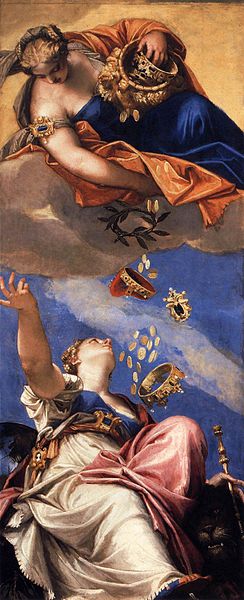
Stories of treasure rarely concern wealth alone. Burial goods connect valuable objects with the dead. Hidden hoards preserve wealth through war, flight and political collapse. Folklore surrounds buried riches with guardians, curses, oaths and supernatural ownership.
Occult traditions also contain repeated attempts to locate hidden treasure through dreams, divination, spirits, ritual and grimoires. Such stories can become adventure evidence: the ritual may be wrong, partly right, deliberately deceptive or pointing toward something whose guardian matters more than the gold.

At the Table
GM Advice — How Much Treasure?
Treasure is both a reward and a campaign resource. Too little can limit what characters can accomplish; too much can change the scale of the campaign. The interesting part is what wealth allows the characters to do and who notices when they acquire it.

Using Rewards
- Give treasure that reflects its former owner.
- Use valuable information as well as valuable objects.
- Allow wealth to open access to people, institutions and opportunities.
- Let famous or stolen treasure attract attention.
- Let powerful rewards create new possibilities and new problems.