
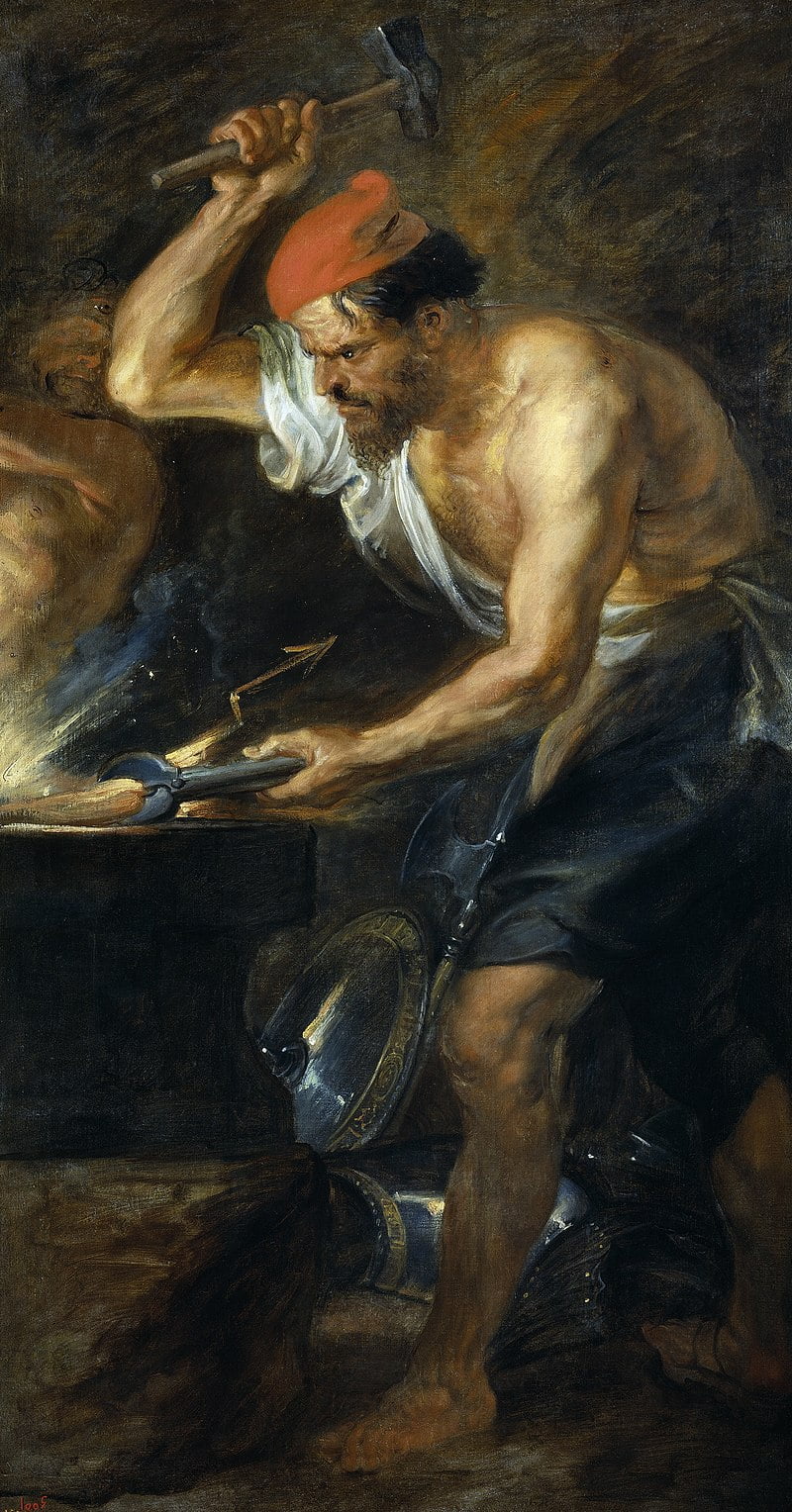
Vulcan at a Glance
Tradition
Roman and Italic
Divine standing
Intermediate Deity
Campaign alignment
Neutral
Portfolio
Fire, destructive heat, furnaces, metalworking, foundries and controlled burning
Principal festival
Vulcanalia, 23 August
Sacred places
Forges, foundries, kilns, volcanic ground and places vulnerable to urban fire
Emblems
Hammer, tongs, anvil, flame and furnace
Favoured weapon
Warhammer
Hellenic relationship
Closely identified with Hephaestus, while Roman fire-averting cult remains distinct.
Related Roman powers
Roman Pantheon · Fire · Heat · Forge · Metalworking · Destruction
Vulcan is the Roman god of dangerous fire, destructive heat and the metalworking that learns to master both. His identification with Hephaestus strengthens the smith-god image, but the Roman Vulcanalia reminds worshippers that the god belongs first to fire that can escape human control.
Same Deity, Different Cultural Aspect
Vulcan is the Roman aspect of Hephaestus: one god expressed through Roman dangerous fire, furnaces, metalworking and fire-averting cult. The Hephaestus page presents the Hellenic aspect. Both pages remain separate and self-canonical because they describe different cults and cultural presentations, not different cosmic beings.
Divine Mechanics
Campaign Divine Tier 35 describes Vulcan’s setting-scale power and is not an SRD challenge rating. The rules-facing 5.5e block stays within SRD 5.2.1 CR 30 and ability-score-30 ceilings.
Vulcan — 5.5e Rules-Facing Form
Medium Celestial (Deity), Neutral
CR 36 (custom epic) · PB +10 · Campaign Divine Tier 35
AC 29 · HP 800 · Speed 40 ft.
| STR | DEX | CON | INT | WIS | CHA |
|---|---|---|---|---|---|
| 32 (+11) | 22 (+6) | 32 (+11) | 30 (+10) | 28 (+9) | 24 (+7) |
Saving Throws Str +21, Con +21, Int +20, Wis +19
Skills Arcana +18, Athletics +19, Investigation +18, Perception +17, Religion +17
Damage Immunities fire
Damage Resistances cold, lightning, radiant; bludgeoning, piercing and slashing from nonmagical attacks
Condition Immunities Charmed, Frightened, Poisoned
Senses Truesight 120 ft. · Languages all; telepathy 120 ft.
Traits
Legendary Resistance (6/Day). If Vulcan fails a saving throw, he can choose to succeed instead.
Magic Resistance. Vulcan has Advantage on saving throws against spells and other magical effects.
Master of the Furnace. Fire damage dealt by Vulcan ignores Resistance; nondivine Fire Immunity becomes Resistance against his effects.
Maker’s Eye. Vulcan instantly knows the material, construction method and most serious structural flaw of a manufactured object he can see within 120 feet.
Divine Spellcasting
Vulcan has access to every spell granted by the deity’s portfolio domains in the edition being used: Fire · Artifice · Earth · Protection. Those spells are always prepared or available to the deity.
Actions
Multiattack. Vulcan makes three Forge Hammer attacks.
Forge Hammer. Attack: +21 to hit, reach 10 ft. Hit: 32 (4d10 + 10) bludgeoning plus 22 (4d10) fire damage.
Open the Furnace (Recharge 5–6). A 60-foot cone erupts with white furnace heat. Creatures make a DC 28 Constitution save, taking 88 (16d10) fire damage on a failure or half on success. Nonmagical metal objects that are not worn or carried melt or warp.
Bonus Actions
Temper the Weapon. One weapon within 60 feet becomes magical until the start of Vulcan’s next turn and deals an extra 18 (4d8) fire damage on a hit.
Reactions
Quench. When Vulcan or an ally within 60 feet takes cold, fire or lightning damage, Vulcan reduces that damage by 36 (8d8).
Legendary Actions
- Move. Move up to half Speed without provoking Opportunity Attacks.
- Divine Strike. Make one Forge Hammer attack.
- Shape the Battlefield (Costs 2). Vulcan raises, lowers or breaks a 15-foot cube of nonartifact stone or metal within 90 feet.
Vulcan — Pathfinder 1e
Campaign epic extension; true deities are not normally given standard PF1e stat blocks.
CR benchmark 30 · hp about 760 · AC about 48 · Primary attack +41 · Primary DC 35 · Good saves +31 · Poor save +26.
Divine expression. Express Vulcan through fire immunity, object knowledge, crafting, battlefield reshaping, forge magic and catastrophic heat.
Spell-Like Abilities. At will—fabricate, greater dispel magic, make whole, wall of fire; 3/day—earthquake, incendiary cloud, wall of iron; 1/day—miracle. Use caster level 30 for the combat benchmark.
Statistics
CR 36 (custom epic) · AC 54 · hp 940 · Fort +37 · Ref +30 · Will +35
Str 32 · Dex 22 · Con 32 · Int 30 · Wis 28 · Cha 24
Base Atk +36 · CMB +47 · CMD 95
Domain Access
Vulcan has full access to the deity’s linked portfolio domains in their Pathfinder-facing versions or clearly marked campaign adaptations.
Vulcan — D&D 3.5e
Intermediate Deity; Divine Rank 14; Neutral Medium Outsider (Extraplanar)
Divine Rank 14 · DR 25/epic · SR 46 · Domain SLA caster level 24.
Divine rules. Divine rank adds to attacks, saves and checks; natural armour is rank + 13; divine AC bonus equals rank; deflection uses Charisma modifier.
Salient Divine Abilities. Alter Reality, Divine Skill Focus, Divine Weapon Mastery, Power of Nature and rank-appropriate fire or crafting abilities.
Statistics
Challenge benchmark 42. Ability scores may exceed 30 where the deity’s divine nature requires it; Divine Rank remains the primary measure of cosmic authority.
Domain Access
Vulcan can use every spell-like ability granted by the deity’s portfolio domains at the caster level determined by Divine Rank.
Vulcan in Roman Religion
Vulcanalia was celebrated on 23 August, during the dangerous heat of late summer. Ancient descriptions preserve offerings cast into fire, including fish, and treat the day as belonging to the god of fire itself.
The later Hephaestus identification makes Vulcan strongly a smith and craftsman, but Roman worship never loses the fear underneath the forge. The same force that shapes iron can consume a warehouse district, fleet or harvest.
What Is Vulcan Doing Right Now?
Foundries, artillery workshops, armouries and dense cities place more destructive heat under human control than ever before. Vulcan is interested in every place where people believe technology has made fire obedient.
He favours skilled makers who respect materials and consequences. He is hostile to careless rulers who demand faster production while ignoring overloaded furnaces, powder stores, unsafe chimneys or workers trapped beside heat they cannot escape.
Worship in the Campaign Present
Smiths, metalworkers, armourers, founders and people responsible for urban fire prevention invoke Vulcan. His shrines are often placed where fire can be honoured without inviting it into crowded domestic space.
The cult is practical: inspect the furnace, clear the ash, honour the heat, do not boast that the city has conquered fire. Vulcan treats arrogance around destructive forces as an invitation.
Domains, Spells and Divine Gifts
Vulcan’s clergy favour Forge, Fire, Knowledge and Protection themes. Suitable spells include Heat Metal, Magic Weapon, Continual Flame, Fabricate, Wall of Fire, Creation, Wall of Iron and Incendiary Cloud.
Gift: Read the Metal
The devotee can identify whether a metal object is cracked, badly tempered, deliberately weakened or magically altered by touch.
Gift: Bank the Flame
Once per long rest, the devotee may extinguish or reduce one nondivine fire filling a 20-foot cube.
Artifacts and Relics
The Black Hammer
Major Divine Artifact · Weapon and smith’s tool (warhammer)
Attunement: Required by a creature proficient with smith’s tools or one that has personally repaired a broken weapon, tool or structure.
The Black Hammer can be used as a weapon, but its defining power is the ability to repair enchanted work without stripping away the magic that made the object worth saving.
5.5e
The Hammer is a +3 warhammer. On a hit it deals an extra 9 (2d8) Fire damage.
Master Repair. During a Short Rest, if all major fragments of a broken nonartifact magic weapon, armour piece or tool are present, you can restore it to working condition without removing its magical properties. The same item can’t benefit again for 7 days.
Forgefire (3/Day). As an action, heat a metal object you can see within 60 feet as though affected by Heat Metal, using DC 21.
Reforge (1/Month). Over 8 hours at a working forge, restore one destroyed nonartifact magic item whose major fragments survive. Consumable magic items and artifacts can’t be restored this way.
Pathfinder 1e
Major Artifact · CL 20th · overwhelming transmutation and evocation.
Functions as a +5 flaming burst warhammer and masterwork smith’s tool. During 1 hour of work it can repair a broken nonartifact magic weapon, armour or tool without suppressing its enchantment, provided all major fragments are present.
3/day: heat metal; 1/month: restore a destroyed nonartifact permanent magic item whose principal fragments survive.
D&D 3.5e
Major Artifact · CL 20th · strong transmutation and evocation.
Functions as a +5 flaming burst warhammer and masterwork smith’s tool. One hour of work repairs a broken nonartifact magic weapon, armour or tool without removing its enchantment if all major fragments survive.
3/day: heat metal; 1/month: restore one destroyed nonartifact permanent magic item from its principal fragments.
Destroying the Hammer
The Black Hammer can be destroyed only by a master smith who uses it to forge a flawless weapon, knowingly breaks that weapon before it ever harms anyone, and then melts both weapon and Hammer in the same furnace.
The Coal That Does Not Cool
Lesser Divine Relic · Wondrous Item (ember)
The Coal gives off heat but burns only material its bearer deliberately feeds it. It can relight any mundane forge, kiln or hearth it touches. Once per day it can keep one ordinary forge at working temperature for 8 hours without other fuel.
Relationships
Minerva shares Vulcan’s concern with skilled work but represents design, knowledge and disciplined technique where Vulcan embodies material transformation and dangerous heat. Jupiter’s thunderbolts belong among the divine weapons Vulcan may forge; Mars depends on armouries and weapons that Vulcan can either perfect or ruin.
Use Vulcan Tonight
The Cold Forge
Every furnace in a weapons district goes cold except one abandoned workshop.
The Bell Melts First
A city fire has not yet begun, but every bronze warning bell starts sagging in the heat.
The Cannon Knows Its Maker
A newly cast gun refuses to fire at the fortress it was built to destroy and turns warm when its original smith approaches.
Divine Estate and Regional Effects
Where Vulcan’s presence is strong, a major sanctuary can project the following effects across roughly six miles. A small shrine normally manifests only one effect in a smaller area. Unless another divine power contests them, the effects fade over 1d10 days after the sanctuary is abandoned or desecrated.
Fires Keep Their Bounds
Forge and kiln fires burn hotter without spreading beyond properly prepared hearths; careless or malicious fires receive no protection.
Metal Reveals Its Flaw
Cracks, bad welds, hidden slag and structural weakness in worked metal show faint heat colours to a trained smith.
The Forge Remembers
A damaged crafted object placed overnight beside a consecrated forge reveals the sequence of blows, stresses or sabotage that broke it.
Deep Dive
Continue through the Roman Pantheon, Hephaestus 2, Minerva, Jupiter, Mars, Vesta. Follow the cult into Rome and wider Italy, or use the Cleric and Cleric Domains pages for player-facing worship.
Historical Sources and Rules Compatibility
- Vulcanalia — 23 August festival and ancient fire offerings.
Historical cult material is separated from campaign invention. The 5.5e block respects SRD 5.2.1 numeric ceilings; the higher Campaign Divine Tier is setting-only. Pathfinder 1e deity mechanics are explicitly a campaign epic extension. D&D 3.5e uses divine-rank structure.
Rules licensing. D&D 5.5e terminology derived from the System Reference Document 5.2.1 is used under CC BY 4.0 where applicable. Pathfinder 1e and D&D 3.5e deity statistics on this page are original campaign conversions rather than official published deity stat blocks.
Keep this reference growing
If this page helped with your reading or game, you can support its upkeep or explore the curated books.
Explore the Bookshop — epics, classics and stories behind imagined worlds.