
Persian and Iranian Pantheon — Gods of the House of Song
At a Glance
| Tradition | Ancient Iranian religion, especially the Avestan and Zoroastrian traditions, alongside older and regional Iranian divine traditions. |
|---|---|
| Heartland | Persia, Media and the Iranian plateau; eastern Iranian traditions reach Bactria, Sogdiana and the lands beyond. |
| Supreme divine power | Ahura Mazda (Ohrmazd), the Wise Lord. |
| Divine company | The six Amesha Spentas and the wider yazatas, including Mithra, Anahita, Tishtrya, Atar, Sraosha and Verethragna. |
| Home realm | Garōdmān, the House of Song: the Persian divine estate of Endless Light within the Celestial Realms. |
| Opposing power | Angra Mainyu (Ahriman) and the daevas, servants of the Lie and ruin. |
| Sacred concerns | Truth and falsehood, good thoughts and deeds, fire, waters, plants, flocks, justice, mortality and renewal. |
| Campaign role | Living sanctuaries, divine patrons, celestial journeys, drought demons, the Chinvat Bridge and the promised restoration of creation. |
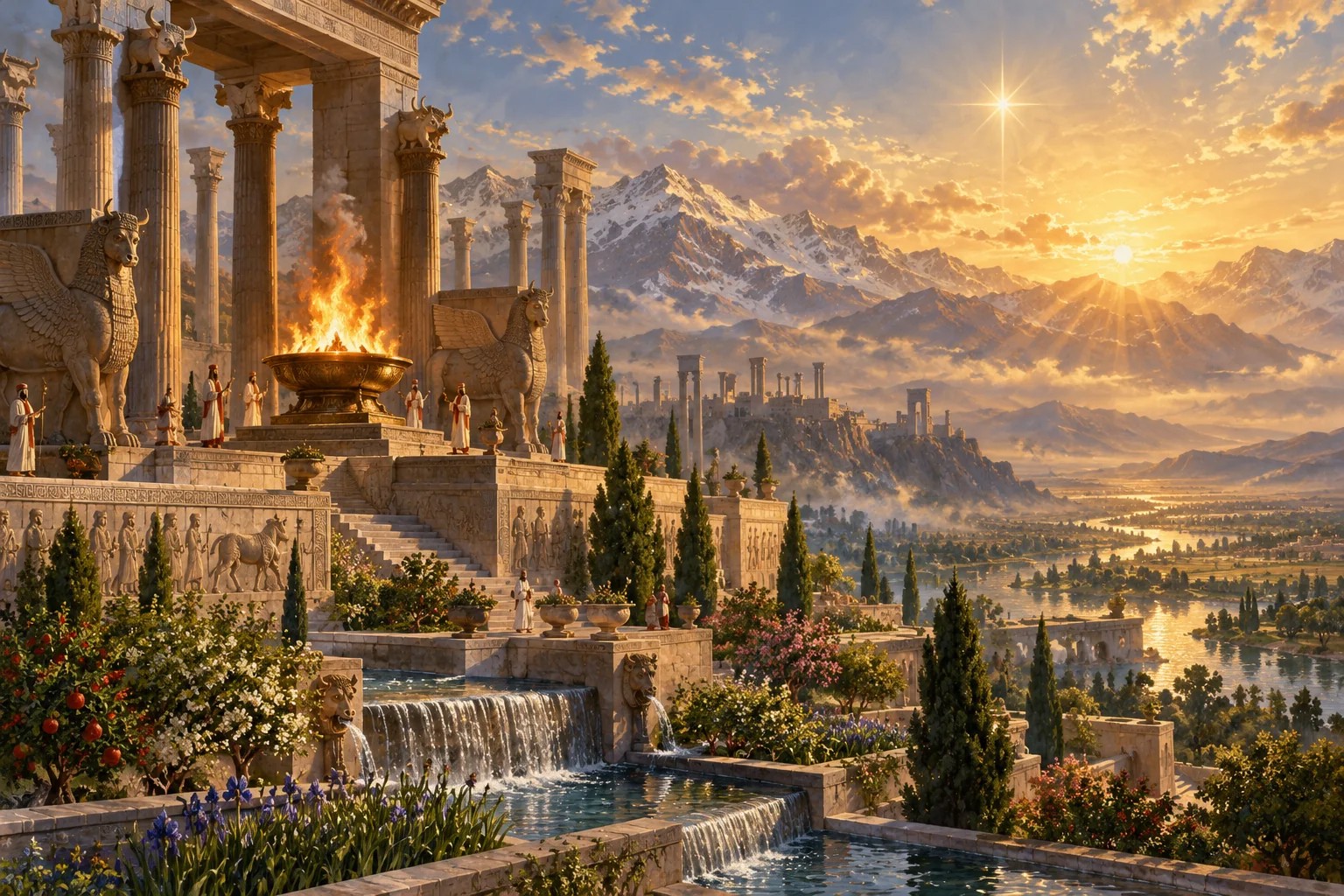
The Persian pantheon gathers Ahura Mazda, the Bounteous Immortals and the yazatas around Garōdmān, the House of Song in the Celestial Realms.
In the Iranian world, a flame is never merely a flame. It is tended against corruption, watched beside the dead, and carried through darkness while the mountains loom over the road. Here the Wise Lord upholds truth; the Immortals guard the good creation; and the powers of drought, deceit and destruction labour to undo it. Their struggle is fought in temples and heavenly courts, but also at a farmer’s well, a caravan’s campfire and a traveller’s last choice.
Meet the Divine Powers
Follow the Wise Lord, his Bounteous Immortals, the venerable yazatas and the rival powers whose conflicts shape the Iranian world.
The Wise Lord
- Ahura Mazda
The Six Amesha Spentas
- Vohu Manah
- Asha Vahishta
- Khshathra Vairya
- Spenta Armaiti
- Haurvatat
- Ameretat
Yazatas and Other Venerated Powers
- Mithra
- Anahita
- Atar
- Tishtrya
- Verethragna
- Sraosha
- Rashnu
- Ashi Vanghuhi
- Haoma
- Apam Napat
- Hvare Khshaeta
- Mah
- Vayu
- Drvaspa
- Daena
Opposing Powers and a Distinct Tradition
- Angra Mainyu
- Apaosha
- Zurvan
The Wise Lord and the Bounteous Immortals
Ahura Mazda — the Wise Lord
Ahura Mazda is the source of wisdom and the defender of asha, the right order and truth on which creation depends. He does not need an army of quarrelling royal relatives to establish his place. The powers around him act through distinct parts of the good creation. His adversary is not a sibling on the same throne but the destructive spirit whose choices and works bring the Lie into the world. Priests invoke Ahura Mazda through attentive prayer, clean fire, truthful speech and deeds that leave the world better than they found it.
The six Amesha Spentas
These are the Bounteous Immortals, at once divine beings and expressions of the Wise Lord’s goodness. They are not six unrelated Olympian-style gods. Each has its own sphere and living meaning for followers.
| Divine being | Sacred identity | In the world |
|---|---|---|
| Vohu Manah (Bahman) | Good Mind; wise understanding | Right judgement, attentive care of cattle and other useful animals; the welcome of worthy souls. |
| Asha Vahishta (Ardibehesht) | Best Truth; perfect order | Purity, justice, the disciplined tending of fire and the refusal to disguise falsehood as necessity. |
| Khshathra Vairya (Shahrevar) | Desirable Dominion | Protective strength, just sovereignty and metals used for worthy purposes. |
| Spenta Armaiti (Spandarmad) | Holy Devotion; patient right-mindedness | The sustaining earth, humility, care and resolute devotion. Frequently understood as feminine. |
| Haurvatat (Khordad) | Wholeness; completeness | Waters, health, flourishing and the state of things made whole. |
| Ameretat (Amordad) | Immortality; deathlessness | Plants, enduring life and the restoration toward which the good creation moves. |
Spenta Mainyu, the Bounteous Spirit, belongs to the teaching of Ahura Mazda’s creative and beneficent activity. He is closely bound to the Wise Lord rather than a seventh independent member of the six. Traditions interpret the relationship in more than one way.
The Yazatas — Powers Worthy of Veneration
The yazatas are neither interchangeable attendants nor lesser versions of Greek gods. Hymns and rituals name them for particular acts of protection, victory, weather, moral attention and life. Some belong to a deep shared Indo-Iranian inheritance; others are distinctive to Iranian religious development.
Mithra (Mihr) — Keeper of Covenants
Mithra sees the agreement made under an open sky and knows when it has been betrayed. His thousand eyes and ears make him a formidable witness; his chariot and weapons make him more than a passive judge. Light accompanies him, but the sun has its own divine personification. The Roman mystery god Mithras bears a related name, but his cult and rites have their own history.
Anahita (Ardvi Sura Anahita) — Mighty Waters
The great river and the purifying current belong to Anahita. Beautiful, powerful and richly adorned in the hymns, she answers the need for rivers, cleansing, fertility and the life they sustain. A dry channel can bring her people to desperation faster than any invading army.
Atar (Ātar) — Sacred Fire
Atar is fire as a holy power, luminous and active, not a licence to burn whatever stands nearby. The sanctuary flame demands careful fuel, shelter from defilement and a community willing to protect it.
Tishtrya (Tištrya) — Star of Rain
Associated with Sirius, Tishtrya contests Apaosha, the demon of drought. A shining white horse, a rain-bearing struggle and the survival of wells and fields make his struggle visible over entire provinces.
Verethragna (Bahram) — The Power of Victory
Victory takes many shapes: boar, bird, bull, horse, warrior and others. A champion who mistakes victory for cruelty discovers that strength is not the same thing as righteous success.
Sraosha (Srosh) — Hearing and Obedience
The hearer of sacred teaching, the protector of ritual attention and an enemy of night-demons. In accounts of the dead, Sraosha stands among the powers associated with judgement and safe passage.
Rashnu — The Straight Judge
With Mithra and Sraosha, Rashnu belongs to the testing of souls. His measure does not bend to rank, gifts or the status of the family waiting at the bridge.
Ashi Vanghuhi — Good Reward
Ashi brings deserved fortune and blessed recompense. Wealth alone is no proof of her favour; she sees what work and generosity produced it.
Haoma — The Sacred Plant
The sacred plant and ritually prepared drink are also personified as a holy being. Haoma belongs to worship, vitality and a religious tradition older than many of its surviving texts.
Apam Napat — Offspring of the Waters
A powerful old divinity associated with waters and their hidden brilliance, at times linked with fiery splendour. He should not be reduced to another name for Anahita.
Hvare Khshaeta and Mah — Sun and Moon
The radiant Sun and the Moon are distinct sacred powers. Their presence also shapes the ordered ascent of souls through the heavens toward the Endless Light.
Vayu and Drvaspa — Wind and Horses
Vayu’s position between good and destructive forces makes him an especially perilous presence at thresholds. Drvaspa guards and nourishes horses, whose speed and strength matter across Iran’s roads and steppes.
Garōdmān — The House of Song
The Iranian divine court dwells in the House of Song, the blessed height of endless light. It is a distinct sovereign estate within the Celestial Realms; it does not rule the other divine estates, and its beings retain their own names and sacred identities. Other divinities may visit its terraces, but none rules in Ahura Mazda’s place.
Its approaches rise through the starry realm of Good Thoughts, the moonlit realm of Good Words, and the sunlit realm of Good Deeds. At the summit, gardens do not wither, water runs unstained and music is a welcome rather than a command. There are gardens and seats for remembered companions, halls without false testimony, and fires that give light without devouring what they illuminate.
The Chinvat Bridge is the fearful crossing associated with the fate of the dead. Sraosha, Mithra and Rashnu have roles in judgement, while Daena gives the traveller an encounter with the reality of their own lived faith and conduct. A traveller’s inward worth matters more than their titles. The souls of the righteous enter blessedness; the destructive powers have their own opposed country of the Lie. These realms and judgements belong to a wider cosmology without being renamed Hell or the Abyss.
The world is not frozen in a hopeless stalemate. Iranian tradition looks ahead to Frashokereti, the making-wonderful or final renewal of creation, and to the saving figure of the Saoshyant. That future remains ahead of the campaign, giving the struggle a direction beyond defeating one demon in one adventure.
The Gods in the Iranian World
Persia and Media. Old stone sanctuaries, mountain passes, orchards and city courts keep older memories alive beneath changing rulers. Worshippers who tend sacred fires, honour the waters and speak carefully about promises can be found among people who no longer share a single public religion. The gods still answer at an isolated shrine, in a clean spring and beside the hearth of a pilgrim’s shelter.
Eastern Iranian lands. From Khorasan toward Bactria, Sogdiana and the caravan cities, Iranian words, local rites and older heroic stories travel with merchants, herders and reciters. Anahita’s waters, Tishtrya’s rains, Mithra’s covenants and the pastoral care of Vohu Manah are not confined to a single capital.
Alborz and Damavand. The high mountains are places of legendary endurance and terror. Persian heroic tradition binds the monstrous tyrant Zahhak (Aži Dahāka in the older mythic layer) to Mount Damavand. His prison is a danger worthy of a campaign: it is not simply a dungeon whose door can be opened without consequence.
Faith and geography are not identical. Not every inhabitant of Iran follows these powers. Zoroastrian religion remains a living tradition, with historical changes and internal differences. Older Iranian cults, eastern Iranian practice, Persian epic and later Zoroastrian theology contribute different material; their stories are related, not interchangeable.
The Destructive Powers and the Lie
Angra Mainyu (Ahriman) is the destructive adversary of the good creation, not a seventh Amesha Spenta or a co-equal seat at Ahura Mazda’s table. In later Zoroastrian cosmology his assault is a real and terrible cosmic struggle, yet it is not destined to continue forever. His servants include the daevas, malicious beings in the Zoroastrian tradition, and specific adversaries such as Apaosha, the drought-demon who fights Tishtrya. The more ancient Indo-Iranian word daeva did not always carry the same meaning; that religious transformation matters.
Zurvan, Time, has a place in the distinct history of Zurvanite interpretations, some of which present Zurvan as a primordial figure connected with Ohrmazd and Ahriman. Other Iranian traditions tell the divine relationships differently. Zarathustra is a prophet rather than a god; Yima/Jamshid and Rostam are legendary kings and heroes; and the Simurgh is a mighty mythic bird, not an additional goddess.
Adventures Among Fire, Water and Stars
The Fire That Has No Smoke — Yazd
Keeper Ardashir of the Three Lamps shelters a small mountain fire sanctuary. For three nights the flame has burned cleanly while everyone who enters forgets the name of one person they love. A caravan guard insists the keeper is concealing a murder, but the culprit is a night-demon imprisoned beneath the abandoned eastern cistern. The characters must recover a spoken genealogy from three living witnesses before dawn, then choose whether to banish the creature, bind it beneath fresh stone, or risk extinguishing the sanctuary fire to break its hold on memory. Success saves names and family ties, not merely a building.
The White Horse and the Dry Well — Khorasan
A spring outside a caravanserai fails on the night Tishtrya’s star should rise. A magnificent white horse appears at the last pool, but it is wounded and will not drink. The drought-demon Apaosha has driven its servants into the underground channels, where the local water-keepers are trapped behind a fallen shaft. The party can rescue the keepers and reopen the qanat, confront the demon at the dry reservoir or follow a secret route to the rain-star’s sanctuary. Simply killing the first creature they find will not restore the water.
The Chains Beneath Damavand — Alborz Mountains
Black iron rings appear on mountain shepherds’ wrists, and cattle refuse a high pasture. A young herder named Mehrnaz has found one of the ancient chains of Zahhak and sold it to an armourer who believes he can forge an unbreakable blade. The metal is already teaching its owners to command rather than persuade. The party must trace the chain, decide whether to destroy the armourer’s forge or save its workers, and return the link to a prison whose guardian has become old and afraid. The iron below the mountain groans as the chains are drawn tight again.
Worship, Devotion and Characters
Fire is treated with reverence because it reveals and purifies; it is not itself a demand for destruction. Water and earth are guarded against pollution. Truthfulness, generous hospitality, care for living creation and responsible choice matter in the ordinary practice of devotion. A follower of Mithra might witness an honest bargain at a roadside camp, while Anahita’s devotees protect a village’s spring and Ameretat’s tend a threatened orchard. A priest of Ahura Mazda restores the life of a community through healing, truthful counsel and practical care.
For adventurers, divine favour is not a substitute for action. The gods provide purpose, warnings, allies and difficult possibilities; mortals must still recover water, resist the Lie, defend the vulnerable and choose what will survive their victory. Each divine patron brings distinct powers, sacred magic, relics and obligations for those who choose to follow them.
Historical and Mythological Sources
The Avesta, including the Gathas and Yashts, the Middle Persian religious texts, Persian epic and modern scholarship preserve different witnesses to these traditions. Their surviving accounts differ in date, emphasis and theological interpretation.
Keep this reference growing
If this page helped with your reading or game, you can support its upkeep or explore the curated books.
Explore the Bookshop — epics, classics and stories behind imagined worlds.