
Drvaspa — Guardian of Healthy Horses and Herds
At a Glance
- Identity
- Drvaspa, also Drwāspā/Druvāspā, an ancient Iranian goddess whose name means “with solid/healthy horses”
- Nature
- Beneficent yazata associated with the protection and health of horses; the Persian Pantheon treats her as a great guardian of working animals
- Portfolio
- Horses, sound limbs, safe passage, herd health, patient husbandry and the dignity of dependent animals
- Alignment
- Lawful Good; she rewards conscientious care and orderly obligation while refusing deliberate cruelty
- Allies
- Ahura Mazda, Vohu Manah, the animal-protecting powers Gə̄uš Tašan and Gə̄uš Uruuan; an early association with Ashi Vanghuhi is debated
- Enemies
- Deliberate cruelty, famine-predators, beast-maiming raiders and those who sacrifice lives for a boast
- Signs
- A lame horse placing its hoof without pain, a chariot wheel that turns again, a herd waiting together at a river ford
- Worshippers
- Stable-hands, farriers, herders, couriers, caravan leaders, healers and riders who treat horses as companions rather than expendable tools
- Estate
- The High Meadow of Unbroken Breath, an original divine preserve at the edge of the celestial highland roads
- Relic
- The Bridle of the Untired Road, a gift that rewards care but never lets cruelty hide behind speed
- Campaign present
- Midgard, 1454; herds and roads remain vulnerable to winter, war, disease and mortal neglect

The Last Horse on the Nishapur Road
The mare will not take another step. Behind her, thirty families will lose the road if she falls.
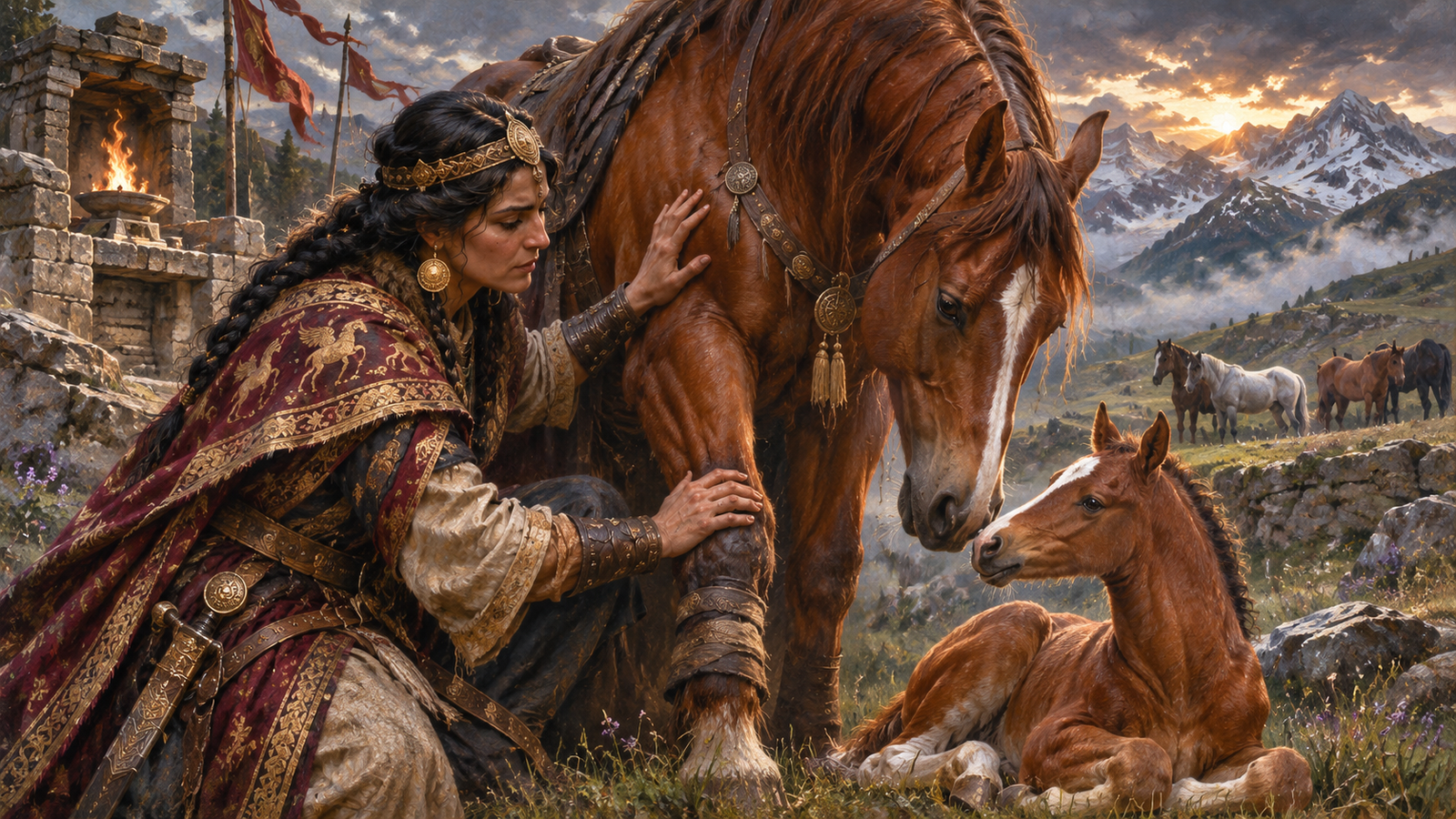
At the dry crossing west of Nishapur, the caravan-master Bahram has a fast horse, three strong sons and a cart full of weapons. None of those things will carry the wounded mare that has hauled the orphaned children from a raided village. A stable-hand named Golnar kneels beside its foreleg while the caravan argues whether to leave the animal, the cart or the slowest refugees behind.
Drvaspa asks a different question: who will bear the cost of saving the weakest creature on the road? The answer determines whether her unseen protection remains with the column. A caring act does not require a sacrifice in blood. It requires time, water, a competent hand and the refusal to make an exhausted animal pay for a human’s ambitions.
Travellers who care for their mounts, herders who shelter their breeding animals in winter, and healers willing to treat a beast before a noble’s parade horse may encounter the Guardian of the Sound Hoof. When she intervenes, the world does not simply become easy: every creature is given a fair chance to reach home, and someone must still do the work.
The Goddess in the Sources
The Avestan name Druuāspā evokes healthy or sound horses. The surviving Drwāsp Yašt (Yasht 9), also called Gōš Yašt, celebrates her protection of flocks and herds and describes her in relation to vigorous horses and a turning chariot. Its distinctive opening is short; much of the hymn repeats wording from the hymn to Ashi Vanghuhi. The surviving text is not evidence for a detailed independent saga or an elaborate temple order.
The Sīrōza associates her with the fourteenth day and the two other protecting animal divinities, Gə̄uš Tašan and Gə̄uš Uruuan. Scholars have disagreed over whether Drvaspa began as a distinct goddess or as a description of another divine power; this remains a question rather than a settled genealogy. A masculine Drooaspo appears on certain Kushan coins, another reason not to insist that every historical image, name and worship practice denotes a single unchanging form.
In this campaign, Drvaspa can visibly intervene in mortal journeys, command a sacred mounted host and bless the animal sick. Her court, adventures and statistics below are original adaptations rather than claims about unrecorded ancient rituals.
What Is Happening Right Now?
Horses are going lame along the eastern caravan roads: not only fighting mounts but the small pack mares used to carry grain, clothing and frightened children. A stable plague spreads from neglected watering troughs, and the richest riders buy the last untainted fodder. Drvaspa’s keepers have traced the first cases to a caravan yard near Herat where an ambitious horse-dealer concealed a fever to sell his stock before winter.
At the caravan shelters, a practical division is opening. Skilled farriers and animal healers ask every group to boil equipment, isolate sick animals and share clean water; hired guards want a forced march and a bonfire for the herd. Drvaspa grants no blanket protection to either side. The party can preserve a community’s transport network by keeping the animals alive, stopping the dealer’s next sale and choosing which road still has grazing.
To a petitioner, Drvaspa appears most often as a quietly authoritative traveller with a spare lead rope and clean bandages. She asks where the injured creatures are; only then does she ask who owns them. If confronted by a demon or a cruel warlord, the same figure becomes a formidable rider whose lance denies escape to those who knowingly spread suffering.
The High Meadow of Unbroken Breath
The highland road bends upward through soft turf and juniper until it reaches a meadow without walls. The animals that graze there are never compelled to kneel for a rider or showman; they come when called by a voice they trust. Rivers run cold enough to refresh a hot mount but never deep enough to swallow a foal. Beside the farrier’s workshop lie baskets of feed, saddle cloths and a row of worn shoes taken from animals rescued from the road.
The estate is a refuge, not a magical stable that removes all consequence from an adventure. Drvaspa’s attendants can restore a badly injured creature, but they ask the visitors to provide something concrete: a route home, a repaired watering place, or honest testimony against the person who inflicted the injury. A visitor who attempts to conscript the sacred herd finds every gate opening outward and no horse willing to follow.
Regional influence
Within six miles of a shrine she actively protects, animals given clean water and one uninterrupted hour of rest have advantage on checks against fear or exhaustion from ordinary travel for the next day (an original campaign blessing, not an automatic benefit of any historical shrine). Sick animals are unusually easy to diagnose; a healer proficient in Medicine or Animal Handling can identify whether injury, infection or magical blight is responsible after ten minutes of examination. Riders who knowingly abuse mounts find the road rougher: hoofbeats lead rescuers to the injured animal, and their beasts resist commands to charge helpless targets.
Three Adventures on the Living Roads
Each adventure begins with a practical problem and can end without a battle. None assumes the party belongs to a particular faith or that all riders share the same alignment.
1. The Sound Hoof at the Fourth Mile
Place: the Nishapur caravan road. People: Golnar, a farrier; Bahram, the caravan-master; Sahra, a refugee child. A wounded mare must be moved before a patrol arrives, but the owner refuses to surrender any grain or detach a cart. Golnar can splint the limb with the party’s help, but doing so costs travel time and forces a choice about who rides.
Obstacle: a pursuit across exposed ground, poisoned tack sold by an itinerant merchant and a shortage of bedding. Agency: the characters can bluff the patrol, divide the caravan, trade a weapon for fodder, fight or repair a disused bridge. Outcome: the mare’s survival makes the whole group mobile again and wins Drvaspa’s favour; abandonment leaves survivors faster but without dependable transport. Destroying an innocent animal does not count as mercy merely because the road is dangerous.
2. Thirty-Two Empty Stalls
Place: a walled caravan yard outside Herat. People: Miraz, a wealthy horse dealer; Dilaram, the keeper of the water trough; Captain Ruzbeh, who needs mounts for a border mission. A feverish animal has been hidden behind a false wall while all newly sold horses drink from the same trough.
Obstacle: a spreading ordinary disease worsened by a minor curse bound into the stable’s copper bowl. Agency: investigate the source, isolate animals without starving their owners, force the merchant to disclose sales, or seize the stock and risk riot. A monster can be defeated, but the outbreak continues unless contaminated equipment and unjust sales are addressed. Outcome: healed animals and accountable buyers restore the road; a hurried military requisition spreads illness into three other towns.
3. The Mare Who Walked Home
Place: a mountain pass between summer pasture and a winter village. People: an old mare called Darya, her young handler Parsa and a warband intent on taking the herd. Darya returns every evening to an empty house where her former owner died; the warband uses her trail to find the community’s hidden mounts.
Obstacle: sleet, a narrow ford and raiders who can be delayed but not all outrun. Agency: convince the villagers to relocate, negotiate ransom, collapse a ridge path, lead the animals through an abandoned shepherd tunnel, or call Drvaspa’s champion at a cost of public service. Outcome: preserving the herd keeps the village self-sufficient; surrendering a few mounts may avert bloodshed but leave the poor unable to plant the next season. Darya’s return ultimately leads to the resting place of a lost child, making the animal an ally rather than loot.
Worship, Behaviour and Divine Favour
Drvaspa’s devotees begin with ordinary duties: clean water, serviceable shoes, honest inspection of animals, adequate rest and a refusal to work the dying for one more mile. Their shrines may be simple stones beside a pasture or well-maintained shelters at a caravan crossing. Horses are not ornaments of status alone. A farm mare matters as much to Drvaspa as a decorated royal charger.
Her lawful goodness appears in what she will not do. She will not bless a racing stable that maims animals, conceal a dealer’s false account of disease or answer a rider’s prayer for speed when the mount is already collapsing. Yet she does not assume all army horsemen are wicked: a disciplined cavalry officer who feeds enemy mounts after a battle may receive protection, while an affluent petitioner who leaves animals to starve loses it.
Favours: a safe road through a storm, early warning of stable sickness, a mount’s calm under hostile magic, an injured animal regaining strength after actual care. Punishments: a glorious charger refuses to obey an abusive commander, a hidden cruelty becomes visible to the caravan, or an unscrupulous trader finds that the animals he sold lead witnesses back to his yard. Her higher intervention is to protect a whole refugee herd, not to make one chosen warrior invulnerable.
She shares responsibility for animal welfare with the wider divine guardians who belong to the Persian Pantheon. Vohu Manah speaks to the care of living creatures and a good mind behind action; Drvaspa answers for their sound limbs and safe passage. Ashi Vanghuhi rewards fitting deeds; a scholarly debate about their ancient relation is never made into a campaign fact.
Cleric Domains and Follower Spell Lists
These are spells and class options for mortal followers, not Drvaspa’s own spell repertoire. A character’s available subclass or domain follows the rules of the chosen edition. The site treats the different rule sets independently.
D&D 2024 — Life Domain
Choose the Life Domain for a healing-focused cleric who protects working animals and travellers. The 2024 list begins at cleric level 3, where four spells are always prepared; subclass mechanics are those of the 2024 cleric, not the 2014 Nature Domain.
| Cleric level | Always prepared spell(s) |
|---|---|
| 3rd | Aid, Bless, Cure Wounds, Lesser Restoration |
| 5th | Mass Healing Word, Revivify |
| 7th | Aura of Life, Death Ward |
| 9th | Greater Restoration, Mass Cure Wounds |
D&D 2014 — Nature Domain
Use the 2014 Nature Domain for an animal-communing and protective priest. The listed spell pairs are always prepared at the indicated cleric levels, subject to the 2014 subclass rules. The Charm Animals and Plants and Dampen Elements features are inherited from that subclass.
| Cleric level | Always prepared spell(s) |
|---|---|
| 1st | Animal Friendship, Speak with Animals |
| 3rd | Barkskin, Spike Growth |
| 5th | Plant Growth, Wind Wall |
| 7th | Dominate Beast, Grasping Vine |
| 9th | Insect Plague, Tree Stride |
Pathfinder 1e — Animal and Healing Domains
The Animal Domain permits Speak with Animals and later an animal companion; the Healing Domain grants Rebuke Death and Healer’s Blessing. At each cleric spell level the worshipper prepares one domain spell from the chosen domain in the normal Pathfinder fashion.
| Spell level | Always prepared spell(s) |
|---|---|
| 1 | Calm Animals |
| 2 | Hold Animal |
| 3 | Dominate Animal |
| 4 | Summon Nature’s Ally IV (animals only) |
| 5 | Beast Shape III (animals only) |
| 6 | Antilife Shell |
| 7 | Animal Shapes |
| 8 | Summon Nature’s Ally VIII (animals only) |
| 9 | Shapechange |
| Spell level | Always prepared spell(s) |
|---|---|
| 1 | Cure Light Wounds |
| 2 | Cure Moderate Wounds |
| 3 | Cure Serious Wounds |
| 4 | Cure Critical Wounds |
| 5 | Breath of Life |
| 6 | Heal |
| 7 | Regenerate |
| 8 | Mass Cure Critical Wounds |
| 9 | Mass Heal |
D&D 3.5e — Animal and Healing Domains
The Animal Domain grants Speak with Animals once per day and Knowledge (nature) as a cleric class skill; the Healing Domain grants +1 caster level with healing spells. These spell lists are specific to 3.5e: its Animal Domain has Commune with Nature at fifth level, unlike Pathfinder 1e, which has Beast Shape III.
| Spell level | Always prepared spell(s) |
|---|---|
| 1 | Calm Animals |
| 2 | Hold Animal |
| 3 | Dominate Animal |
| 4 | Summon Nature’s Ally IV (animals only) |
| 5 | Commune with Nature |
| 6 | Antilife Shell |
| 7 | Animal Shapes |
| 8 | Summon Nature’s Ally VIII (animals only) |
| 9 | Shapechange |
| Spell level | Always prepared spell(s) |
|---|---|
| 1 | Cure Light Wounds |
| 2 | Cure Moderate Wounds |
| 3 | Cure Serious Wounds |
| 4 | Cure Critical Wounds |
| 5 | Mass Cure Light Wounds |
| 6 | Heal |
| 7 | Regenerate |
| 8 | Mass Cure Critical Wounds |
| 9 | Mass Heal |
Divine Encounters in Four RPG Editions
Choose a rules edition. Each panel is a standalone original creature built for its own action economy and rules. A hero who restores the village animals can gain a truce; the deity does not automatically become a fight simply because a stat block is present.
Drvaspa — Guardian of the Sound Hoof
Huge Celestial (Deity), Lawful Good. Original D&D 2024 CR 28 (120,000 XP), PB +8. Homebrew, not playtested.
AC 24 (divine barding); HP 465 (30d12 + 270); Speed 60 ft., fly 60 ft. (hover); Initiative +4 (14). Saves Str +18, Dex +12, Con +17, Wis +19, Cha +17. Skills Animal Handling +19, Insight +19, Medicine +19, Perception +19, Survival +19. Resistances radiant, thunder; Immunities poison and poisoned condition; Senses Truesight 120 ft., Passive Perception 29; Languages Avestan, Celestial, Old Persian, telepathy 120 ft.
| STR | DEX | CON | INT | WIS | CHA |
|---|---|---|---|---|---|
| 30 (+10) | 18 (+4) | 28 (+9) | 24 (+7) | 32 (+11) | 28 (+9) |
Traits
Legendary Resistance (3/Day). A failed saving throw may become a success. Magic Resistance. Advantage on saving throws against spells and magical effects. Voice of the Living Road. Drvaspa’s spells require no material component without an indicated price; priced components are still required. Refuse the Cruel Charge. A beast or celestial mount starting its turn within 60 feet of her has advantage on saves against being Frightened and against exhaustion from magical forced marching; it may instead refuse a rider’s command that knowingly requires trampling a helpless creature.
Actions
Multiattack. Drvaspa makes three Sound Hoof attacks. Sound Hoof. Melee Attack Roll: +18, reach 15 ft.; Hit: 32 (4d10 + 10) Bludgeoning plus 13 (3d8) Radiant damage. Banner of the Rested Herd (Recharge 5–6). Drvaspa chooses creatures in a 60-foot Cone. Enemies make a DC 27 Wisdom saving throw, taking 54 (12d8) Radiant damage and becoming Frightened until the end of their next turn on failure, or half damage with no Frightened condition on success. Up to six allied animals in the Cone instead gain 30 Temporary Hit Points and may stand from Prone without spending movement. Healing of the Road (3/Day). One creature she can see within 60 feet regains 70 Hit Points and ends one of the following conditions: Blinded, Deafened, Frightened, Paralyzed or Poisoned.
Bonus Actions
Step Between Hoofbeats. Drvaspa and one willing adjacent allied creature teleport up to 30 feet each to unoccupied spaces they can see; neither may teleport into an occupied mount or vehicle.
Reactions
Guardian’s Intercession. When a creature within 30 feet is hit, she reduces damage to that creature by 25 and may move it 10 feet without provoking Opportunity Attacks (one Reaction).
Legendary Actions
Three Legendary Action uses per round, regained at the start of her turn, usable at the end of another creature’s turn: Move (1). Move half Speed without provoking Opportunity Attacks; Heal Mount (1). A beast within 30 feet regains 20 HP; Hoof (2). Make one Sound Hoof attack.
Personal Spellcasting (not follower domains)
Her personal 20th-level divine spellcasting uses Wisdom; spell save DC 27, spell attack +19. Spell slots by level 1–9: 4/3/3/3/3/2/2/1/1, recovered on a Long Rest. Spells require their normal V, S and M components except when explicitly waived by her Divine Voice trait; concentration follows the edition rules. At will cantrips: Guidance, Light, Resistance, Sacred Flame, Thaumaturgy. 1st: Animal Friendship, Bless, Cure Wounds, Healing Word. 2nd: Aid, Lesser Restoration, Locate Animals or Plants. 3rd: Mass Healing Word, Revivify, Speak with Plants. 4th: Aura of Life, Death Ward, Freedom of Movement. 5th: Greater Restoration, Mass Cure Wounds, Commune with Nature. 6th: Heal, Heroes’ Feast. 7th: Regenerate, Resurrection. 8th: Animal Shapes, Holy Aura. 9th: Mass Heal, True Resurrection.
Drvaspa — Rider of the Healing Meadow
Huge Celestial, Lawful Good. Original D&D 2014 CR 26 (90,000 XP), PB +8. Homebrew, not playtested.
AC 23 (natural armour); HP 419 (27d12 + 243); Speed 60 ft., fly 40 ft. (hover); Saves Str +17, Dex +12, Con +17, Wis +18, Cha +17. Skills Animal Handling +18, Insight +18, Medicine +18, Perception +18, Survival +18. Damage Resistances radiant, thunder; Damage Immunities poison; Condition Immunities poisoned; Senses truesight 120 ft., passive Perception 28; Languages Celestial, Avestan, Old Persian, telepathy 120 ft.
| STR | DEX | CON | INT | WIS | CHA |
|---|---|---|---|---|---|
| 28 (+9) | 18 (+4) | 28 (+9) | 22 (+6) | 30 (+10) | 28 (+9) |
Traits
Legendary Resistance (3/Day). Failed save becomes success. Magic Resistance. Advantage on saving throws versus spells. Merciful Cavalry. Friendly beasts within 30 ft. have advantage on saving throws against fear, and a mount with no more than half its HP cannot be forced into combat by the dominate beast spell while within the aura.
Actions
Multiattack. Drvaspa makes three Lance of Mercy attacks. Lance of Mercy. Melee Weapon Attack: +17 to hit, reach 15 ft., one target. Hit: 31 (4d10 + 9) piercing plus 9 (2d8) radiant. Road of Returning (Recharge 5–6). Allies of her choice within 60 ft. regain 35 HP and may immediately move 15 ft. as a reaction without provoking opportunity attacks. Enemies within 30 ft. of any affected ally make a DC 26 Wisdom save or are frightened of Drvaspa until the end of their next turn. Restore the Foundering (3/Day). A creature Drvaspa touches regains 70 HP and ends either poisoned, blinded or paralyzed.
Reactions
Take the Blow. On seeing a beast or rider within 30 ft. take damage, Drvaspa reduces the damage by 20 and moves up to 10 ft. without provoking opportunity attacks.
Legendary Actions
Three actions per round, spent at the end of other creatures’ turns: Advance (1). Move half Speed; Restore (1). One allied animal within 30 ft. regains 15 HP; Lance (2). Make one Lance of Mercy attack.
Personal Innate Spellcasting (2014)
Drvaspa’s own innate spellcasting functions as a 20th-level Wisdom-based cleric (spell save DC 26, spell attack +18), with spell slots 4/3/3/3/3/2/2/1/1 (1st–9th). Concentration and components follow 2014 rules. Cantrips: Guidance, Light, Resistance, Sacred Flame, Spare the Dying. 1st: Animal Friendship, Bless, Cure Wounds, Healing Word. 2nd: Aid, Lesser Restoration, Find Steed. 3rd: Mass Healing Word, Revivify, Speak with Plants. 4th: Death Ward, Freedom of Movement. 5th: Mass Cure Wounds, Greater Restoration. 6th: Heal, Heroes’ Feast. 7th: Regenerate, Resurrection. 8th: Animal Shapes, Holy Aura. 9th: Mass Heal, True Resurrection. Find Steed is an original granted spell for this divine monster, not a 2014 cleric-domain benefit.
Drvaspa — CR 27 / Mythic Rank 6
LG Huge outsider (extraplanar, good, lawful, mythic); original Pathfinder 1e creature; unplaytested.
Init +8; Senses darkvision 60 ft., true seeing; Perception +40. Aura Guardian Herd 30 ft. DEFENSE: AC 42, touch 18, flat-footed 37 (10 base, –2 size, +4 Dex, +19 natural, +5 deflection, +5 armour, +1 Dodge); hp 392 (27d10 + 243); Fort +20, Ref +21, Will +27 (27 outsider Hit Dice, Fortitude poor, Reflex and Will good, and the listed save-feat bonuses); DR 15/epic and evil, immune disease and poison, resist electricity 20 and sonic 20, SR 38. OFFENSE: speed 60 ft.; melee +5 lance +41/+36/+31/+26 (3d6+15/x3, 19–20 threat) or hoof +35 (2d6+10); space 15 ft., reach 15 ft. Special Attacks: restorative charge, mythic power (6/day, surge +1d8), mounted grace.
| STR | DEX | CON | INT | WIS | CHA |
|---|---|---|---|---|---|
| 30 (+10) | 18 (+4) | 28 (+9) | 22 (+6) | 30 (+10) | 28 (+9) |
STATISTICS: Base Atk +27; CMB +39; CMD 59 (including +5 deflection and +1 dodge to CMD); Feats (14): Combat Reflexes, Dodge, Great Fortitude, Improved Critical (lance), Improved Initiative, Iron Will, Lightning Reflexes, Mobility, Mounted Combat, Power Attack, Ride-By Attack, Skill Focus (Handle Animal), Spirited Charge, Weapon Focus (lance). Skills: Handle Animal +42, Heal +40, Knowledge (nature) +36, Perception +40, Ride +34, Sense Motive +40, Survival +40 (27 ranks + related ability; Handle Animal includes Skill Focus +3). Languages: Avestan, Celestial, Old Persian, telepathy 100 ft. Treasure: divine lance and the Bridle of the Untired Road.
Special Abilities
Guardian Herd (Su). Allied animals within 30 feet gain +4 morale bonus on saving throws against fear and poison; a mount that is helpless may instead be stabilised at the start of its turn if Drvaspa spends one mythic power use. Restorative Charge (Su). On a successful mounted lance charge, Drvaspa may redirect up to half the damage rolled as healing for an allied creature within 30 ft.; unwilling targets of the lance still take the remaining damage, and this ability cannot heal dead creatures. Mounted Grace (Ex). Drvaspa is treated as mounted for feats requiring mounted status while standing in her divine chariot; its movement is included in her Speed and does not add a companion creature.
Personal Spellcasting (Pathfinder 1e)
Personal spells: CL 20th divine casting; concentration and action economy use Pathfinder rules, Wisdom 30, save DC 20 + spell level; base prepared spells 4/4/4/4/4/4/4/4/4/4 for levels 0–9, plus one domain slot at each spell level 1–9 and bonus spells from Wisdom. Orisons can be cast without expending their prepared uses. 0: Detect Magic, Guidance, Light, Resistance. 1: Bless, Calm Animals, Cure Light Wounds, Shield of Faith. 2: Lesser Restoration, Hold Animal, Aid. 3: Remove Disease, Prayer, Dominate Animal. 4: Cure Critical Wounds, Freedom of Movement, Restoration. 5: Breath of Life, Beast Shape III, True Seeing. 6: Heal, Antilife Shell. 7: Regenerate, Animal Shapes. 8: Mass Cure Critical Wounds, Holy Aura. 9: Mass Heal, Shapechange. Spell-like abilities: Speak with Animals and Detect Poison at will, Heal 3/day (DC 26 for any save allowed), and Commune with Nature 1/day; all are independent of her cleric-domain spell table.
Drvaspa — Divine Rank 6
Lawful Good Huge Outsider (extraplanar, good, lawful); divine rank 6, 24 outsider HD, original D&D 3.5e deity; unplaytested. Deity Hit Dice are maximised.
Initiative +14 (+4 Dex, +4 Improved Initiative, +6 divine); Senses darkvision 60 ft., true seeing; Listen +43, Spot +43. AC 46, touch 27, flat-footed 42 (10 –2 size +4 Dex +19 natural [rank 6 +13] +6 divine +9 deflection/Cha); hp 408 (24d8 maximised = 192, Con +9 × 24 = 216). Fort +29, Ref +24, Will +30 (outsider base +14, +ability, +6 divine); DR 20/epic, SR 38, immunity to disease and poison; Speed 60 ft., fly 40 ft. (perfect); Base Atk +24; Grapple +48 (+24 BAB, +10 Str, +8 Huge, +6 divine); Space/Reach 15 ft./15 ft.
| STR | DEX | CON | INT | WIS | CHA |
|---|---|---|---|---|---|
| 30 (+10) | 18 (+4) | 28 (+9) | 22 (+6) | 30 (+10) | 28 (+9) |
Attack +5 sacred lance +44 melee (3d6+15/x3); Full Attack +44/+39/+34/+29 lance. Calculation: +24 BAB +10 Str –2 Huge +6 divine +5 enhancement +1 Weapon Focus = +44. Skills Handle Animal +42, Heal +43, Knowledge (nature) +39, Listen +43, Ride +37, Spot +43, Survival +43. Feats (9): Alertness, Combat Reflexes, Dodge, Endurance, Improved Initiative, Mobility, Mounted Combat, Run, Weapon Focus (lance). Salient Divine Abilities: Divine Blessing of the Herd (original), Divine Shielding of the Vulnerable (original); divine rank 6.
Special Attacks and Qualities
Divine Blessing of the Herd (Su). In a one-mile radius, domestic animals receiving proper food and rest gain +4 sacred bonus on saves against disease and fear; not a substitute for veterinary care. Divine Shielding of the Vulnerable (Su). Three times per day, Drvaspa may transfer up to 80 damage from a willing beast within 60 feet to herself as an immediate action; this damage ignores damage reduction. Lance of Mercy (Su). Once per round when hitting a creature harming an unconscious or helpless animal, she deals 4d6 extra sacred damage.
Personal Spellcasting (D&D 3.5e)
Personal spells: divine CL 24th, Wisdom 30, base save DC 20 + spell level, daily spell allotment 6/6/6/6/6/5/5/4/4/3 for levels 0–9 (before bonus spells). 0: Detect Magic, Guidance, Light, Resistance. 1: Bless, Calm Animals, Cure Light Wounds, Shield of Faith. 2: Hold Animal, Aid, Remove Paralysis. 3: Dominate Animal, Remove Disease, Prayer. 4: Cure Critical Wounds, Freedom of Movement. 5: Commune with Nature, Mass Cure Light Wounds. 6: Heal, Antilife Shell. 7: Animal Shapes, Regenerate. 8: Holy Aura, Mass Cure Critical Wounds. 9: Mass Heal, Shapechange. Her Animal and Healing domain spells above are follower spells, not this personal list. Spell-like abilities: Speak with Animals at will, Remove Disease 3/day, and Regenerate 1/day (CL 24th); divine rank does not substitute for spell slots.
Divine Relic — The Bridle of the Untired Road
The bridle is woven of dark leather and five silver threads; it feels weightless when fitted by a patient hand. The item is a direct campaign invention, not a claimed ancient Iranian relic. No version can force a mount to trample an unconscious person or continue while its own limbs are broken.
D&D 2024
Legendary Wondrous Item (bridle; requires attunement). While fitted to a willing Beast mount, the wearer and the mount have advantage on Animal Handling and Wisdom (Survival) checks associated with safe travel. Once per Long Rest the rider can use a Magic action to restore 60 HP to the mount, end one level of Exhaustion and remove the Poisoned condition. The bridle then loses its power until next dawn if the rider knowingly forces the animal to travel after it is reduced to 0 HP. It gives no immunity to ordinary starvation or dehydration.
D&D 2014
Legendary wondrous item (requires attunement). A willing steed wearing the bridle ignores nonmagical difficult terrain during ordinary overland travel. Once per dawn, as an action the wearer casts greater restoration on the steed only, requiring no material component, and the steed regains 40 hit points. If the rider deliberately abuses the steed, the magic becomes dormant until the steed receives one full day of rest and care.
Pathfinder 1e
Major wondrous item (aura strong conjuration, CL 17th, slot none, price 120,000 gp). While fitted to a willing mount, it grants a +4 competence bonus to Ride and Handle Animal checks concerning that mount. Once per day the rider may cast heal (CL 17th) on the mount only, as a standard action. This is a command-word activation, not an automatic free action. A rider who knowingly abuses the creature suppresses the item’s powers for 24 hours. Original item; market price is provisional.
D&D 3.5e
Major wondrous item (strong conjuration [healing], CL 17th, slot none, price 115,000 gp). A willing mount wearing the bridle gains +4 resistance bonus on Fortitude saves against disease and poison, and the rider receives a +4 competence bonus on Ride checks. Once per day, the rider activates heal (CL 17th) on the mount as a standard action, requiring a spoken command. The effect ends for 24 hours following deliberate abuse of the mount. Original item, with provisional creation price and requirements to verify.
Travel, Horses and Winter Roads
In 1454 a mount is transport, work, wealth and often a family’s last means of keeping together. A ford impassable to a wagon may be easy for a sure-footed horse; that does not make every bridge or mountain pass safe. Caravans need grass, dry fodder, clean water, farrier work and rest. Disease spreads easily when stables exchange stock without examination. Those facts give adventurers practical choices before divine magic appears.
Travellers approaching a shrine of Drvaspa should find a water trough before a temple façade, a competent keeper before a priest in costly robes, and a place to let a weary animal lie down. Her worship encourages preparation and mercy, not a supernatural guarantee that no horse will ever die.
Sources and Licensing
Attested Iranian tradition: Encyclopaedia Iranica — “Drvāspā” (Jean Kellens); Encyclopaedia Iranica — “Gōš Yašt” (William W. Malandra); Avesta.org — Drvasp Yašt / Gōš Yašt, Yasht 9. Historical iconography, specific independent rites and the goddess’s relationship to Ashi remain uncertain.
Rules reference: D&D 2024 Cleric (Life Domain); D&D 2014 Nature Domain; Pathfinder 1e cleric domains; D&D 3.5e domain spell lists. The deity’s original mechanical expressions are homebrew and unplaytested, not official deity blocks.
Original campaign inventions: the High Meadow of Unbroken Breath, Golnar, Bahram, Sahra, Miraz, Dilaram, Ruzbeh, Darya and Parsa, all three adventures, divine intervention traits, and the Bridle of the Untired Road. The painted hero and divine emblem are original SpiralWorlds campaign artworks; they do not represent historically attested depictions or symbols.
Keep this reference growing
If this page helped with your reading or game, you can support its upkeep or explore the curated books.
Explore the Bookshop — epics, classics and stories behind imagined worlds.