
Mah — The Moon, Keeper of the Living Seed
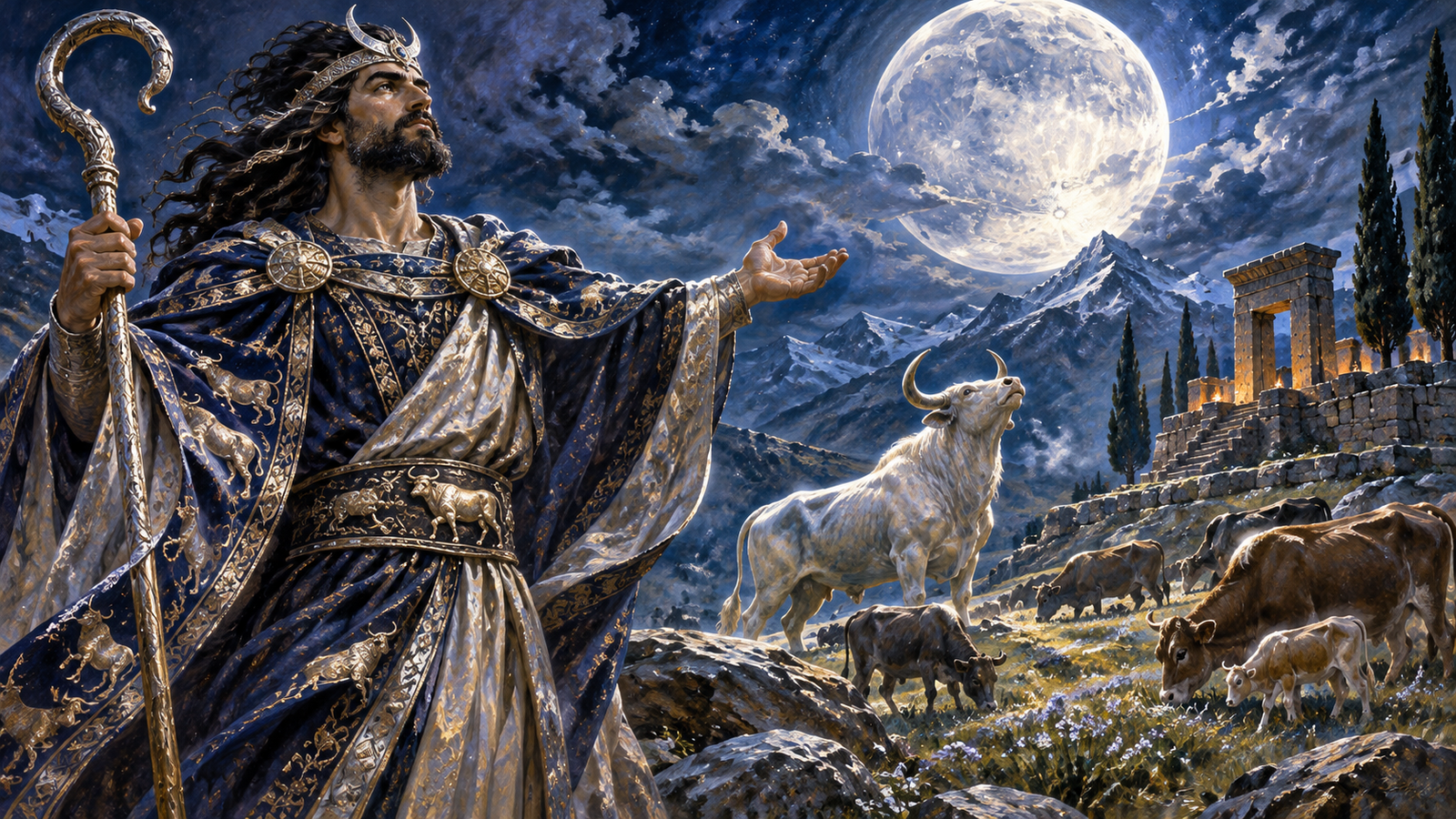
At a Glance
- Name
- Māh; Avestan måŋha-/māh-, the Moon; in the Māh Yašt called the bearer of the life-seed of cattle
- Nature
- A beneficent Iranian lunar yazata, with a brief surviving hymn and fuller later Middle Persian animal-origins tradition
- Alignment
- Neutral Good in this campaign: a patient preserver who resists cruelty and protects the vulnerable without demanding identical customs from every household
- Portfolio
- Lunar phases, safeguarded animal origins, night travel, grazing cycles, seasonal observation, patient restoration
- Signs
- The correct crescent reflected in a still trough; sick calves stirring at moonrise; hoofprints that circle a chasm rather than descend into it
- Relationships
- Ahura Mazda orders creation; Vohu Manah cares for cattle; Hvare Khshaeta provides the complementary sunlight; Drvaspa tends the health of horses; Tishtrya struggles for rain
- Estate
- The Pastures of the Returning Moon, an original lunar sanctuary beyond the mortal sky
- Worshippers
- Herd keepers, night guards, midwives attending animal births, astronomers, travellers and caretakers of winter grazing grounds
- Enemies
- Corruptors of the first cattle, deliberate famine-makers, night predators seeking the helpless, saboteurs of seasonal reckoning
- Relic
- The Crescent of the First Herd — a protective moon-silver torque, devised for this campaign
- Campaign present
- Midgard, 1454 CE; the lunar cycle still turns while isolated places suffer magical interference

The Herd That Refuses the Moon
The cows are walking uphill in the middle of a blizzard. At the winter pasture above Nishapur, one hundred cattle leave their pens every night and try to climb a dead shepherd’s trail. Their hooves are split, the youngest calves are failing, and there is a perfect half-moon over the ridge on every single night. The farmers have begun to kill the animals they cannot restrain. A caravan guide named Samira has found a second shadow on the snow: the valley’s moon-reflection is painted onto a great bronze mirror set into the abandoned watchtower.
Samira needs a party willing to cross the narrow pass, recover the stolen lunar calendar and discover who has changed the cattle’s sense of season. If the travellers smash the mirror at once, they free the sky but strand a shepherd and his children sheltering in its machinery. If they wait, the livestock will break through the frozen ridge before dawn. The challenge is to preserve both lives and the proper passage of the night.
The Moon is not a capricious thief of daylight. Mah measures the changes that allow herds, seed and travellers to survive the year. Those who call upon him to rescue their beasts are expected to protect living creatures in return, even when doing so costs time, grain or the chance to make a profitable sale.
The Moon Bearing the Seed of Cattle
The Māh Yašt, Yasht 7, is a short Avestan hymn addressed to the Moon. Its repeated act of reverent looking is inseparable from the observed changes between new, half and full Moon. The text praises a shining, life-giving lunar power, not a ruler who steals the Sun’s crown or turns human emotions into an astronomical calendar.
One of Mah’s oldest epithets concerns the seed of cattle. The later Pahlavi accounts explain why: when the primordial Bovine was slain by the destructive spirit, a portion of its generative essence was carried to the Moon, purified, and became a source from which beneficent animal kinds could multiply. That account survives in a different layer of literature from the brief Avestan hymn. The two traditions belong together, but they are not the same passage or the same historical level of detail.
The Moon waxes and wanes; it does not hoard life forever in one full, changeless circle. A traveller watching its phases can read the turning month. A livestock keeper can remember which lambs were born under the last dark sky and which pastures will carry them through winter. Farmers may turn these observations into customs of their own, but those local observances are not all prescribed in the ancient hymn.
In this world the divine order of Ahura Mazda makes room for change and care. Vohu Manah witnesses the good mind with which people treat domestic animals, while Mah guards the possibility of living generations yet to come. Hvare Khshaeta, the Sun, supplies heat and waking daylight; Mah keeps the night from becoming an empty void. Angra Mainyu and his creatures may try to destroy the living seed, but the moon’s changing face is not itself an evil omen.
What Is Happening Right Now?
Along a chain of caravan stops east of Nishapur, herds are coming into heat at the wrong time and newborn animals have begun to perish in freezing weather. A guild calendar kept by the astronomer Varaz once reconciled the moon’s signs with the needs of real pasture. Now the marks for half Moon and new Moon have been exchanged, and someone has been carrying carved bronze slivers to the watchtower at dusk.
The district’s wealthy breeder, Zarin, has hired guards to confiscate any healthy calves for his private shelter. He claims to be following a revelation from the Moon, yet his own animals have been spared because their pens lie below the mirror’s reach. His argument fails the simplest test of Mah’s care: a blessing that depends on starving other households is not the preservation of life.
An old shepherd, Davud, remembers the original cycle and knows where a narrow spillway passes under the tower. He will show it to adventurers who escort the sick animals first. The party may instead bargain with Zarin’s guards, scale the observatory’s upper vault, follow the silver-bearing courier, or warn the families below. Each choice changes whose herd remains alive when the mirror is finally lowered.
Meeting Mah
Mah’s avatar rarely arrives as an enthroned monarch. A cloak of soft silver lies over a traveller’s shoulders; beyond it the stars are visible through the dark fabric. The face is calm and difficult to remember because a visitor notices the changing light upon it more readily than any feature. His eyes follow the weakest creature in the gathering, not the richest petitioner.
He asks what the adventurers will protect when nobody is watching. Those who have carried an injured beast to safety may receive a clear path through an otherwise impassable pass. Those who have sold a sick animal as healthy are offered a chance to make restitution. Cruelty repeated for profit earns no blessing: the offending stable may find its doors open each night until the animals can escape, a warning that is frightening rather than gratuitously lethal.
No single priest can command a perfect full Moon. Mah will show a path, alter a local enchantment or protect a creature’s birth, but will not change the sky for a governor who wants a permanent festival. His strongest rebuke is a vision of the generations lost if a chosen act of neglect continues.
Worship, People and the Night Road
At the coldest caravan stages, lunar observances are practical. A watchkeeper can hang a polished bowl over the door to see whether the cloud cover will break; a cattle healer notes the phase and symptoms in a leather ledger; a grandmother counts lambings by the bright nights she has survived. These are original living customs of the campaign communities, not direct quotations of a Zoroastrian ritual manual.
Offerings are measured by the needs they meet: milk for a weak child, hay for a stranded caravan, a repaired bridle, a pledge to return stolen stock. Worshippers sometimes speak aloud the names of animals entrusted to their care. A wealthy house may commission a silver lunar disk, but Mah’s shrines most often contain a clean trough and a place where an exhausted beast can lie down.
Clergy are divided between observers who study the lunar cycle and keepers who move from fold to fold tending vulnerable animals. A keeper who lies about a herd disease can be removed by the others; a keeper who challenges an abusive patron does not lose divine favour merely for disobedience to a human superior.
On roads shared with Mithra’s oath witnesses, Mah’s caretakers make agreements about shared grazing and shelter, but they do not turn every dispute into another system of tolls. The consequences of breaking a promise matter because creatures suffer, not because a tablet of rules has been violated.
The Pastures of the Returning Moon
The lunar estate is a vast silver-grey range of meadows where no species is kept in permanent infancy and no wounded beast is abandoned. Half the sky shows a slender crescent; on the opposite horizon a full Moon rises through a veil of frost. The two lights are not different moons, but the passing of time visible at once to a visitor who has lost all sense of season.
Along the First Ford are footprints of the primordial Bovine, so enormous that each depression has become a lake. These traces and the herds roaming from them are original campaign visions of the old animal-origins story. The resident wardens wear no fixed uniform: a shepherd from one valley may appear beside a camel-driver from another, both summoned by an animal crying in distress.
When a soul arrives seeking to take a beast home, Mah asks whether the life can prosper in the place to which it is carried. A stolen mount cannot be kept merely because a victorious adventurer invokes a deity. In a divine audience, the party can request a lost animal, the means to mend a poisoned pasture or safe passage during the blackest night; only the last two are readily granted without an obligation of care.
Three Adventures Under the Changing Moon
1. The Mirror of Thirty Nights (levels 5–8). Varaz the astronomer lies bound in the watchtower, while Zarin’s hired spellwright repeats the same half-moon over the district. Samira can lead the party along the cattle trail but cannot leave the calves undefended. A map of the tower identifies three anchor mirrors: one over the valley, one over the stable and one beneath the prison floor. Destroying the first ends the false lunar command immediately but floods the underground refuge; disarming the second first frees the herd but allows the spellwright to escape with a silver calendar. Bargaining with the spellwright may save Varaz without a fight, provided the characters promise a fair winter refuge for the displaced workers. Success restores genuine seasons; failure causes a cattle migration that the next adventure begins with.
2. The Calf with No Shadow (levels 9–12). A newborn white calf in the village of Abarkuh casts no shadow even under a full Moon. The stablemaster claims it is a blessing and auctions it to the household of an ambitious officer. Davud knows that this is the only surviving heir to a line bred from cattle that crossed an ancient plague. The calf’s missing shadow hides a black larva planted by servants of the destructive spirit. Adventurers can expose the larva with a moon-silver bowl, defend the stable through three successive lunar phases or follow the creature to the officers’ vault where other unborn beasts are held. Killing the calf destroys the larva but also ends a line of resistance to disease. A rescue and cure grants a lasting ally among the keepers; a theft without explanation turns the town against the party.
3. The Last Pasture of Winter (levels 13–17). Beyond a high pass, a concealed sanctuary holds the names of animal kinds lost to a primordial winter. Its door opens only during a true new Moon, but a false sky has been conjured over the valley so the door never unlocks. A necromantic collector seeks the sanctuary’s contents not to revive herds but to remake them as obedient dead mounts. The party must move a mixed herd to safety, shelter a village under collapsing snows and decide whether to reveal the sanctuary’s location to the living world. They can shatter the collector’s observatory, use the genuine lunar calendar to open the sanctuary, or convince its wardens to carry living seed to new pastures. Mah rewards preservation, not indiscriminate release of creatures into habitats that cannot support them.
Boons and Punishments
Safe Passage of the Crescent. Once after the party protects a vulnerable herd, Mah can mark a chosen road for three nights. Those who follow it do not lose their way to ordinary darkness, though storms, exhaustion and hostile scouts remain real obstacles. A shepherd can teach the way to strangers, and the blessing persists through generous use.
The Debt of the First Calf. If a character willingly restores stolen livestock and repairs the harm done to its keepers, Mah may grant that character a single dream in which the next night’s dangerous crossing appears as it truly will be. The dream reveals geography and animals in danger, not a guaranteed victory or the secret thoughts of every enemy.
Night Without Shelter. A powerful figure who burns a communal stable for profit sees the same lost animal at every midnight halt. The haunting ceases when the losses have been answered with real restitution. This sign is a consequence tied to a choice, not a universal rule that mortal wrongdoing turns a person into a fiend.
Cleric Domains and Spells for Worshippers
The following are the spells and granted powers of Mah’s clerical followers, not Mah’s personal spell repertoire. The editions do not share a universal Moon Domain: this campaign assigns the closest published class choices in each. In the 2024 rules the Trickery Domain represents concealing the vulnerable at night, not approval of malicious deceit. In 2014 the Twilight Domain is directly suited to nocturnal shelter and a protective transition.
D&D 2024 — Trickery Domain
| Cleric level | Always-prepared spells |
|---|---|
| 3rd | Charm Person; Disguise Self; Invisibility; Pass without Trace |
| 5th | Hypnotic Pattern; Nondetection |
| 7th | Confusion; Dimension Door |
| 9th | Dominate Person; Modify Memory |
From cleric level 3 the official 2024 Trickery Domain grants the listed spells. Blessing of the Trickster and Invoke Duplicity are handled under their 2024 feature text. No homebrew lunar spell is silently added to the domain list.
D&D 2014 — Twilight Domain
| Cleric level | Domain spells |
|---|---|
| 1st | Faerie Fire; Sleep |
| 3rd | Moonbeam; See Invisibility |
| 5th | Aura of Vitality; Leomund’s Tiny Hut |
| 7th | Aura of Life; Greater Invisibility |
| 9th | Circle of Power; Mislead |
This uses the 2014 edition’s Tasha’s Cauldron of Everything Twilight Domain, including Eyes of Night and Twilight Sanctuary as defined there. It is not the 2024 Trickery feature set.
Pathfinder 1e — Animal and Darkness Domains
| Spell level | Animal | Darkness |
|---|---|---|
| 1st | Calm Animals | Obscuring Mist |
| 2nd | Hold Animal | Blindness/Deafness (blindness only) |
| 3rd | Dominate Animal | Deeper Darkness |
| 4th | Summon Nature’s Ally IV (animals only) | Shadow Conjuration |
| 5th | Beast Shape III (animals only) | Summon Monster V (1d3 shadows) |
| 6th | Antilife Shell | Shadow Walk |
| 7th | Animal Shapes | Power Word Blind |
| 8th | Summon Nature’s Ally VIII (animals only) | Greater Shadow Evocation |
| 9th | Shapechange | Shades |
Animal grants Speak with Animals (rounds per day equal to 3 + cleric level) and an animal companion at cleric level 4 (effective druid level minus three). Darkness grants Blind-Fight, Touch of Darkness and Eyes of Darkness using the Pathfinder cleric rules. The two domains occupy the normal separate domain spell slots.
D&D 3.5e — Animal and Protection Domains
| Spell level | Animal | Protection |
|---|---|---|
| 1 | Calm Animals | Sanctuary |
| 2 | Hold Animal | Shield Other |
| 3 | Dominate Animal | Protection from Energy |
| 4 | Summon Nature’s Ally IV | Spell Immunity |
| 5 | Commune with Nature | Spell Resistance |
| 6 | Antilife Shell | Antimagic Field |
| 7 | Animal Shapes | Repulsion |
| 8 | Summon Nature’s Ally VIII | Mind Blank |
| 9 | Shapechange | Prismatic Sphere |
Animal adds Knowledge (nature) as a cleric class skill and Speak with Animals once per day. Protection grants a protective ward once per day, granting a touched ally a resistance bonus equal to cleric level on its next save within one hour. These are the 3.5e domain powers rather than Pathfinder animal companion or darkness powers.
Divine Presence and Encounter Guidance
Mah is not meant to be a routine random fight. He protects endangered animal life and may turn hostile if adventurers deliberately destroy a refuge. Characters can defuse a confrontation by letting innocent creatures escape, ceasing a slaughter or returning the stolen seed. If they fight nonetheless, his moonlight first exposes hidden dangers, then bends the battlefield into safe and unsafe routes.
For a mid-level group, use agents, corrupted keepers, the moon-mirror apparatus or a celestial warden rather than full divine statistics. For epic play, his lair is broad open terrain without walls where the changing Moon controls lines of sight. A beast cornered by frightened soldiers may be convinced to follow him with a gentle word, while an enemy that attacks from concealment must cope with sudden silver light. The greatest challenge is to stop a conflict before a vulnerable herd is trampled between the combatants.
Mah — Divine Statistics by Rules Edition
Mah appears beneath the moon in four distinct forms. Each manifestation bears the same charge: preserve the seed of living herds and guard the passage of the seasons.
Mah — D&D 2024
Large Celestial (deity), Neutral Good; CR 31 (original epic encounter; PB +10 extrapolated beyond published CR tables; no official XP value)
AC 26 (moon-woven hide); HP 465 (30d12 + 270); Speed 40 ft., fly 100 ft. (hover); Initiative +19 (Dex +9, proficient +10); Saving Throws Str +17, Dex +19, Con +19, Int +18, Wis +23, Cha +20; Skills Insight +23, Perception +23, Nature +18; Resistances Necrotic, Cold; Immunities Charmed, Frightened; Senses Truesight 120 ft., passive Perception 33; Languages Avestan, Old Persian, Celestial, telepathy 120 ft.
| STR | DEX | CON | INT | WIS | CHA |
|---|---|---|---|---|---|
| 24 (+7) | 28 (+9) | 28 (+9) | 27 (+8) | 36 (+13) | 30 (+10) |
Moonlit Refuge. Bright light or dim light created by Mah cannot be blocked by nonmagical fog within 90 feet. Allies he chooses in this area ignore the first 15 feet of difficult terrain each turn; an unwilling creature cannot use this benefit.
Threefold Phase. At the start of his turn, Mah chooses new, half or full: new grants allies within 30 feet advantage on Dexterity (Stealth) checks, half grants them resistance to Necrotic damage, full makes invisible creatures in the area visible until his next turn. The effect ends when he is Incapacitated.
Legendary Resistance (3/Day). If Mah fails a saving throw, he can choose to succeed instead.
Actions
Multiattack. Mah makes two Crescent Staff attacks. Crescent Staff. Melee Attack Roll: +17, reach 10 ft. Hit: 23 (3d10 + 7) Bludgeoning damage plus 13 (3d8) Radiant damage. A creature struck cannot reduce its Speed below 5 feet until the end of its next turn from fear or a magical freezing effect caused by Mah.
Sanctuary of the First Herd (Recharge 5–6). Mah creates a 60-foot-radius Moonlit Refuge centred on himself for 1 minute (Concentration). Up to six allies of his choice gain 30 Temporary Hit Points immediately and may end the Frightened condition. Hostile creatures in the area must make a DC 31 Wisdom saving throw or be unable to target a beast or a creature protecting one until the end of their next turn; they can repeat the save at the end of that turn.
Bonus Actions
Crossing of the Crescent. Mah teleports up to 60 feet to a space in Dim Light he can see; one willing adjacent beast may accompany him.
Reactions
Shield the Weak (3/Day). When a creature he sees within 90 feet takes damage, Mah halves that damage and moves it up to 15 feet without provoking Opportunity Attacks.
Legendary Actions
Mah has 3 Legendary Action uses, regaining all at the start of his turn; he can use one at the end of another creature’s turn. Step of the Phase (1). Move up to half Speed without provoking Opportunity Attacks. Silver Blow (1). Make one Crescent Staff attack. Guide the Herd (2). Up to three allied creatures within 60 feet move up to half their Speed as Reactions without provoking Opportunity Attacks.
Personal Spellcasting
Wisdom is Mah’s spellcasting ability (save DC 31, spell attack +23). The following are his own prepared spells, not Trickery Domain spells for worshippers. Unless stated otherwise, use normal casting time, verbal/somatic/material components and Concentration rules; he must spend slots (1st–9th): 4/3/3/3/3/2/2/1/1 per Long Rest. Cantrips at will: Guidance, Light, Resistance, Thaumaturgy. 1st: Bless, Cure Wounds, Sanctuary, Speak with Animals. 2nd: Aid, Lesser Restoration, Moonbeam. 3rd: Daylight, Dispel Magic, Revivify. 4th: Divination, Freedom of Movement, Locate Creature. 5th: Greater Restoration, Mass Cure Wounds, Scrying. 6th: Heal, True Seeing, Heroes’ Feast. 7th: Plane Shift, Regenerate, Resurrection. 8th: Animal Shapes, Holy Aura. 9th: Mass Heal, True Resurrection. Mah’s ability to prepare spells from outside the normal cleric class list is an explicit feature of this original deity.
Mah — D&D 2014
Large celestial (deity), neutral good; CR 30 (original epic encounter; PB +9)
Armor Class 25 (lunar vestment); Hit Points 403 (26d12 + 234); Speed 40 ft., fly 90 ft. (hover); Initiative +8; Saving Throws Str +17, Dex +17, Con +18, Int +16, Wis +21, Cha +18; Skills Insight +21, Perception +21, Nature +16; Damage Resistances necrotic, cold; Condition Immunities charmed, frightened; Senses truesight 120 ft., passive Perception 31; Languages Avestan, Old Persian, Celestial, telepathy 120 ft.
| STR | DEX | CON | INT | WIS | CHA |
|---|---|---|---|---|---|
| 26 (+8) | 26 (+8) | 28 (+9) | 24 (+7) | 34 (+12) | 28 (+9) |
Waxing Protection. Allied beasts within 60 feet gain advantage on saving throws against being frightened; allies defending them gain the same protection if within 10 feet of a beast.
Unbroken Cycle. At the end of his turn, Mah can change the region within 30 feet to dim light or restore normal light conditions. This never blocks sight for creatures with normal vision.
Legendary Resistance (3/Day). On a failed saving throw, Mah chooses to succeed instead.
Actions
Multiattack. Mah makes two silver staff attacks. Silver Staff. Melee Weapon Attack: +17 to hit, reach 10 ft., one target. Hit: 21 (3d8 + 8) bludgeoning damage plus 13 (3d8) radiant damage. Restoring Moon (Recharge 5–6). Each ally chosen within 60 feet gains 20 temporary hit points and may immediately repeat a saving throw against frightened or charmed. Each enemy within 30 feet makes a DC 29 Wisdom save; failure prevents it from attacking an animal or its defender until the end of its next turn.
Reactions
Turn the Path (3/Day). Reduce damage to a willing ally within 60 feet by 20; that ally may move 10 feet without opportunity attacks.
Legendary Actions
Mah may take three legendary actions, one at the end of another creature’s turn, regaining all spent uses at the start of his turn. Step (1). Move 20 feet. Silver Staff (1). Make one staff attack. Guard a Herd (2). Three allies within 60 feet gain 10 temporary hit points each.
Personal Spellcasting
Mah is a 20th-level Wisdom-based divine spellcaster (save DC 29; +21 to hit with spell attacks), with slots 1st–9th: 4/3/3/3/3/2/2/1/1, restored after a long rest. Cantrips at will: guidance, light, resistance, thaumaturgy. 1st: bless, cure wounds, sanctuary, speak with animals. 2nd: aid, lesser restoration, moonbeam. 3rd: dispel magic, revivify, daylight. 4th: divination, freedom of movement, locate creature. 5th: greater restoration, mass cure wounds, scrying. 6th: heal, true seeing, heroes’ feast. 7th: regenerate, resurrection, plane shift. 8th: animal shapes, holy aura. 9th: mass heal, true resurrection. Cross-list lunar and animal magic in this personal repertoire is an original divine trait; no follower automatically gains it. Normal Concentration and spell casting times apply.
Mah — Pathfinder 1e
NG Large outsider (good, extraplanar); 28d10 outsider HD; CR 28 (original epic outsider, without mythic rank)
Init +12 (+8 Dex, +4 Improved Initiative); Senses darkvision 60 ft., truesight-like magic as stated; Perception +43; AC 41, touch 25, flat-footed 33 (+8 Dex, +16 natural, +8 deflection, –1 size); hp 406 (28d10 + 252); Fort +20 (+9 poor outsider base +9 Con +2 Great Fortitude), Ref +26 (+16 base +8 Dex +2 Lightning Reflexes), Will +30 (+16 base +12 Wis +2 Iron Will); DR 15/epic and evil; SR 37; resist cold 20, electricity 20; immune fear and disease; Speed 40 ft., fly 100 ft. (perfect).
| STR | DEX | CON | INT | WIS | CHA |
|---|---|---|---|---|---|
| 30 (+10) | 26 (+8) | 28 (+9) | 24 (+7) | 34 (+12) | 28 (+9) |
Defensive Abilities and Special Qualities
Guard the Newborn (Su). As an immediate action 3/day, Mah grants a willing animal or ally within 60 ft. DR 10/— against one attack; a successful attack after this reduction cannot cause a bleed effect. Eyes of the Three Phases (Su). Mah sees normally through magical darkness and the effects of deeper darkness; this is an original deity trait, not the cleric domain power.
Offense
Melee +3 moon-silver quarterstaff +40/+35/+30/+25 (1d8+18 bludgeoning and 2d6 positive energy, critical 19–20/×2). The weapon is two-handed; total listed bonus is BAB 28 + Str 10 –1 size +3 enhancement = +40; total physical damage is 1d8 +15 Str +3 enhancement. The critical threat range uses Improved Critical (quarterstaff). Space/Reach 10 ft./10 ft.; CMB +39, CMD 65 (includes +8 deflection to CMD).
Restoring Quarter (Su, 1/day). Standard action, 60-ft. emanation: Mah can grant up to ten willing creatures 30 temporary hit points and remove fatigued or shaken; creatures who have deliberately harmed animals within the last day may still receive aid if they are undertaking restitution. This is a supernatural ability and is not a Pathfinder cleric domain power.
Feats
Improved Initiative, Great Fortitude, Lightning Reflexes, Iron Will, Combat Casting, Spell Focus (abjuration), Greater Spell Focus (abjuration), Spell Penetration, Greater Spell Penetration, Quicken Spell, Extend Spell, Improved Critical (quarterstaff), Power Attack, Blind-Fight (14 feats for 28 Hit Dice).
Skills
Perception +43 (28 ranks +3 class +12 Wisdom); Knowledge (nature) +38 (28+3+7 Intelligence); Knowledge (planes) +38; Diplomacy +40 (28+3+9 Charisma); Spellcraft +38. Base attack +28; touch and flat-footed armour follow standard size adjustments.
Personal Divine Spellcasting
Prepared cleric magic as an original 20th-level cleric with caster level 22; Wisdom 34 (+12), ordinary spell DC 22 + spell level, or 24 + spell level for abjuration after the two Spell Focus feats; spell penetration +4 from feats. Base spells/day for levels 0–9 at cleric level 20: 4/4/4/4/4/4/4/4/4/4, plus Wisdom bonus slots and one separate domain slot at each spell level 1–9. 0: guidance, detect magic, purify food and drink, light. 1: bless, sanctuary, calm animals, speak with animals. 2: aid, lesser restoration, hold animal. 3: dispel magic, remove disease, magic vestment. 4: freedom of movement, divination, restoration. 5: breath of life, true seeing, animal growth. 6: heal, heroes’ feast, greater dispel magic. 7: greater restoration, resurrection, regenerate. 8: holy aura, animal shapes, greater planar ally. 9: miracle, mass heal, shapechange. Personal access to non-cleric animal spells is original; domain lists above do not automatically add all spells to followers.
Mah — D&D 3.5e
NG Large outsider (extraplanar, good); 26d8 maximised divine outsider Hit Dice, divine rank 8; original epic deity, CR 30 (campaign encounter rating)
Init +19 (Dex +7, Improved Initiative +4, divine rank +8); Speed 40 ft., fly 100 ft. (perfect); AC 54, touch 33, flat-footed 47 (10 –1 size +7 Dex +21 natural [rank 8 + 13] +9 deflection +8 divine rank); hp 442 (26 × maximised d8 + 26 × Con modifier +9); Fort +34 (15 base +9 Con +8 divine rank +2 feat), Ref +32 (15+7+8+2), Will +37 (15+12+8+2); SR 40 (32 + divine rank 8), DR 20/epic; resist fire 13 (5 + divine rank); immune acid, cold, electricity, poison, disease, mind-affecting effects, stunning, sleep, paralysis, death effects, disintegration, energy drain and effects that imprison or banish under divine immunities. Alignment neutral good.
| STR | DEX | CON | INT | WIS | CHA |
|---|---|---|---|---|---|
| 30 (+10) | 24 (+7) | 28 (+9) | 26 (+8) | 34 (+12) | 28 (+9) |
Divine Qualities
Divine Rank 8. Mah possesses the senses, immunities and presence of a lesser divine power appropriate to his rank, as well as the specific original abilities here. A natural 1 does not automatically fail an attack roll or saving throw for Mah. Guard the Living Seed (Su). As an immediate action 3/day, Mah may reduce damage to an animal or protecting creature within 60 ft. by 20 (before applying temporary hit points). Crescent Passage (Su). As a standard action 3/day, he moves one willing creature and one willing animal within 30 ft. to a visible unoccupied location within 60 ft., provoking no attacks of opportunity.
Feats
Improved Initiative, Great Fortitude, Lightning Reflexes, Iron Will, Spell Focus (abjuration), Combat Casting, Extend Spell, Quicken Spell, Power Attack (9 ordinary feats for 26 Hit Dice). These nine feats are separate from his divine powers.
Salient Divine Abilities (10)
- Alter Size (Su). As a free action Mah can take any size from Fine to Colossal; his printed combat values apply to the Large form and change with size.
- Automatic Metamagic — Extend Spell. Mah may apply Extend Spell to his cleric spells without increasing their spell slots.
- Call Creatures (Su). He can call willing celestial cattle or oxen of no more than 8 Hit Dice each, with at most eight called creatures serving at once.
- Clearsight (Su). Within 80 feet Mah recognises illusions, transmuted beings and disguised creatures or objects for what they are.
- Divine Recall. He remembers every birth and death of a herd animal, including events long forgotten by mortal witnesses.
- Divine Skill Focus — Knowledge (nature). Mah gains +18 on this skill, reflected in the +63 total listed below.
- Gift of Life (Su). Mah can restore a dead creature as true resurrection without a material component or time limit, subject to the divine restrictions governing the soul.
- Grow Creature (Su). As animal growth, Mah may enlarge up to eight animals per day; each effect lasts one day.
- Power of Nature (Su). As a full-round action Mah can alter weather, wind, temperature or the earth within 8 miles; effects persist while he concentrates and up to 8 minutes afterward.
- Speak with Creatures (Su). Mah can converse with animals as though under a permanent speak with animals effect.
Skills
Spot +49 (29 ranks +12 Wis +8 divine rank), Listen +49, Knowledge (nature) +63 (29 ranks +8 Int +8 divine rank +18 Divine Skill Focus), Knowledge (the planes) +45, Diplomacy +46 (29+9 Cha+8 divine rank). Base attack bonus +26; three good outsider base saves are +15. His divine rank of 8 applies to attacks, Armor Class, saves and skill checks as shown.
Combat
Melee divine crescent staff +43/+38/+33/+28 (1d8+15 bludgeoning plus 2d6 positive energy, crit ×2), using +26 BAB +10 Str –1 Large size +8 divine rank; staff held in both hands (1½ × Strength 10 = +15). Space/Reach 10 ft./10 ft. Special Action — Moon’s Shelter (Su, 1/day): standard action. Up to eight allies within 60 ft. gain 25 temporary hit points and may immediately retry a saving throw against a fear effect; this is a supernatural ability, not a domain spell. Special Attack — Silver Arc (Su, 3/day): standard action. A 60-ft. line of lunar radiance deals 10d6 damage, Reflex DC 35 half (10 + ½ HD 13 + Wisdom 12), and outlines invisible enemies struck for one round. The DC equals 10 + half his Hit Dice + his Wisdom modifier.
Personal Divine Spellcasting
Personal cleric prepared magic, 20th-level spell progression, caster level 24; Wisdom 34 (+12), ordinary spell DC 22 + spell level (23 + level for abjurations with Spell Focus). Base cleric slots/day levels 0–9: 6/5/5/5/5/5/4/4/4/4, plus Wisdom bonus slots and one separate domain slot per level 1–9. 0: guidance, detect magic, purify food and drink, light. 1: bless, sanctuary, calm animals, speak with animals. 2: aid, lesser restoration, hold animal. 3: dispel magic, protection from energy, magic vestment. 4: restoration, divination, freedom of movement. 5: true seeing, commune, animal growth. 6: heal, heroes’ feast, blade barrier. 7: resurrection, repulsion, greater restoration. 8: holy aura, animal shapes, mind blank. 9: miracle, mass heal, shapechange. Non-cleric animal magic is a special permission of this original deity, not a follower’s free spell choice. Normal action economy and spell components apply.
The Crescent of the First Herd
The torque is forged of blue-silver; a caretaker attunes to it and may then secure it gently around the neck of a willing animal. Its engraved lines change with the lunar phases. The item is an original creation of this campaign; the animal that receives it must be consenting or accustomed to gentle handling. It never compels beasts to obey a holder against their safety.
D&D 2024
Wondrous Item, Very Rare (Requires Attunement by a creature with proficiency in Animal Handling or Nature). Four charges, regaining 1d4 at moonrise. As a Magic action, spend 1 charge to cast Speak with Animals or Calm Emotions (save DC 17), or spend 2 charges for Freedom of Movement on a willing beast. Once per Long Rest, when a beast within 30 feet is reduced to 0 HP without dying outright, use a Reaction to leave it at 1 HP instead. Concentration, duration and range follow the cast spell, except the specified willing-beast restriction.
D&D 2014
Wondrous item, very rare (requires attunement). Four charges, regain 1d4 at moonrise. An action spends one charge to cast speak with animals or calm emotions (DC 17), or two for freedom of movement on a willing beast. Once per long rest, use a reaction when a visible beast within 30 feet would be reduced to 0 hit points but not killed outright to leave it with 1 hit point. Do not apply this property retroactively to damage already resolved.
Pathfinder 1e
Wondrous item (neck), strong enchantment and abjuration, CL 13th; unique divine relic, not for sale. Three times per day calm animals (DC 16); once per day freedom of movement (CL 13, willing animal only); once per day, as an immediate action, give a visible animal within 30 ft. a +4 sacred bonus on one saving throw against fear. These activations are standard actions unless indicated. The crescent is awarded by Mah’s servants, not made or sold in an ordinary workshop.
D&D 3.5e
Wondrous item, throat slot, strong enchantment, caster level 13; unique divine relic, not for sale. Three times per day activate calm animals (Will DC 16 negates), once per day activate freedom of movement (willing animal only). Activation is a standard action that provokes attacks of opportunity unless the underlying spell ability says otherwise. Once per day an immediate action grants an animal within 30 ft. +4 sacred bonus on its next saving throw against fear in the next minute. The crescent occupies the wearer’s throat item slot and cannot be purchased from ordinary merchants.
Travel and Signs of the True Moon
A route may be safe by day and lethal by moonlight. At the new Moon, a canyon crossing is invisible except to a guide who knows the old stone markers. At full Moon, fresh snow reveals tracks in clear lines but also exposes the caravan to thieves waiting above the pass. The party’s priorities determine whether it travels by the most illuminated route or the one the animals can bear.
The watchtower’s false phases are a local magic; the night sky beyond the mountains remains true. An adventuring group can test the lie by comparing the Moon’s position against the stars, by riding to a neighbouring valley, or by observing that animal instincts differ only within range of the mirror. These tests reward observation and local knowledge rather than forcing divination as the only solution.
A magistrate cannot decree that a hungry herd is fit to march. Characters who listen to experienced herders learn where pasture still grows and where the snow is too deep for calves. Mah’s servants favour the route that keeps living creatures alive; a long detour can be the heroic decision.
Sources and Licensing
Early Iranian source: William W. Malandra, “Māh Yašt,” Encyclopaedia Iranica; Darmesteter, Māh Yašt (Yasht 7), historic English translation. The phases and epithet concerning cattle are attested in the brief hymn; the later origins of animal kinds are a separate Pahlavi development.
Later Iranian sources: Malandra, “Gāw ī Ēwdād,” Encyclopaedia Iranica, on the primordial Bovine. A later astronomical term related to the lunar nodes must not be confused with the original lunar epithet: “Gōzihr,” Encyclopaedia Iranica.
Rules references: 2024 Trickery Domain; 2014 Twilight Domain spell table; Pathfinder 1e Cleric, Animal and Darkness; D&D 3.5e cleric domains. Site interpretations are independently original and have not undergone encounter playtesting.
Original campaign material: the Pastures of the Returning Moon, Samira, Davud, Varaz, Zarin, the three adventures, livestock mysteries, persona, rules adaptations and Crescent of the First Herd are original. The lunar crescent-and-herd emblem is original artwork. The divine estate, associated characters and relic are original fantasy interpretations.
Keep this reference growing
If this page helped with your reading or game, you can support its upkeep or explore the curated books.
Explore the Bookshop — epics, classics and stories behind imagined worlds.