
Vohu Manah — Good Mind, Guardian of the Living Herds
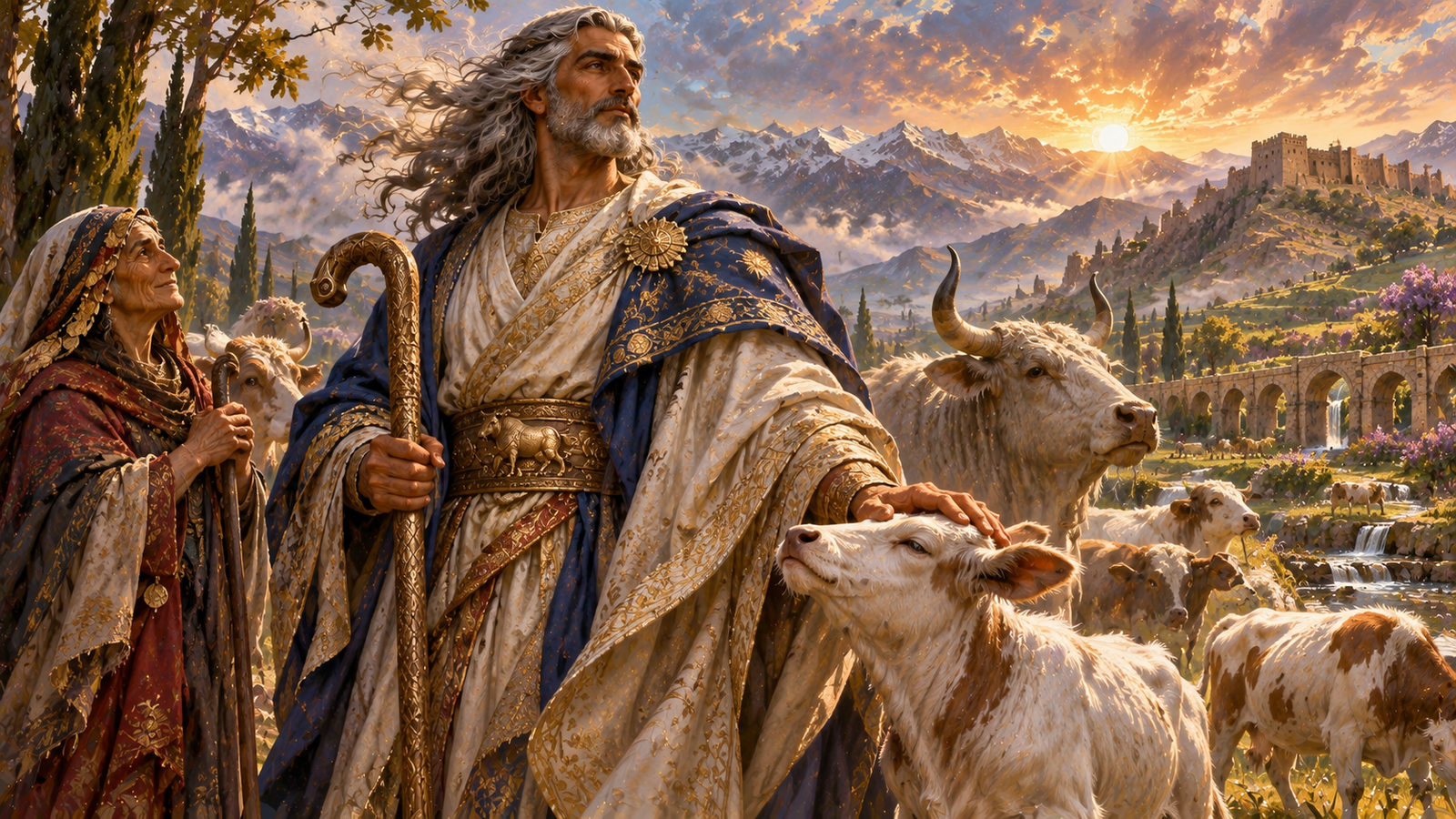
At a Glance
| Name | Vohu Manah; Middle Persian Wahman, New Persian Bahman |
|---|---|
| Title | Good Mind or Good Thought; one of the Six Amesha Spentas |
| Tradition | Avestan and Zoroastrian Iranian traditions |
| Alignment | Lawful Good — wise choice, compassion and care in action |
| Divine relationship | Closely associated with Ahura Mazda and Asha Vahishta; opposed by Aka Manah (Evil Thought) |
| Portfolio | Good judgement, beneficent animals, cattle, ethical intention, welcome of the righteous |
| Realm | The Meadow of Good Thought, a celestial estate within Garōdmān |
| Sacred signs | The calm ox, a welcoming hand, clear eyes, a path through untrampled pasture |
| Followers | Herd guardians, thoughtful judges, travellers, healers of animals and caretakers of the vulnerable |
| Domains | D&D 2024: Life; D&D 2014: Knowledge; Pathfinder 1e and D&D 3.5e: Good, Knowledge |
| Campaign year | 1454 CE |

The first good thought is not the end of wisdom. It is the beginning of a good deed.
At the edge of a spring-fed pasture, the last cow in the herd refuses to drink. Its keeper, grey with exhaustion, says the animal has always known the mountain paths better than he. A caravan master offers silver if the road is opened immediately. Above the meadow, a clear-eyed stranger waits until someone asks why the water smells of bitter stone.
Vohu Manah does not arrive as a king demanding tribute. He makes the right question impossible to ignore: whom will the choice protect, and who will suffer when it is made? His servants are companions to people who preserve the living creation through good judgement, practical kindness and the courage to look honestly at their own intentions.
The Meaning of Good Mind
Vohu Manah is both a way of thinking and a divine being. In the Gathas, good thought is the ethical disposition through which human beings recognise their duties and choose to fulfil them. In later Avestan and Middle Persian traditions, Good Mind becomes a more distinctly personified member of the Bounteous Immortals, an adviser, protector and welcoming presence among righteous souls.
He is not merely the deity of cleverness, scholarship or a high Intelligence score. A brilliant plan that betrays a trust or destroys a pasture is not wise in his sight. Thought becomes good when understanding leads to humane action. A peasant who takes care over one sick calf may be closer to his purpose than a sage who knows the names of every star but ignores a hungry village.
Vohu Manah is especially associated with beneficent animals and cattle in later religious tradition, while the earliest texts speak of good intention and the protection of the herdsman in more closely interwoven terms. The image of the living cow stands for patient service, nourishment, mutual care and the peace that predatory raiding threatens.
Ahura Mazda is named as his father in some Gathic passages, but this is not a licence to invent a literal royal dynasty with quarrelling offspring. The Six Amesha Spentas belong together in the care of the good creation. The evil thought opposed to Vohu Manah is Aka Manah (Akoman in Middle Persian); it is not identical to every daeva or to Angra Mainyu himself.
What Is Happening in 1454?
In the Iranian uplands, herders have driven their animals to a valley once held in common. An armed household has fenced the spring, arguing that it can protect the water more efficiently than the families who have used it for generations. Its soldiers offer the villages grain in exchange for permanent obedience. At night the oldest ox bellows whenever a cart passes the eastern gate.
The valley’s dispute is not solved by a document, a toll or a clever decree. The springs upstream have been poisoned by the abandonment of a mine. The soldiers themselves are desperate for drinking water. Vohu Manah’s followers offer a harder choice: expose the source of the harm, make the mine safe, reopen the channels and give every household a share in the repair.
Elsewhere in Persia and the eastern caravan regions, animal healers and good-minded witnesses travel between settlements. Their aid may be welcomed, ignored or mistaken for weakness. The presence of armies, orc successor households and competing princes does not turn this divine tradition into a faith belonging to only one people or ruler.
Divine Relationships and Adversaries
Ahura Mazda is the Wise Lord who upholds the good creation. Vohu Manah exemplifies the disposition required to serve it. Asha Vahishta, the embodiment of Best Truth and right order, acts alongside him: wise intention without truthful action can become self-deception.
Mithra protects covenants, but an oath can bind only those who understand what they have promised. Anahita and Tishtrya protect water and rain that sustain livestock. Haurvatat guards wholeness and water, while Ameretat preserves plants. These powers cooperate without losing their separate identities.
Aka Manah tries to make each merciful choice appear foolish and every act of exploitation look necessary. Angra Mainyu profits from this corruption, but Good Mind is not defeated simply because one mortal makes a mistake. The danger is in accepting harmful thought as permanent truth.
Followers and Sacred Duties
His worshippers are neither a secretive college of philosophers nor a single caste of shepherds. The best teachers join clear reasoning to practical service. A hereditary keeper knows which grazing lands must rest; a travelling healer notices the animals that have stopped feeding; a merchant does not hide disease in a herd before selling it to a neighbouring village.
Gifts and Favour
A devotee may receive a warning through an animal’s refusal to move, a moment of clarity about a deceptive offer, or the trust of frightened creatures. These are signs, not guarantees. The faithful must examine evidence and take responsibility for mistakes.
Failures and Restitution
Deliberate cruelty to animals, starvation used as leverage, and wilful ignorance of another’s suffering offend Good Mind. An offender who admits wrongdoing and works to repair it may earn renewed trust. A ritual gift without changed conduct has no power to purchase it.
The Meadow of Good Thought
On the approaches to the House of Song lies a pasture of clear streams and undisturbed grass. No predator hunts merely for pleasure. The souls of the truthful are welcomed here, not by a magistrate reading charges but by an attentive presence who remembers how each person’s understanding grew through their deeds.
Estate Effects
- A creature that sincerely asks how to repair harm it has caused hears one truthful, practical suggestion within its ability to attempt. The estate does not compel anyone to obey.
- Beneficent animals are free from ordinary hunger and fear while within the meadow, but may choose to depart.
- A visitor who deliberately deceives a dependent companion sees its own reflection turn away in the clear water, until it acknowledges the deception.
Regional Effects
- Within six miles of a sanctuary of Good Mind, frightened cattle are easier to calm; Wisdom (Animal Handling) checks made to protect them receive Advantage, not those made to force them into danger.
- A neglected animal may lead a compassionate traveller toward someone needing aid.
- At dawn, those who knowingly betrayed a dependant dream of an empty pasture and wake remembering the person or creature they failed.
Four Adventures of Good Mind
The Last Calf of the High Valley
A rare white calf is the only survivor of a herd that disappeared overnight. Its tracks lead to an abandoned mine and a trapped family. The party can save the family, recover the herd and expose the mine’s poisonous runoff, but the valley’s armed guards would rather burn the evidence. Reward: the calf’s keeper offers a blessing that once lets a character calm a frightened herd without a roll.
The Feast No One Will Eat
A governor commands a festival after a poor harvest. The cattle refuse food brought from the palace, and the villagers blame a curse. A grain merchant has mixed bitter fungus into the stores and offered a miracle cure at ten times the price. Reward: a travelling healer becomes a loyal contact. Failure: a needless famine follows the celebration.
The Second Thought
A young judge can see two versions of every choice: one glorious for herself, one survivable for the people before her. The flattering vision belongs to Aka Manah. Characters must recover testimony from people too frightened to speak openly, and show her a third path involving shared sacrifice. Reward: one honest judgement restores a whole town’s confidence in its elders.
The Welcome of the Dead
At the Chinvat Bridge, a warrior who once spared a village refuses to recall the cruelty that made his victory possible. Vohu Manah waits to welcome the good deeds, but the soul cannot pass by forgetting the harmed. The characters must find the living witnesses and bring the full account to the crossing. Reward: a celestial guide grants safe passage through a perilous mountain pass.
Relics, Companions and Omens
The Bell of the Returning Herd: an original campaign relic that rings softly when a domesticated animal within 300 feet is trapped or wounded; it has no power to locate a person. The Staff of Clear Counsel: three times each dawn, its bearer may gain Advantage on an Insight check made to understand a frightened or distressed creature. The Golden Threshold: a celestial gatekeeper who welcomes truthful souls to the Meadow of Good Thought and refuses bribes, inherited rank and appeals to personal glory.
A herd that chooses a different path, an exhausted animal that lies down before danger, or a stranger who listens before giving advice may all carry Vohu Manah’s influence. Not every strange animal is a divine messenger; a patient investigation remains part of good judgement.
Divine Domains and Domain Spells
Clerics devoted to Good Mind may emphasise protection and repair, or careful judgement and learning. The following choices use the named game’s existing domains rather than inventing a single shared spell table.
D&D 2024 — Life Domain
| Cleric level 3 | Aid, Bless, Cure Wounds, Lesser Restoration |
|---|---|
| Cleric level 5 | Mass Healing Word, Revivify |
| Cleric level 7 | Aura of Life, Death Ward |
| Cleric level 9 | Greater Restoration, Mass Cure Wounds |
D&D 2014 — Knowledge Domain
| Cleric level 1 | Command, Identify |
|---|---|
| Cleric level 3 | Augury, Suggestion |
| Cleric level 5 | Nondetection, Speak with Dead |
| Cleric level 7 | Arcane Eye, Confusion |
| Cleric level 9 | Legend Lore, Scrying |
Pathfinder 1e — Knowledge and Good
Choose two eligible domains. A Knowledge cleric seeks truth through inquiry; a Good cleric protects what is living and beneficent.
| Spell level | Knowledge | Good |
|---|---|---|
| 1 | comprehend languages | protection from evil |
| 2 | detect thoughts | align weapon (good only) |
| 3 | speak with dead | magic circle against evil |
| 4 | divination | holy smite |
| 5 | true seeing | dispel evil |
| 6 | find the path | blade barrier |
| 7 | legend lore | holy word |
| 8 | discern location | holy aura |
| 9 | foresight | summon monster IX (good only) |
D&D 3.5e — Knowledge and Good
The 3.5e Knowledge list differs at first and third spell level; do not import the Pathfinder substitutions.
| Spell level | Knowledge | Good |
|---|---|---|
| 1 | detect secret doors | protection from evil |
| 2 | detect thoughts | align weapon (good only) |
| 3 | clairaudience/clairvoyance | magic circle against evil |
| 4 | divination | holy smite |
| 5 | true seeing | dispel evil |
| 6 | find the path | blade barrier |
| 7 | legend lore | holy word |
| 8 | discern location | holy aura |
| 9 | foresight | summon monster IX (good only) |
Manifestation — Game Statistics
These combat rules describe a manifestation of Good Mind, not the entirety of the Amesha Spenta. Destroying a manifested form does not erase wisdom, end its celestial office or kill the immortal being.
Vohu Manah — Manifestation of Good Mind
Huge Celestial (Deity), Lawful Good
AC 25 (divine protection); Initiative +7 (17); HP 560 (32d12 + 352); Speed 40 ft., Fly 80 ft. (Hover)
| STR | DEX | CON | INT | WIS | CHA |
|---|---|---|---|---|---|
| 30 (+10) | 24 (+7) | 32 (+11) | 36 (+13) | 38 (+14) | 34 (+12) |
Saving Throws Str +20, Dex +17, Con +21, Int +23, Wis +24, Cha +22; Skills Animal Handling +34, Insight +34, Medicine +24, Perception +24; Resistances Cold, Fire, Lightning; Immunities Necrotic, Poison; Condition Immunities Charmed, Frightened, Poisoned; Senses Truesight 120 ft., Passive Perception 34; Languages All, Telepathy 120 ft.; CR 33 (custom epic manifestation, no standard XP value); PB +10.
Legendary Resistance (4/Day). On failing a saving throw, the manifestation can choose to succeed instead. Magic Resistance. Advantage on saving throws against spells and magical effects.
Good Counsel. Friendly creatures within 30 feet have Advantage on saving throws against the Charmed or Frightened conditions.
Actions
Multiattack. The manifestation makes three Staff of Good Mind attacks. Staff of Good Mind. Melee Attack Roll: +20, reach 15 ft. Hit: 32 (4d10 + 10) Force plus 22 (4d10) Radiant damage. Clarity of Thought (Recharge 5–6). Each hostile creature of choice within a 90-foot Emanation must succeed on a DC 32 Wisdom saving throw or take 63 (14d8) Radiant damage and be unable to make Opportunity Attacks until the end of its next turn; success halves damage and avoids that restriction.
Bonus Actions
Restore the Vulnerable (3/Day). One creature within 120 feet regains 90 Hit Points and can immediately repeat a saving throw against a Charmed or Frightened condition with Advantage.
Reactions
Protect the Defenceless. Trigger: a creature the manifestation sees within 60 feet takes damage. Response: reduce the damage by 45 (10d8); the protected creature may move up to 10 feet without provoking Opportunity Attacks.
Legendary Actions
Three each round, one at a time immediately after another creature’s turn; regain all at the start of its turn. Clear Sight (1): reveal one illusion within 120 feet as an illusion to creatures of choice. Staff Strike (2): make one Staff of Good Mind attack. Renewing Word (3): restore 45 (10d8) Hit Points to one creature within 120 feet.
Vohu Manah — Avatar of Good Mind
Huge celestial, lawful good
Armor Class 25 (divine protection); Hit Points 528 (32d12 + 320); Speed 40 ft., fly 80 ft. (hover)
| STR | DEX | CON | INT | WIS | CHA |
|---|---|---|---|---|---|
| 30 (+10) | 24 (+7) | 30 (+10) | 34 (+12) | 36 (+13) | 34 (+12) |
Saving Throws Str +19, Dex +16, Con +19, Int +21, Wis +22, Cha +21; Skills Animal Handling +31, Insight +31, Medicine +22, Perception +22; Damage Resistances cold, fire, lightning; Damage Immunities necrotic, poison; Condition Immunities charmed, frightened, poisoned; Senses truesight 120 ft., passive Perception 32; Languages all, telepathy 120 ft.; Challenge 30 (custom epic manifestation).
Legendary Resistance (4/Day). If the avatar fails a saving throw, it can choose to succeed instead. Magic Resistance. The avatar has advantage on saving throws against spells and other magical effects.
Actions
Multiattack. The avatar makes three Staff of Good Mind attacks. Staff of Good Mind. Melee Weapon Attack: +19 to hit, reach 15 ft., one target. Hit: 32 (4d10 + 10) force plus 22 (4d10) radiant damage. Mind Made Clear (Recharge 5–6). Each hostile creature of choice within 90 feet makes a DC 30 Wisdom saving throw, taking 54 (12d8) radiant damage on failure, or half on success. A creature failing cannot make opportunity attacks until the end of its next turn. Restorative Touch (3/Day). One creature within 120 feet regains 90 hit points and can immediately repeat a saving throw against being charmed or frightened with advantage.
Reactions
Compassionate Intercession. When an ally within 60 feet takes damage, the avatar reduces it by 36 (8d8).
Legendary Actions
Three each round, one at a time at the end of another creature’s turn. Insight (1): detect one hidden or illusory creature within 120 feet. Staff (2): make one Staff of Good Mind attack. Mercy (3): restore 36 (8d8) hit points to a creature within 120 feet.
Vohu Manah, Emanation of Good Thought — CR 30
XP epic/custom; LG Huge outsider (extraplanar, good, lawful); Init +11; Senses darkvision 60 ft., true seeing, Perception +48; Aura good counsel (30 ft.)
DEFENSE AC 45, touch 29, flat-footed 38 (–2 size, +7 Dex, +16 natural, +8 deflection, +6 sacred); hp 496 (32d10+320); Fort +28, Ref +25, Will +31; DR 20/epic and evil; Immune fear, poison; Resist cold 20, electricity 20, fire 20; SR 41.
OFFENSE Speed 40 ft., fly 80 ft. (perfect); Space 15 ft.; Reach 15 ft.; Melee +5 sacred sceptre +45/+40/+35/+30 (3d6+15 plus 2d6 holy damage against evil creatures); Special Attacks renewing counsel, wakeful judgement; Spell-Like Abilities (CL 32nd; concentration +44): constant—true seeing, tongues; at will—calm emotions (DC 24), discern lies (DC 25), greater dispel magic, heal, speak with animals; 3/day—greater restoration, holy aura (DC 30), mass heal; 1/day—miracle (healing or guidance effects only).
STATISTICS Str 30, Dex 24, Con 30, Int 34, Wis 36, Cha 34; Base Atk +32; CMB +44; CMD 75; Feats Alertness, Blind-Fight, Combat Casting, Combat Reflexes, Dodge, Great Fortitude, Improved Initiative, Iron Will, Lightning Reflexes, Power Attack, Skill Focus (Sense Motive), Skill Focus (Handle Animal), Toughness, Weapon Focus (heavy mace), Improved Critical (heavy mace), Improved Bull Rush; Skills Diplomacy +47, Handle Animal +48, Heal +48, Knowledge (nature) +47, Perception +48, Sense Motive +48; Languages all, telepathy 120 ft.
SPECIAL ABILITIES Good Counsel (Su): allies within 30 feet gain +4 sacred bonus on saving throws against charm and fear effects. Renewing Counsel (Su, 3/day): standard action; one creature within 120 feet heals 90 hit points and may immediately attempt a new saving throw against a charm or fear effect. Wakeful Judgement (Su, 3/day): enemies of the emanation within 60 feet make Will saves (DC 38) or take 12d8 holy damage and lose the ability to make attacks of opportunity for 1 round; success halves damage. Save DC is Charisma-based (10 + one-half HD + Cha modifier).
Domains Good, Knowledge.
Vohu Manah, Manifested Good Thought — CR 30
LG Huge outsider (extraplanar, good, lawful); Hit Dice 32d8+320 (464 hp); Initiative +11; Speed 40 ft., fly 80 ft. (perfect); Armor Class 45 (–2 size, +7 Dex, +16 natural, +8 deflection, +6 sacred), touch 29, flat-footed 38; Base Attack/Grapple +32/+50; Attack +5 holy sceptre +45 melee (3d6+15 plus 2d6 holy damage against evil creatures); Full Attack +5 holy sceptre +45/+40/+35/+30 melee (3d6+15 plus 2d6 holy damage against evil creatures); Space/Reach 15 ft./15 ft.
Special Attacks clear judgement, spell-like abilities; Special Qualities DR 20/epic and evil, darkvision 60 ft., immunity to fear and poison, resistance to cold 20, electricity 20 and fire 20, SR 41, true seeing; Saves Fort +28, Ref +25, Will +31; Abilities Str 30, Dex 24, Con 30, Int 34, Wis 36, Cha 34; Skills Diplomacy +47, Handle Animal +48, Heal +48, Knowledge (nature) +47, Listen +48, Sense Motive +48, Spot +48; Feats Alertness, Blind-Fight, Combat Casting, Combat Reflexes, Dodge, Great Fortitude, Improved Initiative, Iron Will, Lightning Reflexes, Power Attack, Skill Focus (Sense Motive), Skill Focus (Handle Animal), Toughness, Weapon Focus (heavy mace), Improved Critical (heavy mace), Improved Bull Rush; Environment celestial meadow; Organization solitary or accompanied by benevolent guardians; Challenge Rating 30 (custom epic); Treasure none; Alignment always lawful good; Advancement —
Spell-Like Abilities (caster level 32nd): at will—calm emotions (DC 24), discern lies (DC 25), greater dispel magic, heal, speak with animals; 3/day—greater restoration, holy aura (DC 30), mass heal; 1/day—miracle (healing or guidance effects only).
Clear Judgement (Su). Three times per day, as a standard action, all hostile creatures of the manifestation’s choice within 60 feet take 12d8 holy damage (Will DC 38 half); a target failing the save cannot make attacks of opportunity for one round. This is a supernatural, mind-affecting compulsion; save DC is Charisma-based (10 + 1/2 HD + Cha modifier).
Domains Good, Knowledge.
Historical Sources and Campaign Interpretation
Vohu Manah is part of a living religious tradition. The personification of Good Mind, his connection to cattle and his welcoming of righteous souls are grounded in Avestan and later Iranian sources; the painted appearance, celestial meadow encounters, relics and RPG statistics are original campaign interpretations. The later special guardianship of cattle should not be read backward as an identical doctrine in every early Gathic passage.
Keep this reference growing
If this page helped with your reading or game, you can support its upkeep or explore the curated books.
Explore the Bookshop — epics, classics and stories behind imagined worlds.