
Angra Mainyu — the Destructive Spirit and Lord of the Lie
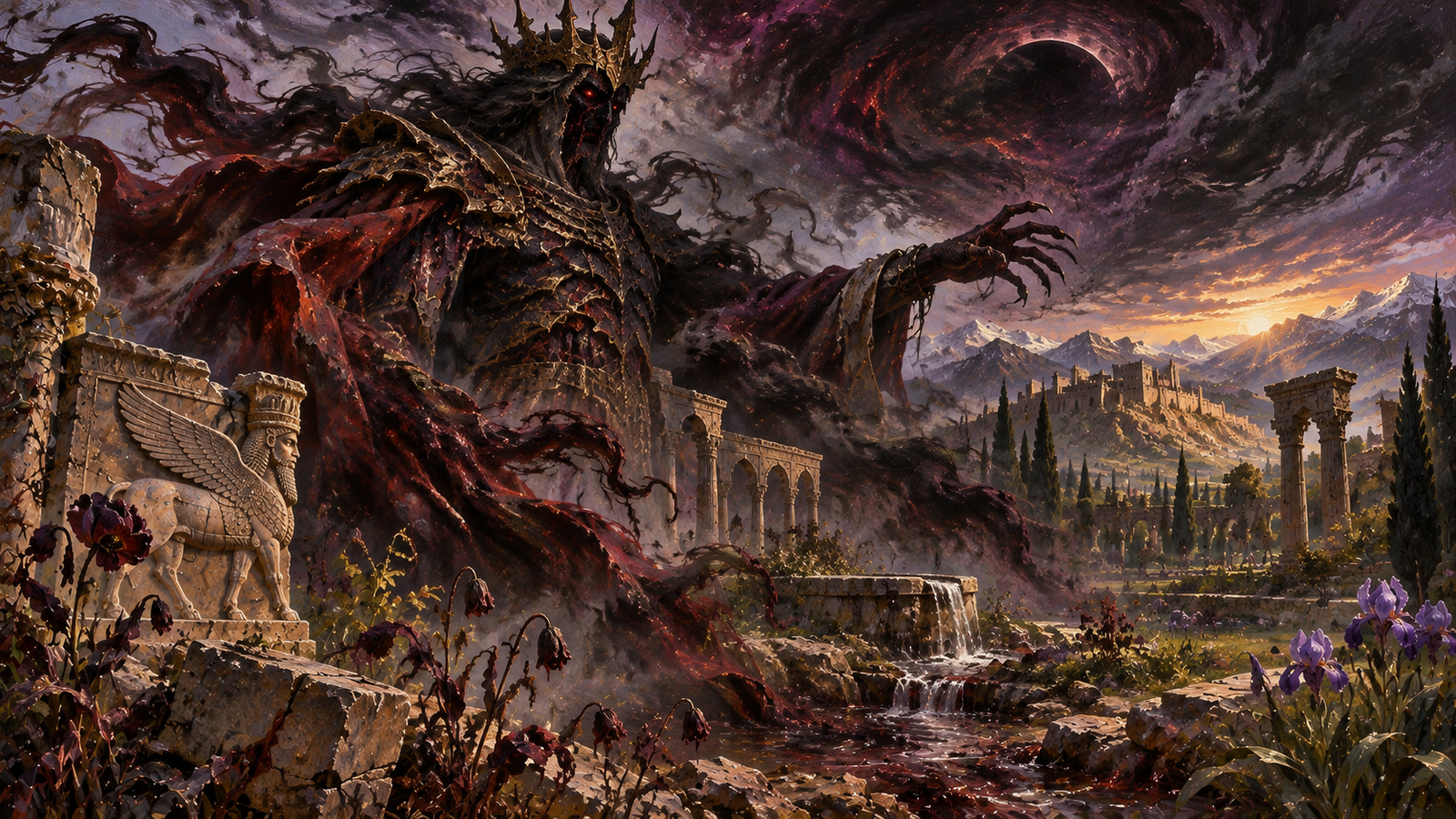
At a Glance
| Name | Angra Mainyu (Ahriman; Middle Persian: Ahreman) |
|---|---|
| Nature | Destructive spirit; antagonist in the Iranian religious cosmology |
| Alignment | Chaotic Evil — hostile to truth, flourishing and the order that sustains life |
| Portfolio | The Lie (druj), desecration, decay, deliberate cruelty, corruption and ruin |
| Opposes | Ahura Mazda, Spenta Mainyu, the Amesha Spentas and the yazatas |
| Associated powers | Daevas, agents of the Lie; no claim that all were originally created by him |
| Divine realm | A self-fashioned region of darkness and corruption; placed on the borders of Abaddon in the fantasy setting, not identified with all of Abaddon |
| Sacred sign | An invented broken black ring surrounding a descending crimson fissure |
| Clerical domains | 2024 and 2014: Trickery; Pathfinder 1e and D&D 3.5e: Chaos, Evil, Destruction, Trickery |
| Favoured weapon | Cruel black sceptre; campaign convention, not a documented historical cult weapon |
| Campaign year | 1454 CE |

A World Taught to Welcome the Lie
The cruelest victory is not to burn the city. It is to persuade its people that cruelty is how cities survive.
A desert town’s wells are drying. Its new keeper has found a solution: the wells run again whenever a family gives up someone accused of dishonesty. The water grows clear as the prisoners vanish. When the player characters arrive, townspeople defend the bargain as practical and fair. They cannot see the black sediment forming around the stones.
The spirit behind the bargain has no need to appear in person. Angra Mainyu’s greatest strength is to turn ordinary fears into justifications for deliberate evil. The confrontation begins with a question of who is harmed and who profits; battle follows only when the truth has a chance to survive.
The Destructive Spirit in Iranian Tradition
In the Gathic texts, Angra Mainyu is the destructive or hostile spirit whose choice stands against Spenta Mainyu, the Bounteous Spirit. In later Zoroastrian cosmology, Ahriman is the great adversary of Ohrmazd, opposing good creation and acting through demons, destructive forces and the Lie. These accounts should not be collapsed into a single, unchanging genealogy. Zurvanite claims that Time produced both opposing principles remain a distinct tradition rather than a universal premise.
Druj is the Lie in the sense of falsehood and moral disorder, not a single spell that forces every victim to be dishonest. The daevas stand among those who turn to deceit and hostile action. Some texts relate them to Evil Thought rather than describing Angra Mainyu straightforwardly as their creator. His armies are therefore an alliance of destructive spirits, corruptors and willing servants, not a biological family.
Where the Wise Lord’s followers preserve good thought, speech and action, Angra Mainyu cultivates the opposite: corrupt intention, deliberate deception and injury that makes further injury seem necessary. The world is not already his. The promise of final renovation means his apparent victories are neither inevitable nor permanent.
Allies, Enemies and False Kinships
Ahura Mazda and Spenta Mainyu
His great opposition is to the good creation and to the beneficent spirit. A failed harvest is useful to him not because hunger is inherently evil, but because desperate people may then betray each other. He does not hold a legitimate seat on the Wise Lord’s council.
The Amesha Spentas
He attacks each sacred concern at its vulnerable human boundary: Vohu Manah by turning sound judgement into panic, Asha Vahishta by bribing judges and defiling fire, Khshathra Vairya by exalting tyranny, Spenta Armaiti through wasted and poisoned earth, Haurvatat through polluted waters, and Ameretat through blight.
The Yazatas and the Daevas
Sraosha resists malicious spirits at night; Mithra unmasks broken promises; Rashnu cannot be bribed at the Chinvat Bridge; Tishtrya defeats Apaosha and brings rain. The divs and other ruin-making entities can act in Angra Mainyu’s interest without sharing a single species, identity or rank. Akvan Div and Vaporighu are concrete threats for a party.
Not a Persian Lord of Hell
Angra Mainyu is not Asmodeus, Lucifer, a Duke of Hell, or a convenient name for every devil. His destructive opposition belongs to the Iranian sacred drama. His campaign estate can touch Abaddon without absorbing the Nine Hells, the Abyss or every other hostile power into his domain.
What Is Happening in 1454?
In the Iranian highlands, the memory of conquest still shapes the security of cities and mountain villages. Court claimants recruit scribes to certify fraudulent inheritances; hungry garrisons seize irrigation channels; frightened caravans offer false testimony to avoid a levy. A corrupt official can do the spirit’s work without ever seeing a demon.
The Ashen Reed Circle infiltrates water administrations and encourages punishment of inconvenient witnesses. The Black Accountants sell fabricated genealogies to pretenders, then hunt the people capable of disproving them. The Night-Seeders poison orchards and blame neighbouring villages, provoking raids that destroy the surviving crops. These are original campaign factions, not historical Zoroastrian institutions.
The spirit’s influence should be concentrated in identifiable sites, people and choices. A priest sheltering the hungry can be a genuine ally; neither an entire region nor every practitioner of another faith becomes evil through association.
The Waste of Unmaking — Divine Estate
The Waste of Unmaking is a shadowed border-realm where every apparent refuge exacts a price. Rivers run clear until a traveller tries to share them. Trees bear immaculate fruit whose seeds kill the soil. At the centre stands a council hall built from stolen names, where Ahriman’s manifestations debate which hope to corrupt next. In the campaign cosmology this estate borders Abaddon , but remains a distinct Iranian pocket domain rather than a reassignment of all that plane’s lore.
Estate Effects
- Division’s echo. A spoken deliberate falsehood rings with a pleasing second voice; listeners may mistake it for consensus until they compare testimony with physical evidence.
- Rot without hunger. Food left untended spoils rapidly. Fresh nourishment shared freely resists this influence for one day.
- Road of accusations. Waymarkers point travellers toward the person they most distrust; a guide who names an honest destination aloud can resist the effect.
Regional Effects
- Within six miles of an active corrupted shrine, bad dreams provoke suspicion, but do not remove a creature’s free will.
- Water near a deliberate atrocity becomes dark and bitter until the physical contamination is found and removed.
- A ruler who condemns an innocent witness hears their testimony repeated in every great hall for three nights.
These effects fade after the responsible corruption is exposed and its victims helped. No ritual automatically absolves the guilty without restitution.
Followers, Cults and the Cost of Favour
The spirit’s mortal devotees rarely advertise themselves as servants of destruction. They claim that deception is wiser than honesty, that famine justifies any seizure, and that survival proves righteousness. A few openly worship ruin; others choose wickedness because they enjoy dominance. Those who resist him may be frightened, mistaken or selfish without being evil outsiders.
Hierarchy
False witnesses serve local corrupters. These gather around nightmare envoys and divs, who compete for favour with the greater manifestations. Rank brings no lasting safety: failures are blamed on subordinates, victories stolen by superiors, and every alliance relies on betrayal.
Rewards and Punishments
A follower might receive immunity to one disease, an illusory disguise, or knowledge of a neighbour’s secret. The benefit is real and its cost cumulative: the servant must betray those who depended on them. A cultist who tries to leave is offered one final bargain; an adventuring party can break the trap by making the promised harm impossible rather than slaughtering every compromised recruit.
Four Adventures of the Lie
The Well That Wants a Prisoner
The water runs when the council condemns an innocent person. A submerged div is opening a second hidden channel, not working a miracle. Discover the source, protect the accused and repair the abandoned aqueduct. Failure: the executions become an accepted seasonal custom.
Records of the Black Accountants
Three claimants possess identical royal seals, and all three accuse the same elderly scribe. Find the living witnesses, the stamp-maker and the original archive before a claimant’s mercenaries burn the town. Success: a bloodless settlement. Failure: a war fought on forged ancestry.
The Orchard Under Ash
A valley’s fruit spoils overnight. An herbalist discovers an unnatural seed traded by the Night-Seeders, but a militia blames a rival village. Destroying the monster without stopping the imminent raid will still produce the enemy’s victory.
Judgement at the Wrong Bridge
A dead captain’s ghost appears to be held at Chinvat, but his testimony has been stolen into the Waste of Unmaking. Recover his true deeds, then let Rashnu judge him rather than manufacturing a heroic acquittal. Reward: a faithful witness as an ally.
Relics, Servants and Countermeasures
The Black Ledger: an original cursed book that copies a written confession into any nearby blank page; each copying also falsifies one factual detail. The forgery can be caught by comparing dates with material records. Severing Seed: a black kernel that ruins one tree when planted, though the victim tree can be saved by carefully removing the root infestation. The Sundered Ring: a cult token that confers one use of disguise self per day but brands a knowing betrayer’s palm with a dark stain visible in sacred fire.
Counterplay relies on protection of witnesses, restitution, clean water, trusted records and ordinary kindness in addition to divine spells. A high-level party should be able to foil the spirit’s scheme even when a manifestation survives the encounter.
Clerical Domains and Domain Spells
These are optional cult mechanics for adversaries, not a moral endorsement. A cleric may refuse service and keep their normal class abilities according to the chosen rules system. Domain spell lists are kept separate by edition.
D&D 2024 — Trickery Domain
| Cleric level 3 | Charm Person, Disguise Self, Invisibility, Pass without Trace |
|---|---|
| Cleric level 5 | Hypnotic Pattern, Nondetection |
| Cleric level 7 | Confusion, Dimension Door |
| Cleric level 9 | Dominate Person, Modify Memory |
The 2024 Trickery Domain is the closest official cleric option for deception. A cultist need not receive a separate new subclass. Exact spells and features follow the 2024 version.
D&D 2014 — Trickery Domain
| Cleric level 1 | Charm Person, Disguise Self |
|---|---|
| Cleric level 3 | Mirror Image, Pass without Trace |
| Cleric level 5 | Blink, Dispel Magic |
| Cleric level 7 | Dimension Door, Polymorph |
| Cleric level 9 | Dominate Person, Modify Memory |
Pathfinder 1e — Chaos, Evil, Destruction, Trickery
Clerics select two permitted domains; Chaos and Evil require matching alignment. Domain powers and spells use Pathfinder 1e class rules.
| Level | Chaos | Evil | Destruction | Trickery |
|---|---|---|---|---|
| 1 | protection from law | protection from good | true strike | disguise self |
| 2 | align weapon (chaos only) | align weapon (evil only) | shatter | invisibility |
| 3 | magic circle against law | magic circle against good | rage | nondetection |
| 4 | chaos hammer | unholy blight | inflict critical wounds | confusion |
| 5 | dispel law | dispel good | shout | false vision |
| 6 | animate objects | create undead | harm | mislead |
| 7 | word of chaos | blasphemy | disintegrate | screen |
| 8 | cloak of chaos | unholy aura | earthquake | mass invisibility |
| 9 | summon monster IX (chaos only) | summon monster IX (evil only) | implosion | time stop |
D&D 3.5e — Chaos, Evil, Destruction, Trickery
Separate 3.5e cleric domains follow the 3.5e rules; Trickery has polymorph any object at eighth level, unlike the Pathfinder list.
| Level | Chaos | Evil | Destruction | Trickery |
|---|---|---|---|---|
| 1 | protection from law | protection from good | true strike | disguise self |
| 2 | align weapon (chaos only) | align weapon (evil only) | shatter | invisibility |
| 3 | magic circle against law | magic circle against good | rage | nondetection |
| 4 | chaos hammer | unholy blight | inflict critical wounds | confusion |
| 5 | dispel law | dispel good | shout | false vision |
| 6 | animate objects | create undead | harm | mislead |
| 7 | word of chaos | blasphemy | disintegrate | screen |
| 8 | cloak of chaos | unholy aura | earthquake | polymorph any object |
| 9 | summon monster IX (chaos only) | summon monster IX (evil only) | implosion | time stop |
Manifestations — Four Rules Editions
Destroying a manifestation does not remove the cosmic principle of destruction. CRs beyond the published D&D 5e scale are custom epic estimates and must be playtested before publication.
Angra Mainyu — Voice of Unmaking
Huge Fiend (Deity), Chaotic Evil
AC 26 (blackened panoply); Initiative +15 (25); HP 700 (40d12 + 440); Speed 40 ft., Fly 80 ft. (Hover).
| STR | DEX | CON | INT | WIS | CHA |
|---|---|---|---|---|---|
| 28 (+9) | 24 (+7) | 32 (+11) | 34 (+12) | 30 (+10) | 38 (+14) |
Saving Throws Str +20, Dex +18, Con +22, Int +23, Wis +21, Cha +25; Skills Deception +36, Insight +21, Perception +21, Religion +23; Resistances Cold, Fire, Lightning; Immunities Necrotic, Poison, Psychic; Condition Immunities Charmed, Frightened, Poisoned; Senses Truesight 120 ft., Passive Perception 31; Languages All, Telepathy 240 ft.; CR 37 (custom epic estimate, no published XP); PB +11.
Legendary Resistance (5/Day). If the manifestation fails a saving throw, it can succeed instead. Magic Resistance. Advantage on saving throws against spells and magical effects. The Lie Beneath Speech. When a creature that can hear the manifestation fails a saving throw against its spell or ability, it has Disadvantage on its next Wisdom (Insight) check before the end of its next turn.
Actions
Multiattack. Three Sceptre of Ruin attacks. Sceptre of Ruin. Melee Attack Roll: +20, reach 15 ft. Hit: 35 (4d12 + 9) Necrotic plus 18 (4d8) Psychic. False Consensus (Recharge 5–6). Each enemy in a 60-foot Emanation makes a DC 33 Wisdom saving throw, taking 55 (10d10) Psychic damage on a failure, or half on a success. A creature that fails is Frightened until the end of its next turn. Pollute Creation (3/Day). One 30-foot-radius area of nonmagical water or growing plants within 120 feet becomes foul for 1 minute; creatures entering for the first time on a turn or starting there take 18 (4d8) Necrotic damage, DC 33 Constitution save for half.
Bonus Actions
Shadow Step. Teleport up to 60 feet to an unoccupied space it can see in Dim Light or Darkness.
Reactions
Turn the Accusation. When hit by an attack, the manifestation forces the attacker to succeed on a DC 33 Wisdom saving throw or take 14 (4d6) Psychic damage; the original hit still occurs.
Legendary Actions
Three actions, spent one at a time at the end of another creature’s turn, regained at the start of this creature’s turn. Mocking Whisper (1): One enemy within 120 feet takes 10 (3d6) Psychic damage. Sceptre (2): One Sceptre of Ruin attack. Corrupting Miasma (3): Creatures of its choice within 20 feet make DC 33 Constitution saves or gain the Poisoned condition until the end of their next turns.
Angra Mainyu — Avatar of the Lie
Huge fiend, chaotic evil
Armor Class 25 (natural armor); Hit Points 620 (40d12 + 360); Speed 40 ft., fly 80 ft. (hover)
| STR | DEX | CON | INT | WIS | CHA |
|---|---|---|---|---|---|
| 28 (+9) | 24 (+7) | 28 (+9) | 34 (+12) | 30 (+10) | 36 (+13) |
Saving Throws Str +20, Dex +18, Con +20, Int +23, Wis +21, Cha +24; Skills Deception +24, Insight +21, Perception +21; Damage Resistances cold, fire, lightning; Damage Immunities necrotic, poison, psychic; Condition Immunities charmed, frightened, poisoned; Senses truesight 120 ft., passive Perception 31; Languages all, telepathy 240 ft.; Challenge 37 (custom epic estimate)
Legendary Resistance (5/Day). A failed saving throw can become a success. Magic Resistance. Advantage on saves against spells and magical effects.
Actions
Multiattack. Three Black Sceptre attacks. Black Sceptre. Melee Weapon Attack: +20 to hit, reach 15 ft., one target. Hit: 35 (4d12 + 9) necrotic plus 18 (4d8) psychic. Whisper of Betrayal (Recharge 5–6). Each enemy of its choice within 60 feet makes a DC 32 Wisdom saving throw, taking 55 (10d10) psychic damage on a failure, half on success. A failure also frightens the target until the end of its next turn.
Legendary Actions
Three legendary actions, one after another creature’s turn; spent actions return at the beginning of its turn. Whisper (1): One creature within 120 feet takes 10 (3d6) psychic damage. Sceptre (2): Make one Black Sceptre attack. Blight (3): Each enemy within 20 feet makes DC 32 Constitution save or is poisoned until the end of its next turn.
Angra Mainyu — Emanation of Corruption
CR 35 (custom epic); XP epic/custom; CE Huge outsider (chaotic, evil, extraplanar); Init +11; Senses darkvision 60 ft., true seeing; Perception +51; Aura druj (60 ft., Will DC 32)
DEFENSE
AC 60, touch 30, flat-footed 53 (+7 Dex, +20 natural, +9 deflection, +6 profane, -2 size, +10 armour); hp 620 (40d10+400); Fort +33, Ref +29, Will +32; DR 20/epic and good; Immune poison, fear; Resist cold 30, fire 30, electricity 30; SR 46
OFFENSE
Speed 40 ft., fly 80 ft. (perfect); Melee +5 unholy sceptre +52/+47/+42/+37 (4d8+14 plus 4d6 unholy); Space 15 ft.; Reach 15 ft.; Special Attacks whisper of corruption, druj aura
Spell-Like Abilities (CL 35th; concentration +48): constant—true seeing, tongues; at will—bestow curse (DC 26), greater dispel magic, greater invisibility, nightmare (DC 28), unhallow; 3/day—blasphemy, destruction (DC 30), earthquake; 1/day—meteor swarm (DC 32), time stop.
STATISTICS
Str 28, Dex 24, Con 30, Int 34, Wis 30, Cha 36; Base Atk +40; CMB +51; CMD 83; Languages all; Skills Bluff +56, Intimidate +56, Knowledge (planes) +55, Perception +53, Sense Motive +53, Spellcraft +55; Feats Alertness, Blind-Fight, Combat Casting, Combat Reflexes, Critical Focus, Dodge, Great Fortitude, Improved Critical (heavy mace), Improved Initiative, Iron Will, Lightning Reflexes, Power Attack, Toughness, Weapon Focus (heavy mace), Improved Bull Rush, Quicken Spell-Like Ability (greater dispel magic), Combat Expertise, Improved Trip, Greater Trip, Skill Focus (Bluff).
SPECIAL ABILITIES
Druj Aura (Su). Every enemy that begins its turn within 60 feet must succeed at Will DC 43 or take a -4 penalty on Sense Motive and on saves against mind-affecting effects until the start of its next turn. This is a mind-affecting fear effect. Whisper of Corruption (Su). Three times per day as a standard action, each enemy within 60 feet takes 15d8 damage (Will DC 43 half), and a failed save also causes confusion for 1 round. The damage is a profane magical effect.
Domains Chaos, Evil, Destruction, Trickery; domain spells shown above.
Angra Mainyu — Shadow of the Lie
CE Huge outsider (chaotic, evil, extraplanar); Hit Dice 40d8+400 (580 hp); Initiative +11; Speed 40 ft., fly 80 ft. (perfect); Armor Class 60 (-2 size, +7 Dex, +20 natural, +9 deflection, +6 profane, +10 armour), touch 30, flat-footed 53; Base Attack/Grapple +40/+58; Attack +5 unholy sceptre +53 melee (4d8+14 plus 4d6 unholy); Full Attack +5 unholy sceptre +53/+48/+43/+38 melee (4d8+14 plus 4d6 unholy); Space/Reach 15 ft./15 ft.; Special Attacks unmaking word, spell-like abilities; Special Qualities DR 20/epic and good, immunity to poison and fear, resistance to cold 30, electricity 30 and fire 30, SR 46, true seeing
Saves Fort +32, Ref +29, Will +32; Abilities Str 30, Dex 24, Con 30, Int 34, Wis 30, Cha 36; Skills Bluff +56, Intimidate +56, Knowledge (the planes) +55, Listen +53, Sense Motive +53, Spellcraft +55, Spot +53; Feats Alertness, Blind-Fight, Cleave, Combat Casting, Combat Reflexes, Great Fortitude, Improved Critical (heavy mace), Improved Initiative, Iron Will, Lightning Reflexes, Power Attack, Quicken Spell-Like Ability (greater dispel magic), Toughness, Weapon Focus (heavy mace); Environment the Waste of Unmaking; Organization solitary or with div servants; Challenge Rating 35 (custom epic); Treasure none; Alignment always chaotic evil; Advancement —
Spell-Like Abilities (caster level 35th): at will—bestow curse (DC 26), greater dispel magic, greater invisibility, nightmare (DC 28), unhallow; 3/day—blasphemy, destruction (DC 30), earthquake; 1/day—meteor swarm (DC 32), time stop.
Unmaking Word (Su). Three times per day, a 60-foot-radius spread within 120 feet deals 15d8 unholy damage (Will DC 43 half) and leaves a failed target confused for 1 round. This is a supernatural mind-affecting compulsion; the save DC is Charisma-based.
Domains Chaos, Evil, Destruction, Trickery; 3.5e domain spells are distinct from Pathfinder 1e as shown above.
Historical Sources and Campaign Attribution
The destructive spirit is treated differently in the Gathas, Younger Avesta and Pahlavi literature. The portrait, estate, relics, cults, 1454 scenarios and epic manifestations here are original fantasy extrapolations. No claim is made that this material represents a practising community’s sacred rites or that the broken-ring emblem is archaeologically attested.
Keep this reference growing
If this page helped with your reading or game, you can support its upkeep or explore the curated books.
Explore the Bookshop — epics, classics and stories behind imagined worlds.