
Ashi Vanghuhi — Good Recompense and the Giver of Fortune
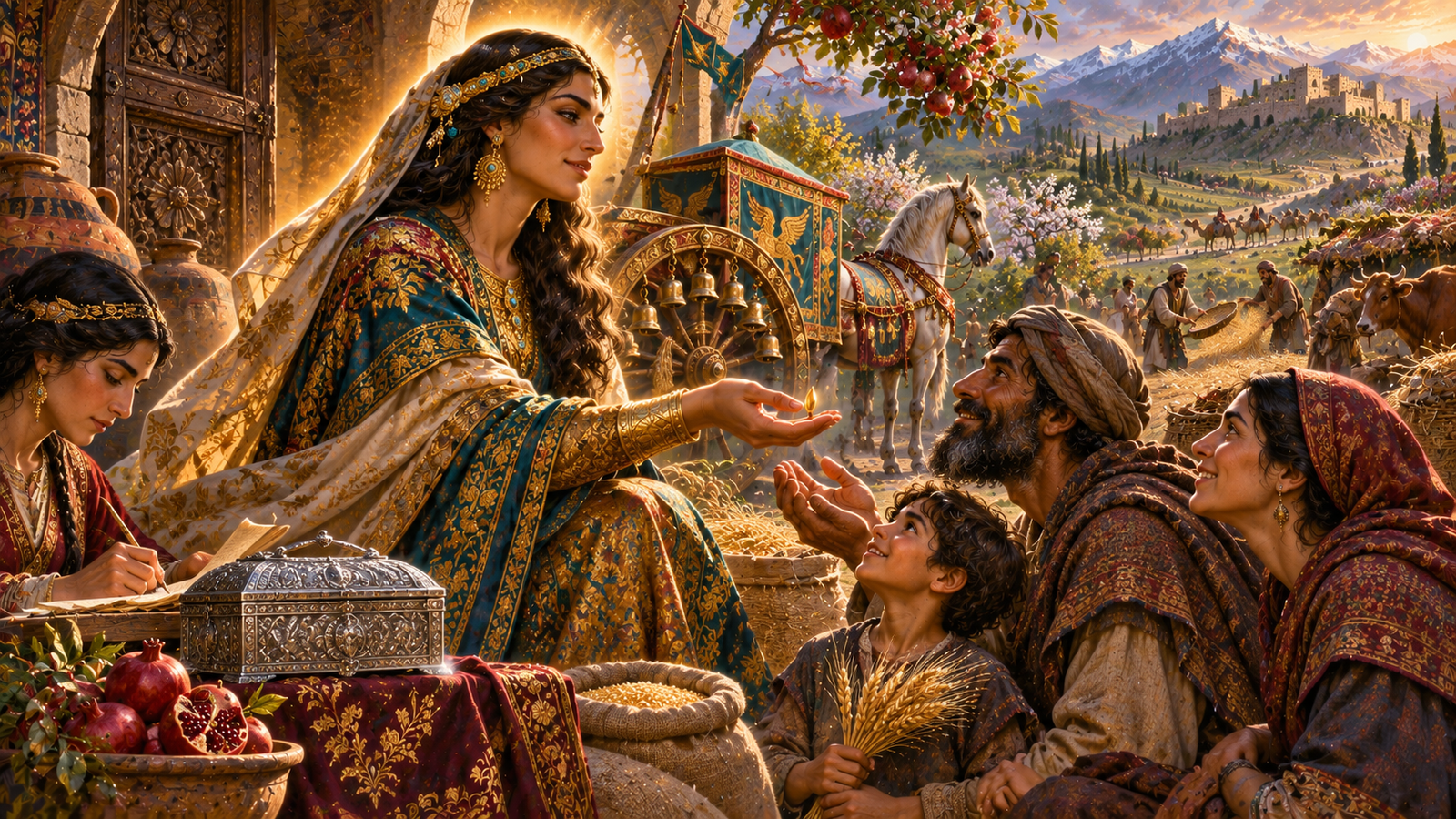
At the market gate a merchant discovers that the most valuable thing he owns cannot be kept in his strongbox.
Herat’s caravan road is choked with loaded mules. A silver merchant has promised his dying friend that the friend’s family will receive a caravan’s profit. The merchant’s partner has secretly bought grain from a famine-struck village, then raised the price beyond anyone’s reach. As wagons assemble, a woman in a blue and gold mantle approaches a labourer who has given away his wages to feed strangers. She places one seed in the man’s palm and tells him to plant it where the hungry can see. By dawn the merchant’s sealed account books tell a different story from the one he has sworn to his family. Ashi Vanghuhi has heard the invocation.
Also called Aši Vaŋuhī, Ard and Ahrišwang, she is the divine personification of good reward, fortunate recompense and the prosperity that follows right action. She can grant grain, fertile herds, treasure, beautiful things and clear understanding. Her greatest gifts are not random windfalls. They are the flourishing that ought to reach the people who have laboured, sheltered neighbours, kept faith or chosen generosity when it cost them something.
Adventurers may ask Ashi for gold. She may instead give them an opportunity to save a village, a chance to restore a household’s broken future, or the knowledge that allows them to refuse a tempting theft. This deity is not a counting-house official in divine dress: she loves generosity, the beauty of a well-tended home, hospitality, accomplished work and unexpected good fortune.
At a Glance
- Names
- Aši Vaŋuhī (Avestan), Ashi Vanghuhi, Ard, Ahrišwang, Ardušwang; Ardoxšo in related iconographic traditions
- Spheres
- Good recompense, fortunate prosperity, spiritual richness, wisdom, households, grateful generosity and a flourishing livelihood
- Alignment
- Neutral Good — generous with deserved blessings; unmoved by greed or attempts to purchase holiness
- Symbols
- Full grain measure, flowering branch, well-travelled chariot, radiant star and horn of plenty (the last used for this campaign emblem, not asserted as an Avestan seal)
- Kindred
- Daughter of Ahura Mazda and Spenta Armaiti; siblings named in Yašt 17 include Mithra, Sraosha, Rashnu and Daena
- Opposition
- Deliberate hoarding during hunger, cruelty to dependants, treachery against a guest and wealth obtained by dispossessing the helpless
- Worshippers
- Householders, travellers, healers, harvest workers, generous merchants and people trying to rebuild after loss
- Divine estate
- The Singing Granaries, a store of memory, seed and thanksgiving opening upon an orchard road
- Relic
- The Seed-Purse That Returns
- Campaign present
- 1454 CE; blessings and their consequences are active throughout the Iranian trade roads

Ashi in Iranian Tradition
The Avestan noun aši denotes an allotted portion, reward, share or recompense. In the older Gathic material the concept concerns the outcome of words and deeds; scholars warn against assuming that each early occurrence is already a fully personified goddess. Later hymns describe the exalted Good Ashi as an active divine power. Yašt 17, known as the Ard Yašt, is her principal praise-hymn. Its opening calls her radiant, mighty, healing and the bearer of a resonant chariot, with wisdom as well as material bounty at her disposal.
In that hymn Ashi is described as Ahura Mazda’s daughter and sister of the Amesha Spentas; a later passage names Spenta Armaiti as her mother. Sraosha, Rashnu and Mithra are her brothers, and the Mazdayasnian Daena is her sister. Ancient genealogical formulas differ in what they emphasise, and should not be reduced to a modern nuclear family drama. Her association with Mithra is particularly important: a fitting offering to Ashi can also be described as honouring him.
Her chariot travels toward those who invoke her from near and far. The hymn describes homes bright with fine cloth, rich furnishings, cattle, grain, jewellery and the lives made possible by security. It also speaks of spiritual understanding. Those material descriptions are neither a command for every worshipper to accumulate treasure nor evidence that prosperity in the real world always proves moral merit. The text makes ritual exclusions associated with fertility and reproduction that modern readers may find painful; these belong to the historical source and are not turned into a blanket rule for every character, settlement or clergy member in this campaign.
Later Iranian tradition knows her as Ard or Ahrišwang. Comparisons with the cornucopia-bearing figure Ardoxšo on Indo-Scythian and Kushan coinage are historically discussed, but this page’s horn-of-plenty emblem is a fresh artistic interpretation. The caravanserai, the Singing Granaries and the named people below are original playable worldbuilding, not recorded ancient myths.
What She Expects
Ashi’s Neutral Good alignment is visible in her choices. She rewards a farmer who shares seed with neighbours and a trader who keeps workers paid when a venture fails. She may refuse a lord who buys public praise with coin taken from the hungry. She will not steal wealth from an innocent child to compensate a negligent parent. Her gifts require no rigid hierarchy of perfect virtue; one genuine act of care can matter even in an imperfect life. Her blessing can be withdrawn if its recipient deliberately turns it into cruelty, yet she favours restitution over public humiliation.
The Giver of Fortune in the World
On the roads between Herat and Nishapur, a traveller may find a single lamp burning in a caravanserai that had appeared abandoned the night before. Its keeper might be an ordinary widow who has set out food despite having little left, or a servant of Ashi wearing the travel-stained garments of a woman who has walked for three days. The divine power herself does not need to arrive in a blaze of wealth. Sometimes she comes as the guest nobody expects the house to feed.
The story of Ashi is told differently by different households. In one home she is praised when animals recover after a bitter winter; in another when a woman learns a craft that keeps her family independent. Some itinerant devotees set aside a share of every successful journey to repair wells and shelters. Other followers make fine cloth, welcome refugees, keep communal seed stores or carefully record who helped them after disaster. Their generosity can be imprudent, politicised or performed for status; the goddess sees the cost and intention as well as the words.
In the campaign city of Herat, Pari-Mehr the Weaver runs a hospice for caravan workers injured on the road. She wears a dyed blue cord around her wrist, never a priestly crown. Her greatest adversary is a loan-holder who buys failed farms through intermediaries and insists that no law has been broken. Ashi does not demand that Pari-Mehr destroy every contract. She asks whether each new bargain leaves room for a family to live.
The Singing Granaries
Beyond the ordinary roads is a wide cloister hung with bells and the scents of fresh bread and rain-wet earth. Its doors open toward gardens that are never stripped bare. Each room holds the memory of a blessing received and passed on: grain shared, a stranger sheltered, a skill taught, medicine given without price. Ashi’s attendants are not hoard-guarding dragons. They are keepers who know how much remains, what is needed and who has forgotten to thank the person who helped. The estate is a campaign invention, not a claimed Avestan geography.
In this realm, a selfish request may be answered with an opportunity rather than a command. An adventurer who demands a crown may find a sick child’s medicine at their feet. An adventurer who insists they deserve only punishment may instead find a path to repair harm. The granaries cannot make a harvest out of nothing without consequence: when they open in Midgard, people still must plant, tend, protect and share.
Offering and Covenant
Food, libation, truthful words and gratitude are associated with Ashi in the texts; the site’s original shrines may also receive symbolic portions of bread, grain, clean water or newly woven cloth. There is no fixed price for a blessing. Ashi’s clergy teach that extravagant gifts taken from an exploited servant are worse than a bowl of water honestly offered. A visitor who has wronged someone is more likely to receive help after making restitution than after laying a heavy gold ornament on the altar.
Three Adventures of Good Recompense
The Last Granary in Herat
Opening. Pari-Mehr asks the party to investigate why three farms have ceased sending grain to the hospice while their owners publicly advertise a full harvest. At the market, an apprentice named Darya offers proof that a powerful trader has been paying raiders to frighten caravans off the road. Her brother works for that trader and will suffer if she is identified.
Obstacle and choice. The grain is hidden in a storehouse beneath a dye workshop. The party can enter by stealth, persuade workers to testify, negotiate a release or seize the carts by force. A rival neighbourhood desperately needs its own winter supply, and returning every sack to the hospice would condemn it. Ashi’s reward follows a solution that recognises the human cost; stealing all the grain for a single faction may win one night but lose the next season.
The Price of a Welcome
Opening. On a cold road east of Nishapur, the stable-keeper Behruz feeds a column of displaced travellers from his private stores. The next morning a locked chest appears beside his door filled with silver and a note naming the family who once owned it. A caravan captain offers protection if Behruz will hand over the silver and the note without showing them to the family.
Obstacle and choice. The family is alive but hiding under another name, and the coin was seized from their household in a raid. A daeva’s agent circulates an attractive false story claiming the treasure is Ashi’s unconditional payment. Players may discover the chest’s history, protect the refugees, expose the agent or work out compensation with the captain. If they keep the wealth, it does not become cursed by fiat; the people they fail to aid face measurable consequences.
When the Chariot Bell Rang
Opening. In the orchards above Tus, a wounded carter finds a silver bell from a chariot buried beneath a ruined bridge. Its sound brings clean water to a dry spring for one hour each dawn. A village matriarch wants the bell kept hidden for her household, while children from distant farms need the water for their orchards.
Obstacle and choice. The bridge is collapsing and a predatory spirit hides beneath it, feeding on conflict between villagers. The party can repair the arch, bargain for communal access, defeat the spirit or relocate the bell at the risk that the spring goes dry. Ashi rewards those who preserve a future that belongs to more than the loudest claimant; she does not forbid players from choosing between imperfect remedies.
Kindred, Companions and Adversaries
Ahura Mazda: Her divine parent in the hymn and the source of the larger moral order in which good recompense has meaning. She does not replace his wisdom or sovereignty. Spenta Armaiti: Her mother in Yašt 17.16, associated with devoted care for earth and living things; Ashi shows how care can flourish as a shared livelihood. Mithra: Her brother and an ally wherever a promise kept protects the vulnerable; he guards the covenant, while she brings the good that grows from keeping it. Sraosha and Rashnu: Her brothers embody heeding duty and just measure. Their moral order can support her generosity, but neither reduces the goddess to a payment officer.
Daena: named as her sister in Yašt 17.16, and concerned with faith and the soul’s path. Parendi: associated with treasures and invoked beside Ashi in later texts; campaign depictions may place her in the Singing Granaries, but she should not be mistaken for a separate servant whose role is to mint limitless coins.
In the campaign she opposes wealth used to engineer scarcity. A daeva that persuades neighbours to betray one another for a promised windfall can wound her work more deeply than an army that burns a storehouse. Her servants sometimes work alongside those of Mithra, and her gifts become especially visible when the promise of Asha Vahishta is translated into ordinary honest conduct.
Clerics of Ashi Vanghuhi: Domains and Spells
These spell lists belong to her worshippers, not to Ashi’s own combat manifestation. Choose only the edition in play. When an edition lacks a dedicated Fortune domain, the listed official domain expresses her healing, wisdom, communal security or good luck without inventing an allegedly official subclass.
D&D 2024 — Life Domain
Choose Life at Cleric level 3. Ashi’s gift expresses itself in the protection of households and the recovery of people whose livelihoods would otherwise end. The 2024 Life Domain always prepares the listed spells, and its Channel Divinity uses the 2024 Magic action.
| Cleric level | Always-prepared Life spells |
|---|---|
| 3 | Aid, Bless, Cure Wounds, Lesser Restoration |
| 5 | Mass Healing Word, Revivify |
| 7 | Aura of Life, Death Ward |
| 9 | Greater Restoration, Mass Cure Wounds |
D&D 2014 — Knowledge Domain
Choose Knowledge at Cleric level 1. This interpretation foregrounds the bright understanding Ashi grants in the Ard Yašt: discerning need, protecting records and choosing a good use for scarce means. The 2014 domain grants two languages and its edition-specific skill expertise at first level.
| Cleric level | Knowledge Domain spells |
|---|---|
| 1 | Command, Identify |
| 3 | Augury, Suggestion |
| 5 | Nondetection, Speak with Dead |
| 7 | Arcane Eye, Confusion |
| 9 | Legend Lore, Scrying |
Pathfinder 1e — Luck and Community Domains
The cleric chooses two permitted domains, each with the usual domain slot per spell level and its own powers. Luck grants Bit of Luck and Good Fortune; Community grants Calming Touch and Unity. The first-level Luck spell is true strike, not the 3.5e entropic shield.
| Spell level | Luck | Community |
|---|---|---|
| 1 | True Strike | Bless |
| 2 | Aid | Shield Other |
| 3 | Protection from Energy | Prayer |
| 4 | Freedom of Movement | Imbue with Spell Ability |
| 5 | Break Enchantment | Telepathic Bond |
| 6 | Mislead | Heroes’ Feast |
| 7 | Spell Turning | Refuge |
| 8 | Moment of Prescience | Mass Cure Critical Wounds |
| 9 | Miracle | Miracle |
D&D 3.5e — Luck and Good Domains
Luck grants one reroll per day before success or failure is announced, keeping the new result. Good raises caster level by one for spells with the Good descriptor. These are 3.5e domains, not Pathfinder powers: notably the first-level Luck spell is entropic shield.
| Spell level | Luck | Good |
|---|---|---|
| 1 | Entropic Shield | Protection from Evil |
| 2 | Aid | Aid |
| 3 | Protection from Energy | Magic Circle against Evil |
| 4 | Freedom of Movement | Holy Smite |
| 5 | Break Enchantment | Dispel Evil |
| 6 | Mislead | Blade Barrier |
| 7 | Spell Turning | Holy Word |
| 8 | Moment of Prescience | Holy Aura |
| 9 | Miracle | Summon Monster IX (good only) |
Ashi in Play — Four Rules Editions
Ashi can be encountered in a heroic manifestation without implying that every part of her divine nature fits in one mortal contest. She would usually negotiate, heal, warn or protect before fighting. Violence becomes plausible when a predator uses her worshippers as hostages or engineers misery for profit. Each following version is an original and independently operated encounter in its own rules edition. The epic assignments are unplaytested; 2024 CR beyond 30, its proficiency bonus and all XP estimates are unofficial extrapolations, not published monster-table entries.
Ashi Vanghuhi, the Restoring Share
Huge Celestial (Deity), Neutral Good — original 2024 epic manifestation
Armor Class 25 (radiant mantle); Hit Points 496 (32d12 + 288); Speed 40 ft., Fly 60 ft. (Hover). Initiative +6 (16). Challenge 33 (unofficial extrapolation; no official XP), Proficiency Bonus +11 (unofficial extrapolation).
| STR | DEX | CON | INT | WIS | CHA |
|---|---|---|---|---|---|
| 24 (+7) | 22 (+6) | 28 (+9) | 30 (+10) | 40 (+15) | 36 (+13) |
Saving Throws Dex +17, Con +20, Wis +26, Cha +24; Skills Insight +26, Perception +26, Persuasion +24, History +21; Resistances Necrotic; Bludgeoning, Piercing and Slashing from nonmagical attacks; Immunities Radiant, Poison; Condition Immunities Charmed, Frightened, Poisoned; Senses Truesight 120 ft., Passive Perception 36; Languages Avestan, Old Persian, Celestial; telepathy 120 ft.
Traits
Legendary Resistance (3/Day). If Ashi fails a saving throw, she can choose to succeed instead. Ashi’s Share. Ashi can see whether a willing creature has sufficient food and shelter for the next seven days, but does not detect guilt, class or alignment by that ability. Bounded Gifts. Magical money and food created by her manifest form last for the duration specified in an ability; her healing is real and lasting. She cannot create evidence, property rights or virtue by fiat.
Actions
Multiattack. Ashi makes three Bounty Sceptre attacks.
Bounty Sceptre. Melee Attack Roll: +18, reach 15 ft., one target. Hit: 16 (2d8 + 7) Bludgeoning damage plus 27 (5d10) Radiant damage. A creature hit may reduce this damage by half if it voluntarily drops a stolen object and ends a hostile action against one of Ashi’s protected guests on its next turn; this is a creature’s voluntary choice, not compulsion.
Return of the Harvest (Recharge 5–6). Ashi chooses up to three creatures she can see within 60 feet; each regains 60 Hit Points and can end the Poisoned condition. Undead and Constructs cannot regain Hit Points from this ability. The selected creatures regain no additional resources.
Balance the Hoard (1/Day). Each enemy in a 30-foot-radius sphere centred on a point within 120 feet makes a DC 34 Wisdom saving throw, taking 63 (14d8) Radiant damage on a failed save or half as much on a success. A creature that fails also cannot take Reactions until the start of Ashi’s next turn. This ability does not target noncombatant objects, unclaimed coins or innocent bystanders.
Bonus Action
Gift of One More Chance (3/Day). One allied creature within 60 feet gains 25 Temporary Hit Points and Advantage on its next attack roll or saving throw before the end of its next turn. This does not stack with existing Temporary Hit Points.
Reaction
Protect the Giver (1/Round). When a visible creature within 60 feet takes damage, Ashi reduces that instance of damage by 30 (minimum 0). She must be able to perceive the target.
Legendary Actions
Ashi has three Legendary Action uses, restored at the start of her turn. At the end of another creature’s turn she may spend one use to Step Between (move half her speed without triggering Opportunity Attacks) or Restoring Touch (an ally within 30 feet regains 20 Hit Points), or two uses to make one Bounty Sceptre attack. She cannot take the same Legendary Action more than once at a turn’s end.
Personal Spellcasting (2024)
20th-level Wisdom spellcaster, Spell Save DC 34, +26 to hit with spell attacks. Spell slots recover after a Long Rest; spellcasting uses the Magic action, normal spell components and Concentration. Ashi supplies ordinary material components with her star-marked sceptre, but any consumed or costly component must still be provided. These spells are her own, not the Life Domain spells her followers receive.
| Level and slots | Personal prepared spells |
|---|---|
| Cantrips | Guidance, Light, Mending, Spare the Dying, Thaumaturgy |
| 1st (4 slots) | Bless, Cure Wounds, Sanctuary |
| 2nd (3 slots) | Aid, Calm Emotions, Lesser Restoration |
| 3rd (3 slots) | Beacon of Hope, Dispel Magic, Revivify |
| 4th (3 slots) | Divination, Freedom of Movement |
| 5th (3 slots) | Greater Restoration, Raise Dead |
| 6th (2 slots) | Heal, Heroes’ Feast |
| 7th (2 slots) | Regenerate, Resurrection |
| 8th (1 slot) | Holy Aura |
| 9th (1 slot) | Mass Heal |
Ashi Vanghuhi — Avatar of Good Fortune
Huge celestial, neutral good — original 2014 epic encounter
Armor Class 25 (divine mantle); Hit Points 465 (30d12 + 270); Speed 40 ft., fly 60 ft. (hover); Challenge 30 (155,000 XP, official table value for CR 30, original creature is unplaytested); Proficiency Bonus +9.
| STR | DEX | CON | INT | WIS | CHA |
|---|---|---|---|---|---|
| 24 (+7) | 20 (+5) | 28 (+9) | 28 (+9) | 36 (+13) | 32 (+11) |
Saving Throws Dex +14, Con +18, Wis +22, Cha +20; Skills Insight +22, Perception +22, Persuasion +20, History +18; Damage Resistances necrotic; bludgeoning, piercing and slashing from nonmagical attacks; Damage Immunities radiant, poison; Condition Immunities charmed, frightened, poisoned; Senses truesight 120 ft., passive Perception 32; Languages Avestan, Old Persian, Celestial, telepathy 120 ft.
Traits
Legendary Resistance (3/Day). A failed saving throw may be treated as a success. A Householder’s Regard. Ashi automatically notices a creature within 60 feet who has voluntarily spent its last food or medicine to aid another; this does not grant omniscience about the creature’s past.
Actions
Multiattack. Ashi makes three sceptre attacks. Bounty Sceptre. Melee Weapon Attack: +16 to hit, reach 15 ft., one target. Hit: 16 (2d8 + 7) bludgeoning damage plus 18 (4d8) radiant damage.
Return of the Harvest (Recharge 5–6). Three creatures Ashi can see within 60 feet each regain 45 hit points and may end the poisoned condition. This doesn’t affect undead or constructs. Release the Hoard (1/Day). Creatures of Ashi’s choice in a 30-foot-radius sphere centred within 120 feet make a DC 30 Wisdom saving throw or take 54 (12d8) radiant damage and lose reactions until the start of Ashi’s next turn; success halves damage and prevents the reaction restriction.
Bonus Action
Golden Chance (3/Day). An ally within 60 feet gains 20 temporary hit points and has advantage on its next saving throw before the end of its next turn. Temporary hit points do not stack.
Reaction
Guard the Host. Ashi reduces the damage dealt to one visible creature within 60 feet by 25. She may take only one reaction between turns.
Legendary Actions
Ashi can take three legendary actions, choosing at the end of another creature’s turn; expended actions return at the start of her turn. Move. Move up to half speed without provoking opportunity attacks (one action). Blessed Relief. One ally within 30 feet regains 15 hit points (one action). Sceptre. Make one Bounty Sceptre attack (two actions).
Personal Spellcasting (2014)
20th-level Wisdom spellcaster, spell save DC 30 and +22 to hit with spell attacks. Standard 2014 spellcasting actions, components and concentration apply; the following slots return on a long rest. Her personal list is separate from the Knowledge Domain powers and spells of her clerics.
| Level and slots | Personal prepared spells |
|---|---|
| Cantrips | Guidance, Light, Mending, Resistance, Spare the Dying |
| 1st (4 slots) | Bless, Cure Wounds, Sanctuary |
| 2nd (3 slots) | Aid, Augury, Lesser Restoration |
| 3rd (3 slots) | Dispel Magic, Revivify, Speak with Dead |
| 4th (3 slots) | Divination, Freedom of Movement |
| 5th (3 slots) | Commune, Greater Restoration, Raise Dead |
| 6th (2 slots) | Find the Path, Heal |
| 7th (2 slots) | Regenerate, Resurrection |
| 8th (1 slot) | Holy Aura |
| 9th (1 slot) | Mass Heal |
Ashi Vanghuhi, Bestower of the Earned Share — CR 31/MR 5
NG Huge outsider (extraplanar, good, mythic); original Pathfinder 1e epic encounter; XP outside the ordinary table is an untested campaign estimate, not an official value.
Init +10 (Dex +6, Improved Initiative +4); Senses darkvision 60 ft., true seeing; Perception +53; Aura honest hospitality (30 ft., good creatures gain a +2 sacred bonus on saving throws against fear while within it).
AC 45 (10 – 2 size + 6 Dex + 15 natural + 11 deflection + 5 sacred), touch 30, flat-footed 39; hp 465 (30d10 + 270 Con + 30 Toughness, average); Fort +26, Ref +30, Will +39 (Reflex and Will good; +5 resistance cloak and +2 from each matching save feat); DR 15/epic and evil; SR 42; Immune poison, radiant-themed custom effects resolved as holy or positive energy according to spell descriptor.
| STR | DEX | CON | INT | WIS | CHA |
|---|---|---|---|---|---|
| 30 (+10) | 22 (+6) | 28 (+9) | 30 (+10) | 40 (+15) | 34 (+12) |
Speed 40 ft., fly 60 ft. (perfect); Melee +5 holy quarterstaff +44/+39/+34/+29 (2d6+20 bludgeoning plus 2d6 good damage against evil creatures, 19–20/×2); Space/Reach 15 ft./15 ft.; BAB +30; CMB +42; CMD 74 (including +11 deflection and +5 sacred). This attack assumes the quarterstaff is wielded two-handed and Weapon Focus applies; the holy weapon property adds damage against evil opponents only.
Skills Diplomacy +48, Knowledge (religion) +43, Perception +53, Sense Motive +50, Spellcraft +43; Feats Improved Initiative, Alertness, Combat Reflexes, Weapon Focus (quarterstaff), Improved Critical (quarterstaff), Power Attack, Cleave, Toughness, Iron Will, Great Fortitude, Lightning Reflexes, Blind-Fight, Skill Focus (Diplomacy), Skill Focus (Perception), Combat Casting (15 feats for 30 HD); Languages Avestan, Old Persian, Celestial, telepathy 120 ft.
Mythic Powers
Mythic Power 13/day (MR 5; 3 + twice mythic rank). Good Return (Su, 3/day). As a standard action Ashi may heal a willing creature within 60 feet for 12d8+15 hit points or, against a hostile creature, deal the same amount of positive-energy damage if that creature is harmed by positive energy; Will DC 37 halves hostile damage. The save DC is 10 + 15 (half 30 HD) + 12 (Charisma). Second Chance (Su). As an immediate action, spend 1 mythic power to permit a visible ally within 60 feet to reroll a just-failed saving throw; the ally must take the new result. Unbroken Stores (Su, 1/day). Ashi protects one 20-foot-radius stock of food or healing supplies from spoilage, fire and ordinary theft for 24 hours; creatures can still physically carry it away after succeeding at a DC 37 Will save.
Personal Spell-Like Abilities (PF1e)
Caster level 30, Charisma-based save DC 22 + spell level and concentration +42. A standard action activates a spell-like ability unless specified otherwise; no verbal, somatic or material components are required. Uses reset daily. These are Ashi’s own abilities, not the Luck and Community domains available to mortal clerics.
| Spell level / use | Personal spell-like abilities |
|---|---|
| 0 (at will) | Detect Magic, Guidance, Mending |
| 1 (at will) | Bless, Sanctuary |
| 2 (at will) | Aid, Augury |
| 3 (3/day) | Remove Curse, Dispel Magic |
| 4 (3/day) | Divination, Freedom of Movement |
| 5 (3/day) | Break Enchantment, True Seeing |
| 6 (2/day) | Heroes’ Feast, Heal |
| 7 (2/day) | Regenerate, Greater Restoration |
| 8 (1/day) | Holy Aura, Moment of Prescience |
| 9 (1/day) | Foresight |
Ashi Vanghuhi — Divine Rank 12
NG Huge Outsider (Extraplanar, Good), original D&D 3.5e divine-rank manifestation
Hit Dice 32d8 (all maximized by divine rank); hp 576 (32 × 8 + 32 × 10 Con); Initiative +11 (Dex +7, Improved Initiative +4); Speed 40 ft., fly 60 ft. (perfect). AC 60 (10 – 2 size + 7 Dex + 18 natural + 13 deflection + 12 divine + 2 sacred), touch 42, flat-footed 53; DR 25/epic and evil; SR 44; Saves Fort +42, Ref +39, Will +47 (base +18, divine rank +12, ability modifiers and +2 respective save feats included).
| STR | DEX | CON | INT | WIS | CHA |
|---|---|---|---|---|---|
| 30 (+10) | 24 (+7) | 30 (+10) | 30 (+10) | 40 (+15) | 36 (+13) |
Base Attack/Grapple +32/+62 (includes Huge size +8 and divine rank +12 to grapple); Attack +5 holy quarterstaff +58 melee (2d6+20 bludgeoning plus 2d6 extra vs. evil, 19–20/×2); Full Attack +58/+53/+48/+43; Space/Reach 15 ft./15 ft. Skills Diplomacy +63 (35 ranks, Cha +13, divine rank +12, Skill Focus +3); Listen +64 and Spot +64 (35 ranks, Wis +15, divine rank +12, Alertness +2); Knowledge (religion) +57 (35 ranks, Int +10, divine rank +12). Feats Improved Initiative, Alertness, Combat Reflexes, Weapon Focus (quarterstaff), Improved Critical (quarterstaff), Power Attack, Great Fortitude, Lightning Reflexes, Iron Will, Skill Focus (Diplomacy), Blind-Fight (11 feats for 32 HD).
Divine Abilities
Reward of Mercy (Su, 3/day). As a standard action, Ashi heals a creature she can see within 60 feet for 12d8+20 hit points. An unwilling undead target may make a Will DC 39 save for half as much positive energy damage (10 + half HD 16 + Cha 13). Chance Returned (Su, 3/day). Immediate action, grant a visible ally within 60 feet a reroll of a failed saving throw; the second roll is mandatory. Open the Stores (Su, 1/day). Ashi fills an unlocked, empty 10-foot-by-10-foot storeroom with enough food and water for a hundred people for one day. The provisions are permanent and wholesome, but cannot be magically multiplied or sold as precious goods. Divine rank grants her standard divine immunities, sensory reach and other rank-based benefits; the listed adjustments are included in her statistics.
Personal Spell-Like Abilities (3.5e)
Caster level 32; Charisma-based save DC 35 + spell level (10 + Cha modifier 13 + divine rank 12 + spell level); standard-action activation unless a listed spell differs, without verbal, somatic or material components. These are Ashi’s personal powers, not the Luck and Good domain spells granted to clerics.
| Spell level / use | Personal spell-like abilities |
|---|---|
| 0 (at will) | Detect Magic, Guidance, Mending |
| 1 (at will) | Bless, Sanctuary |
| 2 (at will) | Aid, Augury |
| 3 (3/day) | Remove Curse, Dispel Magic |
| 4 (3/day) | Divination, Freedom of Movement |
| 5 (3/day) | Break Enchantment, True Seeing |
| 6 (2/day) | Heroes’ Feast, Heal |
| 7 (2/day) | Regenerate, Greater Restoration |
| 8 (1/day) | Holy Aura, Moment of Prescience |
| 9 (1/day) | Foresight |
The Seed-Purse That Returns
A little embroidered leather purse holds seven grain seeds and one small silver coin. When the bearer plants a seed or shares the coin without demanding a personal return, the purse becomes warm in the hand. In the campaign it is a unique divine item, not an attested historical object; its gifts are deliberately modest beside the goddess’s personal power. It will not produce infinite wealth, circumvent local economies or make exploitation profitable.
Four independent editions of the relic
D&D 2024 — Wondrous Item, Rare (Requires Attunement)
The purse holds 3 charges and regains 1d3 charges each dawn. While holding it, as a Magic action expend one charge to cast Aid at level 2 without a material component, or two charges to cast Lesser Restoration. Once per Long Rest, when you give a ration or potion to an ally, use your Reaction to grant that ally 10 Temporary Hit Points; no creature can receive this benefit twice in the same day. Neither silver nor grain can be sold for a magical profit.
D&D 2014 — Wondrous Item, Rare (Requires Attunement)
Three charges, recovering 1d3 at dawn. Use your action to spend one charge to cast aid as a 2nd-level spell or two to cast lesser restoration, without material components. Once per long rest, when handing a ration or potion to an ally, use your reaction to grant that ally 10 temporary hit points. These do not stack with other temporary hit points.
Pathfinder 1e — Unique Minor Wondrous Item
CL 9; three charges per day. As a standard action spend one charge to produce aid (CL 9) on a touched willing creature, or two charges to produce lesser restoration (CL 9). The purse has no market price. Creation prerequisites are unavailable because its blessing comes directly from Ashi, and it does not create usable currency.
D&D 3.5e — Unique Minor Wondrous Item
CL 9; three charges per day. Standard-action activation while holding the purse; one charge produces aid (CL 9) on a touched creature, two charges lesser restoration (CL 9). The relic has no fixed market price or creation feat, and its seeds cannot be magically multiplied into wealth.
People Around the Goddess
Pari-Mehr, Darya and Behruz are mortals, not three more deities or celestials disguised as named companions. They can be represented by normal commoner, expert, priest or guard rules in whichever edition is used, and their actual achievements come from witness testimony, courage, craft and connections. Ashi’s estate contains noncombatant stewards of grain and memory, but no independent combat companion needs a full divine stat block here. Should a future adventure make an individual attendant into a recurring combat ally, that attendant needs all four standalone editions before publication.
Her blessing does not deny hardship. Farmers may lose a harvest despite treating others well, and unscrupulous people may temporarily prosper. The plot turns on the choices that become possible when Ashi offers a chance to act, not on a rule that poverty is always punishment or that wealth always proves virtue.
Sources and Licensing
The name Aši Vaŋuhī, the sense of allotted good recompense, the Ard Yašt and its descriptions of her chariot, blessing, wisdom and family relationships are taken from Iranian textual traditions and modern scholarly analysis. Scholarly distinctions between the Gathic abstract and the later personified yazata are retained. The Herat household, the Singing Granaries, the three adventures, the Seed-Purse and all epic RPG rules are original campaign adaptations. The original campaign portrait and emblem do not claim archaeological authenticity. All stat blocks remain unplaytested, and above-30 2024 CR calculations are unofficial extrapolations.
- Encyclopaedia Iranica — Aši, Reward and Fortune
- Encyclopaedia Iranica — Ard Yašt
- Encyclopaedia Iranica — Ahrišwang
- Ashi Yašt 17, Darmesteter translation at Avesta.org
- D&D 2024 Cleric Life Domain
- D&D 2014 cleric class and domains
- Pathfinder 1e Cleric domains
- D&D 3.5e Cleric domains
- D&D 3.5e divine rank rules
Return to the Persian Pantheon. Related published entries: Ahura Mazda, Mithra, Asha Vahishta and Vohu Manah.
Keep this reference growing
If this page helped with your reading or game, you can support its upkeep or explore the curated books.
Explore the Bookshop — epics, classics and stories behind imagined worlds.