
The Princess Bride (1987)
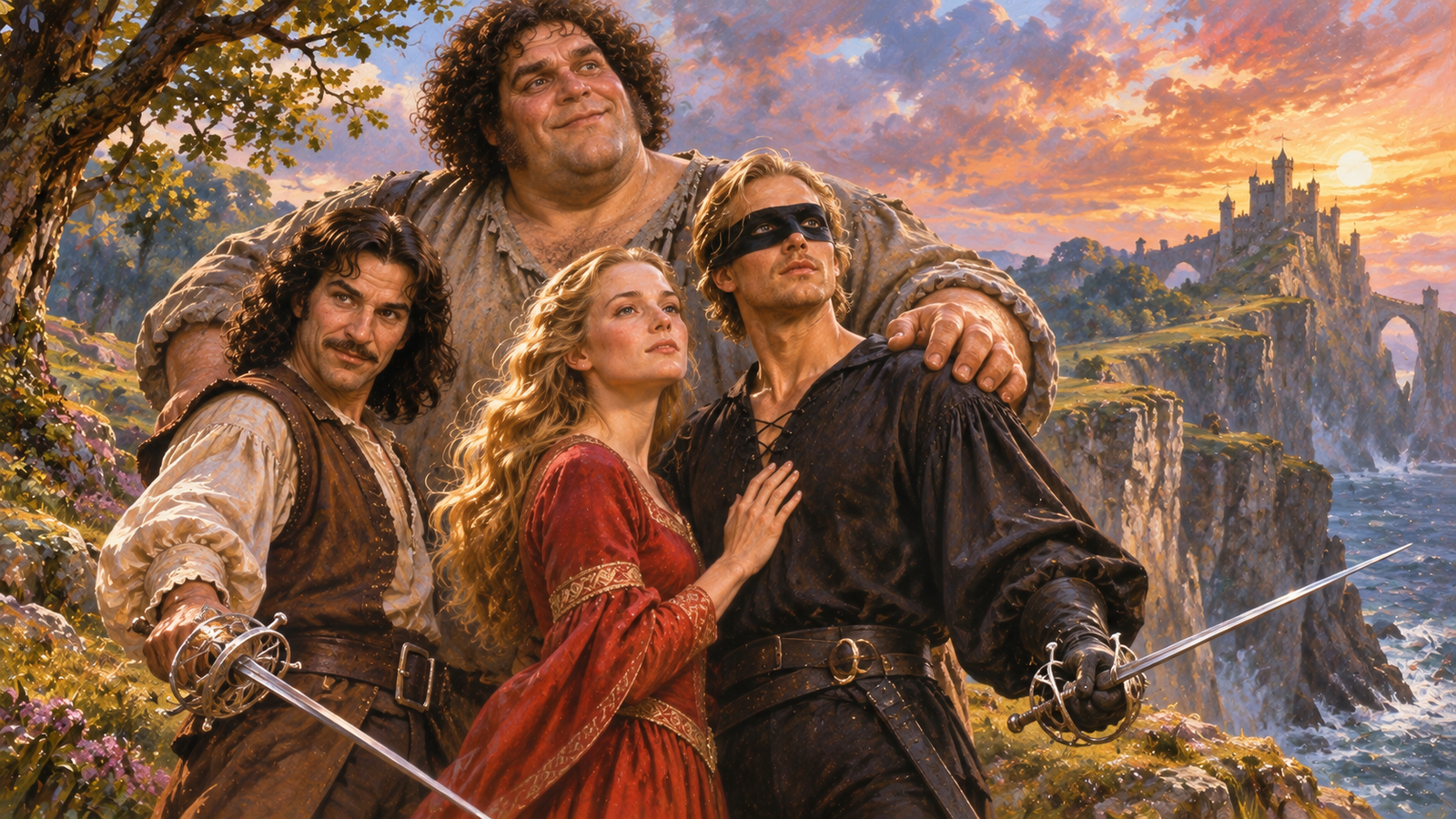
A tale of true love, improbable escapes and the pleasure of a very good story told by someone who knows when to interrupt it.
Rob Reiner’s The Princess Bride (1987) is a romantic fantasy adventure that affectionately turns the conventions of fairy tales upside down. A grandfather reads a story to his ill grandson, and the tale comes alive as an adventure involving a kidnapped bride, a masked swordsman, an enormous but gentle fighter and an ambitious prince. Its comedy works because the characters take their dangers seriously, even when the storyteller and audience know just how extravagant the adventure has become.
At a Glance
| Film | The Princess Bride (1987) |
|---|---|
| Director | Rob Reiner |
| Screenplay | William Goldman, adapting his own novel |
| Principal cast | Cary Elwes, Robin Wright, Mandy Patinkin, Chris Sarandon, André the Giant, Wallace Shawn, Christopher Guest, Peter Falk and Fred Savage |
| Music | Mark Knopfler; song by Willy DeVille |
| Running time | 98 minutes |
| Genre | Romantic fantasy; adventure comedy; fairy-tale satire |
| Source novel | The Princess Bride by William Goldman (1973) |

Why This Film Matters
Many films parody fairy tales by dismissing the emotions that make them work. The Princess Bride takes the opposite path: it recognises how predictable an old tale can be and still allows its love, danger and loss to matter. The grandfather and child can interrupt the adventure, question its twists and argue over the ending, but none of those interruptions cancels the story’s emotional force.
The film’s memorable characters also make an important point about fantasy worlds. Not everyone is a hero or villain by occupation. A hired swordsman may possess an honourable goal, a giant may be the kindest person in the room, and a prince may be far less noble than the bandits who oppose him.
The Story — Without Major Spoilers
In the country of Florin, Buttercup falls in love with Westley, a young farmhand who goes away to seek a fortune. Years later she is promised to Prince Humperdinck, but is abducted by a trio of unusual criminals. A mysterious masked stranger pursues the abductors across dangerous terrain, and the journey becomes entangled with the ambitions of powerful people who have very different plans for Buttercup’s future.
The present-day framing story follows a grandfather reading the tale to his sick grandson. The boy’s evolving response changes how we hear the supposedly familiar romance and makes the act of storytelling as important as the adventures inside the book.
Characters and Performances
Westley (Cary Elwes) is resourceful, graceful and sometimes too confident in his own ingenuity. Buttercup (Robin Wright) begins as the object of competing desires but must also confront the price of the decisions others try to make for her. Inigo Montoya (Mandy Patinkin) carries a private quest for justice; his wit and discipline make him more than a convenient ally.
Fezzik (André the Giant) pairs exceptional strength with gentleness. Vizzini (Wallace Shawn) is clever enough to create elaborate plans, but not wise enough to recognise his own limitations. Humperdinck (Chris Sarandon) turns royal entitlement into a dangerous appetite for control. The performances balance sincerity and comic rhythm without reducing everyone to a single joke.
The World on Screen
Florin and its neighbouring regions are deliberately drawn from the traditions of storybook adventure: coastal cliffs, castles, forests, dangerous marshes and villages whose inhabitants know more than visiting nobles imagine. The geography is more theatrical than historical, and the film rarely pauses to explain how the kingdom functions. That simplicity gives the story momentum, while the variety of locations makes each new obstacle feel different.
Combat relies as much upon personality as upon weaponry. The celebrated sword duel is a conversation expressed through movement, with rivals learning about one another as they fight. Other encounters depend on observation, persuasion, courage and the ability to recognise when a direct fight is the wrong choice.
Behind the Camera
William Goldman adapted his own 1973 novel, retaining the playful framing narrative that helps distinguish it from a conventional swashbuckler. Director Rob Reiner and producer Andrew Scheinman brought together a large ensemble of actors whose contrasting styles reinforce the tale’s playful tone. Mark Knopfler supplied the score, while Willy DeVille’s song adds to the storybook romance.
The film’s sets, landscapes and practical stunt work support a world that is stylised without appearing weightless. Swordplay, climbing and physical comedy give the more extravagant story elements an immediate human scale.
The Novel and the Film
Goldman’s novel is not a straightforward fictional history of Florin; it plays games with the idea of a narrator selecting and reshaping an older tale. The film keeps an analogous framing structure by letting a grandfather read aloud and inviting the child to challenge what he hears. Some novelistic digressions disappear, but the relationship between the story and its audience remains central.
The cover displayed in the information panel belongs to a first edition of the source novel. It is included to acknowledge the book behind the film, not as an image of the 1987 theatrical release.
Themes and Critical Assessment
The film examines devotion, revenge, friendship, social status and the uneasy line between telling someone a story and deciding their fate. Its humour is affectionate enough that the moments of danger remain persuasive. A character’s exaggerated confidence may be funny, but consequences are not always painless.
What works: a remarkably strong ensemble, dialogue that reveals personality, action built around character choices and a framing device that makes the audience’s love of stories part of the film. What works less well: some familiar fairy-tale roles are lightly sketched, and the romantic idealisation occasionally leaves Buttercup with less room to shape events than her companions. Its warmth and invention nonetheless account for its enduring appeal.
Related Films
For another tale of unlikely companions travelling through an enchanted kingdom, explore Willow (1988). For a more unsettling examination of what honour means to a knight, see The Green Knight (2021). Browse Fantasy Films and Television for more adventure and folklore.
Explore in SpiralWorlds
For original tabletop characters and encounters that echo the film’s fencing, intrigue and extraordinary companions, explore the Duelist prestige class, Swashbuckler, Princess NPC, poisons and Resurrection spell. These are game materials to adapt creatively, not direct statistics for Inigo, Westley, Buttercup, Fezzik or Miracle Max.
Ideas for the Table
Build an adventure around three groups with incompatible goals, then let the party discover that the supposed villains may have understandable reasons for their actions. A noble wedding may conceal political coercion, a hired swordsman may be pursuing justice, and a criminal band may contain a loyal friend whose conscience can be reached.
Give characters opportunities to change sides, make bargains and resolve personal rivalries without destroying every opponent. A duel can win respect rather than merely settle a combat score. A rescued prisoner may reveal new information, and a prince’s authority may prove weaker than the loyalty of common people. Use the NPC archive for original rival personalities and the Bestiary for dangers whose motives extend beyond an encounter.
Sources and Credits
- 20th Century Studios — The Princess Bride (official film details).
- Criterion Collection — The Princess Bride (film production and commentary).
- American Film Institute Catalog — The Princess Bride (adaptation and production history).
Film characters and source-novel artwork belong to their respective rights holders. This review and original game suggestions are independent editorial material.
Keep this reference growing
If this page helped with your reading or game, you can support its upkeep or explore the curated books.
Explore the Bookshop — epics, classics and stories behind imagined worlds.