
Willow (1988)
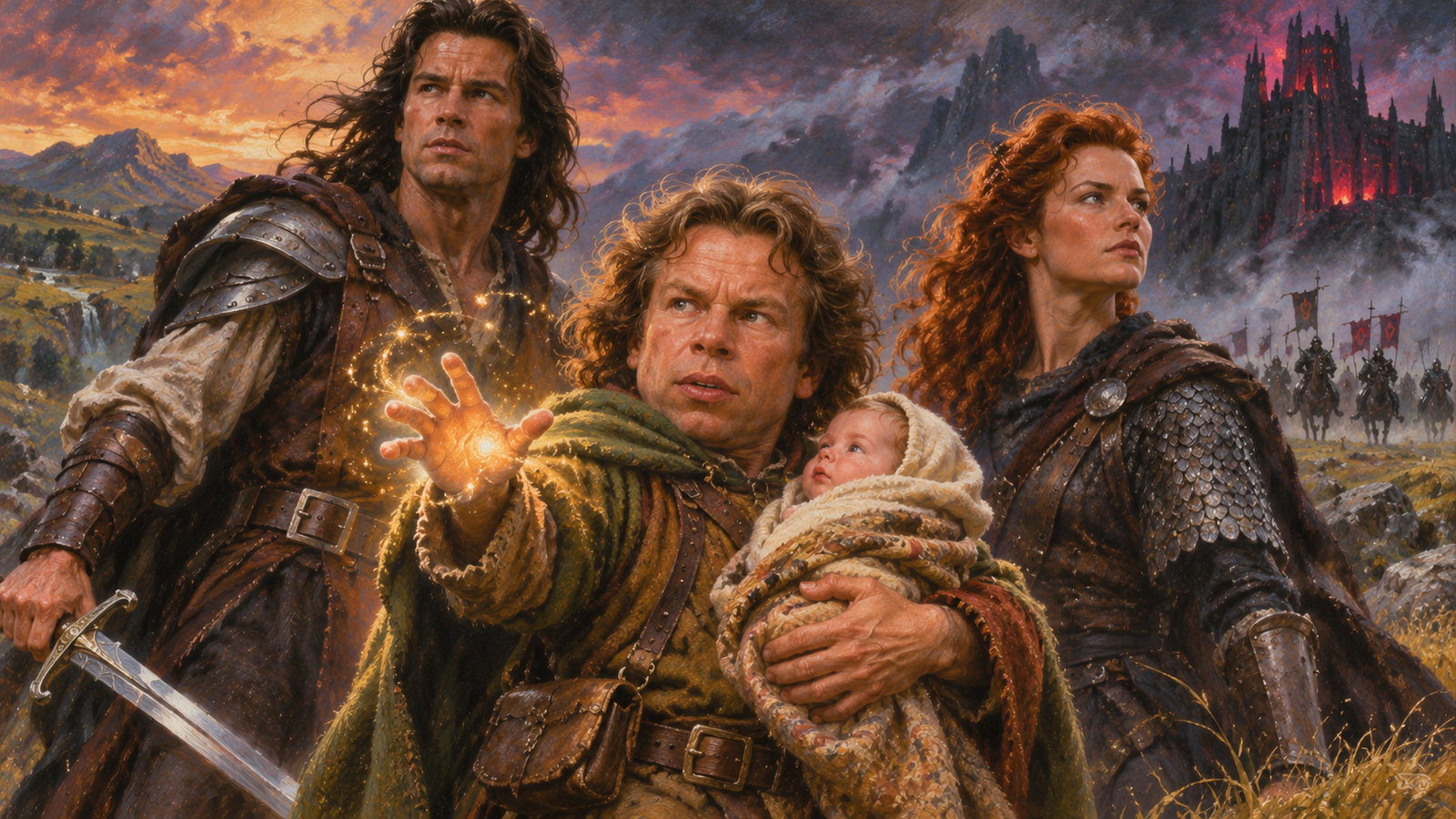
An ordinary farmer becomes the unlikely guardian of a child whose fate troubles an empire.
Ron Howard’s Willow (1988) is a sweeping fantasy adventure built around the courage of people who are seldom treated as heroes. Warwick Davis plays a farmer and aspiring magician drawn far from home when an abandoned baby is revealed to be a threat to a powerful sorceress. The film combines fairytale danger, eccentric travelling companions and large-scale battles with an unusually domestic starting point: protecting someone who cannot protect herself.
At a Glance
| Film | Willow (1988) |
|---|---|
| Director | Ron Howard |
| Story | George Lucas; screenplay by Bob Dolman |
| Principal cast | Warwick Davis, Val Kilmer, Joanne Whalley, Jean Marsh and Patricia Hayes |
| Music | James Horner |
| Production | Lucasfilm and Imagine Entertainment |
| Running time | Approximately 126 minutes |
| Genre | Epic fantasy; adventure; fairy tale |

Why This Film Matters
Fantasy often defines importance through ancestry, command or spectacular combat ability. Willow begins with the opposite: the person who makes the decisive choice is neither a monarch nor an accomplished wizard. Willow Ufgood has a family, a community and reasons to stay safe. His bravery matters because leaving home costs him something. The film’s adventure is therefore not simply about fulfilling a prophecy but about deciding what to do when an innocent person needs help.
The Story — Without Major Spoilers
In a land ruled by the ruthless Queen Bavmorda, the birth of Elora Danan threatens the sovereign’s grip on power. The infant is set adrift and reaches the village of the Nelwyns, where Willow takes responsibility for her safety. He sets out to return her to people who may protect her, but the journey becomes an increasingly dangerous flight from Bavmorda’s forces.
Willow meets the boastful swordsman Madmartigan, the rebellious Sorsha and magical allies whose intentions are not immediately clear. A simple errand becomes a journey through hostile territories, old rivalries and magic that is as unpredictable as it is impressive.
Characters and Performances
Willow Ufgood (Warwick Davis) combines anxiety, persistence and a desire to prove his magical ability. His courage rarely means being unafraid. Madmartigan (Val Kilmer) uses bravado to conceal an unreliable sense of purpose and gradually discovers a loyalty he did not expect. Sorsha (Joanne Whalley) begins within Bavmorda’s power structure but has motives and choices of her own.
Bavmorda (Jean Marsh) is a tyrant whose fear of losing authority has grown into persecution. Fin Raziel (Patricia Hayes) suggests a magical tradition that has suffered defeat but not disappeared. The relationships among these characters create more lasting interest than the prophecy alone.
The World on Screen
Howard’s world contains small farming communities, dangerous roads, great strongholds and extraordinary wilderness. The different settlements imply different customs and scales of power, while the journey gives the protagonists repeated opportunities to encounter people outside their immediate conflict. The countryside is not an empty corridor between set pieces: it contains homes, camps, hazards and beings with lives of their own.
The film’s creature effects, transformations and practical stunt work help magic feel both wondrous and hazardous. A transformation can be an exhausting ordeal, not a simple change of costume. The scale of castles and soldiers also keeps the central party’s vulnerability visible.
Behind the Camera
George Lucas originated and produced the story, with Ron Howard directing and Bob Dolman writing the screenplay. Warwick Davis took his first leading feature role. Industrial Light & Magic contributed effects that included early digital image-morphing techniques, alongside practical creature work and extensive live-action production. James Horner’s score gives the quest breadth and emotional momentum.
Themes and Critical Assessment
The film is concerned with found families, responsibility, courage and the difference between inherited power and chosen loyalty. It also grants its characters room for comedy. Madmartigan’s swagger and Willow’s worry produce an entertaining contrast, while the danger surrounding Elora prevents the adventure from becoming only a sequence of jokes.
What works: Warwick Davis’s sympathetic hero, the distinctive relationship with Madmartigan, striking landscapes and an expansive sense of classic fantasy adventure. What works less well: some broad comedy interrupts the story’s tension, and the prophecy occasionally makes events feel predetermined. The film is most persuasive when its characters have to make choices the prophecy cannot make for them.
Legacy and Related Viewing
Willow remains an accessible example of a perilous journey made memorable by its companions rather than its final battle alone. Compare Dragonslayer (1981) for darker creature fantasy, Krull (1983) for a party assembled against a supernatural invader, and The Princess Bride (1987) for wit, friendship and swashbuckling romance. The film characters remain distinct from the world of the SpiralWorlds campaign; game ideas are adaptations, not shared canon.
Ideas for the Table
Start with an obligation that requires a choice. Someone helpless arrives at the party’s doorstep, and protecting them will disrupt the community’s fragile peace. Give the characters several plausible routes rather than a single prescribed path. One road is safer but passes through a hostile lord’s territory, another crosses wilderness where food and shelter are uncertain, and a third depends on trusting a stranger with a questionable reputation.
Companions should have histories that affect the journey. A mercenary might be recognised by former enemies; a would-be magician might know just enough to attempt a risky spell; a noble hunter might have reasons to turn against a ruler. Let the party create new alliances and change the course of events through these relationships. For game creatures and characters, use the Bestiary and NPC archive.
The child on the river. A basket washes up near an isolated community, carrying an infant and a piece of cloth marked with a feared queen’s emblem. Soldiers arrive asking questions. The party must decide whom to trust, who can shelter the child, and whether the emblem is genuine.
The spell that fails twice. A respected witch has been trapped in an animal’s body. The first attempt to free her does not work and reveals that the enchantment is part of a larger curse. Investigating its source opens competing routes through a forest controlled by rival powers.
A general changes sides. A commander ordered to capture a fugitive discovers evidence that the monarch has lied. The characters may help the commander defect, exploit that doubt to infiltrate a fortress, or refuse a risky alliance. None of those decisions forces a predetermined ending.
Trailer and Further Viewing
Lucasfilm — official film entry.
Production Deep Dive — From Puppets to Digital Morphing
Industrial Light & Magic’s production portfolio records its work on the film. In ILM’s retrospective on artist Jean Bolte, the studio describes the animal puppets she helped construct for the celebrated transformation sequence, which used digital morphing. The National Library of New Zealand’s DVD catalogue identifies two video supplements, Willow: The Making of an Adventure and From Morf to Morphing: The Dawn of Digital Filmmaking. These are useful companions to the film’s practical creatures and location photography, and are available with the relevant disc edition.
Sources and Credits
- Lucasfilm — Willow (film and production background).
- BFI — Willow (cast and credits).
- AFI Catalog — Willow (historical production details).
The film’s characters and promotional poster belong to their rights holders. Review and adventure suggestions are original commentary.
Keep this reference growing
If this page helped with your reading or game, you can support its upkeep or explore the curated books.
Explore the Bookshop — epics, classics and stories behind imagined worlds.