
Great Barrier Reef — Sea Country, Coral Passages and Folklore
At a Glance
| Region | More than 2,300 kilometres of coral reef, islands and channels off northeastern Terra Australis |
|---|---|
| Character | Turquoise lagoons, surf-beaten outer walls, sand cays, wooded islands and deep sea passages |
| People | Distinct Aboriginal coastal and island communities and Torres Strait Islander seafarers, each with particular Sea Country knowledge |
| Ways through | Local canoes, seagoing craft, experienced reef pilots and crossings governed by tide, season and weather |
| Useful supplies | Fresh water, food, strong line, paddles, hull-repair material and a trustworthy local navigator |
| Wildlife | Corals, giant clams, turtles, dugongs, rays, reef fish, sharks and rare sea serpents in deeper water |
| Main dangers | Grounding, coral cuts, exposed crossings, storms, failing water stores and dangerous territorial creatures |
| Campaign present | 1454 CE |
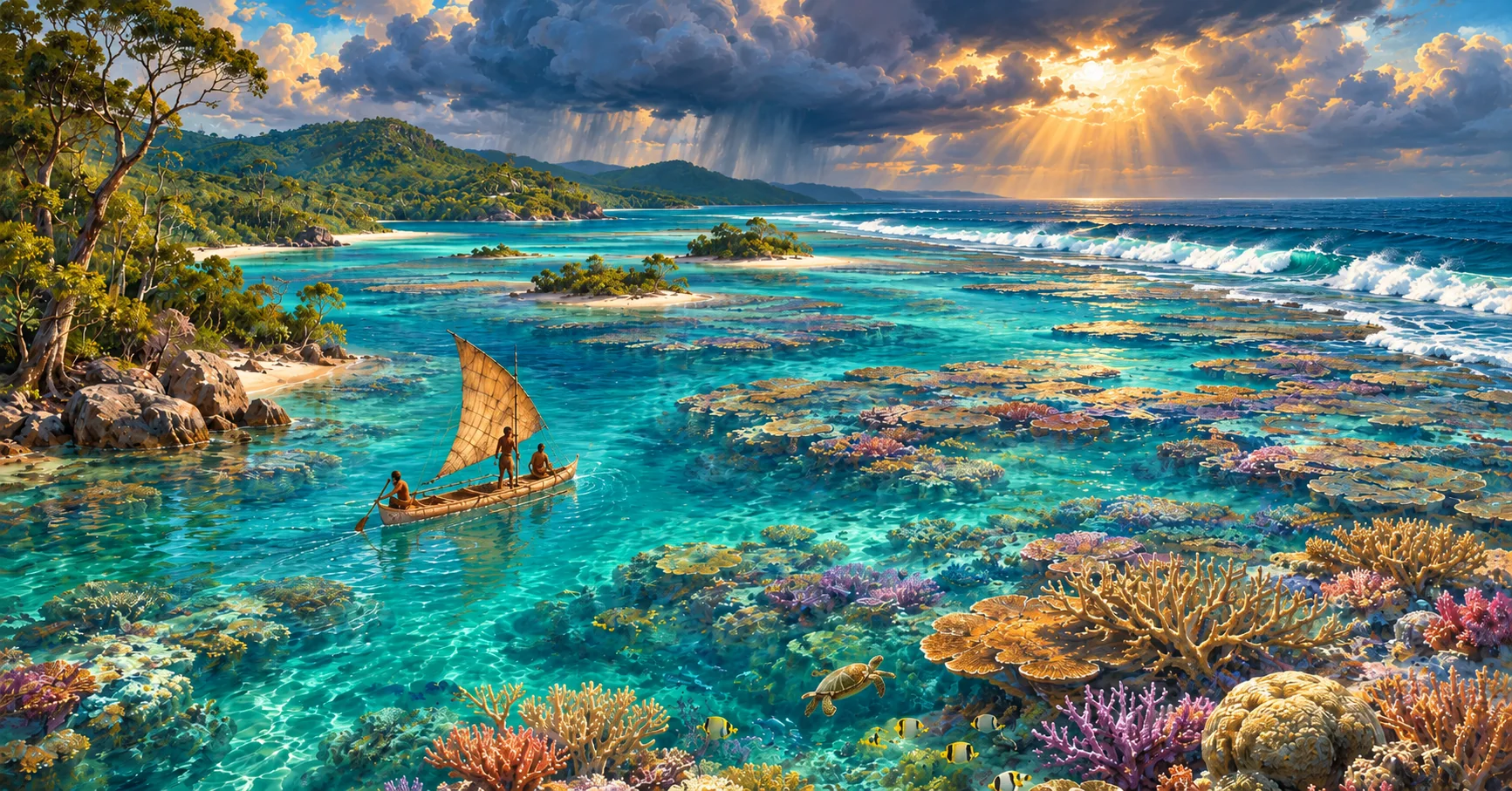
At dawn the lagoon shines turquoise between pale ridges of living coral. Beyond the white line of surf, dark water heaves against the outer wall; inside it a narrow canoe slips between shallows that will stand bare at the turn of the tide. Smoke rises from an island cooking place, seabirds wheel above the fishing ground and a watcher on the headland lifts a paddle to signal the safe approach.
The Great Barrier Reef is no single wall of stone. Thousands of reefs, cays and winding channels extend along the northeastern coast of Terra Australis. These waters are inhabited, travelled and cared for by many peoples whose sea roads are not interchangeable. A fisher who knows when the turtles gather, a boat-builder who can mend a split bark seam and an elder who remembers an old channel possess knowledge no stranger’s chart can replace. A ship may be well provisioned and still be helpless a bowshot from land.
What Is Happening Right Now?
The stranded trader
A foreign trading vessel sits tilted above coral north of the Whitsunday island passages. Its captain brought iron, cloth and medicine from a distant charter harbour, but his chart showed open water where living reef rises. The tide is falling; two sailors are hurt, and the carpenter fears the keel will break when the swell returns. A pair of reefclaws has begun hunting among crates washed beneath the hull, making the cargo as dangerous to reach as the open sea. Yala, a boat-builder from the nearby Sandspit Shelter, has canoes and the knowledge to carry the people to safety. She will not permit the crew to empty the landing’s drinking-water jars or drag heavy cargo across its fishing grounds.
A strong swimmer can take a line through the shallows, careful hands can lighten the vessel, and a persuasive traveller can make the captain abandon his chests. The iron would pay richly for the work, but a canoe overloaded with it may never reach shore. Whom the rescuers save first will matter long after the tide rises.
The passage closed by storm
Farther north a night’s violent weather has shifted sand and broken coral across a familiar island crossing. Fishing households on opposite shores need water, food and news of their relatives. The first boat to test the gap returned scraped and leaking. The storm has exposed a nesting hollow of coral drakes along the safest-looking channel; forcing the passage would put the brood and the canoe at risk. A navigator will scout a wider course on the next suitable tide, but only with companions who obey her signals. An observer on high ground can find the new break in the reef; a swimmer can sound the bottom; a craftsperson can mend the damaged canoe. None of these efforts will command the weather to clear.
The serpent at the outer wall
Outside the breakers a huge sea serpent has begun attacking boats that take a deep-water passage. Its existence is beyond dispute: a steering oar split by its jaws has washed into the lagoon. The creature hunts where currents gather fish and shelters beneath a steep coral ledge. An iron harpoon lodged behind one fin has left it wounded and furious.
A deep-draught ship needs this opening; smaller boats can take a longer sheltered way. Fishers want their grounds made safe, while one pilot believes that removing the iron may end the attacks. The captain who comes solely for a trophy risks driving the creature into the inhabited channels. A rescue, a perilous healing attempt and an organised hunt will each leave a different Reef behind.
Passages, Islands and Landings
Cape York and the northern reefs
At the northern approaches, outer cays and mainland bays are stepping-stones between the broad sea and the coast. The Wuthathi people maintain enduring connections in the Cape Grenville region; neighbouring waters belong to other communities with their own routes and landing places. A canoe crew reads birds, breaking water, cloud and the colour of the bottom before attempting a crossing. To a stranger, the reef offers a dozen tempting shortcuts. To a navigator, half of them are dead ends when the wind turns.
Hinchinbrook and the Bandjin channels
Wooded mountains rise above swift-running water around Hinchinbrook Island. Bandjin Sea Country includes island shores and the channels between them. The publicly shared Bandjin account of Dhui Dhui binds a great shovelnose ray, dangerous fishing water and the southern night sky to this place. At the warned-of sandspit, a hooked ray can pull a small canoe towards the current as the light fails. The warning is given by people who know the water; it is not an invitation to hunt a sacred story for a prize.
On the mainland-facing shore, boats shelter when contrary wind makes the channel unsafe. A damaged paddle can be replaced, a cut cleaned and a guest fed through the goodwill of a household. None of these gifts gives a visitor the right to take fish from another family’s ground or force a pilot to sail into a storm.
The Whitsunday island seas
Wooded hills, sheltered coves and narrow straits break the horizon among the Whitsunday islands. The Ngaro are accomplished seafarers; their sturdy three-piece bark canoes cross open water and reach beaches barred to deep-keeled ships. Fish traps, working places and paths between bays testify to generations of island life. The shore may provide a sheltered night for a small canoe, while the same bay is unreachable by a visiting merchantman. A return passage that was easy at first light can be closed by a rising wind.
The breakers of the outer reef
Outside the lagoons, long rollers strike the reef’s steep face and burst into a white belt of foam. A deep-water opening may admit a great ship when the tide is right, yet turn into a trap as wind pushes against current. Beneath it are coral overhangs, dark caves and feeding grounds of powerful animals. The wounded sea serpent keeps to one such passage, where even a confident captain must choose between waiting offshore and surrendering the helm to someone who knows the coast.
Boats, Markets and Help
Fishing, gathering, boat-building and exchange sustain the communities along these waters. Shell, plant fibres, worked tools, food and news travel between mainland and islands through relationships maintained across generations. The Reef has no single harbourmaster: at one landing visitors are greeted as friends of a familiar crew, while at another they must explain where they have come from before anyone will guide them ashore.
Sandspit Shelter
A low ridge of white sand protects a small lagoon where a few family boats can rest clear of the surf. Beneath a roof of woven shade, Yala repairs paddles, closes seams in bark hulls and keeps coils of strong line away from the wet sand. Her neighbour Taren watches the precious freshwater jars and tends small injuries with clean dressings. A traveller can find fish, a sheltered sleeping place, simple repairs and an introduction to a trustworthy reef pilot. Fine armour, learned spellcraft, gunpowder and endless provisions are not sold here.
Foreign coins have little value unless a passing trader can use them. Strong fibre, tools, sound timber, food and willing work matter more. Yala has one damaged canoe and a crossing that cannot wait; she will help strangers who first assist the people waiting on her shore. Taren will not let a wealthy passenger buy the last drinking water ahead of an injured child. Those decisions make the shelter safer than any promise of cheap lodging.
Beyond the shelter, the best repairs are often made by the people who built the craft. A boat may need only a replacement paddle, or it may need to be hauled onto sand while its hull dries. A visitor seeking healing for a coral cut will find practical treatment, but infection, fever and exposure can require more help than an isolated landing has to offer. A skilled guide can be persuaded by trust, shared work or a worthwhile exchange; they cannot be compelled to promise a safe tide.
The Living Reef
Coral animals build the limestone ridges over generations, each storm and turning tide reshaping the routes between them. In sunny shallows some colonies form branching thickets; others rise as rounded heads that break the surface before an unwary sailor sees them. A navigator watches the colour of the water, but after heavy rain or a rough sea even familiar ground can become difficult to read.
Rays feed over sand, dugongs graze seagrass beds and turtles move between distant feeding and nesting places. Giant clams open among the corals while shoals of fish flash past anemones and dark crevices. A swimmer searching for a lost paddle might reach it quickly, only to lose sight of the boat when disturbed sand clouds the shallows. Sharks patrol some deeper passes, but sharp coral, infection, sun and thirst often prove the greater enemies.
Creatures of the Great Barrier Reef
The reef’s inhabitants change from one stretch of water to another. A boat moving along its sheltered side may pass through feeding shoals, sand flats and coral gardens for days, while only a few miles away the outer wall drops into deep blue water. Most creatures have no interest in attacking travellers. Those that guard nests, ambush prey or rule a passage can nevertheless decide whether a family fishes, a diver comes home or a ship finds shelter.
Among the coral heads
Coral drakes hide in the branching reef, their coloured scales blending into the living stone. They usually slip away from an approaching boat, but a diver who pushes into a nesting hollow can meet a wall of spines and an armed tail. Fisherfolk know the dangerous patches: a drake’s lair may protect a flourishing coral garden from more destructive hunters, even while it closes a useful shell-gathering ground. Anyone seeking a safe passage must learn where the young are hidden, not simply where the water is deepest.
In darker crevices, giant moray eels wait with open jaws. A fish pulled from a hole may bring an eel with it, and a swimmer reaching after a dropped knife can lose an arm to a sudden strike. The smaller but no less vicious reefclaws hunt along broken coral, sandy inlets and the edges of fishing grounds. Their eel-like bodies and crushing claws make them dangerous to waders and boat crews; where several gather, families may abandon a once-profitable beach until the predators are driven away.
Lagoon wanderers and hunters
Broad-winged manta rays move along plankton-rich channels, sometimes passing so close beneath a canoe that their shadows swallow its reflection. They are feeding animals rather than monsters to be slain. A guide who sees mantas gathering may know where the currents will carry fish or where the bottom falls away unexpectedly. A frightened passenger who strikes at them can cause a far greater danger than the rays themselves.
Hammerhead sharks follow the slopes and shallows, seeking rays buried in sand; dolphin pods hunt fish and sometimes ride the bow wave of passing craft. Their sudden flight may warn of a larger hunter or an unseen disturbance. A dark fin near the boat is a reason to watch the water, not proof of an attack. People who fish these waters distinguish the passing animals from those defending a feeding ground.
Mangrove mouths and island beaches
Where rivers and tidal creeks enter the sea, saltwater crocodiles lie almost invisible at the muddy edge. These are threats of mainland estuaries, mangrove shores and some island waters, not occupants of every outer coral cay. A crew gathering drinking water at a river mouth must watch the bank as carefully as the current. On quiet beaches, crab swarms can erupt from sand and driftwood when the tide turns, forcing exhausted castaways away from an apparently inviting campsite.
The deeper passages
The exposed reef edge is home to dangers less familiar to the sheltered lagoons. A solitary sea drake may hunt beneath the cliffs of a remote island, rising through spray to strike at a vessel that approaches its hunting ground. Deep among coral walls and sunken wreckage, a gigantic shark-eating crab lies in wait for large prey. These creatures do not haunt every channel; their territories create stretches of sea that even experienced navigators approach only with good reason.
Rarest of all are the great dragon turtles of the outer deep. Their long memories, immense strength and territorial pride make them powers to reckon with, not ordinary quarry. One may ignore generations of small canoes but confront a merchantman hauling treasure through its waters. A respectful exchange can open a passage that weapons cannot. Elsewhere, merfolk keep to sheltered underwater caverns and distant reef ledges, observing the boats above; they know which caves flood at high tide and which wrecks have become hunting places. A navigator who has earned their confidence may learn something no landward chart contains.
The wounded sea serpent threatening one outer passage is therefore a particular danger in a much larger wilderness, not the creature by which every reef is known. Between its hunting ground and the mainland lie entire worlds of prey, predators, neighbours and waters that change with each tide.
Sea Country and the Unseen
The Reef’s many peoples keep distinct obligations, knowledge and stories associated with particular waters. One household knows a beach where turtles nest; another watches the wind that makes its island crossing dangerous. The public Bandjin account of Dhui Dhui links the great shovelnose ray to the Hinchinbrook channels and the southern night sky. No guide treats that place or story as belonging to every coast from Cape York to the southern reefs.
Experienced fishers distinguish a passing manta from a hunting shark, a crocodile’s river mouth from a safe beach, and a coral drake’s nesting hollow from a place where divers can gather shell. A channel made dangerous by an animal can interrupt trade and food-gathering as thoroughly as a storm. The households of the Reef know when to keep clear, when to defend a landing, and when to leave a creature undisturbed.
Travel Onward
A traveller can reach the Reef from bays and river mouths along Terra Australis. Shallow canoes work from landing to landing inside the reef where their crews know the channels; larger seagoing vessels must find passages through the outer barrier and often wait offshore for a suitable tide. Northern routes continue towards the Torres Strait islands. Southward lie the Whitsunday passages and the mainland’s farther bays. Beyond the surf is the open Coral Sea, where shelter is scarce.
Carry drinking water rather than trusting an island to provide it. A good chart describes a coast but cannot guarantee the depth of shifting sand. After a storm even a familiar channel may require new soundings. Local pilots judge clouds, wind, tidal current and the vessel itself before choosing whether to sail. A canoe can reach a sheltered cove that a trading ship must pass, while a deep-water opening may only be safe for a few hours.
From the shore, established local routes lead into the very different inland landscapes of the Bush. Farther voyages follow the sea roads of Oceania. The best way onward is not necessarily the shortest, but the one for which a traveller has a sound boat, fresh water and a willing guide.
Older Than the Charts
The Reef rose around much older coastal landscapes as the sea advanced after the last ice age. Coral animals built limestone walls while storms and currents continually altered them. Peoples lived on and travelled these shores long before the modern islands and coral cays took shape. Old knowledge of sea and land does not become less valuable because a navigator carries a foreign chart: the living coast can outlast any map and still change within a single season.
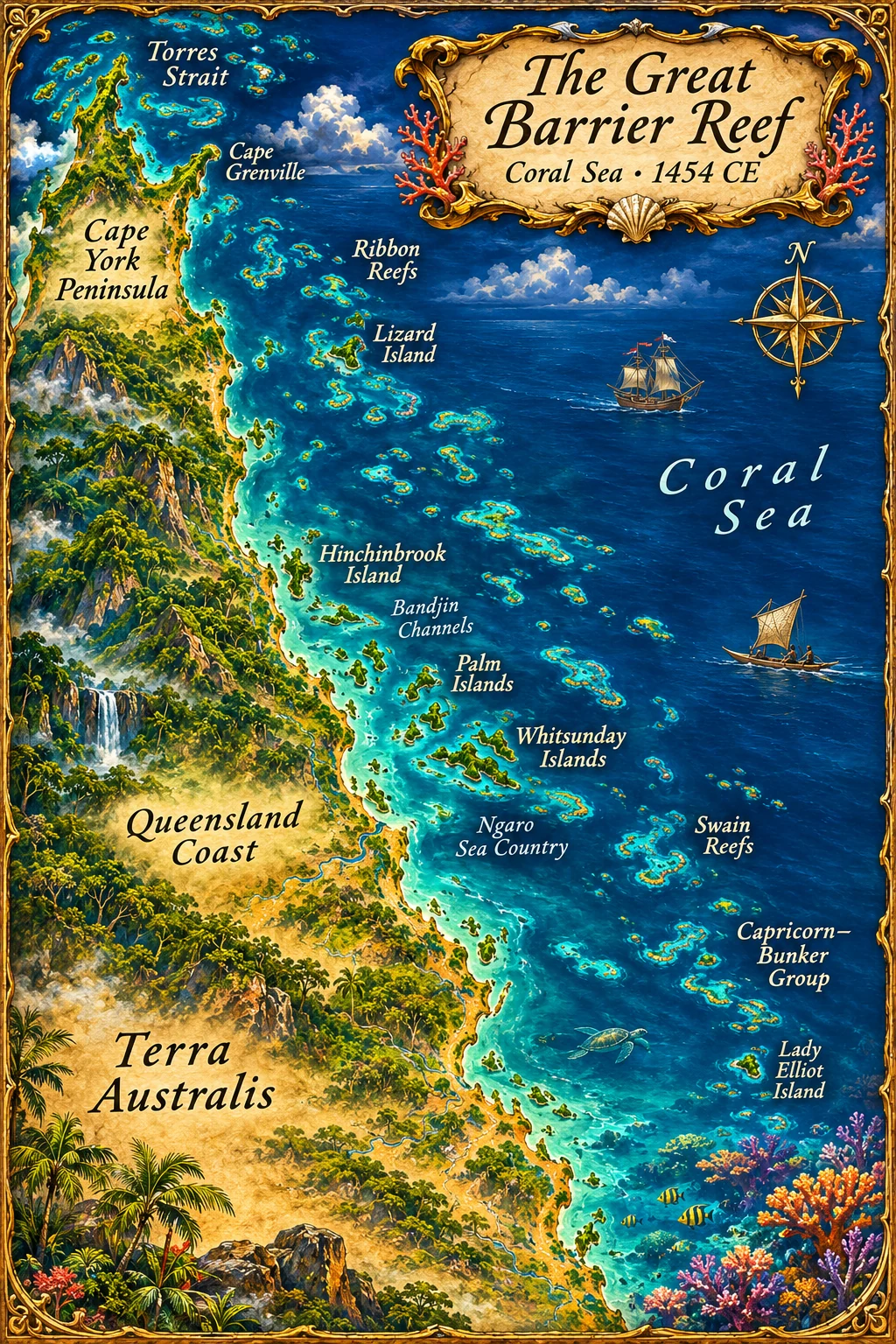
The Reef on the Map
The Reef Authority’s geographical reference maps show the extent of the reefs, mainland coast, island groups and deep-water approaches. They give the geography of the journey, while pilots and local knowledge determine the course through it.
Sources and Setting Notes
- Great Barrier Reef Marine Park Authority — Traditional Owners: named communities, maritime trade and the Dhui Dhui account, publicly shared courtesy of Russell Butler of the Bandjin people.
- Queensland Parks — Whitsunday islands: Ngaro canoes, fishing places and island archaeology.
- Rowland and colleagues (2025) — Reef island archaeology: long coastal occupation and changing shorelines.
- UNESCO — Great Barrier Reef: reef geography, habitats and ecological significance.
Sandspit Shelter, Yala, Taren and the present-day rescues and serpent incident are original setting material. The Bandjin story of Dhui Dhui retains its own community attribution.
Keep this reference growing
If this page helped with your reading or game, you can support its upkeep or explore the curated books.
Explore the Bookshop — epics, classics and stories behind imagined worlds.