
Tortuga — Free Harbour of the Pirate Republic
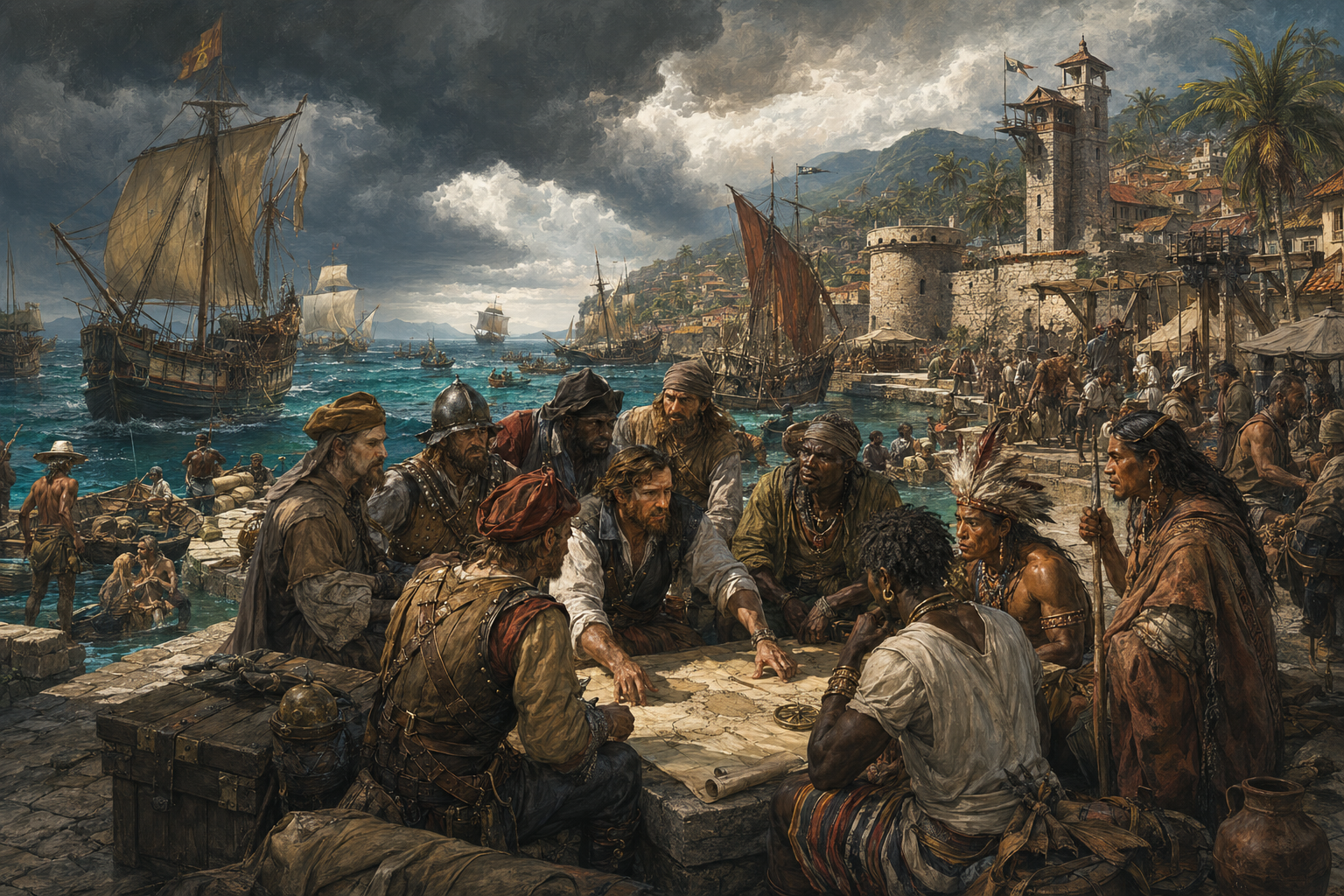
Off northwest Hispaniola · Caribbean Sea · Council of the Free Harbours
The powder boats have not arrived, and a governor’s messenger is waiting below the council chamber. A damaged sloop creeps into the anchorage as the harbour bell calls the captains ashore. Its crew claims to have found the foreign fleet preparing to close the channel. The question facing Tortuga is no longer what treasure can be taken, but whether its pirate republic can survive another month of freedom.
At a Glance
- Place
- Tortuga, a steep, rocky island north of western Hispaniola
- Government
- Free harbour governed by wardens and the Brethren of the Coast‘s Council of the Free Harbours
- Role
- Principal meeting harbour and strategic refuge of the pirate republic
- Harbour
- Sheltered southern approaches, watched reefs and steep inland paths; the northern Iron Coast offers little landing
- Residents
- Ship crews, boatbuilders, merchants, fishing families, Indigenous islanders, maroon sailors and foreign visitors; population varies with the fleets
- Principal Trade
- Repairs, victuals, timber, salted meat, rope, sailcloth, salvage, medicine, charts and prize cargoes
- Arms and Security
- Harbour batteries, lookout signals, guarded powder stores, armed ships and competing crews
- Immediate Danger
- A possible blockade, disputed pardons, empty powder barrels and an unresolved claim before the council
- Useful Contacts
- First Mate, Guide, Pawnbroker / Fence and Veteran Buccaneer
From the open sea, Tortuga resembles the back of a great dark turtle: rock, wooded heights and a cliffbound north coast rising above a narrow channel. The harbour faces the warmer waters toward Hispaniola. It is a good place to hide a ship, difficult to storm from the sea and dangerous to hold without food, fresh water and trustworthy pilots. Boats crowd the southern quay while men and women argue over cargo, repairs and the next call of the council.
A visiting captain may recognise no monarch here, but that does not mean there are no rules. Every ship has articles. The wardens keep order on the quays, merchants demand payment and the council settles matters that put the entire republic at risk. Tortuga’s people must keep trading, fishing, repairing and eating while their most celebrated commanders argue about liberty.
What Is Happening Right Now?
The Treaty Beneath the Lantern
A royal emissary has brought an offer of pardon, lawful trade and full powder barrels. In return, a foreign garrison must occupy the harbour and the republic must accept inspection of its vessels. The Council of the Free Harbours gathers in the Counting House at sunset. The harbour wardens insist they must be consulted; several captains have already made secret promises. Adventurers can seek the missing clauses, discover who was bribed, bargain for another supply of powder or prepare Tortuga to resist.
The Last Powder Lighter
Three boats were due from the opposite coast. Only one reached the quay; its hold contains soaked rope instead of shot and powder. A veteran gunner says the cargo was exchanged before loading, while the merchant’s agent insists the boats were intercepted at sea. The batteries can make a formidable show, but their remaining charges will not withstand a sustained assault. Evidence of the theft could decide the council’s vote.
A Pilot Who Refuses the Passage
A local pilot will not guide another fleet through a reef channel until the captain whose ship damaged the fishing grounds pays compensation. Ship captains call this extortion. Fishing families say the missing nets and smashed coral are how their children eat. Outsiders may try a different channel, investigate the damage or negotiate repair and compensation; the tide will not wait for their arguments.
A Light Below the Battery
On windless nights, a pale light is seen beneath the older gun position, followed by a sound like cargo chains dragging across stone. Dockworkers suspect a signal to smugglers, while an old sailor claims the drowned crew of a seized ship is trying to reveal its lost manifest. A patient inquiry may expose living conspirators, a concealed cavern or an actual haunt tied to an unresolved death.
Harbour, Heights and Places Worth Visiting
The Southern Anchorage and Basse-Terre
This is where Tortuga lives: jetties, shallow-draught lighters, ships waiting for repairs, water carriers, fish sellers and cargo that must be counted twice. The main approach is worth guarding because ships cannot simply sail beneath the sheer northern cliffs and expect another welcoming port. A good pilot knows which reefs can be crossed on a rising tide and where a pursuing ship will strike bottom.
The Council’s Counting House
Above the quay stands an old counting house used for the meetings of the Council of the Free Harbours. An island chart is spread across the main table, with stones for the forts, nails for the ships and empty cartridges marking stores that have not arrived. Captains bring witnesses and sworn articles; harbour wardens bring the lists of food, wages and repairs. The doors open for claims and testimony, but secrets are traded in the stairwell and the passage overlooking the sea.
High Rock Battery and the Harbour Chain
The watch commands the entrance, not the whole island. Guns on rock above the harbour can challenge a ship in the approach, while lookouts signal across the heights. The chain and the batteries require disciplined crews, sound ironwork and a regular supply of powder. A foreign squadron need only learn the gunner’s blind angle—or pay someone to leave the chain slack. The batteries have been rebuilt and enlarged by successive garrisons, each leaving a different weakness in the stonework.
The Lower Market, Storehouses and Sailmakers
The market sells fish, preserved provisions, cordage, tools, spare blocks, tar and cloth alongside stranger parcels from captured ships. A pawnbroker may offer a discreet loan on a recovered jewel; a merchant can buy prize goods openly if the ownership is settled. Shipwrights will not work for patriotic speeches. A quiet strike at the sheds may be as dangerous to the republic as a blockade.
The Iron Coast and the Interior Tracks
The northern shore is a wall of rough cliffs and hard surf. Narrow tracks through the heights lead to watch posts, rain catchments and secluded settlements. They can hide a lookout or bring a message overland when the harbour is watched, but they are no substitute for a safe anchorage. The island’s wooded cover shelters hunters, displaced families and anyone wishing to avoid questions from the port watch.
People Adventurers May Actually Meet
Tortuga is a place of sailors and settlers, not a stage occupied solely by famous captains. The most useful people may be the keeper of the powder tally, a wounded pilot, the cooper whose barrels will not seal, or the fisher who knows which ships came in at night.
| Person or role | Why they matter now |
|---|---|
| Henry Morgan | Seeks a defensible muster of ships, powder and pilots rather than a council resolution without the means to enforce it |
| Anne Dieu-le-Veut | Refuses a treaty that would turn the free harbour into a foreign garrison, whatever its promised reward |
| François l’Ollonais | A dangerous independent raider whose retaliation could destroy a fragile truce |
| Captain Peter Blood | A captain with experience of medicine and confinement, potentially valuable when injured sailors or captive witnesses need protection |
| First Mate / quartermaster | Has the stores book, company articles and a reason to distrust the official prize tally |
| Guide / harbour pilot | Knows the tide, hidden reefs and whether a ship really could have reached Tortuga by the route it claims |
| Pawnbroker / Fence | Can trace marked silver, suspect bills of sale and the buyer of a stolen navigation instrument |
Blanchelande and his overseas patrons make claims to rule through commissions and governors; the free harbour does not accept those claims as settled fact. For wider alliances and enemies consult the Caribbean NPCs and the Brethren of the Coast.
The Powers That Compete for Tortuga
The Brethren of the Coast want the republic to remain free, but a council vote cannot automatically compel every captain. Visiting merchants prefer a harbour whose debts can be collected; those who control food or powder may seek influence without winning a single boarding action. Governors on western Hispaniola and across the island’s colonial frontiers hope to reclaim authority through treaties, privateers and blockade.
Fishing families and Indigenous communities have their own claims to landing beaches, coastal waters and passage across the island, older than the present captains’ articles. Independent maroon settlements and escaped captives have reasons to value a place beyond foreign rule, but they cannot be treated as a captain’s property or presumed subjects of the council. Agreements must protect their security and freedom in practice, not merely celebrate it in speeches. Sea-elven powers near the reefs may demand navigation rights and respect for their waters, as described in the wider Caribbean.
Trade, Provisions and Useful Services
In Tortuga, the most valuable goods are often unromantic. Fresh water, a sound mast, treated canvas, trustworthy scales and medicine can be worth more than a chest of gems if the harbour is besieged. A merchant can arrange repairs, a fence can find a buyer for disputed cargo, a shipmate can crew a water boat, and a veteran buccaneer knows whether the powder is dry and the cannon serviceable.
At the sailors’ cookhouses and market sheds, news passes between watchmen, traders, performers, pilots and wounded men ashore. Public prices change with weather, scarcity, legality and the reputations of buyer and seller. A captain may have abundant bullion yet fail to purchase a sail if the sailmaker has been promised payment twice already.
Visitors seeking healing may find ship surgeons, apothecaries and magical practitioners willing to help, but only if supplies and trust hold out. A strange relic dredged from a wreck is not automatically safe or magical; its nature must be established before anyone sells it as a wonder. Harbour officials demand the same evidence of ownership for enchanted treasure as for ordinary silver.
Dangers, Rumours and Adventures
The Harbour Without a Shot
Word spreads that an attacking fleet is two days away. The batteries seem well armed, but three cannon crews have never trained with their newly acquired pieces. The characters can drill crews, move guns, secure powder, scout the enemy or persuade ships to remain in the anchorage. Failure may leave the town dependent on a humiliating treaty.
The Price of a Free Shore
A fishing family seeks compensation for boats broken by a council captain. His supporters claim that emergency defence allows them to seize anything necessary; the harbour wardens insist that this makes the republic no better than its enemies. The characters can arbitrate, uncover fraud, pay restitution or expose the captain’s true cargo.
The Wreck That Came Ashore Twice
An old sea chart shows a wreck where no reef now stands. After a storm, wreckage bearing the same marks washes up below the cliffs. A pair of salvagers claim to have seen a silent watchman aboard a ship that is supposed to have sunk decades ago. This could be an elaborate signal scam, or a wight guarding a dead captain’s cargo. The proof is a ledger sealed in pitch within the hull.
The Voices Beyond the Breakers
Boatmen swear that enormous figures move below an inaccessible cove. A ship disappears while sounding the water, and someone blames merrows before anyone has seen a body. The island’s pilots insist that the reef itself is dangerous enough. Adventurers who approach by sea, rope or magic may discover predators, a smuggler’s dock or a misunderstanding that can be settled without battle.
Arriving, Leaving and the Law of the Free Harbour
By sea: the island lies off the northwest coast of Hispaniola. The sheltered southern approaches are the practical entry; the northern cliffs and surf offer scant relief. Tides, reefs and the watch’s permission matter more than the apparent calm inside the anchorage. A harbour pilot is advisable for unfamiliar ships. Voyages link to the western coast of Hispaniola, other coasts of Hispaniola, Port Royal and the Caribbean Sea; travel time depends on vessel, season, weather and the route chosen.
At the quay: arrivals declare their ship, make their cargo and quarrels known to the harbour wardens, and settle anchorage, unloading and repairs under the local agreements. An unknown flag is questioned rather than attacked automatically. Sworn articles govern each crew, but violence ashore, arson, theft of stores and assaults on residents answer to harbour law. The council hears disputes between crews and cases that may threaten the republic’s independence.
When trouble comes: the bell gathers wardens and gunners; the chain closes the entrance as ships prepare to move. In a siege the council may ration food and powder, though not every crew will obey. Residents can leave by small boats or interior tracks if those routes remain safe. No visiting captain has a right to commandeer another community’s houses or fishing grounds merely by invoking the republic.
Inhabitants Beyond the Free Companies
Tortuga’s shores and surrounding sea are home to more than humans: sea-elven envoys and other reef-dwellers negotiate safe passage; long-established peoples on neighbouring islands guard their own routes and fishing grounds. Dwarven armourers, halfling sailors, gnome technicians and wandering spellcasters may live or work here as individuals among the wider Caribbean’s varied populations, without being assumed to form a single political bloc. A lost boat, damaged reef or broken bargain can bring these communities into a council dispute without reducing them to a wandering monster encounter.
Older Shores and the Island’s Fortunes
Long before the free captains met above the quay, this island’s fishing grounds, coastal paths and wooded heights were known to island communities with their own histories. Later arrivals found in its turtle-backed cliffs and sheltered southern harbour a place difficult for a great navy to hold and easy for small craft to defend. Hunters, traders, displaced people, raiders and refugees came to rely on it for different reasons.
The free harbour’s present council emerged from bargains between captains, ship companies and shore households, not from a decree by any single ruler. Some families remember promises that the captains have forgotten; some members of the council insist that the republic can only endure if those promises are honoured. The outer forts have been patched, expanded and argued over many times. Their true strength remains the men and women willing to keep the water, food and powder moving through the southern anchorage.
Tortuga Harbour Campaign Map and Sea Routes
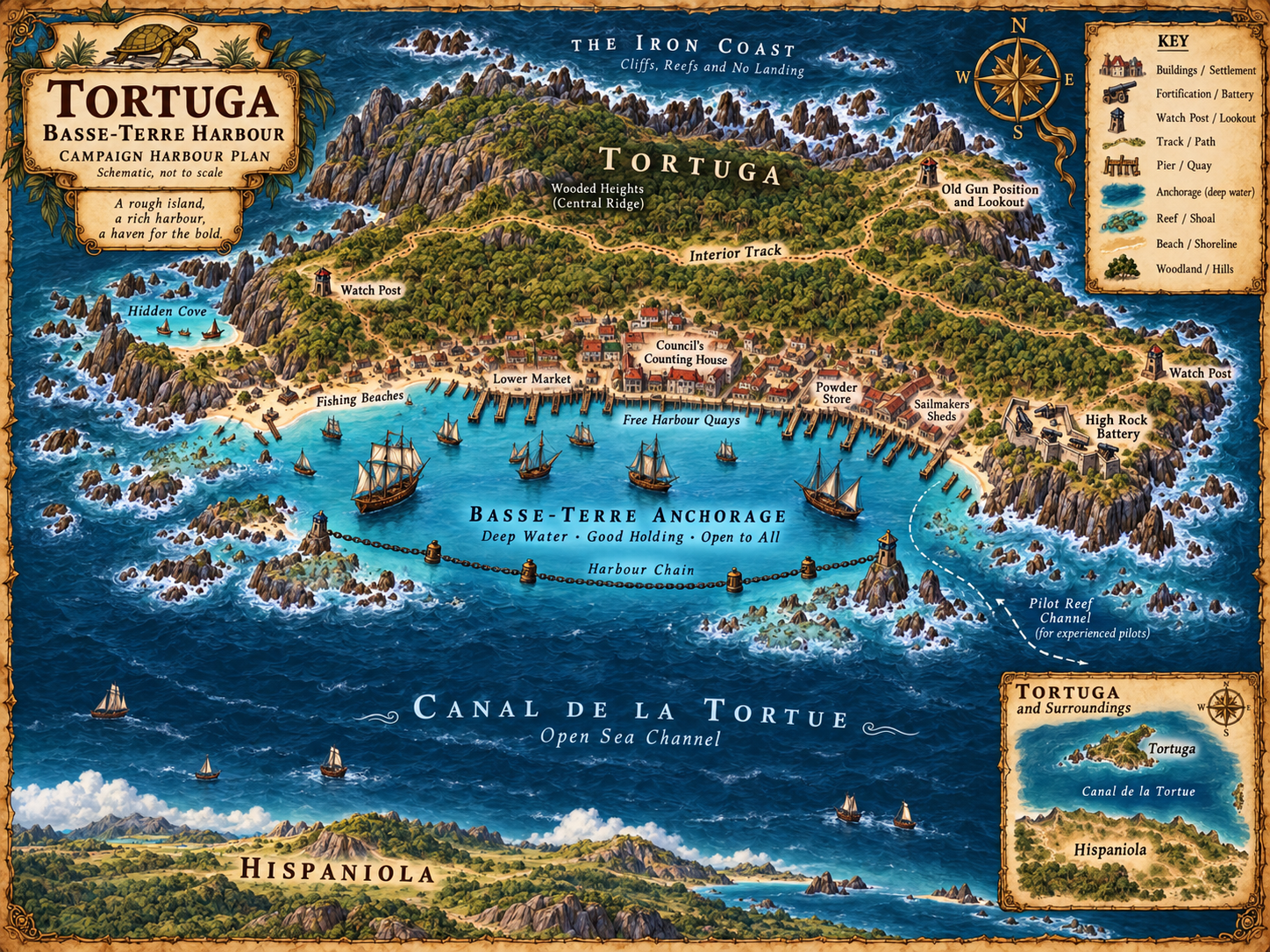
Continue by location: Caribbean region · Caribbean Sea · the western coast of Hispaniola · Santo Domingo · Port Royal. Detailed quay charts are guarded by the harbour pilots; strangers seeking the hidden batteries must earn their trust or find another route.
Sources and Further Paths
The island’s turtle-like outline, steep northern shore, usable southern anchorage and early-modern fortification history are grounded in World History Encyclopedia’s history of pirate havens and archaeological research on Tortuga. The republic’s council, current conflicts and named figures follow the campaign’s own chronology; the real-world buccaneer stronghold rose centuries after 1454.
For the ships, captains and politics behind the settlement, continue to the Brethren of the Coast, Caribbean characters, the Caribbean, the Haunts reference or the Merrow. The missing powder shipment, disputed pilotage and council debts can each bring a new crew into the harbour’s unfinished business.
Keep this reference growing
If this page helped with your reading or game, you can support its upkeep or explore the curated books.
Explore the Bookshop — epics, classics and stories behind imagined worlds.