
Wight — The Grave’s Last Command
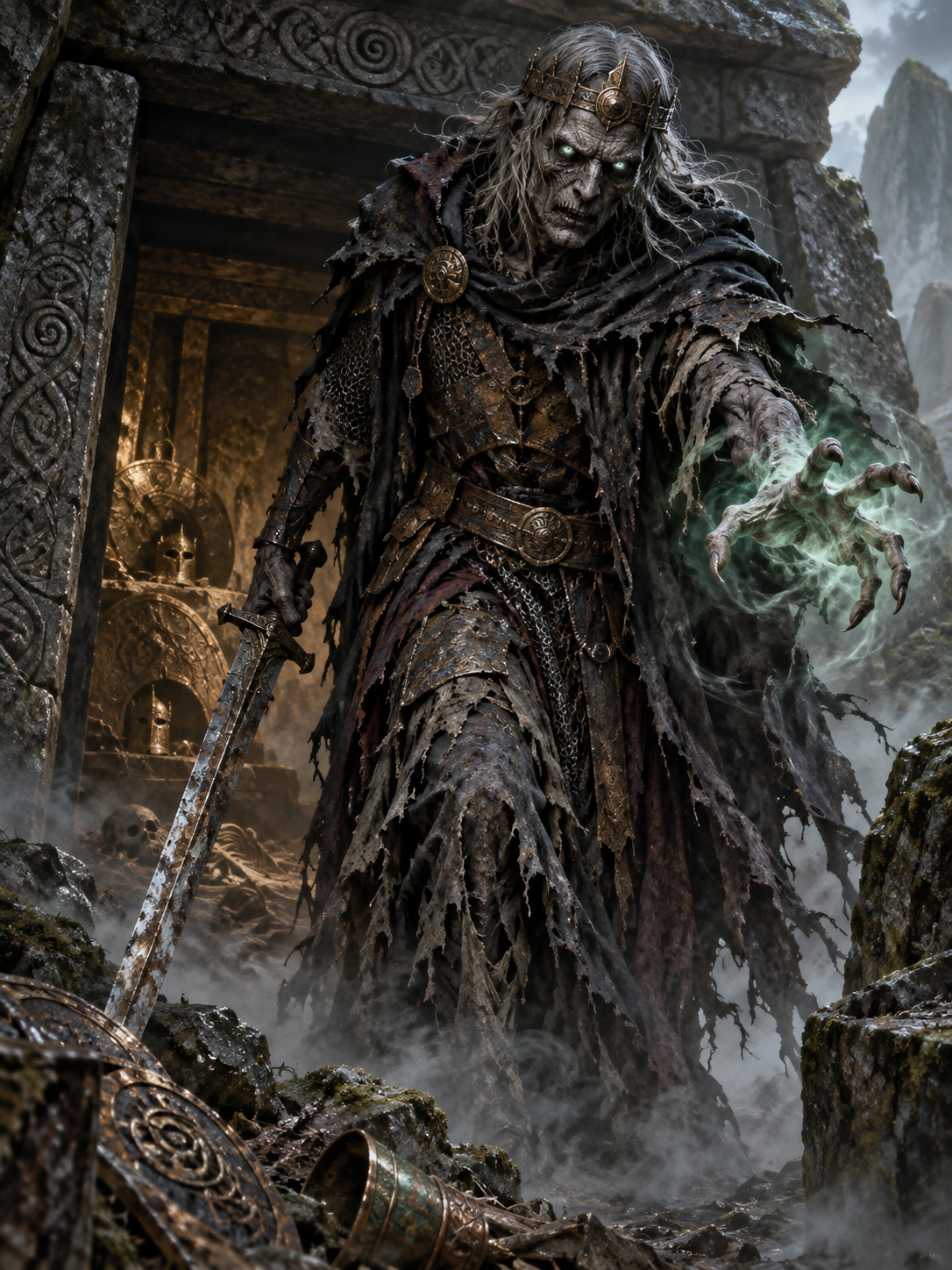
Someone has moved the stone from the tomb door—and the dead commander is taking the names of those who came inside. The first grave-robber returned home walking, but left no footprints in the rain. The second was found beside his bed, cold and stiff, wearing the commander’s rusted ring.
A wight is an intelligent undead corpse with a hunger that outlives the person it was. Its clothing, armour and bearing can reveal who it was: a border captain, a jealous landholder, a tomb guardian, or a victim of necromancy. Its touch steals life. Depending on the rules used, those it kills become obedient Zombies or further Wights.
Unlike a mindless Zombie, a wight knows how to choose an ambush, recognise a former enemy and use the living against one another. Some still honour the literal wording of a pledge made before death; others only pretend to recognise it until a listener steps within arm’s reach.
Wight Stat Blocks
A wight is an intelligent enemy that turns a battlefield into a tomb and carries old orders beyond death. The grave goods and names of its former retainers can reveal where it will next lead the dead. Adventurers who enter its barrow unprepared may find that the guards buried beside it are still awaiting their command.
Wight — D&D 2024
Medium Undead, Neutral Evil · CR 3 (700 XP; PB +2) · SRD 5.2.1
AC 14 (studded leather); Initiative +4 (14); HP 82 (11d8 + 33); Speed 30 ft.
| STR | DEX | CON | INT | WIS | CHA |
|---|---|---|---|---|---|
| 15 (+2) | 14 (+2) | 16 (+3) | 10 (+0) | 13 (+1) | 15 (+2) |
Skills Perception +3, Stealth +4; Resistance Necrotic damage; Immunities Poison damage; Exhaustion and Poisoned conditions; Senses Darkvision 60 ft., Passive Perception 13; Languages Common and one other language.
Traits
Sunlight Sensitivity. While in sunlight, the wight has Disadvantage on ability checks and attack rolls.
Actions
Multiattack. Two attacks using Necrotic Sword or Necrotic Bow in any combination; one attack can be replaced with Life Drain.
Necrotic Sword. Melee Attack Roll +4, reach 5 ft. Hit: 6 (1d8 + 2) Slashing damage plus 4 (1d8) Necrotic damage.
Necrotic Bow. Ranged Attack Roll +4, range 150/600 ft. Hit: 6 (1d8 + 2) Piercing damage plus 4 (1d8) Necrotic damage.
Life Drain. Constitution Saving Throw DC 13, one creature within 5 feet. Failure: 6 (1d8 + 2) Necrotic damage, and the creature’s Hit Point maximum falls by the amount dealt. A Humanoid slain by Life Drain rises after 24 hours as a Zombie serving the wight, unless restored to life or its body destroyed. The wight can command at most twelve such Zombies.
2024 edition: published 2024 Wight, SRD 5.2.1. Its Life Drain is a saving throw, not an attack roll, and the creature has 82 HP and Necrotic weapons.
Wight — D&D 2014
Medium Undead, Neutral Evil · CR 3 (700 XP) · SRD 5.1
AC 14 (studded leather); HP 45 (6d8 + 18); Speed 30 ft.
| STR | DEX | CON | INT | WIS | CHA |
|---|---|---|---|---|---|
| 15 (+2) | 14 (+2) | 16 (+3) | 10 (+0) | 13 (+1) | 15 (+2) |
Skills Perception +3, Stealth +4; Damage Resistances Necrotic; Bludgeoning, Piercing and Slashing from nonmagical attacks that aren’t silvered; Damage Immunity Poison; Condition Immunities Exhaustion, Poisoned; Senses Darkvision 60 ft., Passive Perception 13; Languages the languages it knew in life.
Traits
Sunlight Sensitivity. In sunlight it has disadvantage on attack rolls and Wisdom (Perception) checks that rely on sight.
Actions
Multiattack. Two Longsword or two Longbow attacks. Replace one Longsword attack with Life Drain.
Life Drain. Melee Weapon Attack +4 to hit, reach 5 ft., one creature. Hit: 5 (1d6 + 2) Necrotic damage, then the target makes a DC 13 Constitution saving throw or loses maximum Hit Points equal to that damage until it finishes a long rest. If its maximum reaches 0 it dies. A Humanoid killed by this attack rises 24 hours later as a Zombie under the wight’s command unless revived or its corpse destroyed; limit twelve Zombies.
Longsword. Melee Weapon Attack +4 to hit, reach 5 ft., one target. Hit: 6 (1d8 + 2) Slashing, or 7 (1d10 + 2) with both hands.
Longbow. Ranged Weapon Attack +4 to hit, range 150/600 ft., one target. Hit: 6 (1d8 + 2) Piercing damage.
2014 edition: Basic Rules / SRD 5.1 Wight. This block retains the 45 HP, extra nonmagical weapon resistances, and attack-roll Life Drain of the original 2014 rules.
Wight — Pathfinder 1e
Wight CR 3 (XP 800) · LE Medium Undead · Published Pathfinder 1e
Init +1; Senses Darkvision 60 ft.; Perception +11.
Defense
AC 15, touch 11, flat-footed 14 (+1 Dex, +4 natural); HP 26 (4d8 + 8); Fort +3, Ref +2, Will +5; Defensive Abilities undead traits; Weakness resurrection vulnerability.
Offense
Speed 30 ft.; Melee slam +4 (1d4 + 1 plus energy drain); Special Attacks create spawn, energy drain (1 negative level, DC 14).
Statistics
| STR | DEX | CON | INT | WIS | CHA |
|---|---|---|---|---|---|
| 12 | 12 | — | 11 | 13 | 15 |
BAB +3; CMB +4; CMD 15; Feats Blind-Fight, Skill Focus (Perception); Skills Intimidate +9, Knowledge (religion) +7, Perception +11, Stealth +16 (+8 racial); Languages Common.
Ecology
Environment any; Organization solitary, pair, gang (3–6), or pack (7–12); Treasure standard.
Special Abilities
Energy Drain (Su). A slam bestows one negative level; the DC 14 Fortitude save applies to removal under Pathfinder energy-drain rules. This is not fifth-edition HP maximum loss. Each negative level bestowed grants the wight 5 temporary HP.
Create Spawn (Su). A Humanoid slain by a wight rises as a wight in 1d4 rounds, not a Zombie after 24 hours. Such spawn serve the creator and take −2 on all d20 rolls and checks and −2 HP per Hit Die. They become full wights when their creator is destroyed.
Resurrection Vulnerability (Su). A raise dead spell or comparable resurrection effect can destroy the wight if it fails its Will save; no material component is needed for that use.
Pathfinder 1e rules: Paizo Bestiary Wight. The −2 spawn penalties and resurrection vulnerability apply here, not automatically to other editions.
Wight — D&D 3.5e
Medium Undead · Published D&D 3.5e SRD
Hit Dice 4d12 (26 HP); Initiative +1; Speed 30 ft. (6 squares); Armor Class 15 (+1 Dex, +4 natural), touch 11, flat-footed 14.
Base Attack/Grapple +2/+3; Attack slam +3 melee (1d4 + 1 plus energy drain); Full Attack slam +3 melee (1d4 + 1 plus energy drain); Space/Reach 5 ft./5 ft.
Special Attacks create spawn, energy drain; Special Qualities Darkvision 60 ft., undead traits; Saves Fort +1, Ref +2, Will +5.
Abilities Str 12, Dex 12, Con —, Int 11, Wis 13, Cha 15; Skills Hide +8, Listen +10, Move Silently +16, Spot +10; Feats Alertness, Blind-Fight.
Environment Any; Organization solitary, pair, gang (3–5), or pack (6–11); Challenge Rating 3; Treasure None; Alignment Always lawful evil; Advancement 5–8 HD (Medium); Level Adjustment —.
Combat
A wight closes silently and strikes with its bare hands, using companions or darkness to isolate opponents.
Energy Drain (Su). Its slam bestows one negative level. The Fortitude save to remove that level is DC 14, Charisma-based. It gains 5 temporary HP for each negative level it bestows.
Create Spawn (Su). A Humanoid killed by a wight rises as a wight in 1d4 rounds and is enslaved to its creator until that creature is destroyed. It does not retain its former class abilities.
Published D&D 3.5e SRD Wight. The 3.5e creature has 26 HP, not the 2014 or 2024 total. Unlike the Pathfinder variant, its base attack is +2.
Where Wights Are Found
Old mounds, empty fortresses and disputed graves breed stories of the dead refusing to surrender a boundary, a title or a stolen possession. On the isles of Orkney, a barrow can conceal the burial of a raiding captain whose grave goods still carry the sign of a vanished sea-king. Across the Welsh Marches and Scottish Borders, ruined border keeps shelter commanders who have never learned that their wars ended. The same curse can take root in deserts, catacombs, salt mines, frozen passes or drowned caves.
A barrow-wight is a particularly tomb-bound relation; a frost wight carries the terror into winter country. Do not treat every burial mound as haunted. Establish who was buried there, what oath was broken, and why the door is open now.
Behaviour
A newly risen wight may know only a handful of former names. One that has had decades to think can remember the roads, tolls, family quarrels and old heraldry of its neighbourhood. Some command their spawn like troops, dividing them between a sealed approach and an escape route. Others become possessive of objects or places that once proved their importance: a sword, a land charter, a chair at the lord’s table.
An old master may choose the narrow, low-ceilinged chambers of its own barrow so that intruders cannot stand shoulder to shoulder or make much use of long weapons. Lesser dead watch the visible entrance while the wight listens from a passage behind the tomb. Not every wight stays underground: one can slip through cellar doors, forgotten sewers and thieves’ tunnels to collect a victim’s life or recover an heirloom without showing itself in the streets by day.
It may speak calmly through a barred door to delay visitors until darkness. A wight can recognise bargains and threats, but its desire to extinguish living rivals makes trust precarious. It seldom feeds out of simple starvation: its cruelty can be an effort to correct a wrong it has recast in its own mind.
If Violence Starts
The wight first strikes whoever has disturbed its charge, carries a stolen relic, or looks easiest to isolate. It sets lesser dead between itself and the most dangerous opponent. In fifth edition it uses bows to force an approach or Life Drain against someone already cornered. In Pathfinder and 3.5e a single touch is enough to inflict a negative level, so it prefers sudden blows, retreating beyond reach before an opponent can retaliate.
A tomb fight need not start in the burial chamber. One servant rattles its shield at the sealed main entrance; while the party investigates, another slips down a side passage to close the way out. The wight waits where a shield-wall cannot form, attacking the separated rearmost adventurer before retreating through a route it knows. Alert players can reverse the trap by wedging a door, guarding the rear and forcing the dead commander into daylight. These are its tactics, not extra abilities granted by a stat block.
It may bargain if its orders remain unfulfilled, but a wight defending the object of its fixation often fights beyond all reason. A commander can retreat to rally its spawn; a guardian set to hold one door is less likely to move. Sunlight imposes explicit mechanical penalties in both fifth-edition blocks, but not by default in Pathfinder or D&D 3.5e—do not import those penalties into another tab.
Signs of a Wight
Unburned candles relit from a cold hearth. A grave opened from inside but carefully shut again. Mud carried through a locked strongroom by boots last worn in a battle fifty years ago. Fresh claw-marks in an old wooden door. One corpse lying in a formation as though awaiting an inspection. A survivor who says the dead spoke in a familiar voice.
The best warnings give players practical options: find an alternate entrance, learn the dead officer’s name, fetch an old standard or look for a way to separate the wight from the corpses it commands.
Using the Wight in Play
A wight can be frightening without high damage. Have it notice what a character values, address them by a family name, or deliberately leave one witness alive. In the 2024 rules, extra HP and necrotic weapon damage make it more persistent; in the 2014 rules, nonmagical weapon resistances alter who can injure it. In Pathfinder and 3.5e, energy drain can make a succession of small encounters genuinely dangerous, so foreshadow that threat before allowing an unsuspecting group to stumble into repeated slams.
It is a CR 3 opponent in each edition, but not the same tactical encounter. A single wight backed by Zombies or armed by a former commander can be more memorable than a crowd of identical corpses. Let the characters decide whether to enter the tomb, confront the creature on a road of their choosing, or settle whatever oath binds it.
For a tense investigation, present three discoveries in order: a name recorded on a broken grave seal, the route by which the wight’s servants leave the mound, and evidence that the object it guards was stolen by somebody still living. Each discovery offers a different choice: speak the name, block the escape tunnel, or confront the thief. If the group attacks immediately, the same discoveries become battlefield advantages rather than a punishment for missing the mystery.
Adventure Encounters
The Last Roll of the Dead
A village has begun receiving night-time orders stamped with the seal of a captain killed long ago. The wight has mistaken the descendants of deserters for his surviving soldiers. It commands the corpse of an old sentry and wants a charter returned to the grave. The characters can find the lost muster roll, convince his remaining follower to stand down or risk turning the village into his garrison.
The Stolen Funeral Ring
A broker sells a ring unearthed from a sealed barrow. Each new owner dreams of a debt the dead woman believes unpaid, and a figure in funeral dress waits outside their home. The wight will accept the ring’s return only if the name engraved inside is publicly cleared. The party can recover the record, confront those profiting from the theft or fight the creature before its grievance claims another life.
Twenty-Four Hours Until Dawn
A drover slain on the road has been taken home for burial. Under fifth-edition rules, the household has one day to act before he rises as an enslaved Zombie; under Pathfinder or 3.5e rules, the transformation into a Wight can occur in rounds, making this a desperate immediate rescue instead. The family wants to save him, while the wight lurks nearby in hopes of recovering its new servant. The adventurers must secure the body, confront the killer and find restorative magic before time runs out.
Variants and Bound Wights
Not every wight haunts the same grave. Among the tales preserved by scholars of the dead are cairn wights bound to burial treasure; frost wights with ice in their hair; dust wights of sunburnt ruins; salt wights that leave living flesh parched; and heavier brute wights born of unusually powerful corpses. Treat these as distinctive campaign variants with separately checked rules, not automatic traits of the standard CR 3 wight.
A salt wight’s desiccating touch is a particularly feared variation: in Pathfinder-style campaign rules it may exchange energy drain for a slam that draws water from a victim (Fortitude DC 14 or 1d3 Constitution damage). Such a revenant is a different challenge from an ordinary wight.
Death, Burial and the Old Names
The English word wight once meant a person or being, not necessarily a walking corpse. Later tales of grave-bound spirits and modern fantasy have made the word sound sinister. Legends of treasure watchers, haunted burial mounds and restless warriors can be given local shape without turning every older burial tradition into the same story. Ask what this particular dead person fears losing, and who is still alive to care.
Accursed Treasure
Some wights bind their anger to coins, weapons and heirlooms carried away from the grave. For a Pathfinder-style optional curse, possessions taken from such a tomb may impose negative levels while a claimant holds ownership, removable by returning the object or breaking the curse with suitable magic. One especially harsh curse inflicts a negative level for every 10,000 gp of stolen goods, minimum one; it belongs to a particularly vindictive guardian, not to every grave.
In a fifth-edition game, substitute a fitting curse with explicit duration, a way to discover its conditions and a clear means of lifting it; do not import negative-level mechanics unaltered. The practical treasure may be a royal seal, an unclaimed ransom, or proof that the person interred in the tomb was not the one the records name.
After the Encounter
Destroying a wight does not necessarily settle the grievance behind it. The grave may belong to someone unjustly condemned; a stolen sword may need to return to its rightful inheritor; the spawn may require separate care. Salvaged arms, a family signet or the written order that bound the wight can yield more than a purse of coins, and lifting a curse may win the party allies among the living.
Related Creatures and Lore
Find Barrow-Wights, Frost Wights, Wraiths, Ghosts, Zombies, Skeletons and the Undead Bestiary.
When the Grave Opens
A wight may hold its place for generations, even when the barrow is broken and the dead beneath it have been forgotten. Where its soldiers march at night, the living still know the old banner and the name of the command that sends them out. Breaking the wight’s strength ends the immediate march, but the last words of its oath may lead to another sealed grave.
Sources and Rules
The four edition stat blocks follow the published rules in D&D 2024 / SRD 5.2.1, D&D 2014 / SRD 5.1, Pathfinder 1e and D&D 3.5e SRD. Desiccating and accursed-treasure variants are optional campaign material and are not part of the four standard creatures.
For more on the structure of a wight’s tomb, hidden approach routes and wight packs, see game designer Graeme Davis’s additional material for Ecology of the Wight. It expands on his work for Dragon #348 and is a source of encounter ideas, not a replacement for the edition-specific stat blocks.
The origins of individual wights remain matters for grave-keepers, historians and witnesses: a named tomb, a broken oath and the surviving records of the dead are often more useful than rumour.
Full Open Game License 1.0a and Section 15 notices
OPEN GAME LICENSE Version 1.0a
The following text is the property of Wizards of the Coast, Inc. and is Copyright 2000 Wizards of the Coast, Inc (“Wizards”). All Rights Reserved.
1. Definitions: (a)”Contributors” means the copyright and/or trademark owners who have contributed Open Game Content; (b)”Derivative Material” means copyrighted material including derivative works and translations (including into other computer languages), potation, modification, correction, addition, extension, upgrade, improvement, compilation, abridgment or other form in which an existing work may be recast, transformed or adapted; (c) “Distribute” means to reproduce, license, rent, lease, sell, broadcast, publicly display, transmit or otherwise distribute; (d)”Open Game Content” means the game mechanic and includes the methods, procedures, processes and routines to the extent such content does not embody the Product Identity and is an enhancement over the prior art and any additional content clearly identified as Open Game Content by the Contributor, and means any work covered by this License, including translations and derivative works under copyright law, but specifically excludes Product Identity. (e) “Product Identity” means product and product line names, logos and identifying marks including trade dress; artifacts; creatures characters; stories, storylines, plots, thematic elements, dialogue, incidents, language, artwork, symbols, designs, depictions, likenesses, formats, poses, concepts, themes and graphic, photographic and other visual or audio representations; names and descriptions of characters, spells, enchantments, personalities, teams, personas, likenesses and special abilities; places, locations, environments, creatures, equipment, magical or supernatural abilities or effects, logos, symbols, or graphic designs; and any other trademark or registered trademark clearly identified as Product identity by the owner of the Product Identity, and which specifically excludes the Open Game Content; (f) “Trademark” means the logos, names, mark, sign, motto, designs that are used by a Contributor to identify itself or its products or the associated products contributed to the Open Game License by the Contributor (g) “Use”, “Used” or “Using” means to use, Distribute, copy, edit, format, modify, translate and otherwise create Derivative Material of Open Game Content. (h) “You” or “Your” means the licensee in terms of this agreement.
2. The License: This License applies to any Open Game Content that contains a notice indicating that the Open Game Content may only be Used under and in terms of this License. You must affix such a notice to any Open Game Content that you Use. No terms may be added to or subtracted from this License except as described by the License itself. No other terms or conditions may be applied to any Open Game Content distributed using this License.
3. Offer and Acceptance: By Using the Open Game Content You indicate Your acceptance of the terms of this License.
4. Grant and Consideration: In consideration for agreeing to use this License, the Contributors grant You a perpetual, worldwide, royalty-free, non-exclusive license with the exact terms of this License to Use, the Open Game Content.
5. Representation of Authority to Contribute: If You are contributing original material as Open Game Content, You represent that Your Contributions are Your original creation and/or You have sufficient rights to grant the rights conveyed by this License.
6. Notice of License Copyright: You must update the COPYRIGHT NOTICE portion of this License to include the exact text of the COPYRIGHT NOTICE of any Open Game Content You are copying, modifying or distributing, and You must add the title, the copyright date, and the copyright holder’s name to the COPYRIGHT NOTICE of any original Open Game Content you Distribute.
7. Use of Product Identity: You agree not to Use any Product Identity, including as an indication as to compatibility, except as expressly licensed in another, independent Agreement with the owner of each element of that Product Identity. You agree not to indicate compatibility or co-adaptability with any Trademark or Registered Trademark in conjunction with a work containing Open Game Content except as expressly licensed in another, independent Agreement with the owner of such Trademark or Registered Trademark. The use of any Product Identity in Open Game Content does not constitute a challenge to the ownership of that Product Identity. The owner of any Product Identity used in Open Game Content shall retain all rights, title and interest in and to that Product Identity.
8. Identification: If you distribute Open Game Content You must clearly indicate which portions of the work that you are distributing are Open Game Content.
9. Updating the License: Wizards or its designated Agents may publish updated versions of this License. You may use any authorized version of this License to copy, modify and distribute any Open Game Content originally distributed under any version of this License.
10. Copy of this License: You MUST include a copy of this License with every copy of the Open Game Content You Distribute.
11. Use of Contributor Credits: You may not market or advertise the Open Game Content using the name of any Contributor unless You have written permission from the Contributor to do so.
12. Inability to Comply: If it is impossible for You to comply with any of the terms of this License with respect to some or all of the Open Game Content due to statute, judicial order, or governmental regulation then You may not Use any Open Game Material so affected.
13. Termination: This License will terminate automatically if You fail to comply with all terms herein and fail to cure such breach within 30 days of becoming aware of the breach. All sublicenses shall survive the termination of this License.
14. Reformation: If any provision of this License is held to be unenforceable, such provision shall be reformed only to the extent necessary to make it enforceable.
15. COPYRIGHT NOTICE
Open Game License v 1.0a Copyright 2000, Wizards of the Coast, Inc.
System Reference Document Copyright 2000-2003, Wizards of the Coast, Inc.; Authors Jonathan Tweet, Monte Cook, Skip Williams, Rich Baker, Andy Collins, David Noonan, Rich Redman, Bruce R. Cordell, John D. Rateliff, Thomas Reid, James Wyatt, based on original material by E. Gary Gygax and Dave Arneson.
Pathfinder Roleplaying Game Core Rulebook © 2009, Paizo Publishing, LLC; Author: Jason Bulmahn, based on material by Jonathan Tweet, Monte Cook, and Skip Williams.
Pathfinder RPG Bestiary © 2009, Paizo Publishing, LLC; Author: Jason Bulmahn, based on material by Jonathan Tweet, Monte Cook, and Skip Williams.
Keep this reference growing
If this page helped with your reading or game, you can support its upkeep or explore the curated books.
Explore the Bookshop — epics, classics and stories behind imagined worlds.