
Henry VI — King of England
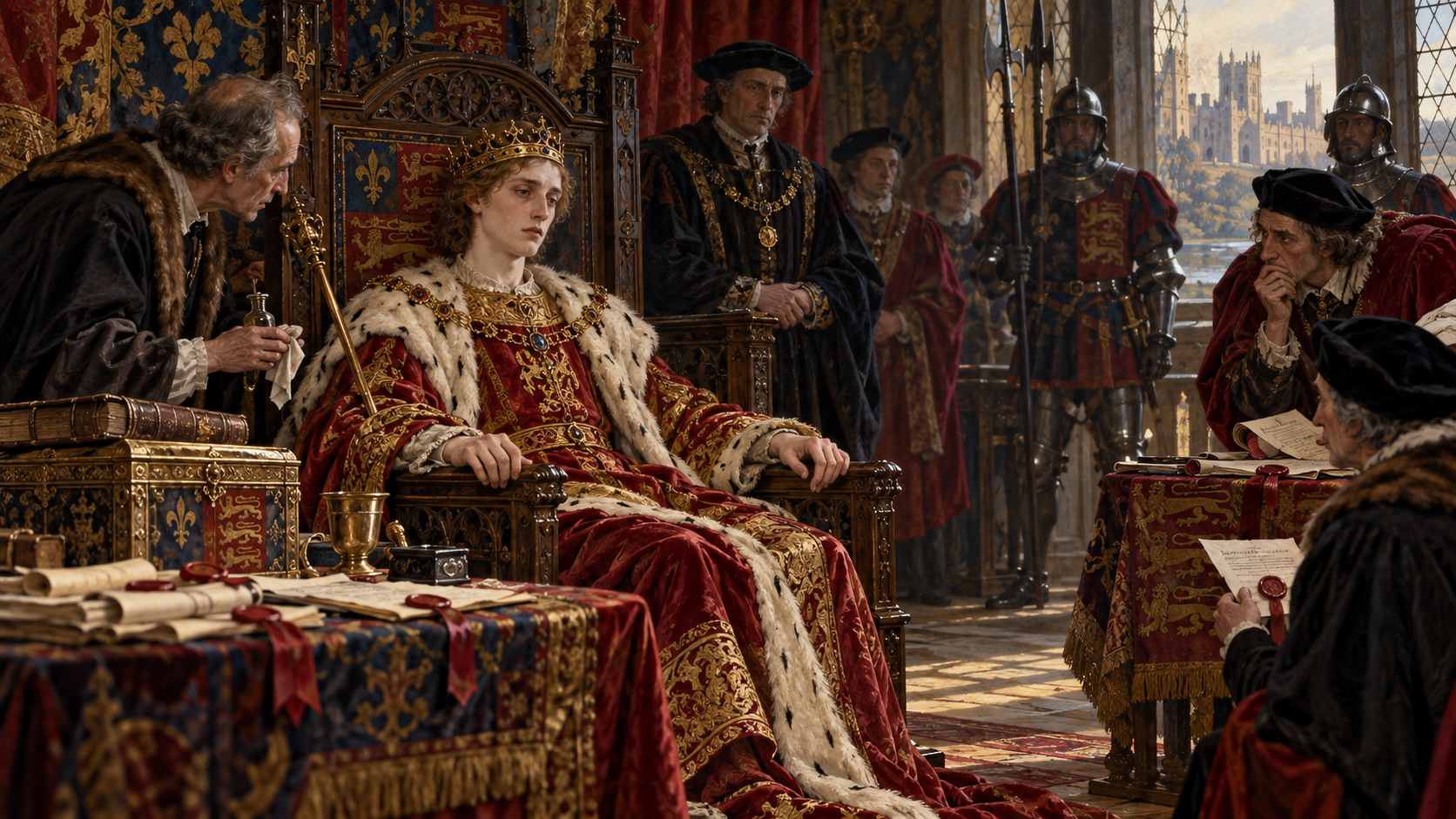
A king whose silence has become a battlefield: Henry VI is physically present at the centre of English government, yet rival factions now struggle over who may speak, appoint and command in his name.
At a Glance
- Name: Henry VI
- Role: King of England
- Age: 32 (born 6 December 1421)
- Race: Human
- Base: The royal household, moving between London, Westminster, Windsor and other secured residences
- Present condition: A profound period of mental incapacity. Henry can spend long stretches silent and unresponsive, showing little awareness of people or events around him and unable to carry out the duties of kingship.
- Campaign use: Protected sovereign, source of disputed authority, kidnapping target, witness whose recovery could overturn plans overnight
- Key connections: British Isles NPCs, England, London, Tower of London
Henry is not an adventuring king. He is the person around whom an adventure happens. A sealed chamber, a physician who cannot be found, an intercepted warrant or a forged command bearing the king’s authority can be more dangerous than a battlefield because every great lord understands what control of the royal person means.
Game Statistics
5.5e / 2024
Henry VI, King of England
Medium Humanoid
Armour Class 11 (padded court doublet)
Initiative +0 (10)
Hit Points 27 (6d8)
Speed 30 ft.
Proficiency Bonus +2
Saving Throws Wis +4, Cha +5
Skills History +4, Insight +4, Persuasion +5
Senses passive Perception 12
Languages English, French, court Latin
Challenge 0 (0 XP; noncombatant)
| STR | DEX | CON | INT | WIS | CHA |
|---|---|---|---|---|---|
| 9 (-1) | 10 (+0) | 10 (+0) | 14 (+2) | 14 (+2) | 16 (+3) |
Royal Person. Loyal household guards prioritise Henry’s safety if he is threatened, subject to their own initiative and available actions.
Authority in Abeyance. While Henry is incapacitated he cannot issue new commands. Documents allegedly issued in his name become evidence, objectives or traps rather than automatic proof.
Actions
Royal Command (Lucid Only). Henry chooses one willing creature he can see within 30 feet that recognises his authority. That creature gains a d6 Leadership Die, which it may add to one ability check or saving throw made before the end of its next turn. A creature can hold only one of Henry’s Leadership dice at a time.
Noncombatant. Henry does not willingly make weapon attacks. If physically cornered and left entirely undefended, resolve any desperate blow as an improvised attack rather than as a normal part of his stat block.
Henry VI, King of England — 5e / 2014
Medium humanoid (human), lawful good
Armor Class 11 (padded court doublet); Hit Points 27 (6d8); Speed 30 ft.; Challenge 0 (0 XP; proficiency bonus +2)
STR 9 (-1), DEX 10 (+0), CON 10 (+0), INT 14 (+2), WIS 14 (+2), CHA 16 (+3)
Saving Throws Wis +4, Cha +5; Skills History +4, Insight +4, Persuasion +5; Senses passive Perception 12; Languages English, French, court Latin
Traits
Royal Person. Loyal household guards prioritise Henry’s safety if he is threatened, subject to their own initiative and available actions.
Authority in Abeyance. When incapacitated, Henry cannot issue commands. A document purporting to carry the royal will remains evidence to investigate rather than automatic proof of authority.
Actions
Royal Command (Lucid Only). Henry chooses one willing creature within 30 feet that recognises his authority. The creature gains a d6 it can add to one ability check or saving throw made before the end of its next turn. A creature can hold only one of Henry’s Leadership dice at a time.
Noncombatant. Henry does not willingly attack. Resolve any desperate physical defence using an improvised weapon, not a special attack in this NPC block.
Henry VI — Pathfinder 1e
Henry VI CR 2; XP 600
Male human aristocrat 4
LG Medium humanoid (human)
Init +0; Senses Perception +7
Defense
AC 11, touch 10, flat-footed 11 (+1 padded court doublet)
hp 22 (fixed; 4d8)
Saves Fort +1, Ref +1, Will +8
Offense
Speed 30 ft.
Melee unarmed strike +2 (1d3−1 nonlethal; only if cornered; provokes an attack of opportunity)
Space/Reach 5 ft./5 ft.
Statistics
Abilities Str 9, Dex 10, Con 10, Int 14, Wis 14, Cha 16
Feats Iron Will, Skill Focus (Diplomacy), Noble Scion (Scion of Peace)
Skills Diplomacy +13, Knowledge (history) +9, Knowledge (nobility) +11, Linguistics +7, Perception +7, Sense Motive +9
Languages English, French, court Latin
Gear Padded court doublet, royal signet and documents
Special Abilities
Scion of Peace When Henry takes 10 on a Wisdom-based skill, treat the die result as 13.
Henry VI — D&D 3.5e
Size/Type Medium Humanoid (Human)
Classes Aristocrat 4
Hit Dice 4d8 (18 hp, fixed)
Initiative +0
Speed 30 ft.
Armour Class 11 (+1 padded court doublet), touch 10, flat-footed 11
Base Attack/Grapple +3/+2
Attack Unarmed strike +2 melee (1d3−1 nonlethal; only if cornered; provokes an attack of opportunity)
Full Attack Unarmed strike +2 melee (1d3−1 nonlethal)
Space/Reach 5 ft./5 ft.
Special Attacks None
Special Qualities Human traits
Saves Fort +1, Ref +1, Will +8
Abilities Str 9, Dex 10, Con 10, Int 14, Wis 14, Cha 16
Skills Diplomacy +14, Knowledge (history) +9, Knowledge (nobility and royalty) +11, Sense Motive +9
Feats Iron Will, Negotiator, Skill Focus (Diplomacy)
Environment English royal household
Organisation With household guards
Challenge Rating 2
Treasure Padded court doublet, royal signet and documents
Alignment Lawful good
Advancement By character class
Level Adjustment +0
Languages English, French, court Latin
What Is Henry VI Doing Now?
Henry remains physically present inside the royal household but is largely unable to take part in government. His illness is not simply weakness or exhaustion: for long periods he may sit silent and unresponsive, appear not to recognise people around him, and show little awareness of events being discussed in his presence. Physicians can keep him fed, rested and guarded, but they cannot explain the illness or predict when his awareness will return.
There is no certain diagnosis for Henry’s condition. What matters at court is what people can see: the king is alive, but often unable to speak, command or confirm what has supposedly been done in his name. Guards control doors, servants are questioned about visitors, messages are copied before delivery, and every faction wants reliable information about any change in his condition. Access to the royal chamber has become a form of political power.
Richard, Duke of York now governs as Protector while Henry cannot rule. Edmund Beaufort, Duke of Somerset, has been confined in the Tower of London, changing the balance around the throne without ending the loyalties built around him.
Queen Margaret works to preserve her husband’s authority and the inheritance of their infant son, Edward of Westminster. Edward was born during Henry’s incapacity and is now Prince of Wales. His existence has transformed the succession: every decision made around the helpless king now also affects the child who stands to inherit from him.
Encounters
- The Silent Audience: The party is admitted to a guarded royal chamber because one companion carries evidence that cannot safely pass through ordinary officials.
- The False Warrant: Two groups possess contradictory orders bearing the king’s authority. One is forged; the other may have been issued before his collapse.
- The Missing Physician: A trusted medical attendant vanishes before reporting a change in Henry’s condition.
- The Prince’s Escort: The party is ordered to move the infant Prince of Wales between royal residences without revealing the route. Two sets of guards arrive with equally convincing authority.
- The Tower Message: A message attributed to the imprisoned Duke of Somerset reaches Henry’s household. Delivering it may be treason, destroying it may be worse, and several councillors already know it exists.
Personality
When lucid, Henry is restrained, courteous and uncomfortable with bloodshed. He prefers reconciliation, ceremony and lawful settlement to threats or displays of force. He can be thoughtful and dignified in quiet company, but he is poorly suited to a court in which powerful men test one another through patronage, armed retainers and calculated pressure.
His gentleness should not be mistaken for irrelevance. A few coherent words from Henry can restore an officer, condemn a forged order, confirm a grant or suddenly make yesterday’s political arrangement untenable.
Relationships
Richard, Duke of York: Protector during Henry’s incapacity. York must govern in the king’s name while knowing that Henry’s recovery could end the protectorate immediately.
Queen Margaret of Anjou: Henry’s wife and the chief guardian of her household’s dynastic interests. She has every reason to scrutinise appointments, access to the king and any arrangement that strengthens York at the expense of her son.
Edward of Westminster, Prince of Wales: Henry and Margaret’s infant son and heir. Born while Henry was incapacitated, Edward’s existence has changed every calculation surrounding the succession.
Edmund Beaufort, Duke of Somerset: A powerful royal councillor and long-standing rival of York. His confinement in the Tower removes him from government but makes his allies, correspondence and eventual fate matters of immediate political importance.
The royal council and household: Councillors, chamber servants, physicians, guards, clerks and seal-keepers can decide who sees Henry, what reaches him and which documents leave in his name. Around an incapacitated king, minor offices become major prizes.
Equipment and Resources
Henry’s personal possessions matter less than the authority attached to them. Royal seals, signet rings, ceremonial robes, a sword of state, guarded correspondence and treasury warrants are all protected by officers whose loyalty can become the subject of an adventure. The ceremonial sword is royal regalia, not a weapon Henry normally draws in a fight. The great seal and other instruments of authentication are far more valuable to conspirators than the sword itself.
His strongest resource is the royal household itself: guards, clerks, messengers, physicians, chamber servants and senior officers who can close a door, delay a visitor, authenticate a document or quietly tell a faction that the king’s condition has changed.
Adventure Hooks
- The King Spoke: A servant swears Henry gave a coherent instruction during the night. Three factions immediately try to control the witness.
- The Seal Chest: A chest containing instruments used to authenticate royal orders disappears between two guarded rooms.
- Recovery: Henry suddenly recognises someone he has not acknowledged for months. The party must decide how to move that information through a court where knowledge itself is dangerous.
- The Prince’s Name: A clerk discovers that a grant concerning the young Prince of Wales has been altered after sealing. Proving when the change was made could ruin a powerful household.
- A Door Left Open: Someone gains unsupervised access to Henry for only a few minutes. Nothing appears to have been stolen, but by morning two contradictory stories of what the king supposedly said are circulating through London.
Connected Places and People
Historical Context
The present crisis began with Henry’s sudden collapse the previous summer. His only son, Edward, was born while the king remained unable to govern. After months in which the council struggled to act in Henry’s name, Richard, Duke of York was appointed Protector in March. The result is not an empty throne but something more dangerous: a living king whose authority remains absolute in principle while other people must exercise it in practice.
Sources and Licensing
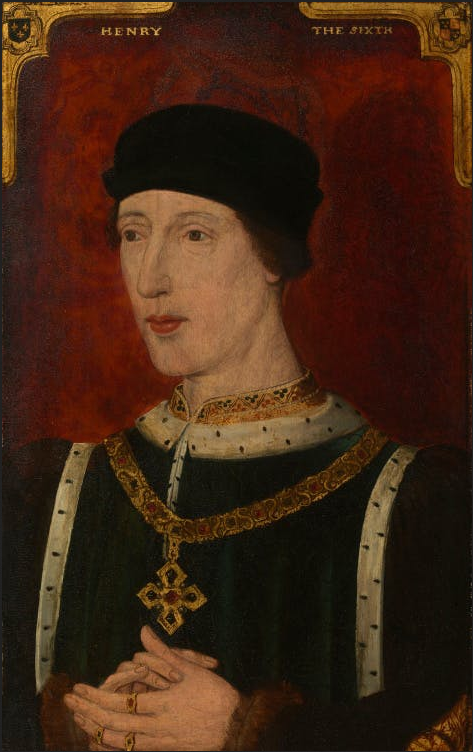
Historical framework: The Royal Family — Henry VI and the UK National Archives overview of the Wars of the Roses. The game statistics, royal-authority traits, encounters and adventure hooks on this page are original adaptations for the stated rules editions.
Keep this reference growing
If this page helped with your reading or game, you can support its upkeep or explore the curated books.
Explore the Bookshop — epics, classics and stories behind imagined worlds.