
Diana — Roman Goddess of the Hunt, Moon and Wild Places
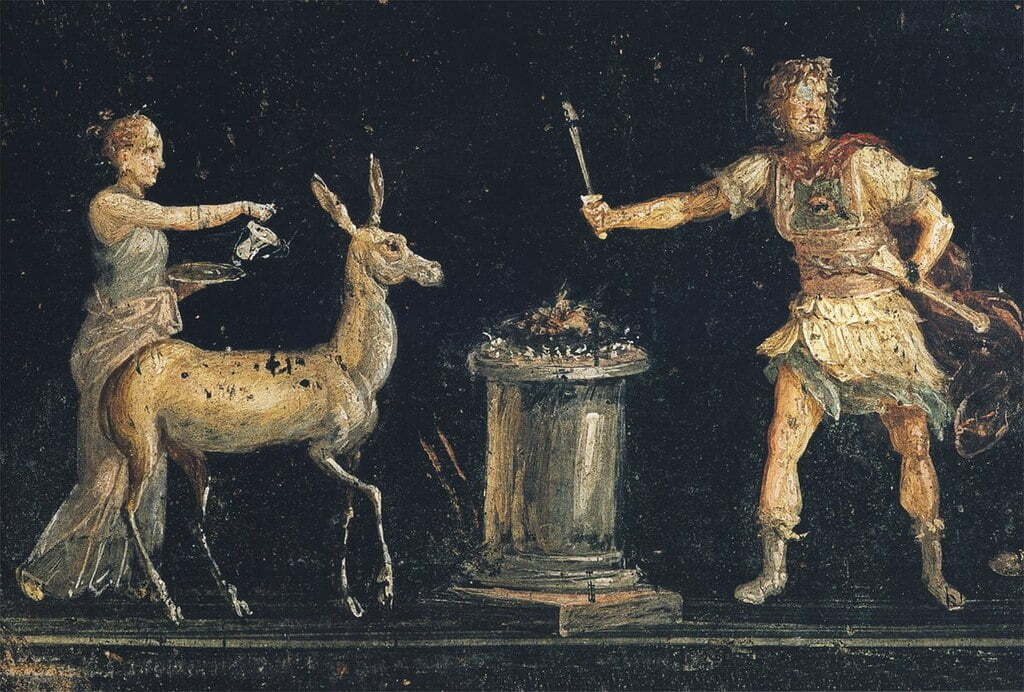
Diana at a Glance
Tradition
Roman and Latin
Divine standing
Intermediate Deity
Campaign alignment
Chaotic Good
Portfolio
Hunting, wild places, animals, moon, women, childbirth and sanctuary
Principal titles
Diana Aventinensis; Diana Nemorensis at Aricia
Sacred places
The Aventine, sacred groves, forest shrines, Lake Nemi and remote crossroads
Emblems
Bow, crescent moon, deer, hound and torch
Favoured weapon
Longbow
Hellenic relationship
Closely identified with Artemis, while Roman and Latin sanctuary traditions remain distinct.
Related Roman powers
Roman Pantheon · Hunt · Wild Places · Moon · Women · Childbirth
Diana is the Roman goddess of the hunt, wild places, women, childbirth and the moon. Her Roman identity has deep Italic roots and an important Aventine cult, while the sanctuary at Aricia links her to sacred woodland, fugitives and dangerous forms of kingship.
Same Deity, Different Cultural Aspect
Diana is the Roman aspect of Artemis: one goddess expressed through Roman and Latin traditions of hunt, moon, childbirth, sanctuary and sacred woodland. The Artemis page presents the Hellenic aspect. Both pages remain separate and self-canonical because they describe different cults and cultural presentations, not different cosmic beings.
Divine Mechanics
Campaign Divine Tier 34 describes Diana’s setting-scale power and is not an SRD challenge rating. The rules-facing 5.5e block stays within SRD 5.2.1 CR 30 and ability-score-30 ceilings.
Diana — 5.5e Rules-Facing Form
Medium Celestial (Deity), Chaotic Good
CR 36 (custom epic) · PB +10 · Campaign Divine Tier 34
AC 28 · HP 720 · Speed 50 ft.
| STR | DEX | CON | INT | WIS | CHA |
|---|---|---|---|---|---|
| 24 (+7) | 32 (+11) | 28 (+9) | 26 (+8) | 32 (+11) | 26 (+8) |
Saving Throws Dex +21, Con +19, Wis +21, Cha +18
Skills Nature +16, Perception +19, Stealth +19, Survival +19, Religion +16
Damage Resistances cold, radiant, psychic; bludgeoning, piercing and slashing from nonmagical attacks
Condition Immunities Charmed, Frightened, Poisoned
Senses Truesight 120 ft. · Languages all; telepathy 120 ft.
Traits
Legendary Resistance (6/Day). If Diana fails a saving throw, she can choose to succeed instead.
Magic Resistance. Diana has Advantage on saving throws against spells and other magical effects.
Mistress of the Wild. Diana ignores Difficult Terrain in natural environments and cannot be tracked except by a deity or artifact unless she chooses to leave a trail.
Moonlit Sanctuary. Allies within 30 feet have Advantage on saves against being Grappled, Restrained or magically compelled to remain in a place.
Divine Spellcasting
Diana has access to every spell granted by the deity’s portfolio domains in the edition being used: Moon · Animal · Protection · Fertility. Those spells are always prepared or available to the deity.
Actions
Multiattack. Diana makes three Moonbow attacks.
Moonbow. Attack: +21 to hit, range 300 ft. Hit: 31 (4d10 + 9) piercing plus 18 (4d8) radiant damage.
Hunt Beneath the Moon (Recharge 5–6). Diana chooses up to six creatures she can see within 120 feet. Each makes a DC 29 Dexterity save, taking 55 (10d10) radiant damage and having Speed reduced by 20 feet until the end of its next turn on a failure, or half damage on success.
Bonus Actions
Forest Step. Diana teleports up to 60 feet between two spaces of dim light, vegetation or natural cover she can see.
Reactions
Protect the Hunted. When a creature within 60 feet is hit while fleeing or protecting a child, Diana reduces the damage by 27 (6d8).
Legendary Actions
- Move. Move up to half Speed without provoking Opportunity Attacks.
- Divine Strike. Make one Moonbow attack.
- Release the Quarry (Costs 2). One ally within 90 feet may move up to its Speed without provoking Opportunity Attacks and may end one Grappled or Restrained condition on itself.
Diana — Pathfinder 1e
Campaign epic extension; true deities are not normally given standard PF1e stat blocks.
CR benchmark 30 · hp about 760 · AC about 48 · Primary attack +41 · Primary DC 35 · Good saves +31 · Poor save +26.
Divine expression. Express Diana through archery, moonlight, mobility, animal affinity, woodland control and sanctuary effects rather than by turning her into a generic melee demigod.
Spell-Like Abilities. At will—freedom of movement, true seeing, commune with nature, greater dispel magic; 3/day—foresight, greater restoration and appropriate moon/light effects; 1/day—miracle. Use caster level 30 for the combat benchmark.
Statistics
CR 36 (custom epic) · AC 54 · hp 940 · Fort +35 · Ref +35 · Will +37
Str 24 · Dex 32 · Con 28 · Int 26 · Wis 32 · Cha 26
Base Atk +36 · CMB +43 · CMD 96
Domain Access
Diana has full access to the deity’s linked portfolio domains in their Pathfinder-facing versions or clearly marked campaign adaptations.
Diana — D&D 3.5e
Intermediate Deity; Divine Rank 13; Chaotic Good Medium Outsider (Extraplanar)
Divine Rank 13 · DR 25/epic · SR 45 · Domain SLA caster level 23.
Divine rules. Divine rank adds to attacks, saves and checks; natural armour is rank + 13; divine AC bonus equals rank; deflection uses Charisma modifier.
Salient Divine Abilities. Alter Reality, Divine Ranger, Divine Skill Focus, Free Move and rank-appropriate nature or protection abilities.
Statistics
Challenge benchmark 42. Ability scores may exceed 30 where the deity’s divine nature requires it; Divine Rank remains the primary measure of cosmic authority.
Domain Access
Diana can use every spell-like ability granted by the deity’s portfolio domains at the caster level determined by Divine Rank.
Diana in Roman Religion
Diana’s Aventine sanctuary belonged to a wider Latin religious world as well as Rome itself. Her cult therefore carries an older regional identity that should not be reduced to a direct copy of Artemis.
The sanctuary of Diana at Aricia beside Lake Nemi adds another Roman-Italian layer: sacred woodland, fugitives, ritual kingship and danger at the edge of ordinary political order. Lunar and Artemis-like features remain important, but the Roman landscape matters.
What Is Diana Doing Right Now?
Forests are being cleared, enclosed and hunted more aggressively while armies and refugees move along old roads. Diana’s cult becomes active wherever people ask whether wild ground can still remain outside a ruler’s control.
She is also invoked by women in childbirth and by people seeking sanctuary beyond ordinary civic protection. A remote grove can therefore be healer’s refuge, fugitives’ sanctuary or a place where a noble hunter discovers that rank no longer matters.
Worship in the Campaign Present
Hunters, midwives, forest communities and women travelling outside city protection maintain Diana’s cult. Moonlit offerings are common, but so are practical rites before a hunt, birth or dangerous journey through wooded country.
Her priests are suspicious of anyone who calls every uncultivated place waste. They can tolerate careful hunting and forestry; they oppose the assumption that wild land has no owner, memory or sacred claim.
Domains, Spells and Divine Gifts
Diana’s clergy favour Nature, Life, Twilight, Protection and Travel themes. Suitable spells include Hunter’s Mark, Animal Friendship, Pass without Trace, Moonbeam, Freedom of Movement, Commune with Nature and Find the Path.
Gift: Track by Moonlight
At night, the devotee can follow a creature’s trail even across hard ground unless the trail was concealed by magic.
Gift: Sanctuary of the Grove
Once per long rest, the devotee can designate a 10-foot-radius natural area as sanctuary for 1 minute; enemies entering it must succeed on a Wisdom save or lose the rest of their movement.
Relics
The Nemi Bow
A bow that becomes weightless beneath moonlight and refuses to fire at a child or creature genuinely seeking sanctuary.
The Aventine Torch
Its light reveals the nearest safe path out of a city into uncultivated ground.
Relationships
Apollo is Diana’s closest major counterpart in light, archery and healing traditions, but her Roman cult remains distinct. Juno overlaps with women and childbirth; Venus with fertility; Minerva with independent female authority.
Use Diana Tonight
The Grove Refuses the Road
A new military road reaches a sacred forest and every survey marker turns back toward Rome overnight.
The King of the Wood Is Missing
A dangerous office at Nemi stands empty, and the grove begins choosing candidates from travellers.
The Moonlit Birth
A child born under Diana’s protection casts the shadow of a stag instead of a human.
Divine Estate and Regional Effects
Where Diana’s presence is strong, a major sanctuary can project the following effects across roughly six miles. A small shrine normally manifests only one effect in a smaller area. Unless another divine power contests them, the effects fade over 1d10 days after the sanctuary is abandoned or desecrated.
Moon Paths Appear
Under moonlight, safe animal trails and hidden paths through wild ground become easier to read; Survival checks to avoid getting lost gain Advantage.
The Hunted Are Warned
Predators, poachers and armed pursuers disturb birds and small animals before they arrive, making ambushes against protected travellers harder to conceal.
Birth Under Her Guard
Those seeking refuge for childbirth or protection of the young find clean water, shelter and useful herbs more readily than chance should allow.
Deep Dive
Continue through the Roman Pantheon, Artemis, Apollo, Juno, Minerva, Venus. Follow the cult into Rome and wider Italy, or use the Cleric and Cleric Domains pages for player-facing worship.
Historical Sources and Rules Compatibility
Historical cult material is separated from campaign invention. Diana’s Aventine and Arician traditions anchor the Roman page rather than treating it as an Artemis duplicate. The 5.5e block respects SRD 5.2.1 numeric ceilings; the higher Campaign Divine Tier is setting-only. Pathfinder 1e deity mechanics are explicitly a campaign epic extension. D&D 3.5e uses divine-rank structure.
Historical Sources and Further Reading
- Temples of Diana in Rome — Aventine cult, dedication traditions and Roman topography.
Rules licensing. D&D 5.5e terminology derived from the System Reference Document 5.2.1 is used under CC BY 4.0 where applicable. Pathfinder 1e and D&D 3.5e deity statistics on this page are original campaign conversions rather than official published deity stat blocks.