
At a Glance
- Type
- Armed ocean-going merchant ship refitted for piracy
- Captain
- George Lowther
- Former name
- Gambia Castle
- Alternative name
- Happy Delivery
- Former owner
- Royal African Company
- Reported armament
- 16 guns
- Reported complement after mutiny
- About 50 sailors and former soldiers
- Waters
- West Africa, Atlantic and Caribbean
- Weaknesses
- Limited crew for its artillery, dependence on safe repair anchorages
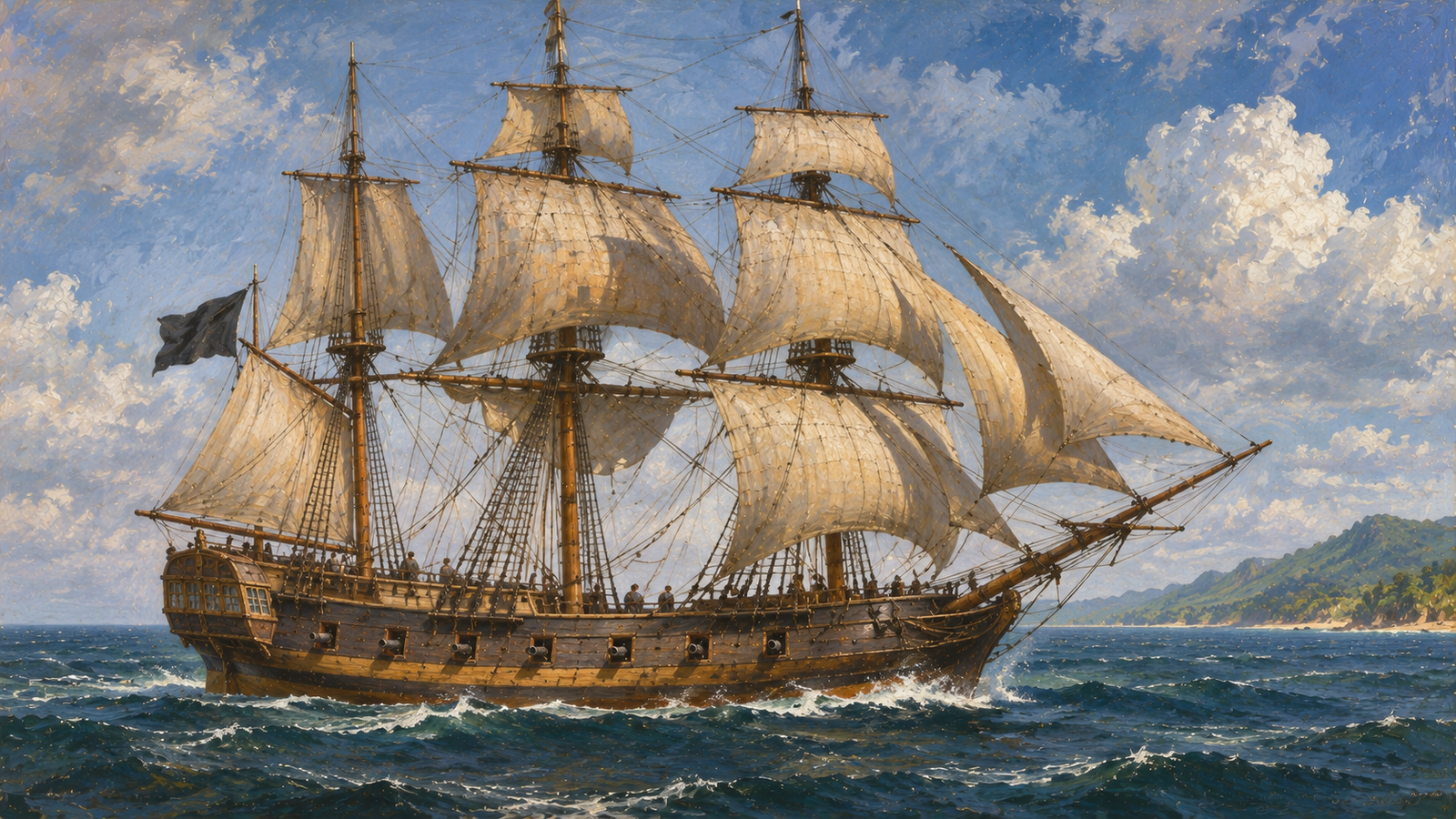
Delivery is George Lowther’s captured merchant ship, formerly the Royal African Company’s Gambia Castle. Her company has thrown off its former officers’ authority and adopted articles to govern the sharing of prizes. The ship is heavily armed for commerce, but the same sailors must work the rig and serve the guns. A prolonged voyage without food, water or repairs can divide the company.
Hull, Decks and Rigging
After taking control of the vessel, the mutineers remove cabin partitions to give the ship a more open working deck. There is room for a fighting company, captured cargo and provisions. Eight light cannon are mounted on each side in the campaign reconstruction. The game dimensions of 85 by 25 feet are illustrative, not measurements from a surviving ship plan; tonnage and precise rig are not established by the sources cited here.
Captain and Crew
George Lowther commands with the agreement of his sailors. John Massey, an army officer who helped seize the vessel, favours different opportunities from the seamen. Edward Low later joins the company and becomes lieutenant. The articles give the captain two shares of prizes, the master one and a half, and the doctor, mate, gunner and boatswain one and a quarter. They provide compensation for the loss of a limb, require the delivery of valuables to the quartermaster and leave punishments for misconduct to the captain and majority of the company. The agreement promises quarter to opponents who ask for it; the pirates do not always honour that promise.
Use the veteran buccaneer and shipmate profiles. Sailors assigned to the rig and helm cannot simultaneously operate the guns.
What Is Happening Now?
The crew seeks water and repairs while its officers debate whether to keep the ship in Caribbean waters or seek better prizes farther north. A sheltered beach offers space to unload stores and careen the hull, but the people living nearby have their own claims to the land and supplies. The captain needs an agreement that will keep his company fed without provoking another conflict.
Adventure Hooks
- Articles disputed. A wounded sailor seeks the compensation promised by the articles. The quartermaster disputes the amount available after repairs.
- The careening camp. A coastal community objects to the pirates using its beach and cutting timber. The adventurers can arrange permission or help the crew find another anchorage.
- Return to England. Massey wants a way home without facing the other officers’ wrath. The party can help negotiate a departure.
- Low’s company. A newly captured vessel gives Low a chance to form a separate crew. The sailors argue over ownership and division of the prize.
Delivery — Vehicle Rules
Delivery
Original named-vessel profile; armed merchant ship. The figures below are game values, not a historical survey.
| Size | Gargantuan vehicle |
|---|---|
| Hull dimensions (approximate in play) | 85 ft. by 25 ft. |
| Travel speed | 3 mph |
| Minimum operating crew | 20 |
| Additional berths | 30 (50 total aboard) |
| Cargo capacity | 45 tons subject to space occupied by crew, stores and ammunition |
| Armor Class | 15 |
| Hit Points | 350 |
| Damage Threshold | 10 |
| Replacement value | 15,000 GP (estimate) |
| Armament | 16 mounted light cannon (8 per side; campaign loadout) |
Shipboard Combat
Light Cannon. Each mounted gun uses a crew of 3 and attacks only targets on its own side of the vessel. Aiming, loading and firing each require one Utilize action. A gunner can perform the firing action once the gun is loaded and aimed. Ranged Attack Roll: +6 to hit, range 200/800 ft., one target. Hit: 16 (3d10) bludgeoning damage. Each shot consumes one load of powder and shot. The cannon is a separate object (AC 19, 50 HP). Assign actual sailors to the guns; sailors required for safe operation cannot simultaneously serve as gunners. With 50 aboard and 20 needed to operate the ship, a full broadside requires 24 more, leaving six for other duties.
Movement and manoeuvres. Travel speed assumes wind and a working crew; for tactical movement use 30 ft. per round under favourable wind, up to 60 ft. with a successful DC 15 Wisdom check using water vehicles, made by the helmsman as an action. Failure leaves ordinary speed; in a calm or with sails disabled, the vessel drifts with the current. Turning, hazards and boarding follow the ship combat procedure. This is an original encounter option.
Damage and repair. Attacks dealing less than the hull threshold do no hull damage. Treat crew and exposed fittings as separate targets. At 0 hull HP the ship begins to sink; characters have 1d6 rounds to abandon ship or make a DC 15 carpenter’s tools check as an action to delay sinking for 1 minute (once per sinking incident). At berth, restoring 1 HP requires 20 GP and one day, halved in a properly equipped shipyard.
Comparison: Sailing Ship; D&D 2024 Basic Rules — Equipment Named-vessel statistics and light cannon are original adaptations.
Delivery
Original named-vessel profile; armed merchant ship. The figures below are game values, not a historical survey.
| Size | Gargantuan vehicle |
|---|---|
| Hull dimensions (approximate in play) | 85 ft. by 25 ft. |
| Travel speed | 3 mph |
| Minimum operating crew | 20 |
| Additional berths | 30 (50 total aboard) |
| Cargo capacity | 45 tons subject to space occupied by crew, stores and ammunition |
| Armor Class | 15 |
| Hit Points | 350 |
| Damage Threshold | 10 |
| Replacement value | 15,000 GP (estimate) |
| Armament | 16 mounted light cannon (8 per side; campaign loadout) |
Shipboard Combat
Light Cannon. Each mounted gun uses a crew of 3 and attacks only targets on its own side of the vessel. Aiming, loading and firing each require one action. A gunner can perform the firing action once the gun is loaded and aimed. Ranged Weapon Attack: +6 to hit, range 200/800 ft., one target. Hit: 16 (3d10) bludgeoning damage. Each shot consumes one load of powder and shot. The cannon is a separate object (AC 19, 50 HP). Assign actual sailors to the guns; sailors required for safe operation cannot simultaneously serve as gunners. With 50 aboard and 20 needed to operate the ship, a full broadside requires 24 more, leaving six for other duties.
Movement and manoeuvres. Travel speed assumes wind and a working crew; for tactical movement use 30 ft. per round under favourable wind, up to 60 ft. with a successful DC 15 Wisdom check using water vehicles, made by the helmsman as an action. Failure leaves ordinary speed; in a calm or with sails disabled, the vessel drifts with the current. Turning, hazards and boarding follow the ship combat procedure. This is an original encounter option.
Damage and repair. Attacks dealing less than the hull threshold do no hull damage. Treat crew and exposed fittings as separate targets. At 0 hull HP the ship begins to sink; characters have 1d6 rounds to abandon ship or make a DC 15 carpenter’s tools check as an action to delay sinking for 1 minute (once per sinking incident). At berth, the same repair rate of 20 GP and one day per HP is a campaign estimate.
Comparison: Sailing Ship; Dungeon Master’s Guide (2014), chapter 5, waterborne vehicles and siege equipment. Named-vessel statistics and light cannon are original adaptations.
Delivery
Gargantuan water vehicle; Squares 85 (85 ft. by 25 ft.); Cost 15,000 gp (replacement estimate).
Defense
AC 6; Hardness 5; hp 850 (broken at 425 or fewer); Base Save +0.
Offense
Maximum Speed 180 ft. (current); Acceleration 30 ft.; CMB +4; CMD 14; Ramming Damage 4d8.
Description
Propulsion current (air); Driving Check Profession (sailor) or Knowledge (nature), +10 to DC for air-current propulsion; Forward Facing bow; Driving Device tiller; Driving Space four squares around the helm; Crew 20; Decks 1; Capacity 45 tons of cargo or 30 additional people (50 total aboard) in crowded conditions; Weapons 16 light cannon (8 each side). These are original vehicle specifications.
Light cannon. Original direct-fire siege firearm: Large, damage 4d6 bludgeoning, critical ×4, range increment 100 ft., crew 3, load 2 full-round actions, aim 1 full-round action, misfire 1. Use the siege-engine rules for crew, attacks, ammunition and firearm misfires. Only guns bearing on the target can fire. Operating crew and gun crews are separate assignments. A complete broadside requires 24 gunners in addition to 20 operating crew.
Rules framework: Ultimate Combat — Vehicles and Siege Engines. Not an official published named-ship profile.
Delivery
Original sailing vessel with shipboard artillery.
| Transport | Armed merchant ship |
|---|---|
| Cost (replacement estimate) | 15,000 gp |
| Dimensions | 85 ft. by 25 ft. |
| Operating crew | 20 |
| Capacity | 45 tons or 30 additional people (50 total aboard) |
| Travel speed | 3 mph |
| Hull AC | 4 |
| Hull hardness | 5 |
| Hull hit points | 180 |
| Weapons | 16 light cannon (8 each side) |
Handling. Use Profession (sailor) for wind and difficult manoeuvres; use the edition’s object damage rules for the hull. In tactical encounters the ship moves 30 ft. per round under favourable wind; a DC 15 Profession (sailor) check as a standard action permits 60 ft. for that round. If all sails fail, the vessel drifts.
Light cannon. Original Large siege weapon: 4d6 bludgeoning damage, critical ×3, range increment 100 ft., crew 3, two full-round actions to load and one to aim; the gunner makes a ranged attack using base attack bonus and Dexterity modifier (apply -4 if nonproficient). Firing is a standard action. One charge of powder and shot is consumed. Hull hardness applies to each hit as normal. Use separate crew assignments for each weapon and for navigation. A complete broadside requires 24 gunners in addition to 20 operating crew.
Repairs. Use Craft (shipbuilding) and the object rules. At 0 hull HP the vessel founders; evacuate or use a DC 15 Craft (shipbuilding) check as a full-round action to delay sinking for 1 minute, once per incident.
Reference: D&D 3.5e SRD — transport and object rules. Hull and cannon statistics are campaign adaptations.
History and Sources
In 1721 the Royal African Company sends the Gambia Castle to the Gambia with soldiers under John Massey. After disputes over conditions, Lowther and Massey seize the ship and depart in June. The early account attributed to Charles Johnson describes her refitting and renaming as Delivery, with sixteen guns and about fifty hands. The same account later calls her Happy Delivery and describes the company abandoning and burning her after an attack on its careening camp, transferring to a sloop named Ranger. The precise hull form, tonnage, gun arrangement and game values are not securely documented.
Sources: A General History of the Pyrates — George Lowther and his crew (early narrative, read critically); International Journal of Maritime History — John Massey, George Lowther, and the taking of the Gambia Castle, 1721; George Lowther — documentary record. The hero is an artistic reconstruction of the armed merchant ship; rig, visible gunports and hull details are not a verified ship plan. Named-vessel mechanics and dimensions are original game adaptations.
See Vehicles, Sailing Ship, Whydah Gally, Bersheba and Ship Combat.
Pathfinder rules framework: Pathfinder Roleplaying Game Ultimate Combat © 2011, Paizo Publishing, LLC; Jason Bulmahn et al.
Keep this reference growing
If this page helped with your reading or game, you can support its upkeep or explore the curated books.
Explore the Bookshop — epics, classics and stories behind imagined worlds.