
Sailing Ship — The Merchant’s Sea Road
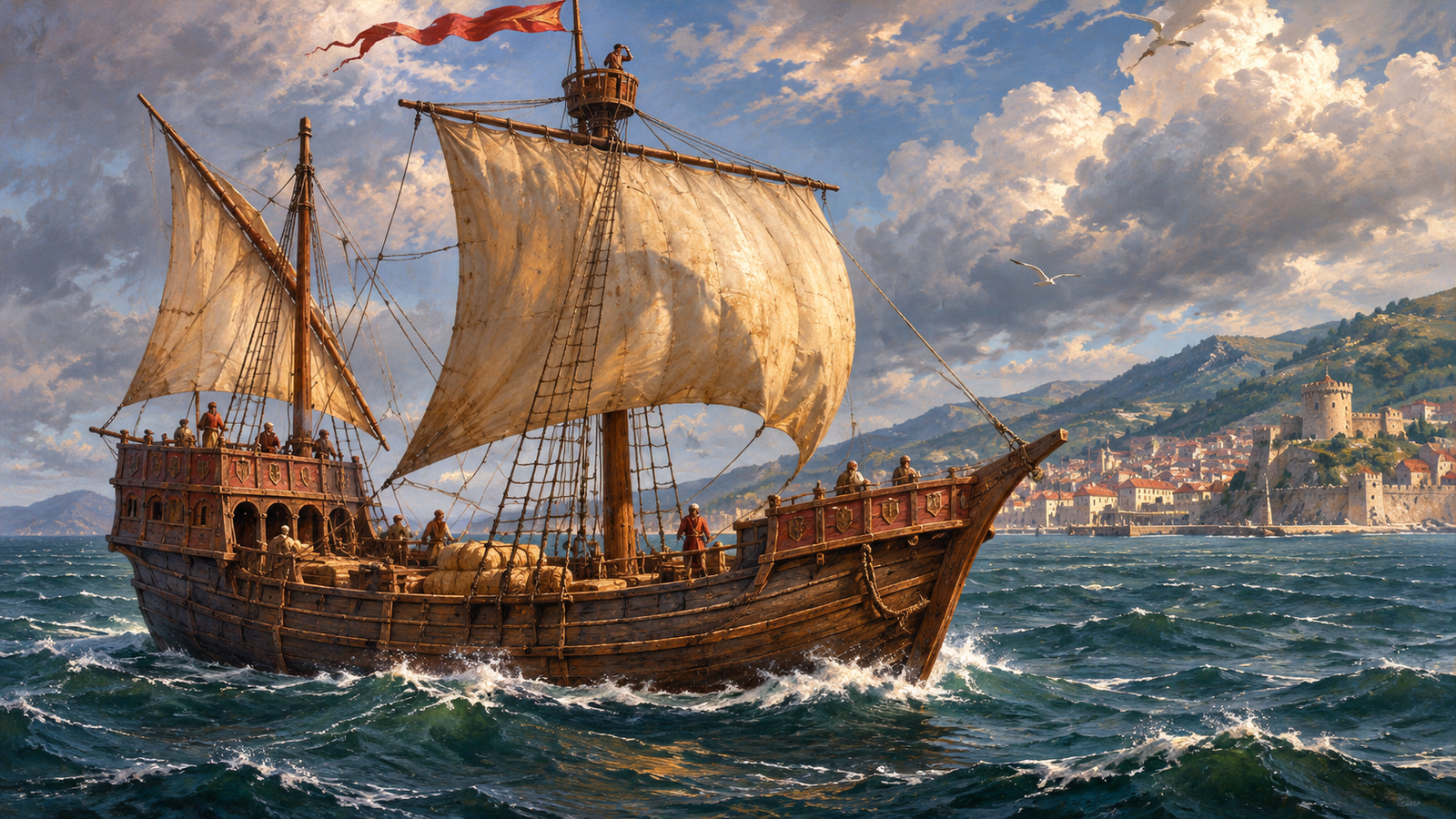
At a Glance
- Kind
- Wind-driven seagoing merchant or passenger vessel
- Propulsion
- Sails set and trimmed by a trained crew
- Typical Work
- Coastal trade, ocean passage, fishing fleets, passengers and valuable cargo
- Outfitting
- Masts, sails, rigging, steering gear, holds, anchors and boats
- Strength
- Greater range and carrying capacity than rowing boats
- Weaknesses
- Unfavourable wind, storms, shallow harbours, fire and boarding
The ship leaves the last friendly harbour with a fresh wind and a hold full of salt, cloth and sealed chests. The captain watches a gull wheel over the stern while the pilot counts the last visible landmarks. By dusk the coast has disappeared. The navigator opens a chart whose western edge is stained black, and the merchant who paid for the voyage refuses to say where the cargo is to be delivered.
Sailing ships join the markets of distant towns and carry people where no road exists. Their hulls and sails vary with country, trade and the shipwright’s traditions. In 1454, broad merchant cogs, early carracks and smaller lateen-rigged coastal craft share harbours with ships built for raiding, pilgrimage or royal service. Each needs a reliable crew, supplies, local charts and enough depth beneath the keel.
Hull, Rigging and Cargo
A seaworthy hull holds its ballast and freight below deck, where bundles are secured against violent movement. Masts and yards carry sails that must be raised, shortened or furled as the wind changes. The helmsman acts on commands from the master; lookouts watch the horizon, while sailors inspect the lines, pumps and planking.
Trade. A manifest records the declared cargo, but the space a merchant reserves for goods competes with the water, food and spare rigging required for the passage. Grain spoiled by seawater can ruin a voyage even if the ship returns intact. The departure port’s tolls and destination’s laws may matter more than the miles between them.
Navigation. Coastal pilots follow soundings and landmarks, while ocean travellers rely upon experience, sky and compass. In fog or a storm the captain may be forced to choose between continuing by uncertain reckoning and shortening sail until visibility improves.
Shipboard routine. Watches rotate through the night. A carpenter plugs leaks, the cook protects provisions and the crew keeps weapons ready when another sail appears. A single torn seam or dragging anchor can become an emergency if a storm is building.
Varieties on the Sea Roads
Cog. A broad northern freight vessel, often recognised by its high sides and substantial single mast. It can work busy ports and carry valuable bulky goods, though it requires a suitable harbour.
Carrack. A large merchantman combining northern and Mediterranean construction, increasingly notable for multiple masts and a mixture of square and lateen sails.
Caravel. A smaller, agile vessel associated with developing Atlantic seafaring traditions. Its precise rig and size vary by place and period; not every later ocean-going design belongs in an ordinary harbour of 1454.
Smaller fishing vessels and coasters may have simpler rigs and crews. These are different hulls in play, not names that automatically change the published game statistics of the base ship.
Voyages, Laws and Adventures
The Sail Beyond the Shoal. A returning merchant ship shows a signal reserved for distress, but refuses to enter the harbour. When the characters board from a pilot boat they find its deck scrubbed clean, its cargo untouched and a chart marked with a new island that no local master recognises.
The Cargo That Owes a Debt. A merchant’s locked chests arrive safely after a long passage, yet the harbour authority orders the entire ship seized. The manifest bears a seal of a ruler who died two centuries before; the cargo is claimed by his heirs, who have come armed with a very old warrant.
Dangers. Squalls, reefs, rotting timbers, mutiny, starvation, piracy and false lighthouse fires all offer meaningful risks. Good seamanship matters: a captain who understands weather and water may save the ship without ever drawing a sword.
Sailing Ship — Vehicle Rules
Sailing Ship — D&D 2024
Official vessel: Sailing Ship.
| Ship | Sailing Ship |
|---|---|
| Speed | 2 mph |
| Crew | 20 |
| Passengers | 20 |
| Cargo (Tons) | 100 tons |
| AC | 15 |
| HP | 300 |
| Damage Threshold | 15 |
| Cost | 10,000 GP |
Running the vessel. A ship larger than a small boat needs a crew of skilled hirelings to operate. The passenger allowance is additional to the crew. Private cabins reduce the number of passengers that can be accommodated relative to hammock berths.
Movement. In a dead calm, a sailing ship with no oars cannot make progress under sail; against a strong wind its speed is halved. Use the actual crew and the ship’s speed with travel and weather rules, not an assumed fixed tactical speed in feet per round.
Damage and repair. The hull has a damage threshold of 15. At berth, repairing 1 HP costs 20 GP and one day; a properly supplied city shipyard halves time and cost. Broken rigging and injured sailors can have separate consequences from lost hull hit points.
Official source: D&D 2024 Basic Rules — Airborne and Waterborne Vehicles.
Sailing Ship — D&D 2014
Official vessel: Sailing Ship.
| Ship | Sailing Ship |
|---|---|
| Speed | 2 mph |
| Crew | 20 |
| Passengers | 20 |
| Cargo (Tons) | 100 tons |
| AC | 15 |
| HP | 300 |
| Damage Threshold | 15 |
| Cost | 10,000 gp |
Sea travel. With a skilled crew at work, the ship follows the published travel speed subject to wind and hazards. It cannot move by sail in a dead calm; a strong opposing wind halves the pace. The DM may call for relevant checks to navigate a storm, approach a reef or hold station in a narrow channel.
Battle. Hull attacks must meet the damage threshold. Boarding, rigging damage and effects on individual crew members use the applicable combat and object rules. Repairing the hull requires appropriate labour and materials while the ship is berthed.
Official source: Dungeon Master’s Guide (2014), chapter 5, Airborne and Waterborne Vehicles, p.119.
Sailing Ship — Pathfinder 1e
Sailing Ship — Colossal water vehicle; Squares 60 (20 ft. by 75 ft.); Cost 10,000 gp.
Defense
AC 2; Hardness 5; hp 900 (broken 449); Base Save +0.
Offense
Maximum Speed 180 ft. (current), 60 ft. (muscle entry); Acceleration 30 ft. (current), 15 ft. (muscle entry); CMB +8; CMD 18; Ramming Damage 8d8.
Description
Propulsion current (air; two masts, 30 squares of sails, 150 hp) or current (water); Driving Check Profession (sailor) or Knowledge (nature), +10 to the DC for air-current propulsion; Forward Facing bow; Driving Device steering wheel; Driving Space nine squares around the aft steering wheel; Crew 20; Decks 2; Capacity 150 tons of cargo or 200 passengers; Weapons 20 Large direct-fire engines (10 per side), or six Huge (three per side); broadsides cannot fire fore or aft.
This printed profile is a two-masted ship used for ocean passages.
Official vehicle profile: Pathfinder Ultimate Combat — Water Vehicles. The carrack is explicitly a modified comparison, not a separate official vehicle.
Sailing Ship — D&D 3.5e
| Transport | Sailing Ship |
|---|---|
| Cost | 10,000 gp |
| Weight | — |
| Dimensions | 75–90 ft. long; 20 ft. beam |
| Crew | 20 |
| Capacity | 150 tons cargo |
| Travel speed | 2 mph |
The SRD lists a two-masted vessel suited to sea voyages.
Rig and voyage. A seaworthy, square-rigged vessel with two masts, capable of ocean travel. Sailing relies upon wind, available crew and sound rigging. The ship’s cargo must be stowed without compromising safe trim or space for provisions.
Damage and handling. Profession (sailor), sea travel, weather and object rules govern dangerous manoeuvres, losses and repairs. This core equipment entry does not specify Pathfinder CMB, CMD or 900 hit points, or another edition’s damage threshold.
Official source: D&D 3.5e SRD — Sailing Ship.
Other Ships and Sources
When the crew must make evasive manoeuvres, fight at sea or rescue people from a sinking vessel, use the Ship Combat procedure for your chosen edition. The manoeuvre and sinking options on that page are original encounter rules; the published vessel figures here remain unchanged.
See the Carrack, Medieval Cog, Warship and Galley, or return to the Vehicles catalogue.
The vessel depicted above is a late-medieval merchant sailing ship, suited to the trade and sea roads of 1454. Its construction illustrates one common form of sailing vessel; rigs and hulls vary between ports and regions.
Section 15: Copyright Notice — Pathfinder Roleplaying Game Ultimate Combat © 2011, Paizo Publishing, LLC; authors Jason Bulmahn, Tim Hitchcock, Colin McComb, Rob McCreary, Jason Nelson, Stephen Radney-MacFarland, Sean K Reynolds, Owen K.C. Stephens and Russ Taylor.
Keep this reference growing
If this page helped with your reading or game, you can support its upkeep or explore the curated books.
Explore the Bookshop — epics, classics and stories behind imagined worlds.