
Transmutation
Transformation, enhancement and the alteration of matter
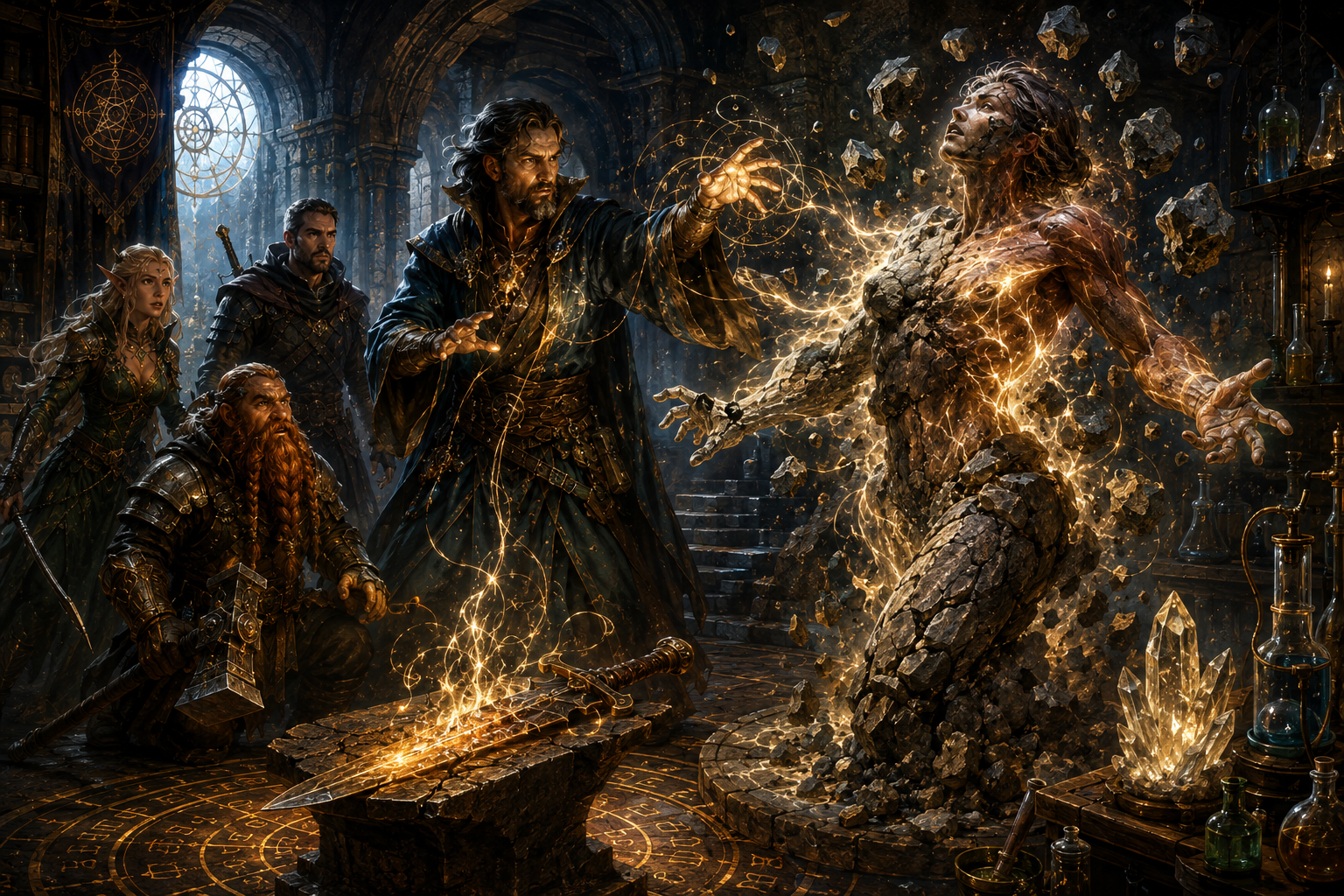
Transmutation is the magic of becoming: stone made fluid, flesh given another shape, motion accelerated, strength awakened and ordinary material persuaded to accept a new form.
The school at a glance
Change Made Real
Transmutation does not merely disguise a subject or place a new object beside it. It changes a creature, object, substance, movement or physical condition according to the exact limits of the spell.
Identity of the school
What Transmutation Does
A Transmutation imposes a new physical truth. The subject may become larger, harder, faster, animate, bestial, crystalline, fluid, weightless or otherwise altered for as long as the spell permits.
The school includes obvious metamorphoses, but it is wider than polymorph magic. A spell may strengthen a body without changing its appearance, animate an object without creating a new one, accelerate movement, alter a material’s workability or reshape an existing structure. Some changes are beneficial; others are restraints, curses or forms of destruction.
Transmutation is distinguished by consequence. An illusory wall may look solid but remains a deception. A conjured wall introduces something into the scene. A transmuted wall is the existing matter, physically changed. That distinction matters whenever a creature touches, carries, damages, dispels or attempts to move through the result.
The Transmuter’s Questions
- What existing creature, object or condition is being changed?
- Does the spell replace statistics or modify selected traits?
- What happens to worn and carried equipment?
- Does size, anatomy or occupied space change?
- Is the effect sustained, permanent or instantaneous?
- What ends, reverses or suppresses the change?
| School | What changes | Practical distinction |
|---|---|---|
| Transmutation | The subject’s actual form, properties, capability or condition. | The alteration has the physical and rules consequences stated by the spell. |
| Illusion | Perception, appearance or sensory information. | A seeming may mislead observers without granting the physical traits it depicts. |
| Conjuration | Presence, location or the arrival and creation of matter. | Conjuration brings or forms something; Transmutation changes what is already there. |
| Enchantment | Thought, emotion, attitude or compelled behaviour. | Changing a mind is not the same as changing the body that contains it. |
The major practices
The Major Forms of Transmutation
Individual spells may combine several of these practices, and editions do not always classify the same effect in the same way.
Polymorph and Shapechanging
The subject assumes another bodily form. The spell determines which statistics, senses, movement types, natural weapons and mental qualities remain.
Size and Anatomy
Limbs lengthen, bodies grow or diminish, natural weapons emerge and organs adapt to new environments. Appearance alone does not define the mechanical result.
Physical Enhancement
Strength, resilience, speed, agility and other bodily capabilities are increased without necessarily replacing the subject’s identity or complete statistics.
Debilitation and Petrification
Hostile Transmutations slow movement, weaken the body, distort anatomy or convert living tissue into an inert material.
Matter and Material Change
Stone, wood, metal, earth and manufactured substances are softened, hardened, reshaped or converted according to the spell’s stated limits.
Objects and Constructed Forms
Existing objects can be animated, repaired, reforged or made to perform functions their ordinary construction would not permit.
Terrain and Environment
Ground, walls, passages and natural materials become tools of movement, fortification, escape, siegecraft and hazard control.
Motion and Temporal Rate
Some editions place magical speed, slowing and extreme changes in the rate of action within Transmutation. Treat this as an edition-specific classification, not a universal law.
Current rules first
Edition Reference
Identify the active rules system before deciding what a transformation changes. Similar spell names can use very different procedures.
D&D 5.5e / 2024
Read Each Spell Literally
The 2024 spell list uses Transmutation for physical alteration, shape-shifting, animation, enhancement and related changes. There is no single school-wide polymorph procedure that replaces the text of every spell.
- Alter Self grants selected adaptations rather than a new creature stat block.
- Animal Shapes specifies which statistics are replaced and which remain.
- Animate Objects creates temporary Constructs from existing objects and explains reversion.
Legacy d20 system
Pathfinder First Edition
Pathfinder defines Transmutation as changing the properties of a creature, thing or condition and supplies a detailed Polymorph subsystem.
- Only one polymorph effect can govern a creature at a time.
- Size-changing magic does not stack onto an active polymorph effect.
- Gear, senses, movement, natural attacks and form-dependent abilities follow specific rules.
Legacy d20 system
D&D 3.5e
D&D 3.5e gives the school the broad identity of changing the properties of a creature, thing or condition. Individual spell descriptions and the edition’s form-changing rules determine the actual result.
- Do not import Pathfinder’s later unified Polymorph procedure.
- Track target, duration, saving throw and Spell Resistance from the individual spell.
- Specific spell wording overrides assumptions based on name or school.
Adjudication
Important Rules Distinctions
Transmutation becomes difficult when the table treats visual description as if it were a complete rules procedure. Resolve the written change first, then narrate it.
- Transformation is not disguise. A spell can alter appearance without granting a new size, anatomy, movement type or statistic. Check what the text actually changes.
- Modification is not replacement. Some spells add a bonus or trait; others replace a complete stat block or defined group of statistics.
- The subject and its equipment are separate. Gear may remain usable, resize, fall away, meld into the body or be unaffected. Never assume one answer for every form.
- Size has spatial consequences. Establish occupied space, reach, legal placement and whether the altered creature can fit before resolving movement or transformation.
- Anatomy limits action. Speech, manipulation, spell components, weapons and equipment use depend on what the new form can physically perform under the active edition.
- Willingness does not replace targeting rules. A willing creature must still be an eligible target within range and subject to every restriction stated by the spell.
- Duration determines reversibility. Concentration, fixed-duration, permanent and instantaneous effects do not end or respond to dispelling in the same way.
- Antimagic suppresses; it does not rewrite history. Apply the active edition’s antimagic text to an ongoing transformation. Do not automatically undo an instantaneous change that has already completed.
- Damage follows the transformed state. Use the spell’s rules for temporary Hit Points, replacement Hit Points, object damage, reversion and excess damage rather than inventing a universal transfer rule.
- Specific restoration must be named. A spell, condition or curse ends only through the methods its text and edition allow. Similar imagery does not make every reversal interchangeable.
Training and practice
Transmuters in Play
A transmuter treats the world as a set of conditions rather than a collection of fixed objects.
In an adventuring company, Transmutation rewards preparation and lateral thinking. The same caster may strengthen an ally, adapt a scout to water, slow a pursuer, reshape a barrier, animate unattended objects or impose a devastating bodily change on a dangerous foe.
The school is often strongest when the caster understands materials, anatomy and space. Knowing that a door is iron, a tunnel is limestone or a monster cannot speak in its assumed form may matter as much as raw spell level.
Transmutation also creates ethical questions. Voluntary enhancement, medical alteration and emergency adaptation are different acts from involuntary reshaping, punitive petrification or experimentation upon captives. The school provides capability, not moral permission.
Curated SpiralWorlds paths
Representative Transmutation Magic
This is a guided selection rather than a duplicate spell catalogue. Each page illustrates a different expression of transformation.
Petrification
Flesh to Stone
A hostile bodily transformation that turns living flesh toward mineral stillness and raises difficult questions about condition, damage and restoration.
Acceleration
Haste
Magical speed alters the rate at which a creature moves and acts. The exact benefits and its relationship with Slow are edition-specific.
Debilitation
Slow
A severe reduction in movement and action that demonstrates how Transmutation can control a battle without directly destroying its targets.
Material reshaping
Reforge
Existing metal is softened and imposed with a new practical shape, illustrating the school’s relationship with craft, repair and field engineering.
Warped flesh
Grotesque Polymorph
An involuntary and dangerous transformation that makes the loss of bodily control central to the spell’s horror and counterplay.
Assumed form
Beast Shape II
A Pathfinder polymorph spell showing how an assumed form grants selected size, movement, armour, ability and natural-attack benefits.
For broader navigation, browse the Sorcerer and Wizard spell collection or return to the Magic reference.
History, language and story
Historical and Mythological Parallels
Fantasy Transmutation is a game category. Historical alchemy and transformation myths are imaginative parallels, not evidence that the tabletop school existed as a real system.
Alchemy and Material Knowledge
Alchemy is often reduced in popular memory to changing base metals into gold, but historical practice was broader. Alchemists and related artisans worked with assaying, mining, metalworking, pigments, dyes, distillation, ceramics, medicine and glass.
Its texts combined theories about matter with workshop knowledge. In fantasy, this provides a strong model for transmuters who are not merely spellcasters but investigators of substances, heat, proportion, decay, refinement and the boundary between natural process and magical command.
The Metropolitan Museum of Art: Alchemy, Science, and Innovations in the Decorative Arts
Metamorphosis in Myth
Transformation stories repeatedly ask whether identity survives a changed body. Gods take animal forms, mortals become trees or stone, warriors gain unnatural strength, and enchantresses remake enemies or victims through herbs and spoken power.
Ovid’s Metamorphoses gathers a vast tradition of forms becoming other forms. Circe’s transformations, petrification tales and divine shapechanging remain especially useful parallels for spells involving bodily alteration, punishment, escape and unstable identity.
Rare and consequential magic
Transmutation in SpiralWorlds
Transmutation is powerful but uncommon, difficult to master and often feared.
Most people encounter it through stories of shapeshifters, petrified victims, cursed bloodlines, unnatural beasts or objects altered by ancient magic. A skilled transmuter may serve a ruler, military company, occult society or wealthy patron, but few communities have dependable access to such magic.
Temporary enhancements and minor alterations are more plausible than permanent changes to flesh or matter. Lasting transformations are exceptional events, often requiring rare ingredients, dangerous rituals or magic beyond ordinary spellcasting. Those who claim they can turn base metal into gold, restore a ruined body or permanently assume another form are treated with suspicion—and are frequently frauds.
Selected existing media
Further Viewing
Two useful videos are retained as ordinary links rather than embedded players, reducing page weight and avoiding autoplay or third-party iframe issues.


Rules sources and licensing
Sources and Edition Boundaries
The summaries above use original wording and are intended for comparison and navigation. Apply the complete spell text and rules of the edition being played.
- D&D 2024 Basic Rules: Spell Descriptions Current spell classifications and individual transformation procedures.
- System Reference Document 5.2.1 Current open D&D rules reference.
- Creative Commons Attribution 4.0 Licence applied to SRD 5.2.1.
- Archives of Nethys: Transmutation Pathfinder First Edition school and Polymorph rules.
- Archives of Nethys: Transmutation School Pathfinder specialist-school description and powers.
- Archives of Nethys: Licences Pathfinder First Edition Open Game License and copyright notices.
- D&D 3.5e SRD: Transmutation Legacy school definition and spell-description framework.
- D&D 3.5e SRD: Open Game License Open Game License v1.0a and the SRD copyright notice.
This work includes material derived from the System Reference Document 5.2.1 by Wizards of the Coast LLC, available through D&D Beyond and licensed under the Creative Commons Attribution 4.0 International License. Pathfinder First Edition and D&D 3.5e rules are summarised in original wording; the linked licence pages identify the underlying Open Game License and copyright notices.
Keep this reference growing
If this page helped with your reading or game, you can support its upkeep or explore the curated books.
Explore the Bookshop — epics, classics and stories behind imagined worlds.