
Flesh to Stone Spell: Petrification and Living Statue Horror
Flesh to Stone Spell: Petrification and Living Statue Horror
Some spells kill the body. Flesh to Stone leaves the victim present, silent, and owned by whoever survives the casting.
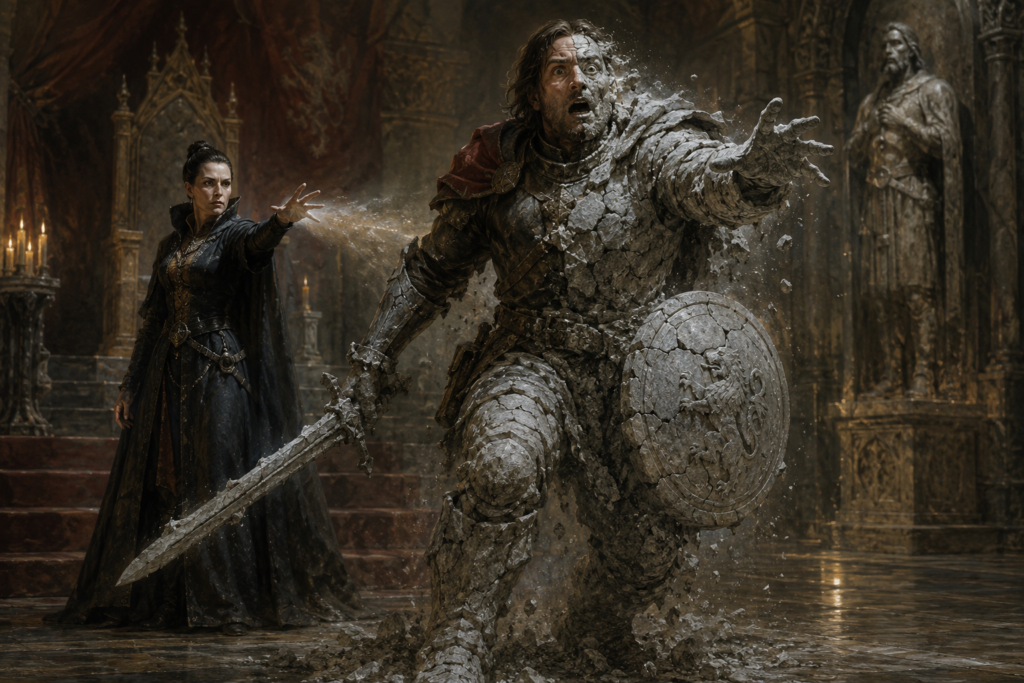
A warrior freezes mid-charge, mail, sword, sweat, and expression hardening into pale stone. A courtier becomes a statue before the lie leaves his mouth. A monster that could not be slain becomes a trophy, a hostage, or a disaster waiting in a sealed room.
Flesh to Stone is not merely a death-like spell. It is imprisonment by transformation. The victim is not properly dead, not properly alive, and not safely gone. The body remains in the world as evidence, property, prisoner, relic, hostage, or crime scene.
Quick Rules Reference
- Transmutation spell that turns a fleshly creature into stone.
- Usually affects one creature at range.
- The target’s carried gear is transformed with it.
- A successful saving throw prevents or resists the transformation, depending on edition.
- The petrified creature is inert, unaware, and effectively removed from play.
- Damage to the statue may carry over if the creature is restored.
- Creatures not made of flesh are normally unaffected.
Effect
Flesh to Stone transforms a living creature of flesh into a mindless, inert statue. The victim’s body and carried gear become stone. The creature does not breathe, speak, perceive, act, or age in any normal sense. It is not simply dead, however, and restoration magic may return it to life if the statue remains recoverable.
The spell is dangerous because the battle does not end the consequences. A petrified victim can be stolen, displayed, shattered, ransomed, hidden, restored years later, or mutilated while helpless. The spell’s real danger begins after the body becomes portable.
Mechanics Tabs
The rules below are mechanics compatible for different game editions.
Flesh to Stone 5.5e / 2024
Flesh to Stone Pathfinder 1e / 3.5e
Flesh to Stone 3.0e
Flesh to Stone 5.5e / 2024
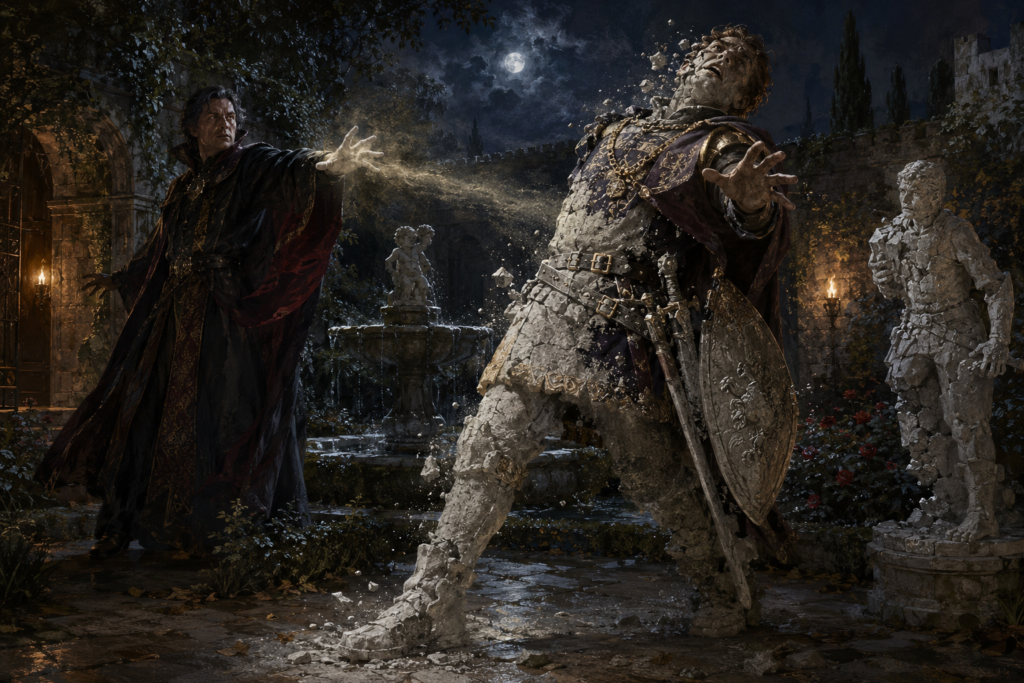
6th-Level Transmutation
Casting Time: Action
Range: 60 feet
Components: V, S, M (lime, water, and earth)
Duration: Concentration, up to 1 minute
Spell Lists: Sorcerer, Wizard
Alternative Spell Name: Flesh to Stone, “The Mercy of Marble”
Choose one creature you can see within range. The spell affects only a creature with a living flesh body. Constructs, oozes, elementals, incorporeal creatures, most undead, and creatures made primarily of stone, metal, wood, shadow, spirit, or other non-flesh substance are unaffected unless the DM rules that the creature’s current body is truly living flesh.
The target makes a Constitution saving throw. On a failed save, it begins to turn to stone and has the Restrained condition as its flesh hardens. On a successful save, the spell ends.
A restrained target repeats the Constitution saving throw at the end of each of its turns. If it succeeds three times, the spell ends and the target is no longer restrained. If it fails three times, it has the Petrified condition while you maintain concentration. The successes and failures do not need to be consecutive; track both until one reaches three.
If the target is petrified in this way and you maintain concentration for the spell’s full duration, the transformation becomes permanent. The creature remains petrified until the condition is ended by Greater Restoration, Wish, or similarly powerful restorative magic.
The target’s worn and carried equipment becomes stone with it. If the statue is broken, damaged, carved, or defaced, the creature suffers corresponding injury, deformity, or loss if restored.
Notes
- Only creatures with living flesh bodies are valid targets.
- The spell should not affect skeletons, ghosts, animated armour, stone golems, air elementals, or similar beings without living flesh.
- A shapeshifted creature can be affected if its current form has a living flesh body.
- A petrified creature is not dead. Effects that target corpses or dead creatures do not normally apply.
- Treat the statue as an object for damage, but as the transformed creature for restoration consequences.
- When a restored statue has been damaged, the DM should assign matching consequences based on the harm done: cracks may become scarring or heavy injury, missing pieces may become maiming or missing limbs, and catastrophic destruction may cause death or failed restoration unless exceptional magic intervenes.
- Do not use Flesh to Stone as a throwaway save-or-lose button. It is strongest when the petrified body still matters.
Flesh to Stone Pathfinder 1e / 3.5e
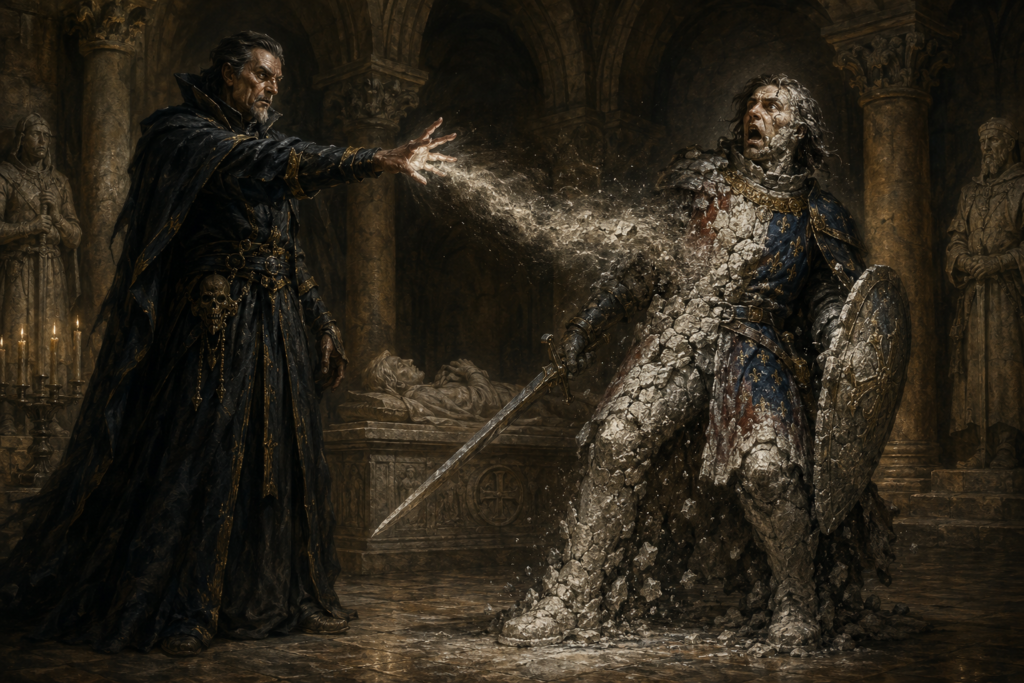
School: Transmutation
Level: Sorcerer/Wizard 6
Components: V, S, M
Casting Time: 1 standard action
Range: Medium (100 ft. + 10 ft./level)
Target: One creature
Duration: Instantaneous
Saving Throw: Fortitude negates
Spell Resistance: Yes
Material Component: Lime, water, and earth
The subject, along with all its carried gear, turns into a mindless, inert statue. The creature is not dead, but it does not seem to be alive either when viewed with spells such as deathwatch.
Only creatures made of flesh are affected by this spell.
If the statue resulting from this spell is broken or damaged, the subject has similar damage or deformities if ever returned to its original state.
Notes
- The spell has no effect on creatures not made of flesh.
- The target’s worn and carried gear becomes stone with the target.
- The spell is instantaneous, so it does not require concentration and is not dispelled like an ongoing magical effect.
- Stone to flesh is the clean reversal for this spell. Other powerful magic, such as limited wish, miracle, or wish, may also reverse or repair the transformation if appropriate to the edition and campaign.
- If the statue is missing limbs, cracked, eroded, or deliberately carved, the restored creature should carry matching wounds or deformities unless the restoration magic also repairs the body.
- If the statue is reduced to rubble, restoration should normally require recoverable remains plus exceptional magic, or else a specific quest or miracle at DM discretion.
Flesh to Stone 3.0e
The subject, along with all its carried gear, turns into a mindless, inert statue.
This material is Open Game Content, and is licensed for public use under the terms of the Open Game License v1.0a.
Transmutation
Level Sorcerer/Wizard 6
Components V, S, M
Casting Time 1 standard action
Range Medium (100 ft. + 10 ft./level)
Target One creature
Duration Instantaneous
Saving Throw Fortitude negates
Spell Resistance Yes
If the statue resulting from this spell is broken or damaged, the subject (if ever returned to its original state) has similar damage or deformities. The creature is not dead, but it does not seem to be alive either when viewed with spells such as deathwatch.
Only creatures made of flesh are affected by this spell.
Material Component Lime, water, and earth.
Why This Spell Is Dangerous in the World
Flesh to Stone creates captives who cannot plead, testify, inherit, rule, repent, or die properly. Kings can become monuments. Witnesses can be silenced without bloodshed. Monsters can be stored beneath temples. Criminals can be sentenced to centuries of stillness. Lovers can be preserved against their will.
Because the victim remains physically present, the spell creates legal, sacred, and political problems. Is the statue property, prisoner, corpse, evidence, hostage, or person? Who has the right to move it? Who is guilty if it is broken? Is restoring the victim an act of mercy, treason, theft, or sacrilege?
A statue can be guarded like a prisoner, inherited like property, mourned like a corpse, or restored like a witness.
In a late-medieval mythic world, custody of a petrified body can matter as much as the spell itself. A statue may still carry inheritance rights, witness status, noble blood, treaty protection, temple protection, oath obligations, ransom value, or unresolved criminal evidence.
Rules Clarifications and Edge Cases
- Gear: Worn and carried gear turns to stone with the creature. Loose nearby objects do not.
- Damage: Harm to the statue matters. Cracks, missing pieces, erosion, and deliberate carving should affect restoration.
- Death effects: The target is not dead. Corpse-only magic should not normally work.
- Creature type: The key question is whether the target has a living flesh body, not whether it is humanoid.
- Restoration: Reversing the spell should restore the creature, but not automatically undo every injury caused while it was a statue unless the magic says so.
- Custody: Moving, hiding, selling, displaying, or damaging the statue may be treated as kidnapping, theft, mutilation, unlawful imprisonment, desecration, or attempted murder depending on local law.
- Consent and punishment: Authorities may treat petrification as imprisonment, mutilation, magical assault, lawful sentence, or forbidden transformation depending on the culture and court.
Adventure and Worldbuilding Hooks
The Gallery of Living Enemies
A prince keeps a private hall of petrified rivals. One statue has begun to weep dust, and the court astrologers insist the victim is trying to wake.
The Broken Witness
The only witness to a royal murder was turned to stone. The head has been found in a chapel wall, but the hands are missing, and the hands held the murder weapon.
The Monster Under the Abbey
An ancient flesh-eating giant was petrified beneath an abbey crypt. The monks have guarded it for generations, but lime dust is falling from the statue’s joints.
The Unlawful Sentence
A city judge uses petrification as punishment for treason. The law says the prisoners are alive. Their families say they have been buried standing up.
Good Combinations
- Bestow Curse: Curse the target’s resilience before using Flesh to Stone, especially if your table allows the curse to weaken Constitution saving throws or physical endurance.
- Slow: Reduce the target’s ability to reposition, pressure the caster, or escape the area while the petrification saves resolve.
- Hold Monster: Lock down a dangerous fleshly creature before attempting Flesh to Stone, giving allies time to protect the caster and control the battlefield.
- Wall of Force: Seal the target where it cannot easily reach the caster or flee while Flesh to Stone completes.
- Counterspell: Protect the casting and aftermath of Flesh to Stone by denying enemy magic that would interrupt, reverse, or prevent the transformation.
Historical and Mythic Context
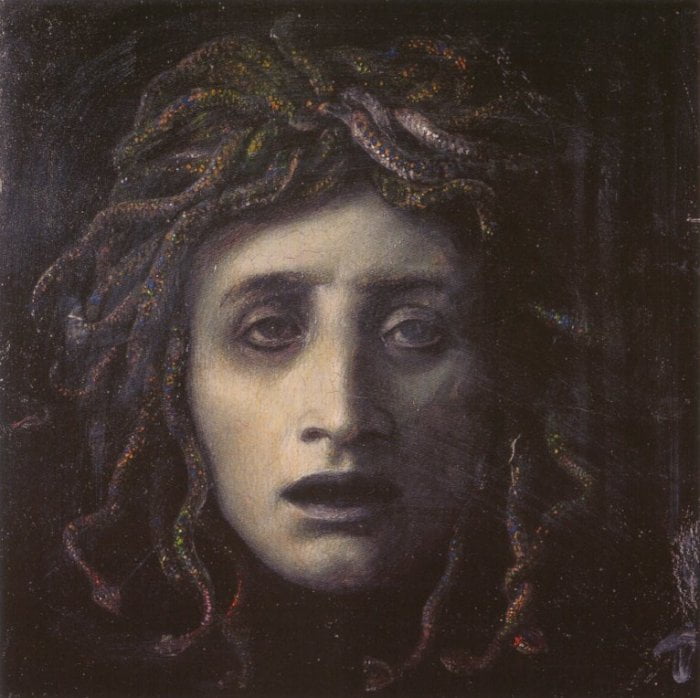
Flesh to Stone belongs to one of the oldest magical fears in myth: the terror of being transformed without dying. In Greek tradition, Medusa and the Gorgons embody the clearest image of petrification. Their power does not merely kill the victim. It arrests the body, fixes the final expression, and turns a living person into a visible warning.
The Gorgons also show why petrification is more disturbing than ordinary death. A slain enemy is removed from the scene. A petrified victim remains there: upright, silent, claimable, and exposed to anyone who controls the place where the body stands. The result is trophy, prison, curse, evidence, and punishment at the same time.
The spell also echoes the wider tradition of metamorphosis in classical myth, where divine or monstrous power changes bodies into trees, animals, springs, stars, stones, or landscape. Such transformations are rarely neutral. They are punishments, rescues, memorials, curses, protections, or acts of supernatural ownership. Flesh to Stone turns that mythic pattern into a spell: identity remains, but agency is taken away.
Ovid’s Metamorphoses gives one of the strongest images of petrification after Medusa’s death, when Perseus uses the severed Gorgon head to transform Atlas into a mountain. In that story, flesh becomes geography, punishment becomes landscape, and a body becomes something the world must continue to live around.
In play, Flesh to Stone should carry that same weight. A petrified person is not simply absent. The statue can be displayed, hidden, inherited, guarded, sold, worshipped, broken, restored, or used as evidence. The spell turns the body into a legal and sacred problem, and the story often begins after the stone has cooled.
Keep this reference growing
If this page helped with your reading or game, you can support its upkeep or explore the curated books.
Explore the Bookshop — epics, classics and stories behind imagined worlds.