

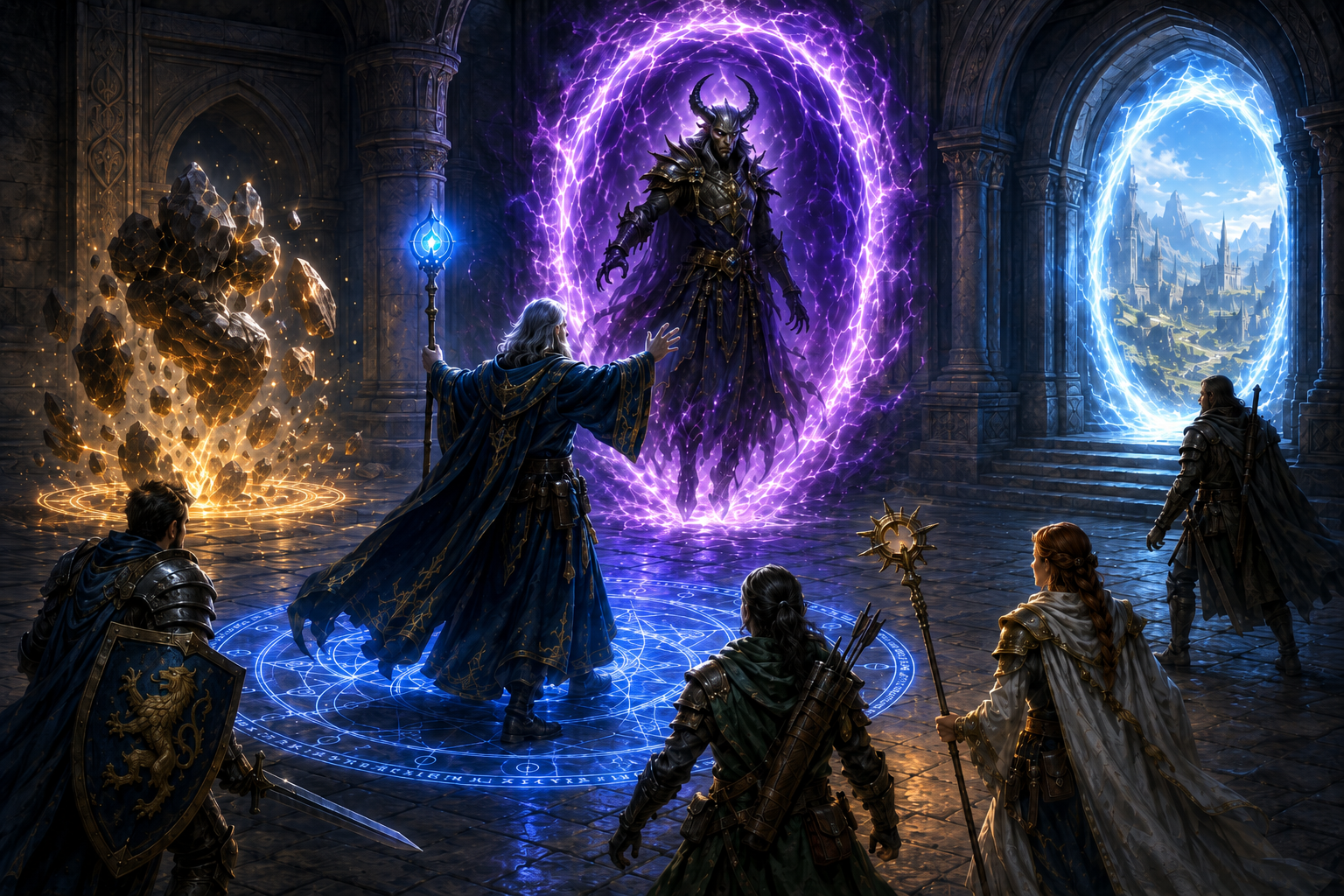
Conjuration is the magic of arrival. It brings creatures into a caster’s presence, creates matter or useful effects, opens passages and moves travellers without requiring them to cross every intervening mile. Its greatest practitioners do not merely produce things from nowhere: they understand distance, destination, identity, obligation and the dangerous difference between borrowing a power and commanding it.
What Conjuration Does
Conjuration is best understood through four broad practices. Individual games and editions classify particular spells differently, but these ideas remain the school’s clearest shared identity.
Summoning
Summoning produces a temporary creature, object or manifestation that answers the spell for a limited time. It is often used for battlefield allies, scouts, mounts and specialised assistance.
Calling
Calling brings an actual independent being across a planar or supernatural boundary. The visitor possesses its own will, history, loyalties and memory of how the caster treated it.
Creation
Creation magic forms matter, objects, substances, terrain or quasi-real servants. Some creations vanish when the spell ends; others endure because the magic has assembled something that can continue to exist.
Teleportation
Teleportation moves creatures or objects without ordinary travel through the intervening space. The spell may cross a room, a kingdom or a planar boundary, depending on its power and destination rules.
Calling Is Not Summoning
The two practices may look similar when a creature appears inside a circle, but their consequences are radically different.
A summoned being
A summoned creature is tied to a temporary magical effect. Its presence is limited by duration, concentration or the spell’s ending conditions. In legacy d20 rules, a summoned creature normally returns when the spell ends or when it is defeated.
Summoning is therefore suited to temporary aid: a creature arrives, performs a defined function and departs with the spell.
A called being
A called creature is actually transported into the caster’s world. In legacy d20 rules, the calling itself is instantaneous, the visitor remains after the spell has resolved and death is real rather than a temporary dismissal.
Calling is diplomacy, coercion or invitation involving a genuine supernatural participant. The creature may negotiate, resent confinement, remember a broken promise or return later under its own power.
| Question | Summoning | Calling |
|---|---|---|
| What arrives? | A temporary manifestation or magically sustained visitor. | An actual independent being transported into the scene. |
| What ends its presence? | The spell’s duration, dismissal, disruption or defeat. | Departure, release, escape, another spell or the creature’s own actions. |
| Does the visitor matter afterward? | Usually only through the immediate effect and consequences of its service. | Yes. It can remember terms, witnesses, injuries, insults and obligations. |
| Best dramatic use | Battlefield support, scouting, utility and temporary companionship. | Bargains, supernatural law, dangerous negotiations and planar politics. |
The Conjurer
A conjurer studies relationships that most spellcasters can ignore. Where is the destination? What occupies the arrival point? Which name identifies the intended being? What token, map, seal or sympathetic object establishes a connection? What survives when the spell ends?
The finest conjurers combine geometry with diplomacy. They calculate distance, prepare safe arrival spaces, catalogue planar correspondences and learn which beings can be requested, compelled or never addressed at all. A careless conjurer can open the correct circle to the wrong destination—or call the correct creature under disastrous terms.
Common instruments
- Circles and boundaries: define an arrival place, a protected working space or a controlled point of negotiation.
- Names and seals: distinguish one being, court, destination or supernatural authority from another.
- Maps and sigil sequences: encode a place accurately enough for travel or repeated access.
- Offerings and contracts: establish payment, hospitality, service, witness and consequences.
- Material correspondences: provide a physical relationship to a plane, element, creature or intended creation.
Conjuration in the World
Conjuration changes institutions as readily as adventures. Once rulers, guilds, temples or colleges can move people, call supernatural specialists and create useful matter, geography no longer has the same authority.
Travel becomes privilege
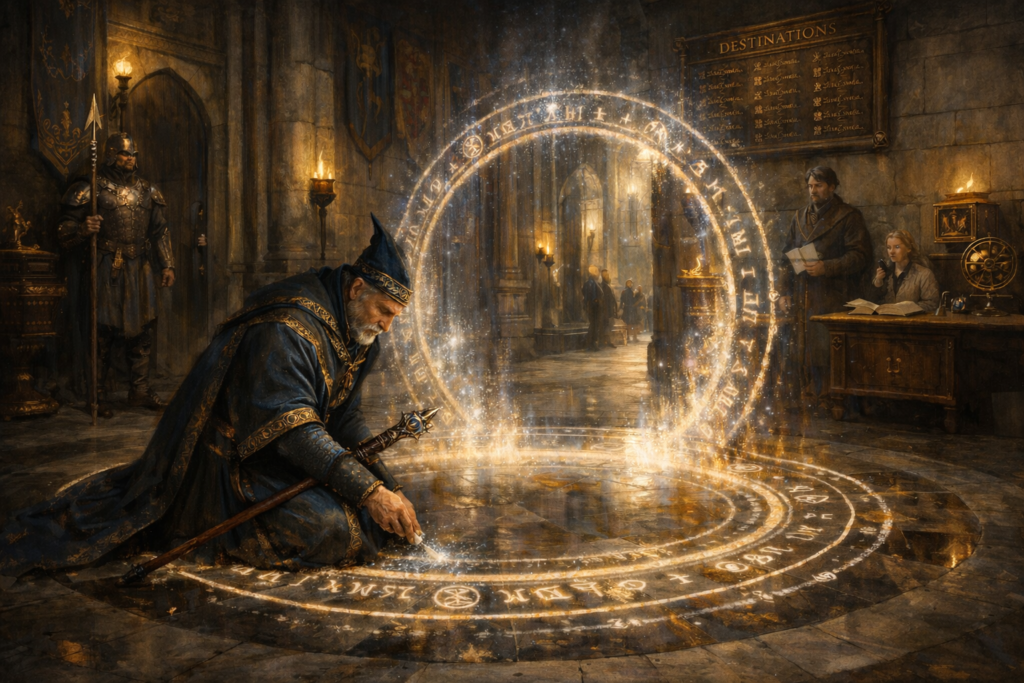
Courts, colleges and merchant powers that control teleportation routes can move envoys, healers, intelligence and elite agents faster than ordinary armies or messengers.
Fortresses need depth
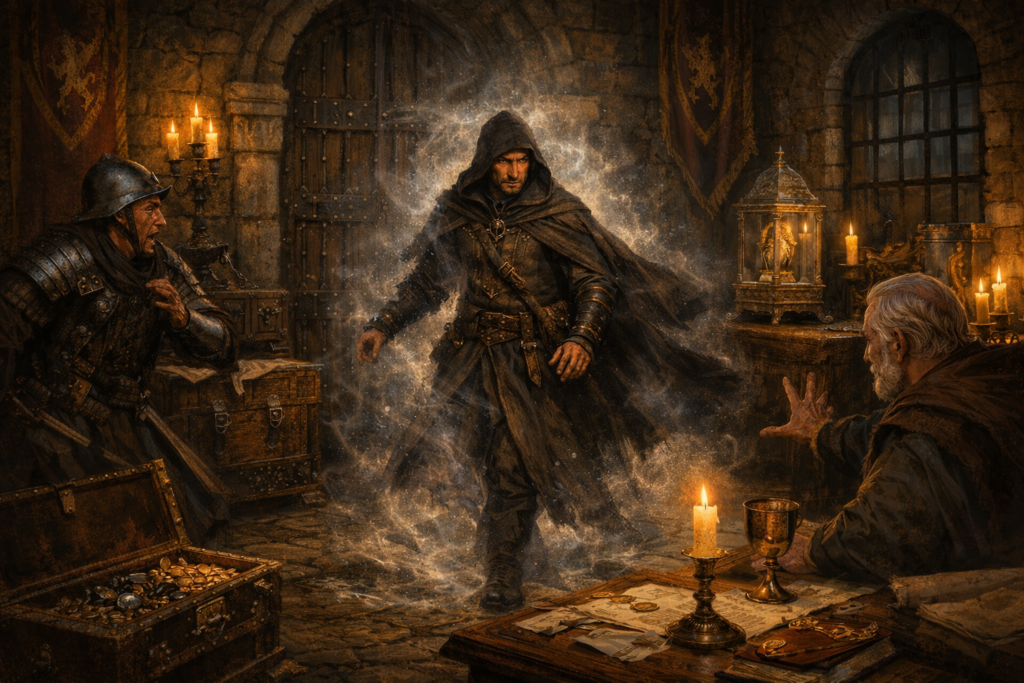
Walls and gates remain useful, but secure sites require concealed interiors, controlled arrival chambers, dimensional wards and procedures for identifying unexpected travellers.
Planar diplomacy becomes real
A court that repeatedly calls outsiders, elementals or supernatural messengers acquires obligations beyond mortal law. Treaties may have witnesses who cannot be bribed—or debts that cannot be inherited safely.
Created matter disrupts trade
Even limited creation magic affects hauling, provisioning, construction and scarcity. Permanent magical creation is therefore likely to be taxed, licensed, monopolised or watched by guilds.
Summoned labour raises questions
Temples and academies must decide which summoned beings are tools, which are persons and which services are too dangerous or exploitative to permit.
Ecology crosses boundaries
Repeated summoning, failed gates and escaped called creatures can introduce unfamiliar predators, diseases, magical substances and supernatural rivalries into a region.
Risks, Boundaries and Countermeasures
Conjuration is powerful because it bypasses ordinary limitations. Good adjudication preserves the school’s power while making destination, duration and control matter.
Occupied destinations
Arrival magic must resolve what happens when the chosen space is occupied, unsupported or otherwise illegal. Use the exact procedure from the active spell and edition rather than inventing one universal result.
Destination knowledge
Seeing, remembering, describing or possessing a sigil for a destination are not interchangeable. The spell itself determines how precisely the caster must know where they are going.
Control is never implied
Appearance does not automatically mean obedience. Summoned creatures follow their spell; called creatures follow bargains, restraints, loyalties or their own judgement.
Temporary and permanent creation
A created object may be sustained only by magic or may remain after an instantaneous effect. Duration and spell wording decide whether it vanishes, decays or becomes ordinary matter.
Dispelling has limits
Dispel Magic can end an ongoing conjuration when the rules allow it, but it normally cannot reverse an instantaneous teleportation or erase a permanent result after the magic has completed its work.
Special wards matter
Antimagic, dimensional anchors, locks, forbiddance effects and planar barriers may obstruct specific forms of conjuration. Ordinary walls do not automatically block magic that never crosses the intervening space.
Representative Conjuration Magic
This is a guided selection rather than a complete spell catalogue. Each page explores a different consequence of summoning, calling, creation or magical travel.
Summoning
Calling and bargains
Creation
Teleportation
- Dimension DoorShort-range placement without crossing the intervening space.
- TeleportLong-range transport governed by destination familiarity.
- Teleportation CircleFixed routes, sigil sequences and magical infrastructure.
- Word of RecallEmergency return to a prepared sanctuary.
- Plane ShiftTravel or exile across the boundaries of reality.
For broader navigation, return to the Magic reference or explore the Sorcerer and Wizard spell collection.
Historical and Occult Development
Fantasy Conjuration is a modern game category, not a claim that historical ritual produced literal summoned creatures or teleportation. Its language and imagery nevertheless draw on older ideas about oaths, invocation, bounded ritual space and dealings with unseen powers.
From oath to invocation
The English verb conjure ultimately derives from Latin coniurare, meaning to swear together or join in an oath. The word later developed senses involving solemn adjuration, invocation and the calling of spirits. This history explains why fantasy conjuration so often combines names, contracts and compelled service rather than simple creation from nothing.
Circles, names and obligations
Early modern magical manuscripts frequently present circles, seals, prescribed words and ritual obligations as tools for approaching spirits while separating the practitioner from what is invoked. These texts are historical evidence for ritual imagination and manuscript culture—not evidence that the supernatural claims were literally effective.
Magic as specialised knowledge
In first-millennium BCE Mesopotamia, ritual experts used incantations, protective objects, omen knowledge and prescribed procedures within religious, medical and political life. Their work offers a historical parallel for the trained conjurer as a learned specialist rather than an improvising stage magician.
Invocation, evocation and conjuration
Occult and literary traditions have used these terms inconsistently. In a fantasy game, clarity matters more than forcing every historical usage into the modern schools of magic. Conjuration should describe what the spell does in its ruleset; historical terminology belongs in context rather than being retrofitted as a universal taxonomy.
Mythological Parallels
These traditions do not contain the game school itself. They provide older story patterns for thresholds, summoned powers, named spirits and dangerous passage.
Hekate and the crossroads
Hekate’s associations with magic, ghosts and crossroads make her a strong parallel for the conjurer’s command of thresholds. The crossroads is not merely a road junction: it is a place where direction, boundary and the unseen meet.
Janus and the governed gate
Janus is the Roman guardian of beginnings, doorways and gateways. His double aspect provides a useful image for magic that must account for both departure and arrival, entrance and return.
Spirits under terms
Many mythic and ritual traditions portray supernatural beings as independent powers approached through names, offerings, taboos, hospitality or oaths. The strongest fantasy calling scenes preserve that independence: the being that answers is a participant, not scenery.
Using Conjuration in Play
For players
- Read the spell’s exact destination, range, duration and control language before assuming what appears or where it can arrive.
- Prepare names, offerings, sigils and safe destinations during downtime rather than treating every conjuration as an improvised combat trick.
- Give called beings terms that can be understood and fulfilled. A precise bargain is safer than a clever ambiguity.
- Use creation and teleportation to solve logistical problems, not only to deal damage or escape combat.
For Games Masters
- Reward preparation and accurate destination knowledge instead of nullifying travel magic whenever it becomes useful.
- Make institutions react sensibly: important vaults, prisons and courts should know that conjuration exists.
- Let called creatures remember agreements, witnesses and mistreatment so planar politics grow from play.
- Distinguish a rule-based limitation from an arbitrary obstruction. Conjuration should remain powerful enough to justify the precautions surrounding it.
Further Viewing
These optional commentaries open on YouTube without loading embedded players on this page.
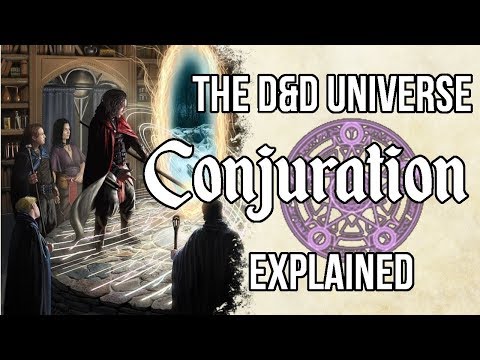


Frequently Asked Questions
Does Conjuration create things from nothing?
Sometimes it creates or assembles matter, but the school also transports creatures and objects, opens passages and produces temporary manifestations. The exact explanation and permanence depend on the spell and edition.
Is every summoned creature a real creature?
Not in the same sense as a called creature. A summoning effect usually sustains a temporary visitor or manifestation. Calling transports an independent being whose presence and consequences continue beyond the initial act.
Can Dispel Magic reverse teleportation?
Normally no. Once an instantaneous teleportation has resolved, there is no continuing travel effect to end. A spell may still be countered during casting, and specialised wards may prevent the movement before it occurs.
Why is healing listed as Conjuration in some sources?
Pathfinder First Edition and D&D 3.5e classify healing as one of Conjuration’s five subschools. That is an edition-specific legacy classification and should not be imported into every modern ruleset.
Is this page a complete list of Conjuration spells?
No. It is the SpiralWorlds overview of the school. The linked spells are representative examples chosen to explain its main practices and campaign consequences.
Rules and Historical Sources
- Archives of Nethys: Pathfinder First Edition Conjuration rules
- D20 SRD: D&D 3.5e Conjuration and its subschools
- Merriam-Webster: conjure, meanings and etymology
- Wellcome Collection: The Key of Solomon
- The Metropolitan Museum of Art: Mesopotamian Magic in the First Millennium BCE
- The Metropolitan Museum of Art: statuette of Hekate
- British Museum: Janus
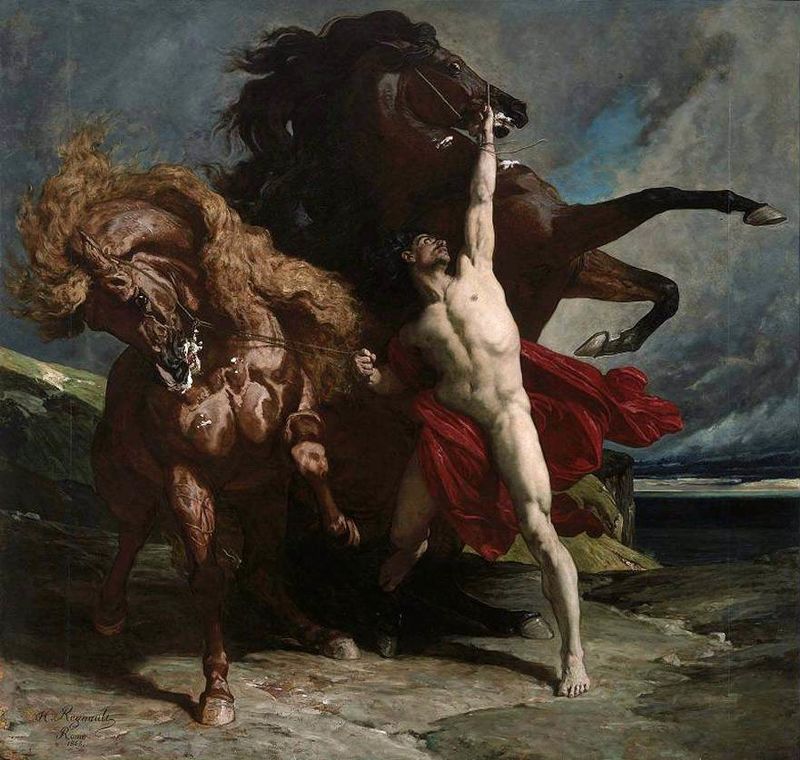
- Wikimedia Commons: Henri Regnault, Automedon with the Horses of Achilles, 1868
Keep this reference growing
If this page helped with your reading or game, you can support its upkeep or explore the curated books.
Explore the Bookshop — epics, classics and stories behind imagined worlds.