

School of influence, emotion and altered choice
Enchantment
Charm, command, emotion, compulsion and the magical alteration of thought, memory and action.
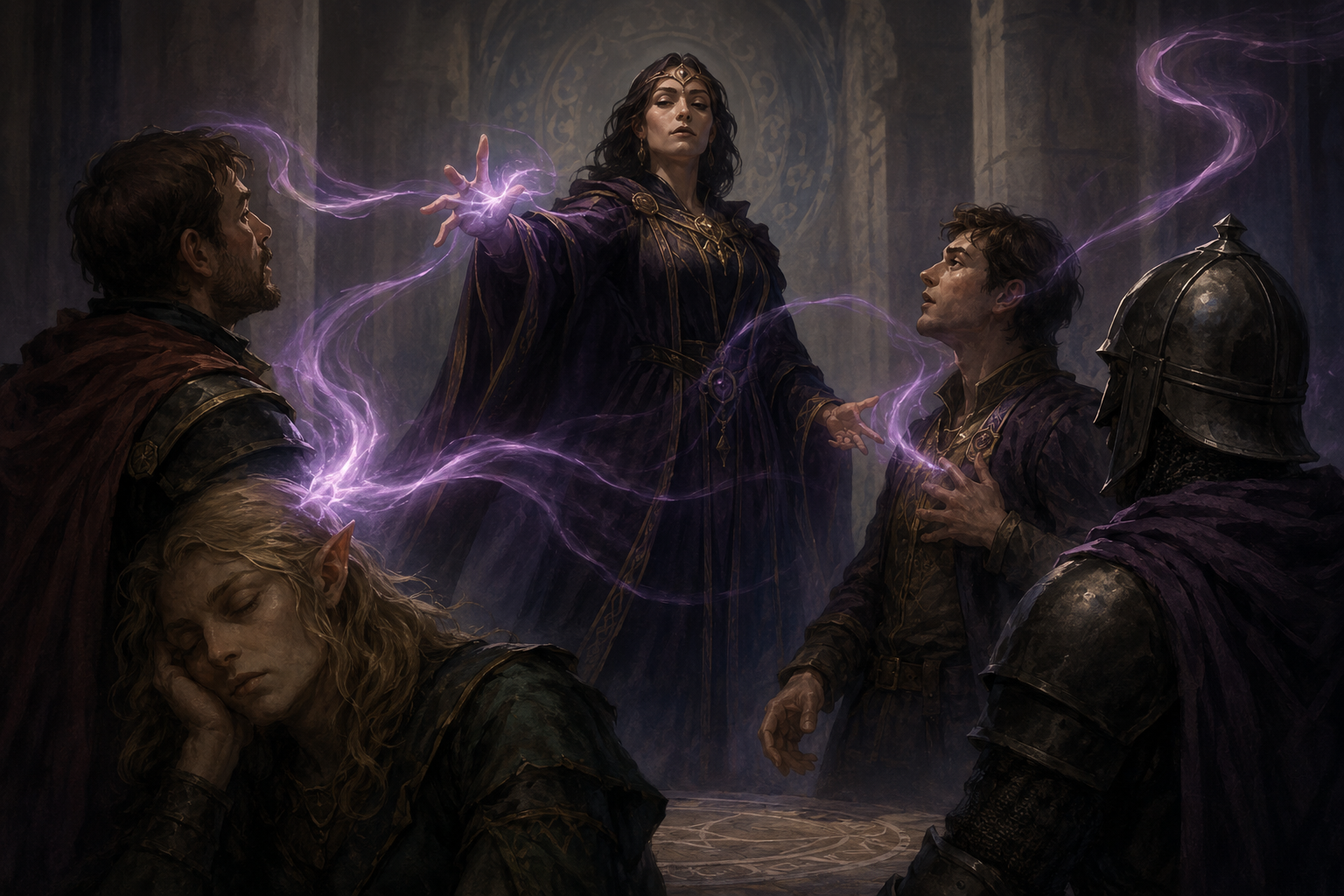
Enchantment is the magic of influence. It changes what another mind feels, believes, remembers, notices or chooses to do. A subtle working may incline a guard towards trust; a stronger one may impose a command, extinguish resistance, rewrite memory or seize control of a creature’s actions.
The school is not synonymous with seduction, persuasion or total domination. Its spells range from encouragement and magical sleep to compulsions, altered loyalties and words of irresistible authority. The decisive question is always the same: whose decision is this, and how much of it still belongs to the subject?
Enchantment has changed between rules systems. This reference presents D&D 5.5e/2024 first, then keeps Pathfinder 1e and D&D 3.5e terminology clearly separate.
- Core purpose
- Influence thought, emotion, memory, attention or voluntary action.
- Typical subjects
- Creatures able to receive the particular mental, emotional or behavioural effect named by a spell.
- Central question
- What part of the subject’s judgement or agency is being altered?
- Rules caution
- The school itself grants no universal control mechanic. Read the exact spell and edition.
The school’s identity
What Enchantment Does
An Enchantment changes the way a creature relates to an idea, emotion, person, memory, instruction or possible action.
A charm may make hostility feel misplaced. A command may turn a spoken word into an immediate obligation. A suggestion may make one course of action seem compelling. A domination effect can replace independent choice with the caster’s direction. Other Enchantments create courage, despair, fascination, magical sleep, confusion or gaps in memory.
The school therefore acts on more than conscious opinion. It can affect attention, emotional weight, inhibition, loyalty, confidence, recollection and the ability to turn intention into action. Some effects leave the subject’s personality largely intact; others make that personality temporarily unable to govern the body.
The defining question
Enchantment should not be adjudicated by asking only whether the creature is “mind controlled.” Establish exactly what has changed: attitude, emotion, available actions, memory, judgement, obedience or bodily agency.
The Enchanter’s Questions
- What is the spell changing?
- What does the target still choose freely?
- Must the target hear or understand the caster?
- Does the spell apply a named condition?
- What actions are forbidden, required or merely encouraged?
- Does harm grant another save or end the effect?
- Can the caster issue new instructions later?
- What will the subject remember afterward?
Eight recurring practices
The Major Forms of Enchantment
Individual spells may combine several of these functions, and different editions may classify the same idea differently.
Charm and Altered Attitude
Charm changes how a subject regards another creature. It may create trust, affection or a favourable interpretation of words and behaviour. A changed attitude is not the same as direct obedience.
Emotion and Morale
These effects intensify or suppress courage, hostility, calm, despair, hope, fascination or other emotional states. The emotion may influence decisions without dictating one exact action.
Suggestion and Inclination
A suggestion makes a described course of activity feel persuasive or compelling. Its boundaries depend on the wording, plausibility, duration and ending conditions of the individual spell.
Commands and Words of Power
Command magic converts language into immediate supernatural authority. Some workings impose one brief action; stronger words can stun, silence, disable or overwhelm without negotiating with the subject’s ordinary judgement.
Compulsion
A compulsion directs behaviour or alters the way a mind operates. It may supply a fixed behaviour, prohibit voluntary action or allow the caster to choose instructions when the spell is cast.
Domination
Domination gives the caster sustained authority over another creature’s actions. It is the clearest form of magical control and usually carries the school’s greatest moral, legal and narrative consequences.
Sleep, Inhibition and Stupefaction
Some Enchantments remove a creature from meaningful action by inducing sleep, paralysis, mental fog or a failure of initiative. They control a scene without necessarily changing beliefs or loyalties.
Memory and Identity
Memory magic can obscure, sharpen, replace or fabricate recollection. It does not automatically rewrite personality, alignment, skills or every conclusion the subject has drawn from the altered event.
The essential distinction
Influence Is Not Domination
The most common Enchantment mistake is treating every favourable attitude, imposed condition or persuasive effect as unlimited control.
| Effect | What it changes | What it does not automatically grant |
|---|---|---|
| Charm or attraction | How the subject regards the charmer or another named creature. | Telepathic control, perfect loyalty, language comprehension or obedience to dangerous orders. |
| Friendly attitude | The social starting point from which requests and reactions are judged. | The right to decide the creature’s actions or override its values and existing obligations. |
| Suggestion | One described course of activity within the spell’s stated limits. | Control over every later decision or the ability to keep changing the order. |
| Command | A narrow action, prohibition or behaviour defined by the spell. | A continuing relationship, changed beliefs or unlimited instructions. |
| Emotional influence | The strength or direction of an emotional state. | A predetermined action unless the spell also supplies one. |
| Domination | Sustained control over behaviour within the spell’s command procedure. | Powers the spell never names, permanent ownership of the subject or freedom from later consequences. |
| Memory alteration | What the subject recalls about a bounded event or period. | Automatic changes to personality, training, allegiance or every belief connected to that memory. |
Charmed is a condition, not a complete personality rewrite
In D&D 5.5e/2024, the Charmed condition has a defined rules effect. Individual spells may add further consequences, but the condition alone does not make the target a puppet, erase its loyalties or force it to reveal every secret.
Current rules first
Edition Reference
Identify the active rules system before deciding what qualifies as an Enchantment or how mental influence is resisted.
D&D 5.5e / 2024
The 2024 rules describe Enchantment broadly as magic that influences minds. The school is a category, not a universal procedure.
Each spell separately defines its eligible target, saving throw, duration, concentration, condition, instructions, awareness and ending conditions. Do not import legacy Charm and Compulsion subschools into current rules unless a specific feature explicitly uses comparable language.
The Charmed condition is also narrower than ordinary English usage. Apply its defined game effects and then add only the consequences stated by the spell.
Pathfinder 1e
Pathfinder describes Enchantments as mind-affecting spells that influence or control behaviour. All Enchantments carry the mind-affecting quality in this edition.
The school formally uses two subschools. Charm changes how the subject views the caster or another creature. Compulsion forces action or changes the way the subject’s mind works.
Will saves, Spell Resistance, creature immunities and the exact charm or compulsion text must be checked spell by spell.
D&D 3.5e
D&D 3.5e uses the same broad legacy structure: Enchantment affects minds, and Charm and Compulsion are formal subschools.
A charmed creature retains free will but views circumstances through a magically altered relationship. A compelled creature has its actions or mental operation overridden to the extent defined by the effect.
D&D 3.5e and Pathfinder 1e share terminology but not every class list, immunity interaction, skill procedure or individual spell rule.
Keep the editions separate
“All Enchantments are mind-affecting,” “Charm is a subschool,” “Will negates” and “Spell Resistance applies” are legacy rules statements, not universal truths about the 2024 school. Conversely, the 2024 Charmed condition should not replace the more detailed legacy charm rules.
Read the exact spell
Targets, Language and Understanding
A creature’s intelligence, type, senses and ability to understand the caster matter only when the active rules or spell make them matter.
Target eligibility comes first
Before resolving an Enchantment, confirm whether the spell targets a creature, a creature of a particular type, creatures in an area, an object, a location or the caster. A school associated with minds does not automatically mean that every creature with thoughts is a legal target.
Hearing is not understanding
A spell may have a verbal component without requiring the target to understand the words. Another spell may explicitly depend on a spoken instruction, shared language, hearing or comprehension. These are separate requirements.
Communication is not control
Telepathy, a shared language or successful social interaction can make an instruction possible, but none of them supplies authority that the spell does not grant. Likewise, magical control does not automatically teach the caster what the subject knows.
Creature traits still apply
Immunity to the Charmed condition, immunity to mind-affecting effects, Magic Resistance, Spell Resistance and other defensive traits are edition-specific. Apply the exact trait against the exact effect rather than assuming a universal “mindless creature” rule.
Control has boundaries
Saving Throws, Resistance and Breaking Control
Enchantment becomes manageable at the table when every stage of resistance is identified before the subject acts.
| Method | What it can do | What it does not automatically do |
|---|---|---|
| Initial saving throw | Prevents or reduces an effect when the spell grants a save. | It does not exist merely because the effect is hostile. |
| Repeated or triggered save | Allows resistance at intervals or when harm, contradiction or another named event occurs. | It is not granted universally to every affected creature each round. |
| Concentration loss | Ends a current spell that requires concentration. | It does not undo instantaneous consequences or unrelated effects. |
| Countering | Interrupts a spell before it resolves when the rules permit. | It does not normally remove a spell already affecting a subject. |
| Dispelling | Ends an ongoing spell or eligible magical effect under the active edition’s procedure. | It is not a universal cure for non-spell conditions, memories or completed consequences. |
| Suppression or antimagic | Temporarily prevents eligible magic from functioning. | It does not necessarily erase the spell or permanently free the subject. |
| Restoration or protection | Ends, suppresses or grants resistance to the specific conditions and effects named by that magic. | It does not provide universal immunity to every Enchantment. |
Self-preservation is spell-specific
Some effects refuse obviously harmful instructions, some allow a new save when the creature is forced against its nature, and some direct behaviour regardless of danger. Do not turn one spell’s safety clause into a school-wide rule.
Harm may end one effect and deepen another
An attack might break a charm, awaken a sleeper, trigger a new save or have no special interaction at all. The result comes from the individual spell. Ordinary damage never supplies an unstated universal escape procedure.
After the spell
Memory, Awareness and Aftermath
The end of an Enchantment is often the beginning of its most important consequences.
Awareness is not universal
Do not assume that every subject automatically knows it was enchanted—or that no subject ever realises. A spell may state what the target knows. Otherwise, witnesses, impossible behaviour, missing time, magical investigation and ordinary inference may reveal the truth.
Memory is separate from attitude
A creature can remember acting under magical influence without continuing to feel friendly. It can also retain a false or edited memory after the controlling spell has ended. Resolve memory and current attitude independently.
Evidence may disappear
Detecting an active spell is not the same as proving who cast it or what instructions were given. Once magic ends, courts and investigators may have to rely on testimony, timing, motive, records and traces left by related ritual materials.
Consequences survive the duration
Doors opened, promises made, crimes committed, alliances damaged and secrets revealed remain part of the world. Ending control does not rewind the scene or remove responsibility from everyone who exploited it.
Player agency
When an effect targets a player character, state the mechanical restriction clearly and leave all remaining choices with the player. For social or intimate coercion, establish campaign boundaries before play and avoid inventing feelings or actions beyond what the rules require.
Training and practice
The Enchanter in Play
An enchanter wins by identifying the smallest change of mind that can reshape the entire scene.
Adventuring role
Enchanters can prevent a battle, divide hostile loyalties, interrupt dangerous actions, create openings for negotiation or remove powerful creatures from effective play. Their best spells often change objectives rather than dealing damage.
Subtlety and timing
A short command at the right moment may matter more than prolonged domination. A charm cast before negotiations creates different risks from one cast during combat. The enchanter’s craft lies in choosing the correct degree of pressure.
Information remains essential
The caster must know enough to issue useful instructions. A controlled guard may not know the vault combination. A charmed courtier may still refuse treason. A fabricated memory can fail when it collides with evidence the subject trusts more strongly.
Consequences are part of the power
Enchantment can achieve extraordinary results without bloodshed, but witnesses, victims and institutions may regard magical coercion as a profound violation. The school is strongest when the campaign treats those reactions as real rather than allowing influence to function as consequence-free dialogue.
Worldbuilding consequences
Enchantment in the World
Once magical influence is real, trust becomes an institution rather than a private feeling.
Courts require procedure
Rulers cannot rely on intuition alone. Sensitive audiences may use multiple witnesses, screened petitioners, rotating advisers, magical wards and written confirmation after any decision with unusual urgency.
Contracts need independent consent
Guilds and magistrates may require signatories to confirm major agreements away from the other party, after a waiting period or before an authorised examiner capable of recognising magical influence.
Armies defend command structures
Officers use relays, countersigns and divided authority so that one enchanted commander cannot redirect an entire force. Orders that violate standing plans may require confirmation from a second officer.
Investigators study behaviour
Enchantment leaves social evidence: abrupt loyalty, missing time, unexplained access, repeated phrases, contradictory memories and decisions that benefit a hidden third party.
Healing and coercion can resemble each other
Magic that calms terror, suppresses rage or removes traumatic memories may be therapeutic when freely chosen and abusive when imposed. Institutions must distinguish treatment from convenience.
Reputation becomes a defence
Trusted enchanters may serve as diplomats, mediators and healers, while feared practitioners are blamed for every unpopular decision. The mere accusation of charm can destabilise a court even when no spell was cast.
Magical law, consent and evidence
A workable legal system should separate magical influence into degrees. Improving a witness’s courage is not identical to altering testimony; calming a riot is not identical to commanding submission; changing memory is not identical to persuading someone to remain silent. The law must define who may authorise an effect, what proof is required and which consequences invalidate an agreement.
Countermeasures should also remain imperfect. A ward may protect only against a named condition. An investigator may detect an active spell but not recover the caster’s words. A truthful witness may remember an event that never occurred. Enchantment is most convincing when institutions adapt without becoming infallible.
Curated SpiralWorlds paths
Representative Enchantment Magic
This selection illustrates different branches of the school without turning the article into a duplicate spell catalogue.
Reference maturity: Sleep has completed the locked multi-edition spell workflow. The other linked entries currently preserve legacy D&D 3.5e Open Game Content and are labelled accordingly.
Language, history and story
Historical and Occult Development
Fantasy Enchantment is a modern game category, but its language draws on older connections between song, persuasive speech, ritual words and altered desire.
From singing to spellcraft
The English verb enchant came through French from Latin incantare, a word formed around chanting or singing upon something. The history suits a magical school in which voice, rhythm, command and compelling speech can change how another person experiences the world.
Merriam-Webster: enchant and its etymology
Charms, songs and written formulae
Historical objects described as charms include written texts, amulets and ritual formulae intended to protect, attract, bind or influence. They are evidence of belief, material culture and ritual practice—not evidence that historical people possessed tabletop spell effects.
The Metropolitan Museum of Art: papyrus charm
Persuasion as a supernatural power
Greek art and myth personified persuasion as Peitho, a figure associated with compelling speech, courtship and Aphrodite’s sphere. The tradition provides a useful narrative parallel for Enchantment as power exercised through attraction, rhetoric and emotional alignment rather than physical force.
Getty Villa: Aphrodite and the gods of love
Love-charms and binding desire
Ancient Mediterranean imagery includes objects identified as love-charms, such as the wheel-shaped iynx. These sources reveal how stories and rituals connected desire with binding, turning, attraction and repeated motion—all images later fantasy can transform into magical practice.
J. Paul Getty Museum: Aphrodite carrying an iynx love-charm
Narrative precedents
Mythological Parallels
Myths and folktales repeatedly imagine influence that exceeds ordinary persuasion: irresistible songs, binding promises, enchanted sleep, love imposed by supernatural means, names that carry authority and obligations that cannot be ignored. These traditions do not contain the role-playing game school itself, but they provide its deepest narrative patterns.
The irresistible voice
Song and eloquence become supernatural when listeners cannot treat them as ordinary speech. The danger lies not in false information alone, but in the inability to weigh that information freely.
The binding obligation
A geis, taboo or sworn command turns language into destiny. Such stories resemble compulsion because refusal carries consequences beyond social disapproval.
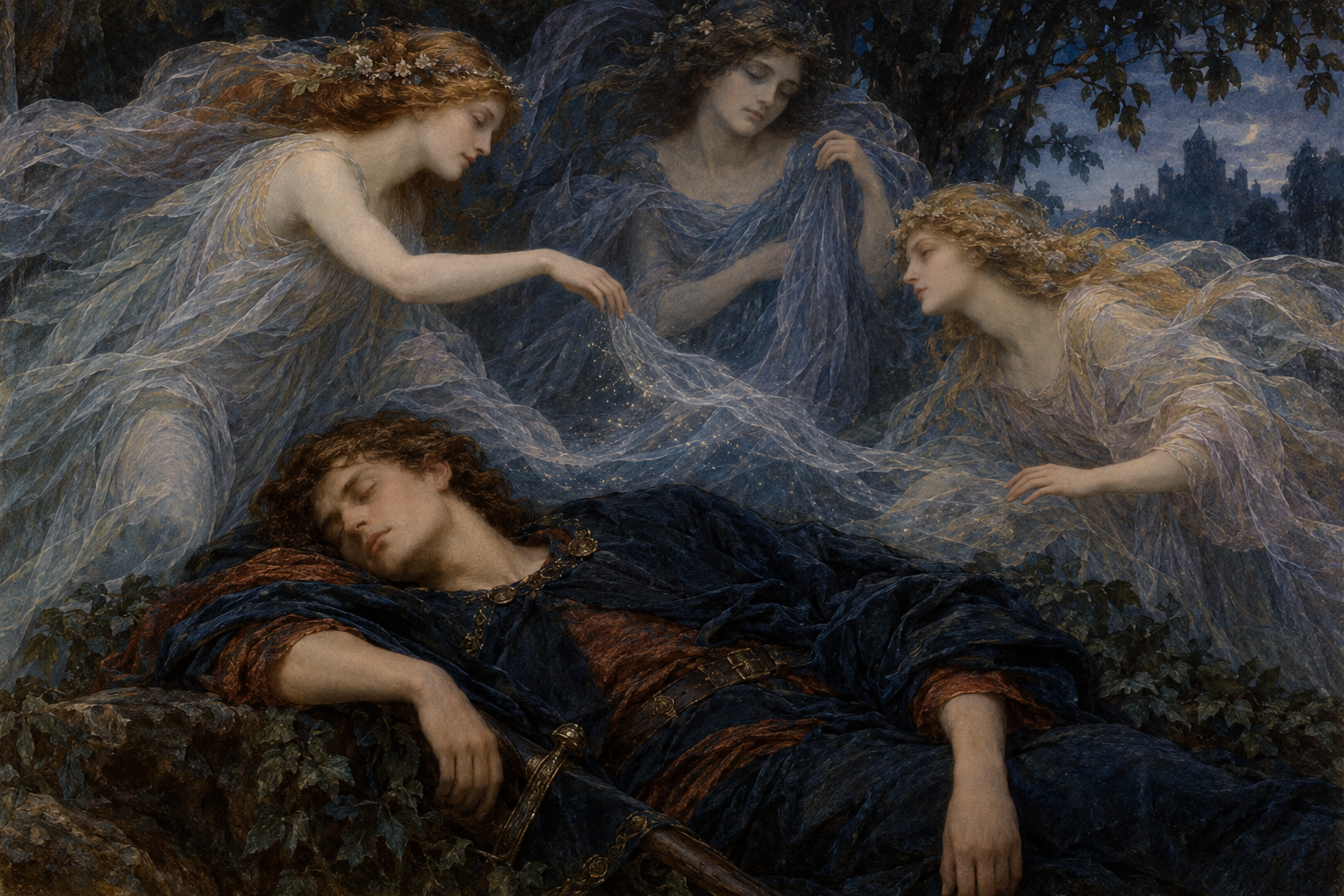
Enchanted sleep
Magical slumber removes the subject from time, conflict or ordinary agency until a condition is fulfilled. It can function as protection, imprisonment, curse or suspended fate.
Altered love and loyalty
Stories of imposed affection expose the difference between desire and consent. Their tragedy often begins when supernatural attraction is mistaken for a genuine relationship.
The school in the setting
Enchantment in SpiralWorlds
In a world where magic is real, power over the mind is never merely a private talent.
Enchanters work as diplomats, interrogators, battlefield controllers, healers of supernatural terror, court advisers and investigators of magical coercion. Colleges teach them how to frame commands, recognise contradictory memories and distinguish influence from control. Responsible schools also teach evidential procedure and the limits of consent under magic.
Courts maintain chambers where major decisions are witnessed and repeated after magical screening. Merchant leagues insist that agreements involving land, inheritance or long service be reconfirmed away from interested spellcasters. Commanders divide military authority among officers because one dominated general must not be able to surrender an entire city.
Enchantment can still become an instrument of tyranny. A ruler may manufacture loyalty, erase evidence or turn public dissent into apparent madness. A rebel may charm a gatekeeper and call the act bloodless. A healer may remove unbearable memories without permission. The school does not decide whether influence is benevolent; it makes the struggle over agency impossible to ignore.
Adventures shaped by altered will
Campaign Hooks
Enchantment stories become strongest when the spell has ended but trust, evidence and responsibility remain unsettled.
- A royal decree was signed in public, but every witness remembers a different speech.
- A city’s commanders obey a sequence of perfectly legal orders that no one recalls issuing.
- An enchanter offers to remove a survivor’s worst memory, but the memory is also the only evidence of a crime.
- A peace treaty remains stable only because both rulers are secretly under the same charm.
- A monastery shelters people whose compulsions have ended but whose lives were destroyed by what they did.
- A famous diplomat has never cast an Enchantment, yet rivals use that accusation to discredit every agreement.
Retained legacy media
Further Viewing
These videos predate the 2024 rules and are preserved as general discussions rather than current rules authorities.

Rules references
Rules Sources and Licensing
Use the individual spell description from the active rules system whenever a general explanation and a specific mechanic appear to conflict.
D&D 5.5e / 2024
Pathfinder 1e
This work includes material from the System Reference Document 5.2.1 (“SRD 5.2.1”) by Wizards of the Coast LLC, available through D&D Beyond. The SRD 5.2.1 is licensed under the Creative Commons Attribution 4.0 International License. Pathfinder 1e and D&D 3.5e rules are summarised in original wording; consult the linked rules and licence notices for the underlying sources. Dungeons & Dragons and related names are trademarks of Wizards of the Coast LLC. Pathfinder is a trademark of Paizo Inc. This site is not affiliated with or endorsed by either company.
Keep this reference growing
If this page helped with your reading or game, you can support its upkeep or explore the curated books.
Explore the Bookshop — epics, classics and stories behind imagined worlds.