
SpiralWorlds Player’s Manual · Before Character Creation
Dice & Core Rolls
Dice notation · d20 tests · advantage · natural rolls · edition differences
You can use physical dice, a digital dice roller or both. What matters is knowing which die to roll, which modifiers apply and what number you are trying to meet. The three supported rules systems all use a d20 heavily, but they do not treat every natural 20, natural 1, multiplier or special roll in exactly the same way.
Read dice notation
What 3d4 + 3 means
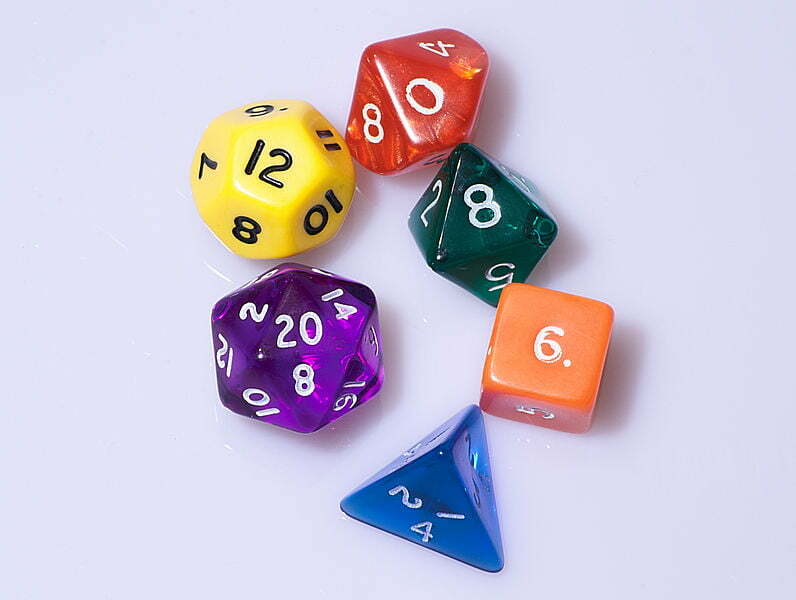
Common dice: d4, d6, d8, d10, d12 and d20. A notation such as 2d6 means roll two six-sided dice and add them together.
Percentile / d100: roll two d10s, using one for tens and one for ones. A result of 70 and 1 is 71; 00 and 0 represents 100.
The basic d20 pattern
Roll high, add the right modifiers, compare to a target
- Roll a d20.
- Add the modifiers required by the rule.
- Compare the total with the target number. If the total equals or exceeds the target, the roll normally succeeds.
The details of the modifier and target depend on the roll: an attack usually compares with Armor Class, a skill or ability check with a Difficulty Class, and a saving throw with a save DC.
Edition rules
Use the right d20 procedure
D&D 5.5e / 2024
The current rules call the game’s three main d20 rolls D20 Tests: ability checks, saving throws and attack rolls.
1. Roll 1d20. If the roll has Advantage or Disadvantage, roll two d20s instead and use only one result.
2. Add modifiers. Add the relevant ability modifier, Proficiency Bonus if relevant, and any circumstantial bonuses or penalties.
3. Compare with the target. Ability checks and saves normally compare with a Difficulty Class (DC); attack rolls compare with Armor Class (AC).
Advantage: roll two d20s and use the higher. Disadvantage: use the lower. Multiple instances do not stack, and one Advantage plus one Disadvantage cancel each other.
Rounding: follow the rule that creates the fraction. Current rules often state whether to round down or up for that calculation; do not import the older 3.x multiplier-combination rule unless a 2024 rule actually instructs you to use it.
Pathfinder 1e
PF1e usually follows the classic d20 pattern: roll d20, add the relevant attack, save, skill or other modifier, and compare with AC, DC or another target.
Attacks: natural 1 always misses and natural 20 always hits. A natural 20 can also threaten a critical hit, which normally requires a confirmation roll under PF1e critical-hit rules.
Saving throws: natural 1 is an automatic failure and natural 20 is an automatic success.
Skill checks: do not treat natural 20 as an automatic success or natural 1 as an automatic failure unless a specific rule says otherwise.
No core Advantage mechanic: PF1e uses its own bonuses, penalties, rerolls and special rules rather than the 5.5e Advantage/Disadvantage system.
Fractions and multipliers: PF1e’s inherited 3.x-style rules generally round fractions down unless a rule provides an exception. When multiple multipliers apply to an abstract value, do not simply multiply them together; for example, ×2 combined with ×2 normally becomes ×3. Real-world measurements such as weight use ordinary multiplication.
D&D 3.5e
3.5e also uses d20 + modifiers against a target for attacks, saves and skills, but its natural-roll rules are specific to the type of roll.
Attacks: natural 1 always misses and natural 20 always hits. A natural 20 is also normally a critical threat requiring confirmation.
Saving throws: natural 1 automatically fails and natural 20 automatically succeeds.
Skill checks: natural 20 is not automatically a success and natural 1 is not automatically a failure.
No core Advantage mechanic: use the bonuses, penalties and rerolls supplied by 3.5e rules.
Fractions: generally round down unless a rule gives an exception. Multipliers: for abstract values, multiple multipliers combine additively after the first: ×2 and ×2 normally become ×3. Real-world measurements use ordinary multiplication.
Before play
Know the rolls on your own sheet
You do not need to memorise the whole rules system. For your first session, know how to find and roll these:
- Your most-used weapon attack.
- Your weapon’s damage dice.
- Your Initiative modifier.
- Your important skill/check modifiers.
- Your saving throws.
- Your Armor Class.
- Your maximum and current Hit Points.
- If you cast spells, your spell attack modifier and spell save DC.
- Any feature that grants Advantage, a reroll, a bonus die or another special roll.
Ready to create a character
Dice checklist
- You can identify d4, d6, d8, d10, d12 and d20.
- You understand notation such as 2d6 + 3.
- You know how percentile dice work.
- You know which edition the campaign uses.
- You have not assumed that natural 20 means automatic success on every roll.
- 5.5e Advantage/Disadvantage has not been imported into PF1e or 3.5e by default.
- PF1e/3.5e multiplier rules have not been imported into 5.5e.
Sources and licensing
Rules sources
- D&D 2024 Basic Rules — Playing the Game
- D&D 2024 Basic Rules — Rules Glossary
- Pathfinder 1e Core Rulebook — Combat
- D&D 3.5e SRD — Combat Statistics
- D&D 3.5e SRD — Using Skills
SRD 5.2.1 attribution: This work includes material from the System Reference Document 5.2.1 by Wizards of the Coast LLC, licensed under Creative Commons Attribution 4.0 International.
Open Game License v1.0a + Section 15
Open Game Content designation: Pathfinder 1e and D&D 3.5e mechanical material on this page is Open Game Content only to the extent previously released as Open Game Content. SpiralWorlds artwork, CSS, page design and editorial presentation are excluded.
OPEN GAME LICENSE Version 1.0a
The following text is the property of Wizards of the Coast, Inc. and is Copyright 2000 Wizards of the Coast, Inc (“Wizards”). All Rights Reserved.
1. Definitions: (a) “Contributors” means the copyright and/or trademark owners who have contributed Open Game Content; (b) “Derivative Material” means copyrighted material including derivative works and translations, potation, modification, correction, addition, extension, upgrade, improvement, compilation, abridgment or other form in which an existing work may be recast, transformed or adapted; (c) “Distribute” means to reproduce, license, rent, lease, sell, broadcast, publicly display, transmit or otherwise distribute; (d) “Open Game Content” means the game mechanic and includes the methods, procedures, processes and routines to the extent such content does not embody Product Identity and is an enhancement over the prior art and any additional content clearly identified as Open Game Content by the Contributor; (e) “Product Identity” includes product and product line names, logos and identifying marks, artifacts, creatures, characters, stories, storylines, plots, thematic elements, dialogue, incidents, language, artwork, symbols, designs, depictions, likenesses, formats, poses, concepts, themes and graphic, photographic and other visual or audio representations and other material identified as Product Identity; (f) “Trademark” means the logos, names, marks, signs, mottos and designs used by a Contributor to identify itself or its products; (g) “Use”, “Used” or “Using” means to use, Distribute, copy, edit, format, modify, translate and otherwise create Derivative Material of Open Game Content; (h) “You” or “Your” means the licensee in terms of this agreement.
2. The License: This License applies to Open Game Content that contains a notice indicating that the Open Game Content may only be Used under and in terms of this License. You must affix such a notice to any Open Game Content that You Use. No terms may be added to or subtracted from this License except as described by the License itself.
3. Offer and Acceptance: By Using the Open Game Content You indicate Your acceptance of the terms of this License.
4. Grant and Consideration: In consideration for agreeing to use this License, the Contributors grant You a perpetual, worldwide, royalty-free, non-exclusive license with the exact terms of this License to Use the Open Game Content.
5. Representation of Authority to Contribute: If You are contributing original material as Open Game Content, You represent that Your Contributions are Your original creation and/or You have sufficient rights to grant the rights conveyed by this License.
6. Notice of License Copyright: You must update the COPYRIGHT NOTICE portion of this License to include the exact text of the COPYRIGHT NOTICE of any Open Game Content You are copying, modifying or distributing, and You must add the title, copyright date and copyright holder’s name to the COPYRIGHT NOTICE of original Open Game Content You Distribute.
7. Use of Product Identity: You agree not to Use any Product Identity except as expressly licensed in another, independent Agreement with the owner of each element of Product Identity.
8. Identification: If you distribute Open Game Content You must clearly indicate which portions of the work that you are distributing are Open Game Content.
9. Updating the License: Wizards or its designated Agents may publish updated versions of this License. You may use any authorized version of this License to copy, modify and distribute Open Game Content originally distributed under any version of this License.
10. Copy of this License: You MUST include a copy of this License with every copy of the Open Game Content You Distribute.
11. Use of Contributor Credits: You may not market or advertise the Open Game Content using the name of any Contributor unless You have written permission from the Contributor to do so.
12. Inability to Comply: If it is impossible for You to comply with any terms of this License with respect to some or all Open Game Content due to statute, judicial order or governmental regulation then You may not Use the affected Open Game Material.
13. Termination: This License terminates automatically if You fail to comply with its terms and fail to cure such breach within 30 days of becoming aware of the breach. All sublicenses survive termination.
14. Reformation: If any provision is held unenforceable, that provision shall be reformed only to the extent necessary to make it enforceable.
15. COPYRIGHT NOTICE
Open Game License v 1.0a Copyright 2000, Wizards of the Coast, Inc.
System Reference Document. Copyright 2000, Wizards of the Coast, Inc.; Authors Jonathan Tweet, Monte Cook, Skip Williams, based on material by E. Gary Gygax and Dave Arneson.
Pathfinder Roleplaying Game Core Rulebook. © 2009, Paizo Publishing, LLC; Author: Jason Bulmahn, based on material by Jonathan Tweet, Monte Cook, and Skip Williams.
END OF LICENSE
Keep this reference growing
If this page helped with your reading or game, you can support its upkeep or explore the curated books.
Explore the Bookshop — epics, classics and stories behind imagined worlds.