
The Adventures of Robin Hood (1938)
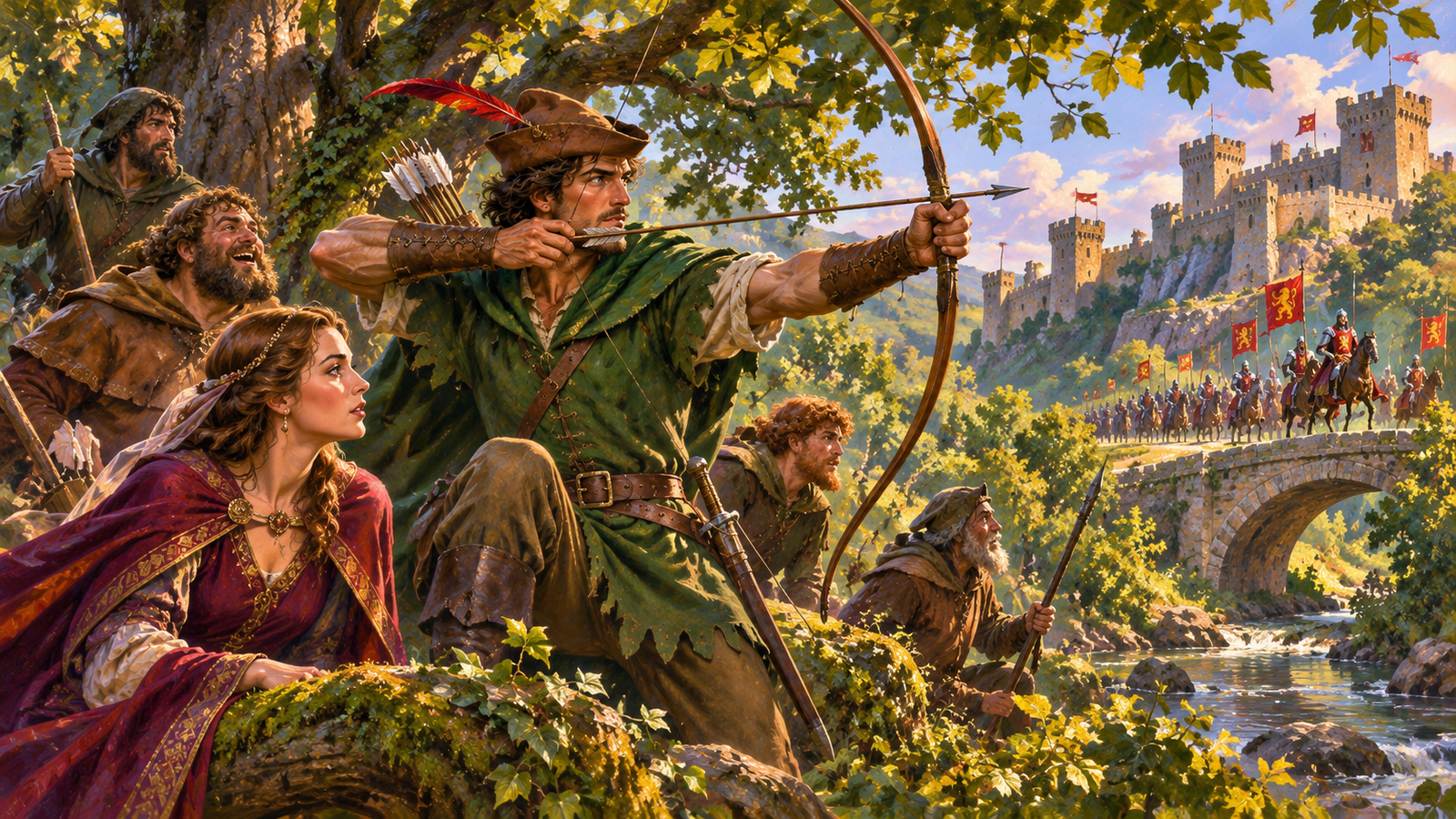
The outlaw of Sherwood returns in a blaze of Technicolor, armed with a bow, a company of companions and an irrepressible appetite for justice.
The Adventures of Robin Hood (1938) is one of Hollywood’s defining swashbucklers. Errol Flynn’s Robin is merry without being foolish, brave without being solemn and capable of turning a castle banquet into an act of rebellion. Michael Curtiz and William Keighley’s film combines radiant forests, colour, adventure, romance, archery and a sweeping score to make its vision of outlaw heroism immediately understandable. It is a tale shaped by medieval legend, not a reconstruction of medieval England.
At a Glance
| Film | The Adventures of Robin Hood (1938) |
|---|---|
| Directors | Michael Curtiz and William Keighley |
| Screenplay | Norman Reilly Raine and Seton I. Miller |
| Principal cast | Errol Flynn, Olivia de Havilland, Basil Rathbone, Claude Rains, Alan Hale, Eugene Pallette, Patric Knowles and Melville Cooper |
| Music | Erich Wolfgang Korngold |
| Production | Warner Bros.; Technicolor adventure |
| Running time | Approximately 102 minutes |
| Source | The Robin Hood legend; Sherwood Forest and King Richard’s absence |

Why This Film Matters
The 1938 film helped establish the Robin Hood image familiar to generations of viewers: green woodland, witty defiance, forest companions, an unfair ruler and a noblewoman who sees beyond the official loyalties of her household. Flynn’s physical ease makes rebellion look joyful. The best scenes are not simply victories by a remarkable swordsman: they show a leader finding allies, rescuing captives, redistributing treasure and making the forest a place where a different community can survive.
Its saturated Technicolor palette and Erich Wolfgang Korngold’s expansive orchestral score give the adventure an influence that extends well beyond costume drama. The film was subsequently selected for preservation in the United States National Film Registry.
The Story — Without Major Spoilers
King Richard the Lionheart is absent, and Prince John exploits the opportunity to strengthen his control with Sir Guy of Gisbourne and the Sheriff of Nottingham. Ordinary people suffer from excessive taxes and intimidation. Robin of Locksley challenges these authorities, becomes an outlaw and gathers a company in Sherwood Forest.
Raids and rescues undermine the officials, but Robin’s growing relationship with Maid Marian complicates the division between forest and court. Marian initially shares the assumptions of the ruling household. Her encounters with Robin and those affected by John’s rule change what she is prepared to defend. The story builds through contests of daring, loyalty and deception, without treating the outlaw’s personal courage as his only strength.
Characters and Performances
Errol Flynn as Robin Hood is exuberant, provocative and physically fearless. He mocks ceremony when those in power use it to conceal cruelty. Olivia de Havilland as Maid Marian gives the story an important change in perspective: she is not only a romantic interest but someone choosing between a privileged position and the people its protectors exploit.
Basil Rathbone’s Sir Guy of Gisbourne embodies skill, ambition and resentment. His rivalry with Robin works because he is a dangerous swordsman rather than merely a fool. Claude Rains’s Prince John shifts between petulance and menace, while Melville Cooper’s Sheriff supplies a more anxious form of self-interest.
Alan Hale’s Little John has warmth and immense strength; Eugene Pallette’s Friar Tuck is a jovial but formidable companion, not a decorative cleric. Patric Knowles’s Will Scarlet and Herbert Mundin’s Much help make the Merry Men feel like a company, while Ian Hunter plays the returning King Richard.
The World on Screen
Sherwood is the film’s visual heart: leafy shelter, river crossings and concealed paths contrast with Nottingham’s stone walls, armed passages and ceremonial rooms. The forest can receive people forced out of the political order, but their refuge depends upon food, local help, secrecy and dependable scouts.
Castles, richly dressed nobles and colourful banners create a persuasive fairy-tale Middle Ages. The film’s simplified Saxon-versus-Norman conflict and its picture of Richard and John, however, are devices of legendary storytelling rather than a complete record of medieval English society.
Behind the Camera
Warner Bros. mounted the production on a lavish scale, with William Keighley directing its earlier stages before Michael Curtiz completed the film. Athletic action, swordplay, archery and vivid colour were designed for spectacle, while Korngold’s music provides emotional shape and momentum. Costumes, lighting, choreography and the distinct screen personalities of the actors work together to make this particular version of the legend feel larger than life.
Legend, Adaptation and Critical Assessment
There is no single definitive Robin Hood story. Ballads, literature and popular performance have repeatedly reshaped his status, companions and adversaries. This film chooses a noble Robin who defends King Richard against the corrupt Prince John, giving its rebellion a remarkably clear moral framework. That clarity makes for excitement, even if it leaves little space for nuance.
What works: exhilarating action, memorable ensemble performances, lush colour, Korngold’s score, companionable humour and a romance that changes how Marian understands the world. Limitations: complex social history becomes a simple conflict between virtuous rebels and bad officials; the portrayal of Norman and Saxon identities serves its fantasy of medieval England more than the historical record.
Connections and Related Viewing
Compare the earlier Robin Hood (1922), another grandly staged interpretation that also features Alan Hale as Little John. Other screen approaches include Robin Hood: Prince of Thieves (1991) and Robin Hood (2018). The films are distinct interpretations, not chapters in one shared continuity.
Explore in SpiralWorlds
Meet the setting’s Robin Hood, Maid Marian, Little John, Sir Guy of Gisbourne, Will Scarlet, Friar Tuck, Much and the Sheriff of Nottingham. Explore Nottingham and Sherwood Forest for places to stage a woodland campaign. These are RPG interpretations of the traditions, not exact versions of the 1938 film’s cast.
Ideas for the Table
Begin with a village facing an impossible levy, not a battle. Characters can rescue hostages, trace the payments to a corrupt official, seek a contact inside an enemy household, or judge whether a forest outlaw band can be trusted. Each raid should affect the garrison’s patrols and the common people’s readiness to offer help. A powerful adversary needs informants and officials as well as soldiers; the outlaw company needs food, discretion and people prepared to keep secrets.
An archery contest, banquet infiltration or ambush on a river crossing can become a tense encounter without specifying how the players must win. Allies should disagree, and the return of a lawful king should create new questions rather than automatically resolve every grievance.
Sources and Credits
- American Film Institute — The Adventures of Robin Hood (1938) (film record and production history).
- British Film Institute — The Adventures of Robin Hood (film credits).
- Library of Congress — The Adventures of Robin Hood (film record).
The hero panorama is an original editorial illustration; the historical film poster belongs to its rights holder. This is an independent review and tabletop commentary.
Keep this reference growing
If this page helped with your reading or game, you can support its upkeep or explore the curated books.
Explore the Bookshop — epics, classics and stories behind imagined worlds.