
Inanna / Ishtar — Goddess of Love, War & the Morning Star
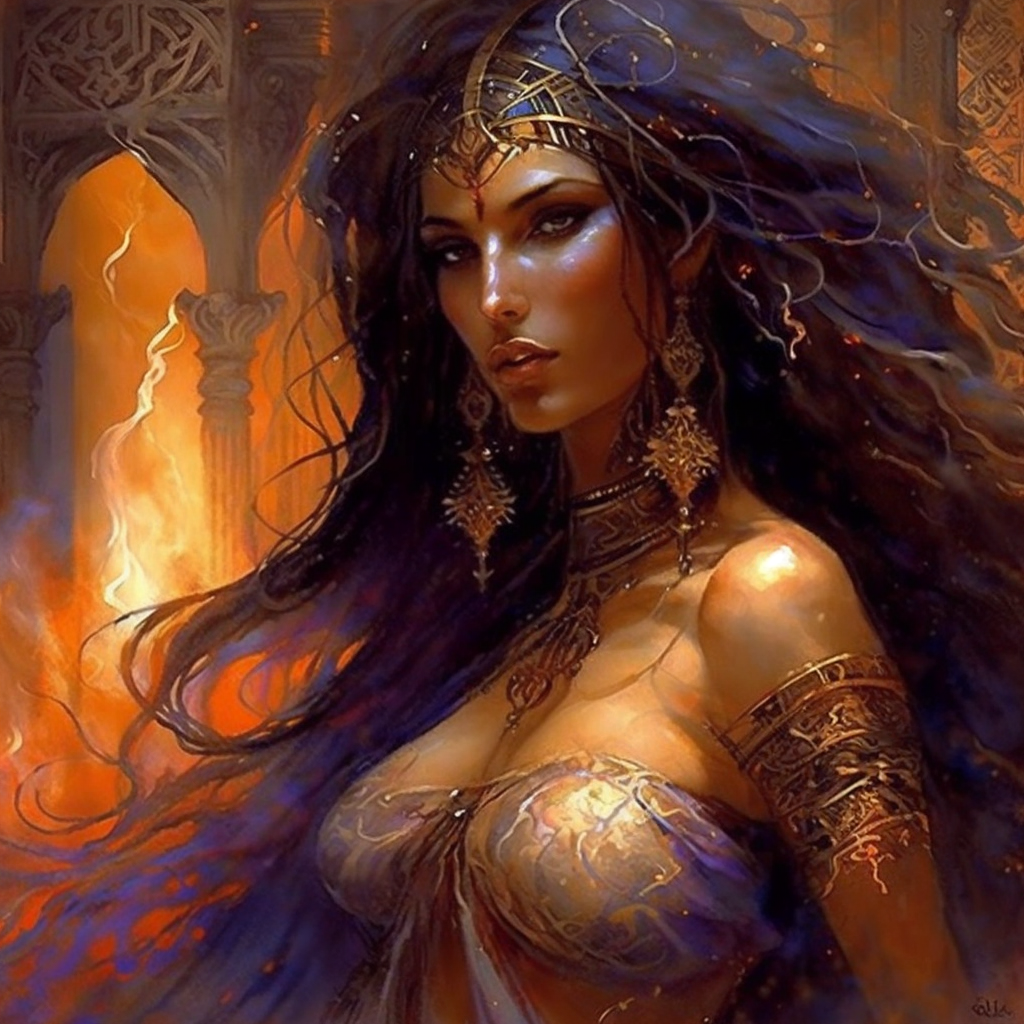
Inanna—Ishtar in Akkadian—is one of the greatest and most complex deities of Mesopotamia. She rules sexual love and warfare, royal power and dangerous transformation, and appears in the heavens as Venus: the morning and evening star. Contradiction is not a flaw in her identity. It is the source of her power.
At a Glance
Mesopotamian — Sumerian Inanna / Akkadian Ishtar
Greater Deity
Chaotic Neutral
Queen of Heaven; Lady of Battle; Morning and Evening Star
Love, desire, warfare, sovereignty, Venus, transformation, ambition and dangerous change
Uruk — especially the Eanna precinct
Lion and associated star imagery
The Star-Crowned Court of Celestial Uruk
Game Mechanics
The following statistics are campaign adaptations for direct divine manifestations, not official rules material.
5.5e / 2024 — Direct Divine Manifestation
Large Celestial (Greater Deity), Chaotic Neutral. AC 29; HP 900; Speed 50 ft., fly 100 ft. (hover); CR 37; PB +11. STR 30, DEX 34, CON 34, INT 30, WIS 32, CHA 40. Saving Throws Dex +23, Con +23, Wis +22, Cha +26. Damage Resistances fire, lightning, psychic; Damage Immunities poison, radiant. Condition Immunities charmed, exhaustion, frightened, poisoned. Truesight 240 ft.; telepathy 1 mile.
Greater Divine Nature. Inanna requires no food, drink, air or sleep. Legendary Resistance (5/Day). Magic Resistance.
Morning Star / Evening Star. At the start of each turn Inanna chooses an aspect. Morning Star grants her and allies within 60 feet +10 feet Speed and +2d8 radiant damage on the first attack they hit with each round. Evening Star gives enemies within 60 feet Disadvantage on saves against Charmed and Frightened.
Contradictory Majesty. Inanna can be both Charmed and Frightened only if she chooses. Whenever a creature within 120 feet attempts to impose either condition, she may reflect the effect back on the source with the same save DC.
Sovereign Desire. Once per round when a creature within 120 feet willingly moves closer to or farther from Inanna, she may increase that movement by 20 feet or reduce it to 0.
Actions — Lion-Bladed Spear. +22 to hit, reach 15 ft.; 4d10+10 piercing plus 6d8 radiant or psychic. Star of Battle (Recharge 5–6). 60-foot cone; DC 31 Dexterity save, 72 radiant damage plus 36 thunder on failure, half on success. Command the Heart (Recharge 5–6). Up to three creatures within 120 feet make DC 31 Wisdom saves; on failure each is Charmed or Frightened, Inanna’s choice, until end of its next turn. Strip the Seven Gates (1/Day). One creature within 120 feet loses one magical defence, resistance, immunity or active buff at the start of each of its turns for up to seven rounds; DC 31 Charisma save ends the effect at the end of each turn.
Legendary Actions (5/round). Star Step; Spear Strike; Lion’s Rush (2 actions), move up to Speed and knock one creature prone on failed DC 31 Strength save; Reverse Affection (2 actions), end Charmed or Frightened on one creature and impose the opposite condition on a hostile creature; Queen of Battle (3 actions), one ally may make one attack and one enemy cannot take Reactions until end of its next turn.
Cleric themes. War, Trickery and Light each capture part of Inanna/Ishtar. A campaign Star Domain might use charm person, heroism; enthrall, spiritual weapon; beacon of hope, fear; compulsion, freedom of movement; dominate person, destructive wave.
Pathfinder 1e — Campaign Adaptation
CR 37 / MR 10; Large outsider (chaotic, divine). AC 58; hp 850; Fort +35, Ref +39, Will +38; DR 20/epic; SR 48. Morning/Evening Star (Su): swift-action stance changing between martial speed/damage and enchantment DC bonuses. Sovereign Desire (Su): immediate-action forced movement modification within 120 ft. Seven Gates (Su): 1/day progressively suppress protective magical effects. Domains: Charm, Chaos, Glory, Love, War.
D&D 3.5e — Campaign Adaptation
Greater Deity; Divine Rank 16; Outsider 20 / Cleric 20 / Fighter 10 / Bard 10; Chaotic Neutral; suggested CR 52. DR 30/epic; SR 68. Salient divine abilities: Alter Reality, Avatar, Battlesense, Divine Battle Mastery, Divine Inspiration, Divine Shield, Divine Spellcasting, Mass Divine Blast. Domains: Chaos, Charm, Glory, War and a campaign Love domain.
What Is Inanna / Ishtar Doing Right Now?
Inanna is moving through courts, battle lines, marriage negotiations, theatres and cities in revolt. She is interested wherever desire becomes political: a ruler marrying for alliance while loving someone else, soldiers who turn victory into mutiny, performers who become symbols of resistance or nobles whose private passions threaten public order.
Venus omens have also become unusually clear. Priests watching the morning and evening star report that Inanna’s signs are arriving in pairs—one promising favour, the other warning of upheaval. Her worshippers argue over which aspect should be read first.
Appearance & Manner
Inanna appears as a radiant horn-crowned sovereign armed for war, robed for court or both at once. Lions, stars and weapons accompany her imagery. She can be intimate, terrifying, playful and imperial in the same conversation. She dislikes anyone who mistakes consistency for virtue.
Love, War & the Morning Star
Inanna/Ishtar’s surviving identity is famously paradoxical. She is a goddess of sexual love and also one of war; associated with attraction and fertility yet equally with battle fury, political power and the dangerous disruption of ordinary boundaries. In her astral form she is Venus, visible as both morning and evening star.
Her myths repeatedly show ambition. Inanna seeks powers, descends into the underworld, contests authority and returns transformed. She is not a passive embodiment of love or beauty. She wants, chooses, fights, loses, negotiates and returns.
Divine Relationships
Dumuzid. Lover and husband in important traditions, bound to seasonal loss, kingship and the descent cycle.
Ereshkigal. Sister and underworld sovereign. Their relationship is central to the Descent of Inanna/Ishtar, where crossing into Ereshkigal’s realm strips Inanna of status and protection gate by gate.
Ninshubur. Loyal minister and intercessor in Inanna’s tradition. Later syncretism links Ninshubur with Papsukkal, but the older service to Inanna remains important.
Nanna/Sin and Ningal. In one major genealogical tradition they are her parents; other traditions assign different ancestry, including links to Anu.
Worship, Uruk & Sovereignty
Inanna’s worshippers include rulers, soldiers, lovers, performers, courtiers, sex workers, diviners and people seeking radical change in personal or political life. Her temples are not places where all contradictions are resolved. They are places where contradiction is given ritual form.
Uruk is her defining city. The Eanna precinct ties her to sovereignty and civic identity as well as desire and war. A ruler claiming Inanna’s favour is making a political statement, not merely displaying private devotion.
Omens, Favour & Displeasure
Favour appears as Venus visible through storm cloud, a lion refusing to attack, a weapon breaking before it kills the wrong person or a rejected lover discovering the courage to choose a different life. Inanna dislikes cowardice disguised as propriety, coercion mistaken for desire and rulers who demand loyalty while refusing passion, risk or change themselves.
Encounters & Adventure Use
The Seven Lost Regalia
Seven divine objects stripped at an underworld gate have resurfaced separately in mortal hands.
The Morning-Star Queen
A ruler receives a perfect omen of victory, while the same evening’s Venus omen predicts the fall of her dynasty.
Ninshubur’s Petition
A divine messenger needs mortals to carry an appeal into a court that refuses to hear another god’s servant.
Divine Realm — The Star-Crowned Court
Inanna’s realm rises around a celestial Uruk of monumental gates, processional courts, armouries, music halls and terraces open to Venus. No guest is allowed to remain only one thing: warrior, lover, ruler, victim or victor. The court constantly tests what happens when identity changes under pressure.
Relics & Sacred Objects
The Star of Eight Points. A divine emblem that reveals whether a desire is genuinely the bearer’s own or magically imposed.
The Lion-Bladed Spear. Its wounds cannot be hidden by glamour, propaganda or false testimony.
The Seven Regalia. A set of divine objects representing layered authority. Each grants power, but each also creates a vulnerability when surrendered or stripped away.
Historical & Mythological Context
Inanna/Ištar is one of the most important deities of Mesopotamia and its most prominent goddess. ORACC describes her as goddess of sexual love and warfare and identifies her astral form with Venus, the morning and evening star. Her contradictory and boundary-crossing traits are central to her historical character rather than modern additions.
The direct divine statistics, current activity, relics and detailed divine realm above are campaign adaptations.
Sources & Licensing
Historical foundation: ORACC — Inana/Ištar. Game mechanics and campaign material are original adaptation. See also the Mesopotamian Pantheon.
Keep this reference growing
If this page helped with your reading or game, you can support its upkeep or explore the curated books.
Explore the Bookshop — epics, classics and stories behind imagined worlds.