
Sir Agravain — Knight of the Hard Hand
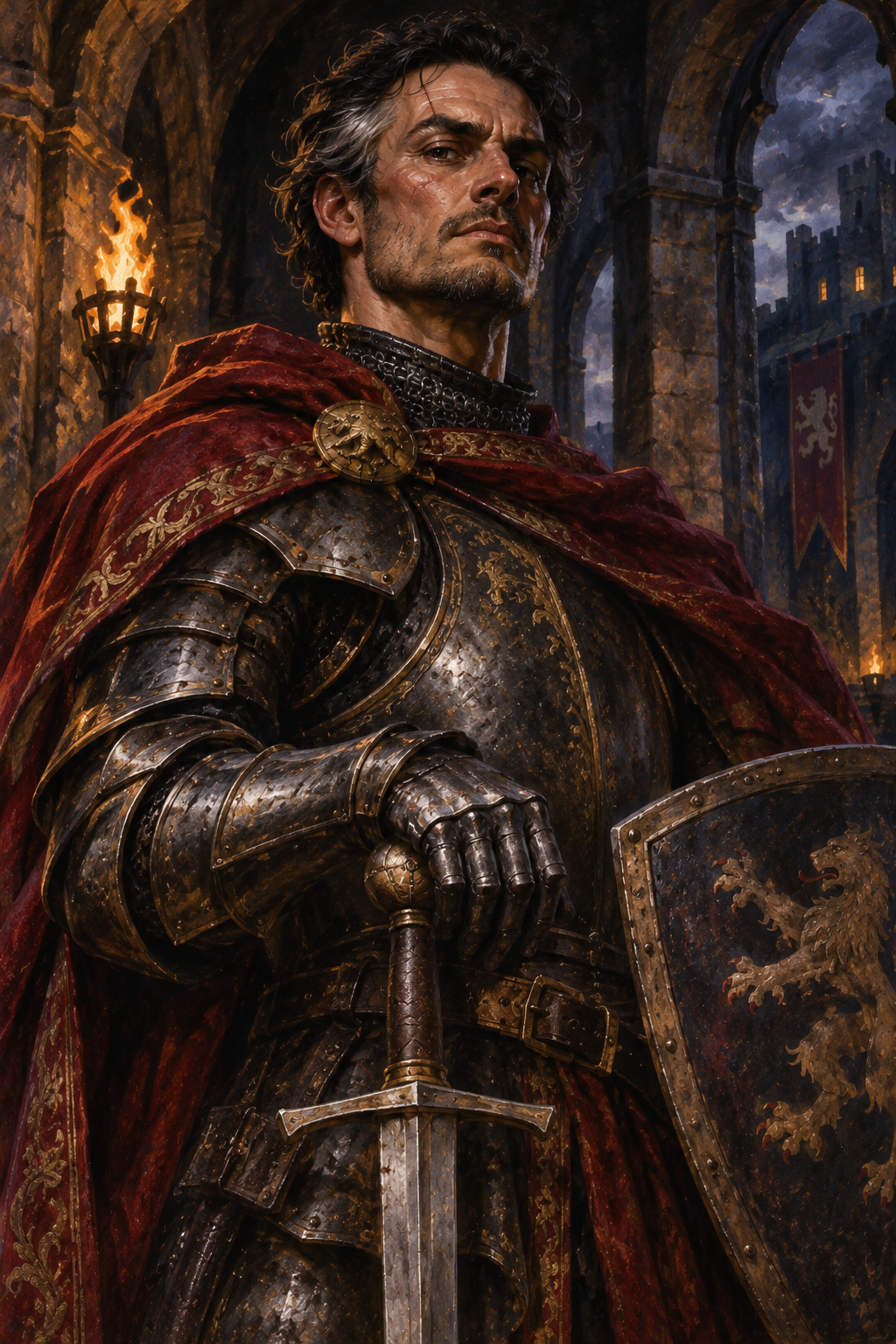
In an earlier hour of Camelot reached from 1454 by a hidden Fey road, Sir Agravain has stationed armed knights outside a corridor leading to Guinevere’s chamber. Two servants have been ordered to leave the passage, and a third refuses to surrender a key. Agravain demands that an adventurer swear before witnesses that no one has passed the doors since sundown. He has evidence against Lancelot and the queen, but he is prepared to turn a suspicion into a deadly arrest rather than submit it to judgement.
At a Glance
- Identity
- Sir Agravain of the Hard Hand; knight of the Round Table
- Nature
- Mortal knight, experienced fighter and hostile court accuser
- Family
- Son of King Lot and Morgause; brother of Gawain, Gaheris, Gareth; maternal half-brother of Mordred in Malory’s account
- Allegiance
- King Arthur and the Orkney faction, though his motives are not identical to Arthur’s
- Rivals
- Lancelot, Guinevere, and those who resist his methods
- Outlook
- Lawful Evil — exploits royal law and family influence to coerce others, preferring a brutal victory to a just hearing
- Languages
- Courtly French, Brythonic
- Equipment
- Plate armour, shield, longsword, lance, seal and a list of supporters
- Immediate danger
- His armed men are ready to seize a knight who will not come quietly
What Is Happening Right Now?
Agravain has collected testimony from two courtiers, watched the queen’s doors and instructed Mordred to summon loyal men. His eldest brother Gawain has warned that a violent seizure may destroy more than the alleged offence. Agravain refuses to wait. He believes that the scandal is the weapon with which Lancelot’s influence can be broken, and he uses the king’s honour as his warrant.
A page carrying a candle knows of a second passage that opens behind the chamber. An honest inquiry might expose a deception or reveal a breach of duty. Agravain’s chosen method will instead create a battle in which witnesses die and the kingdom fractures.
First Meeting
Agravain wears a plain iron cuirass over an old crimson surcoat; the armour is polished at the edges from hard use. His voice is low and exact. He holds his gauntlet open to a servant carrying a sealed letter, then closes it around the man’s wrist when the servant hesitates. He does not shout until witnesses have gathered.
Three Scenes Tonight
- The sealed order: the command to take Lancelot appears to bear Arthur’s authority, but a court scribe admits that its wording was altered after it left the chamber.
- The open stair: a frightened porter knows how the household might escape the cordon. Agravain offers the man protection if he identifies the keyholder.
- Mordred’s report: Mordred claims an ally will bar the courtyard gate; the ally never receives a formal order and may change sides.
Appearance and Manner
A son of a warlike house might have learned patience by watching his brothers. Agravain has instead learned how courtly procedure can give cruelty a respectable voice. He is orderly, sleepless before a confrontation and capable of courage in a fair fight. The trouble is not that he cannot recognise virtue: he recognises it and can still decide that winning matters more.
Ambition, Pressure and Private Knowledge
- Ambition: destroy Lancelot’s position and make the royal court acknowledge the Orkney family’s power.
- Pressure: hostile factions fear Guinevere’s influence and suspect that Arthur’s own reluctance to confront Lancelot weakens the crown.
- Private knowledge: Agravain knows which sworn witnesses refuse to enter the queen’s chamber, and why their testimony will not hold up under questioning.
- Flaw: he believes an accusation becomes stronger when announced before more armed supporters.
- Leverage: guards at the doors, courtiers who will repeat his words and the willingness to call shame upon an opponent.
Relationships and Allegiances
Gawain warns against a quarrel with Lancelot, whom he knows to be formidable. Gareth and Gaheris refuse to join this effort against their friend, though their family ties remain painful. Mordred is Agravain’s accomplice and the man likeliest to carry the charge to Arthur if Agravain falls. Lamorak bears the weight of the Orkney blood feud arising from the death of King Lot and the killing of Morgause. Agravain’s cruelty toward the Lamorak household is a separate grievance from the affair of Guinevere and Lancelot.
Game Statistics
Agravain’s danger comes from soldiers, arrest warrants and an experienced blade. His threats are mortal and political; no necrotic aura, compelled terror or magical lair follows him through Camelot.
Sir Agravain — D&D 2024
Medium Humanoid (Human), Lawful Evil
Armor Class 20 (plate and shield); Initiative +1 (11); Hit Points 150 (20d8 + 60); Speed 30 ft.; Challenge 7 (2,900 XP; PB +3)
| STR | DEX | CON | INT | WIS | CHA |
|---|---|---|---|---|---|
| 18 (+4) | 12 (+1) | 16 (+3) | 14 (+2) | 12 (+1) | 14 (+2) |
Saving Throws Str +7, Con +6, Wis +4; Skills Athletics +7, Deception +5, Insight +4, Intimidation +8; Senses passive Perception 11; Languages courtly French, Brythonic.
Traits
Hard Hand. Agravain has advantage on Charisma (Intimidation) checks when he can present a sealed order or the authority of a recognised royal officer; the feature gives no power to command someone outside that jurisdiction.
Prepared Seizure. Agravain has advantage on initiative checks when his agents have watched the target for at least one minute and he begins the encounter with them in their appointed positions.
Actions
Multiattack. Agravain makes three longsword attacks. The mounted lance strike below is a separate action and cannot be substituted into this Multiattack.
Longsword. Melee Attack Roll: +7 to hit, reach 5 ft., one target. Hit: 8 (1d8 + 4) slashing damage.
Mounted Lance Charge. Melee Attack Roll: +7 to hit, reach 10 ft., one target while mounted. Hit: 9 (1d10 + 4) piercing damage, plus 9 (2d8) piercing damage if the mount moved at least 20 feet straight toward the target immediately before this attack. One attack only.
Order the Arrest (Recharge 5–6). One ally who can hear Agravain within 30 feet may use its reaction to move up to half its speed and make one melee weapon attack against a creature Agravain has named. The ally makes the attack using its own statistics.
Bonus Actions
Close the Exits (2/Day). Agravain chooses up to three willing allies within 30 feet who can hear him. Each may immediately move up to 10 feet without provoking opportunity attacks; the movement must end closer to a door, stair, passage or designated escape route.
Reactions
Parry. Agravain adds 3 to his AC against one melee attack that would hit him, provided he can see the attacker and is holding a melee weapon.
Tactics
Agravain never accepts a public loss gracefully. He tries to put opponents in breach of a rule, then brings an armed escort to enforce it.
Sir Agravain — D&D 2014
Medium humanoid (human), lawful evil
Armor Class 20 (plate and shield); Hit Points 150 (20d8 + 60); Speed 30 ft.; Challenge 7 (2,900 XP)
| STR | DEX | CON | INT | WIS | CHA |
|---|---|---|---|---|---|
| 18 (+4) | 12 (+1) | 16 (+3) | 14 (+2) | 12 (+1) | 14 (+2) |
Saving Throws Str +7, Con +6, Wis +4; Skills Athletics +7, Deception +5, Insight +4, Intimidation +8; Senses passive Perception 11; Languages courtly French, Brythonic.
Traits
Hard Hand. Agravain has advantage on Charisma (Intimidation) checks when he can present a sealed order or the authority of a recognised royal officer; the feature gives no power to command someone outside that jurisdiction.
Prepared Seizure. Agravain has advantage on initiative checks when his agents have watched the target for at least one minute and he begins the encounter with them in their appointed positions.
Actions
Multiattack. Agravain makes three longsword attacks. The mounted lance strike below is a separate action and cannot be substituted into this Multiattack.
Longsword. Melee Weapon Attack: +7 to hit, reach 5 ft., one target. Hit: 8 (1d8 + 4) slashing damage.
Mounted Lance Charge. Melee Weapon Attack: +7 to hit, reach 10 ft., one target while mounted. Hit: 10 (1d12 + 4) piercing damage, plus 9 (2d8) piercing damage if the mount moved at least 20 feet straight toward the target immediately before this attack. One attack only.
Order the Arrest (Recharge 5–6). One ally who can hear Agravain within 30 feet may use its reaction to move up to half its speed and make one melee weapon attack against a creature Agravain has named. The ally makes the attack using its own statistics.
Bonus Actions
Close the Exits (2/Day). Agravain chooses up to three willing allies within 30 feet who can hear him. Each may immediately move up to 10 feet without provoking opportunity attacks; the movement must end closer to a door, stair, passage or designated escape route.
Reactions
Parry. Agravain adds 3 to his AC against one melee attack that would hit him, provided he can see the attacker and is holding a melee weapon.
Tactics
Agravain never accepts a public loss gracefully. He tries to put opponents in breach of a rule, then brings an armed escort to enforce it.
Sir Agravain — Pathfinder 1e
CR 11; XP 12,800; male human fighter 12; LE Medium humanoid (human); Init +5; Senses Perception +10.
Defense
AC 26, touch 12, flat-footed 25 (+10 armour, +4 shield, +1 Dex, +1 deflection); hp 102 (12d10 + 36); Fort +11, Ref +5, Will +5; Defensive Abilities bravery +3 against fear.
Offense
Speed 30 ft. in armour (armour training 3); Melee +2 longsword +23/+18/+13 (1d8+13, 17–20/×2); Mounted +1 lance +18 (1d8+6, ×3; one attack on a charge, tripled damage with Spirited Charge); Space/Reach 5 ft./5 ft. (10 ft. with lance); Base Atk +12; CMB +17; CMD 29.
Statistics
Str 20, Dex 12, Con 16, Int 14, Wis 12, Cha 14; Feats Weapon Focus (longsword), Weapon Specialization (longsword), Greater Weapon Focus (longsword), Greater Weapon Specialization (longsword), Improved Critical (longsword), Power Attack, Cleave, Great Cleave, Improved Initiative, Mounted Combat, Ride-By Attack, Spirited Charge, Shield Focus, Combat Reflexes (14 total, including human and fighter bonus feats). Skills Ride +13, Intimidate +17, Knowledge (nobility) +12, Perception +10, Diplomacy +10. Languages French, Brythonic, neighbouring court tongues.
Special Abilities
Armour Training 3; Weapon Training (heavy blades) +2; Bravery +3. His training follows the native fighter class. The lance does not receive his heavy-blade bonuses. Possessions +1 full plate, +1 heavy steel shield, +2 longsword, +1 lance, ring of protection +1, court seal and prepared arrest warrant.
Tactics
Before combat Agravain sets armed knights near the doors. During combat he tries to isolate a rival rather than fight the whole household. His mission fails if the suspect escapes or testimony to the seizure survives.
Sir Agravain — D&D 3.5e
Male human Fighter 12; LE Medium humanoid; CR 12; Init +5; Senses Listen +8, Spot +8.
Defense
AC 24, touch 12, flat-footed 23 (+9 armour, +3 shield, +1 Dex, +1 deflection); hp 102 (12d10 + 36); Fort +11, Ref +5, Will +5.
Offense
Speed 20 ft. in heavy armour; Melee +2 longsword +21/+16/+11 (1d8+11, 17–20/×2); Mounted +1 lance +18 (1d8+6, ×3; single charge, tripled damage with Spirited Charge); Space/Reach 5 ft./5 ft. (10 ft. with lance); Base Atk/Grapple +12/+17.
Statistics
Str 20, Dex 12, Con 16, Int 14, Wis 12, Cha 14; Feats Weapon Focus (longsword), Weapon Specialization (longsword), Greater Weapon Focus (longsword), Greater Weapon Specialization (longsword), Improved Critical (longsword), Power Attack, Cleave, Great Cleave, Improved Initiative, Mounted Combat, Ride-By Attack, Spirited Charge, Combat Reflexes (13 total including human and fighter bonus feats). Skills Ride +16, Intimidate +16, Knowledge (nobility and royalty) +9, Spot +8, Listen +8. Languages French, Brythonic.
Special Abilities
Martial weapon proficiency and the full base attack progression of a fighter. No magical aura, fiendish attack or lair ability. Possessions +1 full plate, +1 heavy steel shield, +2 longsword, +1 lance, ring of protection +1, signet and seal.
Tactics
Agravain secures the doors before making a public accusation and pursues the intended arrest aggressively. His willingness to risk witnesses and allies is his central weakness.
Run the Encounter
Agravain prefers an arrest, but will attack if he believes the target cannot escape. At the chamber he has at least a dozen allies ready, though each is a separate combatant. An enemy who exposes a forged order may weaken his authority; a party that fights him in public must explain what happened to the king’s officers. He fights hard with a sword and uses his shield, but no magic reinforces a charge he cannot legally make.
Five Encounters
- The chamber watch: the party is asked to verify a witness’s account before the knights break down the door.
- The family summons: Gawain asks the characters to deliver a warning that Agravain has refused to hear from his own brother.
- The Lamorak witness: an old retainer remembers the attack on Lamorak and may be threatened for speaking.
- The private bargain: Agravain promises to release a captured page if the party accuses an innocent messenger.
- The bloody corridor: Agravain’s trap is sprung, Mordred flees and the survivors must tell Arthur who drew steel first.
Six Adventure Hooks
- A red seal recovered in 1454 opens a Fey passage into the night of the queen’s arrest.
- An innocent servant is named in Agravain’s testimony and asks for sanctuary before the court hearing.
- Agravain seeks a witness who remembers the blood-feud with the house of Pellinore.
- Mordred offers the characters money to keep a courtyard gate barred.
- Gawain asks the party to prevent an arrest that would divide the Table even if the charges prove true.
- A letter in Lancelot’s handwriting is missing from the queen’s apartments, and three parties want it for different reasons.
Equipment, Travel and Consequences
Agravain wears plate and shield and carries a serviceable longsword. At court his authority depends on the seal of the king and the willingness of other knights to act. If a group rides out of Camelot after the accusation, roads, lodgings and ferry crossings are held by rival households that will demand names. The path from the 1454 world to this earlier court may close without warning, trapping witnesses on the wrong side of a centuries-old quarrel.
Deeper History
Malory names Agravain among the sons of King Lot and Morgause. He acts with Mordred in accusing Lancelot and Guinevere and joins the armed men who surround their chamber. Lancelot kills Agravain and the knights accompanying him, while Mordred escapes to report the bloodshed. Only later are Gareth and Gaheris killed while unarmed during the rescue of Guinevere. Keeping these moments separate shows why Gawain refuses to avenge Agravain’s death but demands retribution for his other brothers.
Related People and Places
Arthurian characters · Gawain · Gareth · Gaheris · Lancelot · Guinevere · Arthur · Mordred
Portrait and Heraldry


Sources
- Thomas Malory, Le Morte Darthur, books XX–XXI — the accusation, chamber fight and later deaths.
- Malory’s complete text — family relationships and the Orkney feud.
Keep this reference growing
If this page helped with your reading or game, you can support its upkeep or explore the curated books.
Explore the Bookshop — epics, classics and stories behind imagined worlds.