
Magic · Illusion · Spell Reference
Color Spray
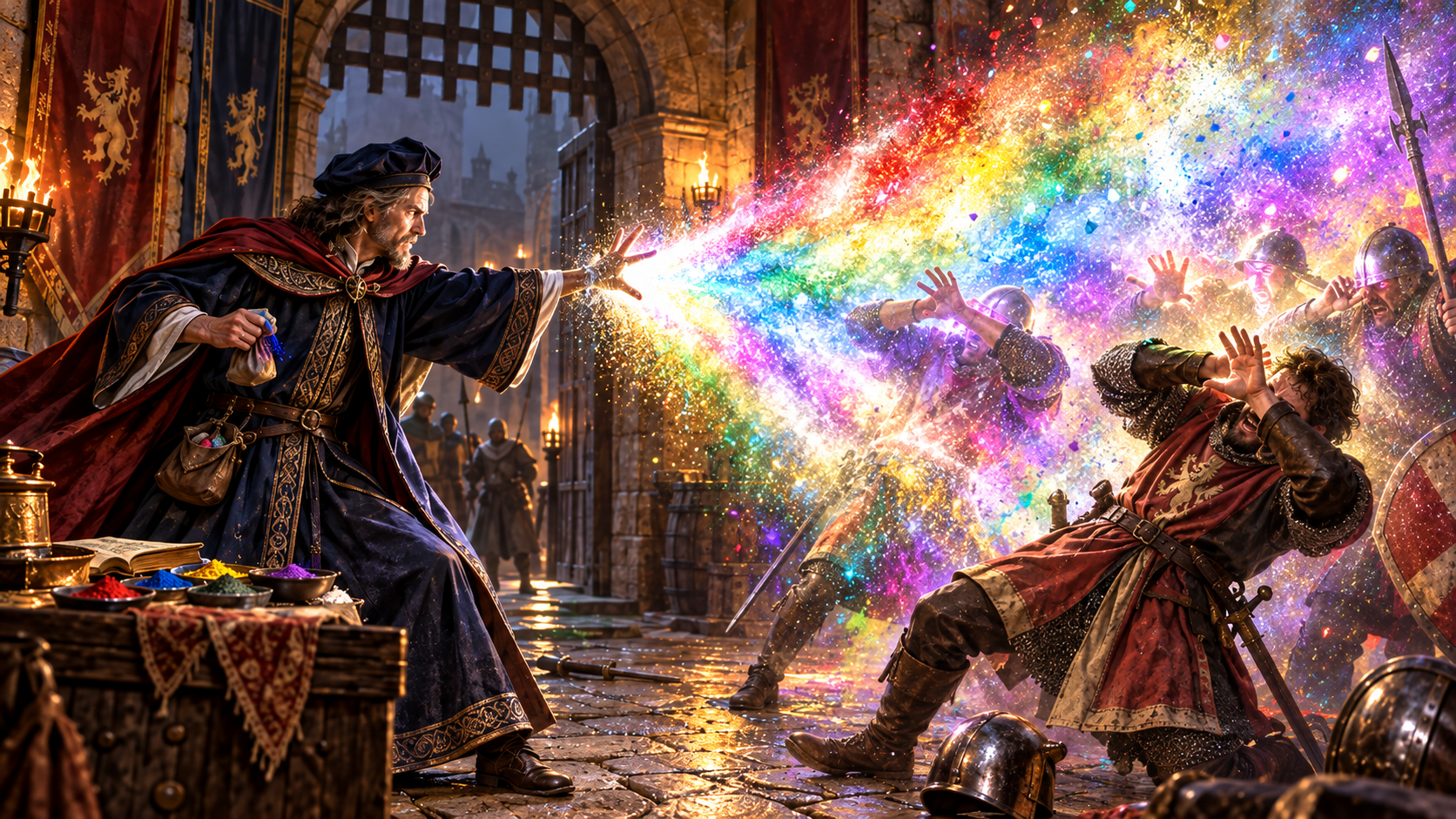
Color Spray is a close-range illusion that floods a 15-foot cone with violent, flashing colour. It is a control spell rather than a damage spell: its exact method of disabling creatures is given in the standalone rules tab for the edition in use.
Rules
Game Statistics
Choose the edition in use. Each rules tab is self-contained.
Color Spray — D&D 5.5e / 2024
Level 1 Illusion (Bard, Sorcerer, Wizard)
- Casting Time
- Action
- Range
- Self (15-foot Cone)
- Components
- V, S, M (a pinch of colorful sand)
- Duration
- Instantaneous
You release a dazzling array of flashing colour. Each creature in a 15-foot Cone originating from you makes a Constitution saving throw. On a failed save, the creature has the Blinded condition until the end of your next turn.
Color Spray — D&D 5e / 2014
1st-level Illusion — Sorcerer, Wizard; Bard with the optional expanded spell list.
- Casting Time
- 1 action
- Range
- Self (15-foot cone)
- Components
- V, S, M (a pinch of red, yellow and blue powder or sand)
- Duration
- 1 round
- Saving Throw
- None
Effect
Roll 6d10. The total is the pool of current hit points the spell can affect. Consider creatures in the cone from the lowest current hit points upward, ignoring unconscious creatures and creatures that cannot see.
Starting with the creature that has the lowest current hit points, affect a creature only if its current hit points are no greater than the remaining pool. An affected creature is Blinded until the end of your next turn. Subtract that creature’s current hit points from the pool and continue to the next eligible creature.
At Higher Levels
For each spell slot level above 1st, add 2d10 to the hit-point pool.
Color Spray — Pathfinder 1e
School Illusion (Pattern) [Mind-Affecting]; Level Sorcerer 1, Wizard 1
Casting
- Casting Time
- 1 standard action
- Components
- V, S, M (red, yellow and blue powder or coloured sand)
Effect
- Range
- 15 ft.
- Area
- Cone-shaped burst
- Duration
- Instantaneous; see text
- Saving Throw
- Will negates
- Spell Resistance
- Yes
Description
A vivid cone of clashing colours bursts from your hand. Each creature in the cone is affected according to Hit Dice if it fails its Will save and is not protected by applicable Spell Resistance.
2 HD or lessThe creature is Unconscious, Blinded and Stunned for 2d4 rounds; then Blinded and Stunned for 1d4 rounds; then Stunned for 1 round. Only living creatures are knocked Unconscious.
3 or 4 HDThe creature is Blinded and Stunned for 1d4 rounds; then Stunned for 1 round.
5 HD or moreThe creature is Stunned for 1 round.
Sightless creatures are not affected.
Color Spray — D&D 3.5e
Illusion (Pattern) [Mind-Affecting]
- Level
- Sorcerer 1, Wizard 1
- Components
- V, S, M
- Casting Time
- 1 standard action
- Range
- 15 ft.
- Area
- Cone-shaped burst
- Duration
- Instantaneous; see text
- Saving Throw
- Will negates
- Spell Resistance
- Yes
A vivid cone of clashing colours springs from your hand. Each creature within the cone is affected according to its Hit Dice.
2 HD or lessThe creature is Unconscious, Blinded and Stunned for 2d4 rounds; then Blinded and Stunned for 1d4 rounds; then Stunned for 1 round. Only living creatures are knocked Unconscious.
3 or 4 HDThe creature is Blinded and Stunned for 1d4 rounds; then Stunned for 1 round.
5 HD or moreThe creature is Stunned for 1 round.
Sightless creatures are not affected.
Material Component
A pinch each of powder or sand coloured red, yellow and blue.
Edition comparison
What Changed Between Editions?
| Change | 5.5e / 2024 | 5e / 2014 | PF1e / D&D 3.5e |
|---|---|---|---|
| Resolution | Constitution save for each creature in the cone. | 6d10 hit-point pool; creatures are checked from the lowest current hit points upward; no save. | Will save and Spell Resistance; severity depends on Hit Dice. |
| Duration | Instantaneous; Blinded lasts until the end of the caster’s next turn. | 1 round; affected creatures are Blinded until the end of the caster’s next turn. | Instantaneous, with condition durations determined by Hit Dice. |
| Scaling | No higher-slot scaling. | Add 2d10 to the hit-point pool for each slot level above 1st. | No slot scaling; target Hit Dice determines severity. |
| Effect | Blinded. | Blinded. | Stunned; lower-HD creatures can also be Blinded or Unconscious. |
| Sightless creatures | No special exclusion in the spell text. | Creatures that cannot see are ignored when determining who is affected. | Sightless creatures are explicitly unaffected. |
| School tags | Illusion. | Illusion. | Illusion (Pattern) [Mind-Affecting]. |
| Material | A pinch of colorful sand. | Red, yellow and blue powder or sand. | Red, yellow and blue powder or sand. |
Tactics
How to Use Color Spray
Own the chokepoint
The spell’s short cone is strongest in gates, corridors, stairs, alleys and doorways where several opponents are forced into the same approach.
Position before casting
A 15-foot cone requires the caster to work close to danger. Move first so the cone catches the creatures you actually want without needlessly exposing allies.
Use the opening
Color Spray creates control rather than damage. Treat the moment after the spell as an opportunity to withdraw, reposition, protect someone vulnerable or press through a defended space.
Do not mistake colour for damage
The brilliant light is the spell’s presentation, not an elemental damage type. Resolve only the effects stated in the selected rules tab.
Color Spray in the Campaign
In SpiralWorlds, Color Spray sits naturally between practical illusion and learned optics. A trained caster does not need a modern theory of the spectrum to know that controlled light, colour, reflective surfaces and prepared pigment can overwhelm sight.
University and guild magic
Masters of natural philosophy use coloured glass, polished metal, water-filled vessels and pigment samples to teach how light changes through materials. Color Spray is the dangerous battlefield application of the same culture of observation.
Workshop components
Red, yellow and blue powders are easy to understand in a world of illuminators, dyers, painters, apothecaries and alchemical workshops. The coloured component can be sourced from ordinary craft materials even though the spell effect is supernatural.
Urban defence
A short cone is ideal for gates, stairs, alleys, counting houses and narrow interiors where attackers are forced into a compact approach. City watch mages and guild guards value it because it can stop a rush without filling the street with fire.
Performance and deception
Performers and illusionists can turn stagecraft into a weapon: a flourish of coloured sand, a shouted phrase and a sudden burst of impossible light. The same spectacle that delights a hall can become battlefield control in a heartbeat.
Historical & Mythic Context
Rainbows, Pigments and Dazzling Colour
The strongest historical and mythic parallels are the serious study of rainbows and light, the manufacture of intense pigments, and older traditions that treated the rainbow as a supernatural sign or divine presence.
Dietrich of Freiberg and the rainbow
Around 1300, Dietrich of Freiberg wrote dedicated works on light, colour and the rainbow. His rainbow theory used reflection and refraction in a watery medium to explain the primary and secondary bows, including their reversed colour order. By the later Middle Ages, optical investigation of light and colour therefore belongs comfortably inside learned natural philosophy even though modern spectral theory does not yet exist.
The alchemy of medieval colour
Medieval manuscript painters produced vivid colour from minerals, plants and chemically prepared substances. The Getty’s work on medieval pigments shows how colour-making overlapped with experimental craft and alchemical practice—an excellent real-world parallel for a spell whose material is coloured powder or sand.
J. Paul Getty Museum — The Alchemy of Color in Medieval Manuscripts
Yellow, red and blue were real workshop materials
Medieval artists had access to powerful yellows, reds and blues from very different substances: vegetable dyes, mineral pigments, metal compounds and imported materials such as lapis lazuli. The exact game recipe is fantasy, but the idea of a caster carrying small packets of intensely coloured powder is entirely plausible for the campaign period.
Iris and the supernatural rainbow
Greek tradition personified the rainbow through Iris, the messenger of the gods. That does not make Color Spray an ancient Greek spell, but it gives the sudden appearance of impossible colour a clear mythic vocabulary: colour can be more than decoration; it can announce supernatural presence.
Related rules & magic
Useful SpiralWorlds Links
- Bard — class reference.
- Sorcerer — class reference.
- Wizard — class reference.
- Sorcerer/Wizard Spells — the arcane spell catalogue.
- Sleep — another 1st-level control spell.
- Disguise Self — another low-level illusion.
- Prismatic Spray — higher-level destructive colour magic.
- Rainbow Spray — a related SpiralWorlds colour-based spell.
- Blinded, Stunned and Unconscious — relevant condition references.
Rules questions
Color Spray FAQ
Does Color Spray deal damage?
No. Color Spray is a control spell. Resolve the condition or targeting mechanics given in the selected rules tab.
Can allies be caught in the cone?
Yes. The spell does not grant selective targeting. Position the cone carefully if allies are close to the creatures you want to affect.
Does bright colour make Color Spray a fire or radiant effect?
No. The flashing colour does not create an additional damage type unless the rules text for the selected edition explicitly says otherwise.
What are the coloured powders or sand?
Where the spell calls for coloured material, ordinary prepared pigment or coloured sand is sufficient unless the rules text states a cost or special requirement.
Rules authority and licensing
Sources and Licensing
- D&D 5.5e / 2024: System Reference Document 5.2.1 — Color Spray.
- D&D 5e / 2014: D&D Beyond — Color Spray (Legacy); the same core mechanics appear in SRD 5.1.
- Pathfinder 1e: Archives of Nethys — Color Spray, Pathfinder RPG Core Rulebook.
- D&D 3.5e: Hypertext d20 SRD — Color Spray.
- Historical context: Stanford Encyclopedia of Philosophy on Dietrich of Freiberg’s optics; J. Paul Getty Museum and Metropolitan Museum of Art on medieval pigments; Getty CONA on Iris and the rainbow.
This work includes material from the System Reference Document 5.2.1 and SRD 5.1 by Wizards of the Coast LLC; see the official SRD page. The Creative Commons releases are licensed under Creative Commons Attribution 4.0. Pathfinder 1e and D&D 3.5e material remains Open Game Content where applicable and is licensed for public use under the Open Game License v1.0a. Dungeons & Dragons and related names are trademarks of Wizards of the Coast LLC. Pathfinder is a trademark of Paizo Inc. SpiralWorlds is not affiliated with or endorsed by either company.
Keep this reference growing
If this page helped with your reading or game, you can support its upkeep or explore the curated books.
Explore the Bookshop — epics, classics and stories behind imagined worlds.