
Van Helsing (2004)
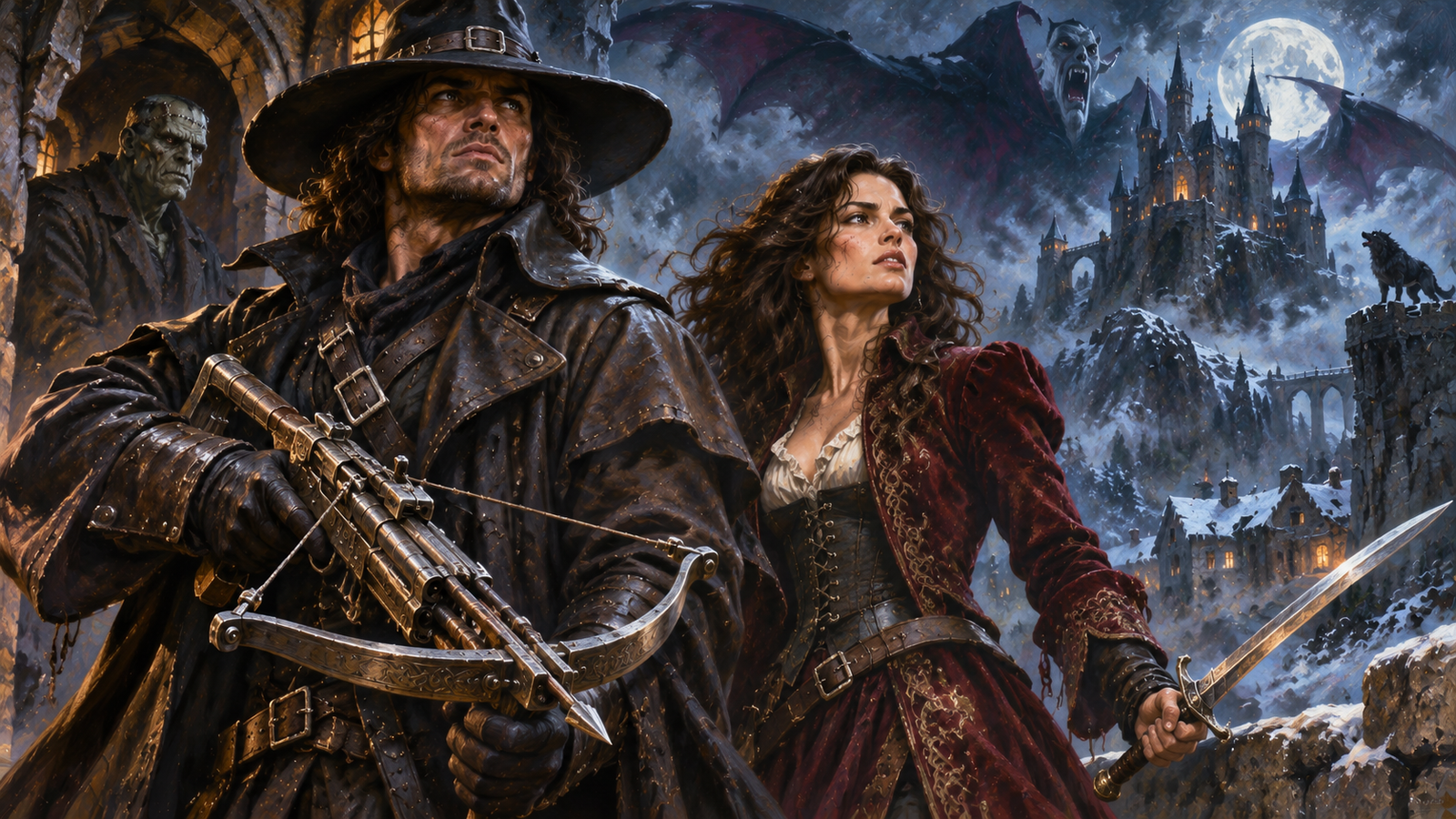
One monster hunter enters Transylvania and finds that Dracula’s fate is bound to a werewolf, an artificial man and the last of an ancient family.
Stephen Sommers’s Van Helsing (2004) is a lavish Gothic adventure that unites familiar screen monsters in a fast-moving action fantasy. Hugh Jackman’s Gabriel Van Helsing and Kate Beckinsale’s Anna Valerious confront Dracula, werewolves, Frankenstein’s Creature and a sprawling castle full of dangerous inventions. The film draws from earlier horror characters but invents its own relationships; its Gabriel is not automatically the same person as the literary physician Abraham Van Helsing.
At a Glance
| Film | Van Helsing (2004) |
|---|---|
| Director and writer | Stephen Sommers |
| Principal cast | Hugh Jackman (Gabriel Van Helsing), Kate Beckinsale (Anna Valerious), Richard Roxburgh (Count Dracula), David Wenham (Carl), Shuler Hensley (Frankenstein’s Monster) |
| Supporting characters | Will Kemp (Velkan), Kevin J. O’Connor (Igor) and Robbie Coltrane (Mr Hyde) |
| Genre | Gothic action horror and monster fantasy |
| Film setting | Transylvania and a stylised nineteenth-century Europe |
| Monster themes | Vampires, werewolves, constructed life, curses and conflicting loyalties |

Why This Film Matters
The film is an energetic celebration of Universal’s classic screen-monster heritage. It reshapes Dracula, the Wolf Man and Frankenstein’s Creature into a shared adventure filled with enormous sets, rapid transformations and elaborate weapons. Sommers gives the monsters different personalities and needs instead of making them identical enemies. The result is less subtle than the original horror stories, but its network of allies, victims and rivals can be valuable to a game master.
The Story — Without Major Spoilers
Gabriel Van Helsing works as a monster hunter with powerful backers. After an encounter with Mr Hyde, he is sent to Transylvania, accompanied by the resourceful friar Carl. There he meets Anna Valerious, the last of a family bound by an ancient promise to defeat Dracula. Her brother Velkan has already become entangled with the curse of the werewolf.
Dracula’s plans involve his brides, strange experiments and Frankenstein’s surviving Creature. As the hunters learn what the vampire intends, they must distinguish people who can be rescued from creatures who actively serve him. Their route moves between villages, dangerous forests, abandoned laboratories and a castle whose secrets cannot simply be solved with a silver bolt.
Characters and Performances
Hugh Jackman’s Gabriel Van Helsing is a skilled, mysterious hunter with unusual weapons and a concealed past. He is not a straightforward portrayal of Bram Stoker’s older scholarly physician. Kate Beckinsale’s Anna Valerious is an active ally whose knowledge of her family and country is essential; she is not merely a prize to be rescued.
Richard Roxburgh’s Count Vladislaus Dracula is a flamboyant supernatural villain working toward a personal scheme. David Wenham’s Carl brings practical invention and humour. Shuler Hensley’s Frankenstein’s Monster is an articulate, sympathetic creation whose interests do not align neatly with those of his creator or the vampire.
Will Kemp’s Velkan illustrates the danger of lycanthropy to someone who is both family and potential enemy. Kevin J. O’Connor’s Igor is an assistant in this film; he is not automatically the setting’s Igor Voss. Robbie Coltrane’s Mr Hyde appears in the opening adventure, a different telling from the site’s literary Jekyll and Hyde.
The World on Screen
The film’s Transylvania is a dramatic region of Gothic towers, mountain villages, storm-filled skies and elaborate mechanical laboratories. Van Helsing’s wide-brimmed hat, dark leather greatcoat, reinforced gear and ingenious weapons make him visually distinct from a conventional priest or courtly adventurer. Anna’s burgundy clothing, shaped leatherwork and swords equally mark her as a hunter.
These fashions and machines belong to the 2004 film’s imagined nineteenth century. In SpiralWorlds, Wallachia and its neighbours have their own campaign-present history. The site need not inherit this film’s technology, chronology, families or vampire origin.
Behind the Camera
Writer-director Stephen Sommers used spectacular sets, detailed physical make-up and extensive digital effects to bring multiple horror creatures into one adventure. The film’s werewolf transformations and flying vampire forms were a major part of its visual identity; the living figure of Frankenstein’s Monster also benefited from physical performance and elaborate practical make-up. The result is a deliberate monster mash rather than an adaptation of a single novel.
Adaptation, Themes and Assessment
The screenplay draws on Bram Stoker, Mary Shelley and Robert Louis Stevenson, as well as decades of Hollywood horror cinema, while creating a new central hunter and vampire mythology. Its Gabriel is not the same as the campaign’s Abraham Van Helsing, and Roxburgh’s Dracula is not simply a film portrait of the site’s Vlad III. The laboratory and the Creature are also different from Shelley’s novel.
Strengths: visual variety, Gothic architecture, a resourceful heroine, sympathetic treatment of the Creature and fast-paced monster encounters. Limitations: the incessant action can flatten suspense, exposition sometimes overwhelms character choices, and digital spectacles may look less persuasive than the physical sets and actors. Its strongest gameable idea is an interconnected set of monsters with conflicting goals.
Legacy and Related Viewing
Compare Frankenstein (1931), Bride of Frankenstein (1935), Dracula (1931) and Bram Stoker’s Dracula (1992). These films use related archetypes but do not share a single authorised chronology.
Explore in SpiralWorlds
Monster hunters and rivals: Meet Abraham Van Helsing, physician and vampire hunter, the setting’s independent character rather than Hugh Jackman’s Gabriel. Confront Vlad III Dracula, vampire prince of Wallachia, whose motives and place in the campaign are not the film Count’s invented lineage.
Creatures: Use the Vampire and Vampire Spawn for undead adversaries; the Flesh Golem is a mechanical parallel to the Creature, not a substitute for his individuality. Look to the Bestiary for other lycanthropic creatures, and the Jekyll and Hyde NPC for an independent transformation story.
Places and companions: Visit Wallachia and Târgoviște for the vampire prince’s real political landscape. The film’s Anna Valerious and Carl should not be assumed to have standalone NPC pages where none is published.
Ideas for the Table
The hunter’s bargain. A vampire offers a cure for a spreading curse if the party delivers a harmless-looking captive. The captive can speak and insists the vampire will misuse it; the characters can test both claims before deciding whom to trust.
Three enemies, one castle. A vampire commands servants, a werewolf seeks revenge on its creator and a constructed guardian wants only to escape. These motives allow several routes to the fortress and more than one ending.
The village’s last defender. A monster hunter has failed and locals blame the person who sheltered him. The party can investigate what went wrong, help the village prepare, and recruit those it would otherwise shun.
Sources and Credits
- Apple TV — Van Helsing (2004), synopsis and cast.
- Animation World Network — Van Helsing creature VFX, production effects.
- Makeup Effects Archive — Van Helsing, practical effects and creature design.
The historical film poster remains for identification. Film-specific monster designs and names are distinguished from the site’s original tabletop interpretations.
Keep this reference growing
If this page helped with your reading or game, you can support its upkeep or explore the curated books.
Explore the Bookshop — epics, classics and stories behind imagined worlds.