
Flesh Golem (Frankenstein’s Monster)
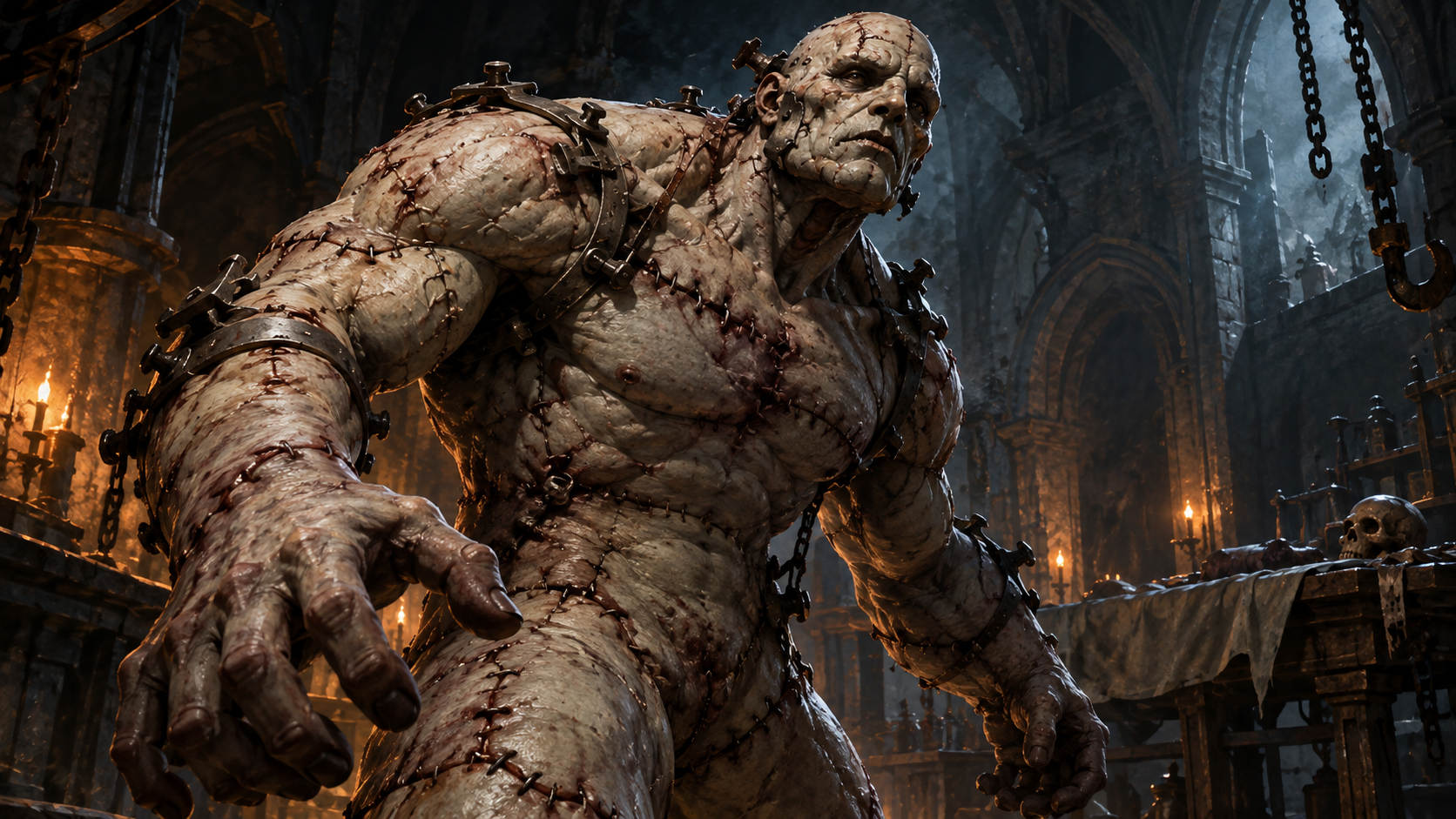
A flesh golem waits for its creator’s next command.
A flesh golem is a hulking construct assembled from the remains of several humanoids and driven by a bound elemental spirit. It obeys the words of its maker with an awful persistence, yet beneath the stitches and metal fastenings there may remain a trace of a life that should have ended.
Its limbs are uneven, its gait stiff, and its skin bears the marks of crude stitching and binding. Most wear little more than battered work clothes. The creature cannot converse, but it can answer injury with a ragged roar. Left alone, it continues the last task it was given: guarding a door, carrying a burden or crushing anyone who trespasses.
Despite the bodies used in its making, a flesh golem is a construct, not an undead creature. It is normally neutral and without a will of its own. A rare specimen may retain confused memories or develop an independent identity; such an occurrence is a story exception, not a change to the standard statistics below.
Flesh Golem — Edition Statistics
Choose the edition used at your table. These are four distinct rules versions, not statistics to combine. In particular, the fifth-edition flesh golem is Medium, while the Pathfinder and 3.5e versions are Large.
Flesh Golem — D&D 5.5e (2024)
Medium Construct, Neutral
Armour Class 9 Initiative −1 (9) Hit Points 127 (15d8 + 60) Speed 30 ft.
| STR | DEX | CON | INT | WIS | CHA |
|---|---|---|---|---|---|
| 19 (+4) | 9 (−1) | 18 (+4) | 6 (−2) | 10 (+0) | 5 (−3) |
Saving Throws Str +4, Dex −1, Con +4, Int −2, Wis +0, Cha −3.
Damage Immunities Lightning, Poison.
Condition Immunities Charmed, Exhaustion, Frightened, Paralyzed, Petrified, Poisoned.
Senses Darkvision 60 ft.; Passive Perception 10.
Languages Understands Common and one additional language but cannot speak.
Challenge 5 (1,800 XP; PB +3).
Traits
Aversion to Fire. Taking Fire damage gives the golem Disadvantage on attack rolls and ability checks through the end of its next turn.
Berserk. At the start of each of its turns while Bloodied (63 HP or fewer), roll 1d6. On a 6, it becomes berserk and attacks the nearest creature it can see, or an object if no creature is in reach. It remains berserk until destroyed or no longer Bloodied. Within 60 ft., its creator can use an action and succeed on a DC 15 Charisma (Persuasion) check to calm it until the start of its following turn. If it is still Bloodied then, resume the 1d6 check.
Immutable Form. The golem cannot shape-shift.
Lightning Absorption. Lightning damage does not harm it; instead it heals HP equal to the Lightning damage it would have taken.
Magic Resistance. The golem has Advantage on saving throws against spells and other magical effects.
Actions
Multiattack. The golem makes two Slam attacks.
Slam. Melee attack +7 to hit, reach 5 ft., one target. Hit: 13 (2d8 + 4) Bludgeoning plus 4 (1d8) Lightning damage.
Rules basis: SRD 5.2.1.
Flesh Golem — D&D 5e (2014)
Medium Construct, Neutral
Armour Class 9 Hit Points 93 (11d8 + 44) Speed 30 ft.
| STR | DEX | CON | INT | WIS | CHA |
|---|---|---|---|---|---|
| 19 (+4) | 9 (−1) | 18 (+4) | 6 (−2) | 10 (+0) | 5 (−3) |
Damage Immunities Lightning, Poison; Bludgeoning, Piercing and Slashing from nonmagical attacks unless made with adamantine weapons.
Condition Immunities Charmed, Exhaustion, Frightened, Paralyzed, Petrified, Poisoned.
Senses Darkvision 60 ft.; passive Perception 10.
Languages Understands its creator’s languages but cannot speak.
Challenge 5 (1,800 XP).
Traits
Berserk. When the golem starts a turn at 40 HP or fewer, roll 1d6. On a 6 it attacks the closest visible creature or an object if none can be reached, and continues until destroyed or restored to full HP. Its creator, within 60 ft., may spend an action on a DC 15 Charisma (Persuasion) check to end the frenzy. Further damage while at or below 40 HP may restart it.
Aversion of Fire. After taking Fire damage, the golem has Disadvantage on attacks and ability checks until the end of its next turn.
Immutable Form. Magic cannot change its form.
Lightning Absorption. Damage that would be dealt by Lightning instead restores that number of HP.
Magic Resistance. Advantage on saving throws against spells and magical effects.
Magic Weapons. Its weapon attacks count as magical.
Actions
Multiattack. Two Slam attacks.
Slam. Melee weapon attack +7 to hit, reach 5 ft., one target. Hit: 13 (2d8 + 4) Bludgeoning damage.
Rules basis: SRD 5.1 Flesh Golem.
Flesh Golem — Pathfinder 1e
CR 7 • XP 3,200 • N Large Construct
Initiative −1 Senses Darkvision 60 ft., low-light vision; Perception +0.
Defence
AC 20, touch 8, flat-footed 20 (−1 Dex, +12 natural, −1 size).
HP 79 (9d10 + 30).
Saves Fort +3, Ref +2, Will +3.
Damage Reduction 5/adamantine.
Immunities Construct traits and magic as described below.
Offence
Speed 30 ft.
Melee 2 slams +13 (2d8 + 5 each).
Space/Reach 10 ft./10 ft.
Special Attack Berserk.
Statistics
STR 20, DEX 9, CON —, INT —, WIS 11, CHA 1.
BAB +9; CMB +15; CMD 24.
Languages None. Environment Any. Organisation Solitary or gang (2–4). Treasure None.
Special Abilities
Berserk (Ex). In combat, the chance of a violent loss of control accumulates by 1 percentage point each round. A berserk golem attacks the nearest living target, or destroys smaller objects when no such target is available. Its creator can attempt to recover control from within 60 ft. with a DC 19 Charisma check. One minute without activity resets the accumulated chance.
Immunity to Magic (Ex). Spells and spell-like effects subject to spell resistance normally fail against it. Magical Fire or Cold slows it for 2d6 rounds without a save. Magical electricity dispels that slowing and restores 1 HP per 3 damage it would have caused; excess restoration becomes temporary HP.
Construction
Caster Level 8th; Price 20,500 gp; Cost 10,500 gp. At least six sets of bodily components and special bindings and unguents worth 500 gp are required. Requirements Craft Construct, animate dead, bull’s strength, geas/quest, limited wish; creator caster level 8th. Assemble with a DC 13 Craft (leather) or Heal check. The ritual includes a spell with the evil descriptor under this edition’s rules.
Rules basis: Pathfinder 1e SRD.
Flesh Golem — D&D 3.5e
Large Construct • CR 7 • Always Neutral
Hit Dice 9d10 + 30 (79 HP) Initiative −1 Speed 30 ft. (6 squares).
Defence
AC 18 (−1 size, −1 Dex, +10 natural), touch 8, flat-footed 18.
Saves Fort +3, Ref +2, Will +3.
Damage Reduction 5/adamantine.
Special Qualities Construct traits, darkvision 60 ft., low-light vision, immunity to magic.
Offence
Base Attack/Grapple +6/+15.
Attack Slam +10 melee (2d8 + 5).
Full Attack 2 slams +10 melee (2d8 + 5 each).
Space/Reach 10 ft./10 ft.
Special Attack Berserk.
Statistics
STR 21, DEX 9, CON —, INT —, WIS 11, CHA 1.
Skills/Feats —. Environment Any. Organisation Solitary or gang (2–4). Treasure None. Advancement 10–18 HD (Large), 19–27 HD (Huge). Level Adjustment —.
Special Abilities
Berserk (Ex). Each round after combat begins, add 1 percentage point to the cumulative chance that the bound spirit breaks control. The golem then assaults the nearest living creature or, failing that, wrecks nearby objects. A creator within 60 ft. can attempt to end this state with a DC 19 Charisma check. One minute of inactivity resets the chance.
Immunity to Magic (Ex). Spells and spell-like abilities permitting spell resistance do not affect it. Magical Cold or Fire slows it for 2d6 rounds; magical electricity removes this effect and instead restores 1 HP for each 3 damage it would inflict. Excess healing grants temporary HP.
Construction
Caster Level 8th; Price 20,000 gp; Cost 10,500 gp + 780 XP. It is built from at least six appropriately preserved human corpses, with bindings and unguents worth 500 gp. Assembly requires DC 13 Craft (leatherworking) or Heal. Requirements Craft Construct, animate dead, bull’s strength, geas/quest, limited wish, and a creator at least 8th level. The construction process requires an evil-descriptor spell.
Rules basis: D&D 3.5e SRD.
Habitat and Behaviour
Flesh golems are built where their makers can work without witnesses: locked alchemical rooms, sealed cells beneath noble towers, abandoned fortresses and underground chambers. A finished golem needs no food or comfort. If instructed to remain in a hall for fifty years, it remains there until the order is revoked or its body is destroyed.
It understands simple commands and recognises its assigned charge. It does not stalk prey for pleasure or devise plots of its own. Instead, it acts with a terrifying literalness. When the spirit bound inside it breaks free of its master’s control, this obedient silence becomes a rampage against whatever living thing stands nearest.
Signs of a Flesh Golem
Visible clue. Oversized muddy footprints lead from a workshop to a door whose iron hinges have been bent outward.
Sound. A slow, heavy footfall; leather restraints creaking; an occasional breathless roar behind stone walls.
Discovery. A careful search finds stout thread, metal staples, embalming compounds and fragments of a maker’s instructions.
Counterplay. Fire hinders the creature in both fifth-edition versions; electrical or lightning magic instead strengthens it. In Pathfinder 1e and D&D 3.5e, magical fire and cold slow it, while electrical magic heals it. Discovering these reactions before a confrontation can matter more than bringing a stronger sword.
Combat and Tactics
A flesh golem is a straightforward, heavy-handed opponent. If guarding a threshold, it stands between intruders and the thing it protects. If told to seize a thief, it keeps coming even after losing sight of an easier victim. Its great weakness is the rigidity of its orders: clever adventurers can lure it away, barricade it or turn its commands against its maker.
Opening. It blocks a doorway or closes into striking distance before making its two slams.
Under pressure. It continues fighting without fear; the party may discover that an electrical attack repairs it rather than damages it.
Loss of control. Once berserk, its priorities change. It may attack another enemy, its master or an unlucky bystander. Use the correct edition’s trigger and calming rules.
GM note. Do not silently apply the older editions’ Large size, reach or damage reduction to the Medium fifth-edition creature.
Encounters and Adventure Hooks
The Door That Cannot Be Opened
A locksmith is hired to open a noble family’s walled-off cellar. Behind it waits a flesh golem ordered to guard a chest; the heirs need what is inside but refuse to reveal what their ancestor concealed.
The Missing Anatomist
A physician vanishes while investigating grave thefts. The trail leads to an alchemical chamber where the physician’s assistant is struggling to control an unfinished guardian.
The Familiar Voice
A golem ignores most petitioners but stops when a visitor speaks an old family name. The creature might be remembering something, or someone may have hidden a command within that name.
The Master’s Last Order
For decades the creature has protected a bridge used by no one. Now a new road crosses the same ground, and a simple order has become a deadly obstacle for traders.
A Playable Encounter
Objective. Recover a locked notebook from a creator’s workshop without allowing the construct to enter the crowded street beyond.
Visible clue. The golem does not pursue anyone who leaves through the western storeroom door; an old instruction plaque directs it to guard the main staircase.
Complication. An apprentice tries to restrain it with a lightning spell, unknowingly restoring its strength.
Resolution. The characters can defeat it, contain it behind a reinforced door, or force its surviving creator to release it from service.
Construction, Magic and Rare Exceptions
The oldest recipes join several sets of mortal remains into a single body and bind an elemental power to its frame. Metal fastenings, carefully prepared tissues and elaborate spells hold the creation together. The exact rites, expenses and crafting checks depend on the game edition; consult the Pathfinder and 3.5e construction sections above for the published d20 procedures.
A golem born with scattered memories need not become a new monster species. Such an extraordinary creation can preserve the standard stat block while recognising a particular face, object or place. Whether it obeys its maker or chooses a path of its own is the central mystery of that encounter.
For related magical rules, see Lightning Bolt, Slow, Adamantine, and Craft Construct.
Mythical and Historical Context
Stories of artificial beings shaped by human hands long predate the modern Gothic novel. They often turn on the moment at which a creator’s command becomes inadequate: is the crafted body merely a tool, or has its maker brought a new person into the world?
Frankenstein; or, The Modern Prometheus, written by Mary Shelley and published in 1818, remains the best-known literary exploration of that question. Its creature is not identical to the fantasy flesh golem: Shelley’s novel gives the creation eloquence and conscious motives, whereas the standard game monster follows limited orders.
The 1910 film Frankenstein, directed by J. Searle Dawley, offered an early screen version; later film imagery, including Boris Karloff’s portrayal, strongly influenced popular conceptions of an artificial man. These are out-of-world historical references, not events imposed on the campaign’s own chronology.
See also Doctor Victor Frankenstein for a related character entry.
Selected Video References
- Flesh Golems and Helmed Horrors — The Dungeoncast: monster lore and practical tabletop context.
- Frankenstein Is More Horrific Than You Might Think — Monstrum: literary and cultural context, rather than rules advice.
- Frankenstein (1910 film): historical screen reference.
Related Creatures and Rules
Golems · Constructs · Bestiary · Doctor Victor Frankenstein · Spell Resistance
Rules Sources and Licensing
2024 rules. Contains rules material adapted from System Reference Document 5.2.1 by Wizards of the Coast LLC, licensed under Creative Commons Attribution 4.0 International. This entry’s editorial text and layout are modified and expanded.
2014 rules. Based on the 5.1 System Reference Document, © 2016 Wizards of the Coast LLC. The source originally credited Mike Mearls, Jeremy Crawford, Chris Perkins, Rodney Thompson, Peter Lee, James Wyatt, Robert J. Schwalb, Bruce R. Cordell, Chris Sims and Steve Townshend, based on original material by E. Gary Gygax and Dave Arneson. See SRD licensing and previous releases.
Pathfinder 1e and D&D 3.5e. Rules references: Pathfinder First Edition SRD and D&D 3.5e System Reference Document. Retain the site’s full Open Game License and applicable Section 15 notices wherever required by the original content’s licence.
Keep this reference growing
If this page helped with your reading or game, you can support its upkeep or explore the curated books.
Explore the Bookshop — epics, classics and stories behind imagined worlds.