
Swiss Confederacy — Eight Places of Armed Oaths and Alpine Passes
Swiss Confederacy at a Glance
What Is Happening Right Now?
The Swiss Confederacy is a web of armed cities and mountain communities, not a single state. Its people have sworn overlapping alliances, fought beside one another, fought against one another and learned that an oath between neighbours can matter more than the command of a distant prince.
A traveller can cross from a wealthy city republic into a rural assembly, enter jointly governed territory, pay several different tolls before noon and discover that a safe-conduct honoured in Lucerne means much less to an angry official in another valley.
This makes the Confederacy excellent adventuring country. The Alpine roads carry silver, salt, cloth, weapons, livestock, messages and secrets between northern Europe and Italy. Councils hire outsiders who are not trapped inside local feuds. Merchants need guards who can keep a caravan moving above the snow line. Delegates disappear. Bridges fail. Seals are forged. And beyond the maintained roads lie mountains where the old stories are very real.
Zürich Has Returned — but Nobody Has Forgotten
The Old Zürich War is over. Zürich has been forced away from its Habsburg alliance and back into the confederate system, but peace has not erased years of sieges, confiscations, executions, lost property and divided loyalties.
The Alliance System Is Expanding East
The Abbey of St Gallen is already tied to confederate places. The City of St Gallen is entering the confederate orbit in its own right, while Schaffhausen is also seeking security through alliance with the Confederacy.
Appenzell Is an Ally — Not an Equal
Appenzell has fought beside the confederates and renewed its alliance with seven places. Its people are called eternal confederates, but they still lack a permanent seat at the Tagsatzung and do not enjoy the rights of one of the Eight Places.
The Mountains Never Signed the Peace
Snow, rockfall, monsters, missing travellers and things descending from the high country are indifferent to treaties. Local authorities can raise men against raiders; they are less certain what to do when livestock starts disappearing upward.
“One oath gets you through the gate. Another decides whether you leave.”
Why Adventurers Come Here
- Escort a trans-Alpine caravan. A few miles of dangerous road can separate enormous profit from financial ruin.
- Carry messages between places. Neutral outsiders are useful when neighbouring councils do not fully trust one another.
- Investigate the aftermath of war. Missing soldiers, disputed estates, hidden weapons and wartime secrets remain behind the peace.
- Guard an alliance delegation. The eastern alliance network creates enemies as well as friends.
- Hunt something in the high country. A communal levy may be excellent at fighting men and completely unprepared for a tatzlwyrm.
- Recover cargo from a closed pass. A merchant may care more about one chest of correspondence than ten wagons of cloth.
- Work for one place without serving another. There is no central authority capable of making every local problem disappear.
- Find a legend. In SpiralWorlds, stories such as William Tell can have living people behind them.
Swiss Confederacy Game Statistics
| Edition | Regional Treatment | Primary Use |
|---|---|---|
| D&D 5.5e | Region of separate jurisdictions rather than one settlement or government | Travel, investigation, local Standing, negotiation and wilderness danger |
| Pathfinder 1e | Regional framework; use individual towns and cantons for settlement statistics | Survival, Knowledge, Diplomacy, Sense Motive and local authority |
| D&D 3.5e | Regional framework linking multiple communities and wilderness routes | Travel, Gather Information, local law, political access and mountain hazards |
Track Standing by Place, Not by “Switzerland”
- 0 — Stranger: judged from papers, appearance, companions and immediate behaviour.
- 1 — Known: local employers or officials recognise useful previous work.
- 2 — Trusted: the party receives introductions, better information and politically sensitive employment.
- 3 — Partisan: the place treats the party as reliable friends; rivals may regard them as agents.
A party can be Standing 3 in Uri, Standing 1 in Lucerne and actively distrusted in Zürich at the same time.
The Eight Places
The Confederacy is built around eight principal places. They are not provinces of a central government. Each has its own institutions, rights, interests and political culture.
Zürich
A rich imperial city controlling important routes between its lake, the Rhine approaches and eastern Switzerland.
Come here for: merchant contracts, confiscated property, espionage, council intrigue, divided families and wartime secrets.
Bern
A powerful western city-state with extensive territories, military weight and ambitions extending far beyond its own walls.
Come here for: high politics, well-funded expeditions, western diplomacy and powerful patrons.
Lucerne
Lake traffic, Alpine commerce and confederate politics meet here.
Come here for: lake journeys, guides, political meetings, southbound trade and rumours from the mountain valleys.
Uri
A mountain valley whose importance is far greater than its population because it controls the northern approach to the St Gotthard route.
Come here for: pack trains, damaged bridges, mountain guides, snowbound routes and monster hunts.
Schwyz
An assertive central Alpine place whose interpretation of confederate obligations has emerged strengthened from the conflict with Zürich.
Come here for: assemblies, arbitration, military contacts, disputed oaths and employers who value loyalty above elegance.
Unterwalden
Unterwalden is one of the Eight Places, formed from the neighbouring lands of Obwalden and Nidwalden.
Glarus
A narrow Alpine land shaped by steep mountains, communal politics, livestock and eastern routes.
Come here for: assemblies, grazing disputes, hidden valleys, escorts and winter creatures.
Zug
Smaller than the great city places but strategically positioned between major roads, lakes and political interests.
Come here for: couriers, discreet meetings, lake travel, arbitration and quiet missions.
Allied and Associated Lands
Appenzell
Appenzell has fought beside the confederates and renewed its alliance with seven places, but it is not yet one of the Eight.
Abbey of St Gallen
The territorial abbey has its own relationship with confederate places and must not be confused with the neighbouring city.
City of St Gallen
The imperial city is entering the confederate alliance network in its own right.
Schaffhausen
The Rhine city is also entering the confederate alliance network, widening the Confederacy’s northern connections.
Roads, Towns, Lakes and High Passes
The St Gotthard Route
The route through Uri is one of the chief reasons the central Alpine valleys matter to powers far beyond the mountains.
Adventure use: blocked passes, missing couriers, sabotaged bridges, competing escorts and mountain predators.
Lake Lucerne
The lake carries livestock, merchants, officials and travellers through the heart of the central Confederacy.
Zürich and the Aargau Roads
Commercially valuable and politically complicated roads run through lands where jurisdiction can be shared or disputed.
Bernese Territory
Bern commands a broad western sphere opening the campaign toward Savoy and the Burgundian world.
Basel
Basel is not one of the Eight Places, but its Rhine position makes it an important gateway for merchants, scholars, agents and travellers.
Lake Geneva
The western lake belongs to a different political sphere connected to Savoy, Geneva and long-distance trade rather than a single confederate jurisdiction.
For the wider mountain environment, see the Alps.
People You Can Meet
William Tell
The living marksman of Uri and Altdorf is already becoming larger in story than he is in life.
He is the obvious contact for adventures involving mountain resistance, Habsburg agents, hunters, isolated valleys and people who believe local liberty must be defended personally.
Paracelsus
Paracelsus is a Swiss physician, alchemist and natural philosopher associated with Einsiedeln in Schwyz. SpiralWorlds shifts his chronology forward so that he is already active in the campaign present.
He rejects stale authority, learns from miners, healers and practical experience, and treats the Alps as a living laboratory of medicine, minerals, poisons and magic.
Use him for: strange illnesses, alchemical commissions, mine expeditions, magical medicine, arguments with established scholars and identifying substances nobody else understands.
Elsbeth Rüegg — Courier of Three Councils
A multilingual mounted courier trusted in Lucerne, Zug and parts of Zürich precisely because everyone assumes somebody else employs her.
Konrad Imfeld — Master of the Southbound Mules
A Uri caravan master whose family knows the dangerous approaches of the St Gotthard road.
Agnes von Rüti — Zürich Ledger-Keeper
A civic clerk sorting property claims left unresolved by the recent war.
Ulrich Bodenmann — Appenzell Captain
A veteran increasingly tired of risking Appenzell lives for an alliance that does not grant Appenzell equal political standing.
Greta Silberhorn — Alpine Natural Philosopher
An investigator of weather, minerals, unusual creatures and magical phenomena.
Beyond the Confederacy: Geneva
Geneva is not one of the Eight Places in the campaign present. Do not treat every famous Swiss-associated character as a confederate citizen.
Victor Frankenstein and Ami Perrin belong primarily to the Geneva and Lake Geneva campaign sphere. They are excellent western contacts, rivals or patrons, but their presence should reinforce Geneva’s distinct political position rather than erase it.
Factions and Competing Interests
The City Councils
Want: urban privileges, revenues, territory and profitable trade.
The Rural Assemblies
Want: local rights preserved against territorial princes and ambitious cities alike.
The Tagsatzung Delegates
Want: a functioning alliance without creating a central government powerful enough to alarm its own members.
Merchant and Transport Networks
Want: roads, ferries and passes kept open.
Appenzell’s Equalists
Want: military friendship transformed into political equality.
Habsburg Interests
Want: recoverable rights, influence and strategic advantage where confederate expansion has weakened Austrian authority.
The Eastern Alliance Network
Want: security around Appenzell, St Gallen and Schaffhausen without allowing any one ally to dominate.
Pass Wardens and Local Guides
Want: roads kept usable and travellers prevented from getting themselves killed through arrogance.
Trade, Markets and Services
| Need | Where to Look | What Complicates It |
|---|---|---|
| Mules and pack animals | Uri, Lucerne and Alpine route towns | Winter demand and owners refusing unsafe passes |
| Armed escorts | Major towns and veteran communities | Good fighters may have strong political loyalties |
| Mountain guides | Uri, Glarus, Unterwalden and local valleys | The best guide may simply refuse a dangerous route |
| Boats and lake passage | Lucerne, Zürich and lakeside communities | Weather, cargo priority and jurisdiction |
| Weapons and armour repair | Zürich, Bern, Lucerne and major markets | Officials notice military-scale purchasing |
| Alchemy and unusual medicine | Einsiedeln, urban scholars and travelling specialists | Knowledge may be controversial, experimental or politically inconvenient |
For general campaign prices and employment, see Hirelings, Servants & Services.
Magic and Monsters of the Confederacy
Magic is known without being centrally regulated. A Zürich scholar may study enchantment as learned natural philosophy while a herder in Uri knows which spring should never be approached after the first hard frost.
The most effective Swiss bestiary is not a random collection of fantasy creatures. It grows out of the Alps themselves: mountain dragons, winter beings, nightmare spirits, fey hunts, mine-dwellers and ordinary animals that make the supernatural feel exceptional when it appears.
Signature Alpine Creatures
Tatzlwyrm
The signature monster of the Swiss Alps. The creature belongs directly to Swiss, Austrian and Bavarian Alpine tradition.
One tatzlwyrm near a pass can shut down commerce, kill livestock and force several communities to cooperate.
Barbegazi
Snow-dwellers of glaciers, deep drifts and high frozen valleys.
Their appearance near ordinary roads may signal unusual weather, displacement or something worse moving down from higher ground.
Alp
A nightmare-feeding spirit well suited to German-speaking Alpine settlements.
Alps work best inside inns, isolated farmsteads and winter houses where people begin waking exhausted, terrified and unable to explain what sat on their chests during the night.
Frost Drake
A lesser dragon ideally suited to frozen roads and Alpine passes.
It need not threaten a kingdom. Making one indispensable road unusable is enough to create a regional crisis.
Winter and Eastern Alpine Powers
Perchten
Horned and masked beings from Alpine tradition, especially useful around Appenzell, Glarus and the St Gallen approaches.
They should feel seasonal, ritual and unsettling rather than like ordinary wandering humanoids.
Frau Perchta
A powerful winter judge rather than a random encounter.
Use her when an entire valley has broken old seasonal obligations or when a winter custom suddenly proves to have supernatural enforcement behind it.
Rare Major Encounters
The Wild Hunt
The Hunt recognises no canton, toll or safe-conduct. Its appearance should be an event remembered for years.
Linnorm / Lindworm
A deeper and rarer mountain dragon than the tatzlwyrm.
Use one for ancient caves, forgotten hoards, old mountain boundaries and regions where people have learned not to climb beyond a particular ridge.
Peoples Beneath the Mountains
Dwarves
Dwarves are part of the living population rather than wandering monsters. Swiss dwarves are found in mines, metalworking guilds, engineering networks, fortified enclaves, workshops and itinerant families.
Their knowledge of stone, ore, tunnels and mountain construction makes them particularly important around passes and mining districts.
Kobolds
Kobolds belong where the local story justifies them: abandoned mines, old galleries, deep workings and underground places humans have stopped maintaining.
Do not treat every Swiss mine as a kobold lair.
Basel’s Basilisk
The Basilisk is best connected specifically to Basel rather than scattered across the Confederacy as a generic monster. It gives the city its own supernatural identity and provides a natural deep-link between the settlement and the Bestiary.
Ordinary Alpine Wildlife
Wolves, brown bears, lynx, eagles, goats, deer and boar remain the normal wildlife of forest, mountain and pasture. Most tracks in snow should belong to animals. Most distant movement should have a mundane explanation.
Make the Strange Earn Its Place
The Alps become more frightening when not everything is supernatural. Let characters spend days dealing with cold, animals, weather and difficult roads before finding one footprint that no ordinary creature could have made.
Dangers on the Roads
| d8 | Encounter |
|---|---|
| 1 | Two armed groups block a bridge. Both claim legitimate authority and accuse the other of acting illegally. |
| 2 | A Zürich veteran recognises a traveller from Schwyz whom he blames for his brother’s death during the recent war. |
| 3 | A loaded mule train stands abandoned beneath a cliff. Every human footprint ends at the same patch of untouched snow. |
| 4 | An Appenzell delegation carries an alliance document east. Someone has paid thieves to steal it without killing the delegates. |
| 5 | A toll collector accepts the party’s receipt as genuine and calmly explains that the official who issued it had no right to do so. |
| 6 | A guide refuses to continue after finding a frozen goat standing upright against the wind. |
| 7 | Recruiters are hiring armed men for foreign service. One recruit claims he was tricked into signing. |
| 8 | A hunting horn sounds above the tree line after sunset. Every local immediately leaves the road. |
Rumours
- “Appenzell will be made the ninth place before winter.” Optimistic, but politically useful.
- “Zürich surrendered every secret agreement it ever made with Austria.” False. Enough records disappeared to keep investigators busy for years.
- “The Confederacy’s cross guarantees passage everywhere.” False. A military recognition mark is not a universal licence.
- “William Tell is hunting above Bürglen.” Entirely possible.
- “Paracelsus can cure any poison.” He would probably object both to the claim and to whoever is repeating it.
- “The Gotthard is closed because of snow.” The snow is real. It is not why experienced guides refuse the road.
- “Something horned is walking through the eastern villages at night.” The locals disagree about whether that is a warning or a punishment.
- “There is a ninth banner in an abandoned arsenal beneath the mountains.” No canton recognises it. Several factions still want it found.
Adventure Hooks
1. The Ninth Voice
An Appenzell envoy possesses a legal argument that may force the Eight Places to confront whether Appenzell deserves a permanent voice at the Tagsatzung. The manuscript disappears.
2. The Zürich Ledger
A wartime account book identifies citizens who secretly supplied both sides during the Old Zürich War.
3. White Crosses in the Snow
A merchant caravan has been massacred by men using confederate recognition marks. Every neighbouring place denies responsibility.
4. The Last Mule Over Gotthard
A sealed diplomatic chest must cross the mountains before a rival messenger, but a tatzlwyrm has begun hunting near the road.
5. The St Gallen Clause
A supplementary page belonging to the city’s new alliance has vanished.
6. Tell’s Second Bolt
A crossbow bolt attributed to William Tell appears for sale in Zürich. Three buyers believe it is a relic. A fourth knows it is a key.
7. The Physician’s Snow
Paracelsus needs samples from a high valley where miners have begun suffering identical waking nightmares. He suspects poisonous vapour. The villagers blame an Alp. Both explanations may be correct.
8. The Winter Masks
A procession of Perchten enters a village on a night when no procession was planned. By morning, one house has been marked for judgement.
Law, Tolls and Local Authority
The most important legal fact for adventurers is simple: there is no single Swiss law. Civic statutes, valley customs, territorial rights, alliance obligations and jointly governed lands overlap.
At Gates
Expect questions about origin, employer, destination, cargo and weapons.
Weapons
Weapons are common where communal defence matters. That does not give armed travellers permission to ignore town peace or civic ordinances.
Tolls
Bridges, markets, roads, ferries and territorial boundaries may all create charges.
Safe-Conducts
A safe-conduct is only as useful as the authority recognised by the person reading it.
Magic
There is no confederate magical code. Harm, fraud, coercion, theft and sabotage remain offences regardless of whether the means are mundane or magical.
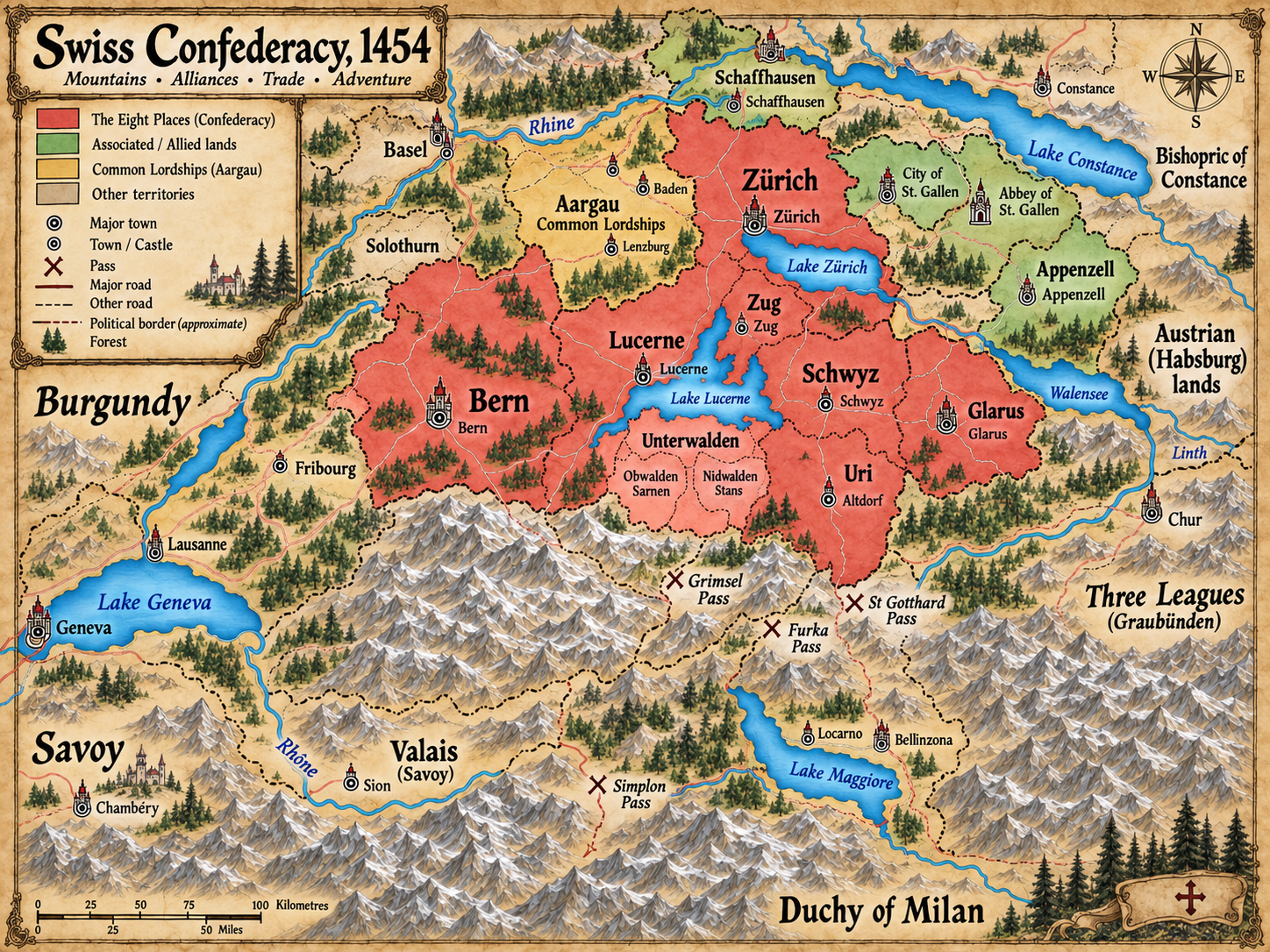
Map of the Swiss Confederacy
From Zürich to Lucerne
The route crosses politically sensitive country where the memory of Zürich’s recent war remains fresh.
From Lucerne into Uri
Lake travel carries merchants and travellers toward the St Gotthard approach.
East Toward Glarus and St Gallen
This is the politically active edge of the alliance system and the strongest zone for Perchten, Frau Perchta and other eastern Alpine supernatural traditions.
West Through Bern
Bern opens the campaign toward Savoy, Burgundian politics and the western plateau.
North Toward Basel and Schaffhausen
The Rhine connects the Confederacy to the wider Empire.
How the Confederacy Works
The Confederacy has grown through a network of individual alliances rather than through one founding constitution. Uri, Schwyz and Unterwalden form part of the central Alpine core. Lucerne, Zürich, Glarus, Zug and Bern complete the traditional Eight Places.
The Tagsatzung
Delegates meet to discuss disputes, war, diplomacy and common territories, but they remain representatives of their own governments rather than ministers of a central state.
Unterwalden Is One Place
Obwalden and Nidwalden have distinct local communities but together form the confederate place of Unterwalden.
The Old Zürich War Changes the Confederacy
Zürich’s separate alliance with Habsburg Austria turns disagreement over confederate obligations into war. Zürich loses the political contest, and the settlement of 1450 returns it firmly to the confederate system.
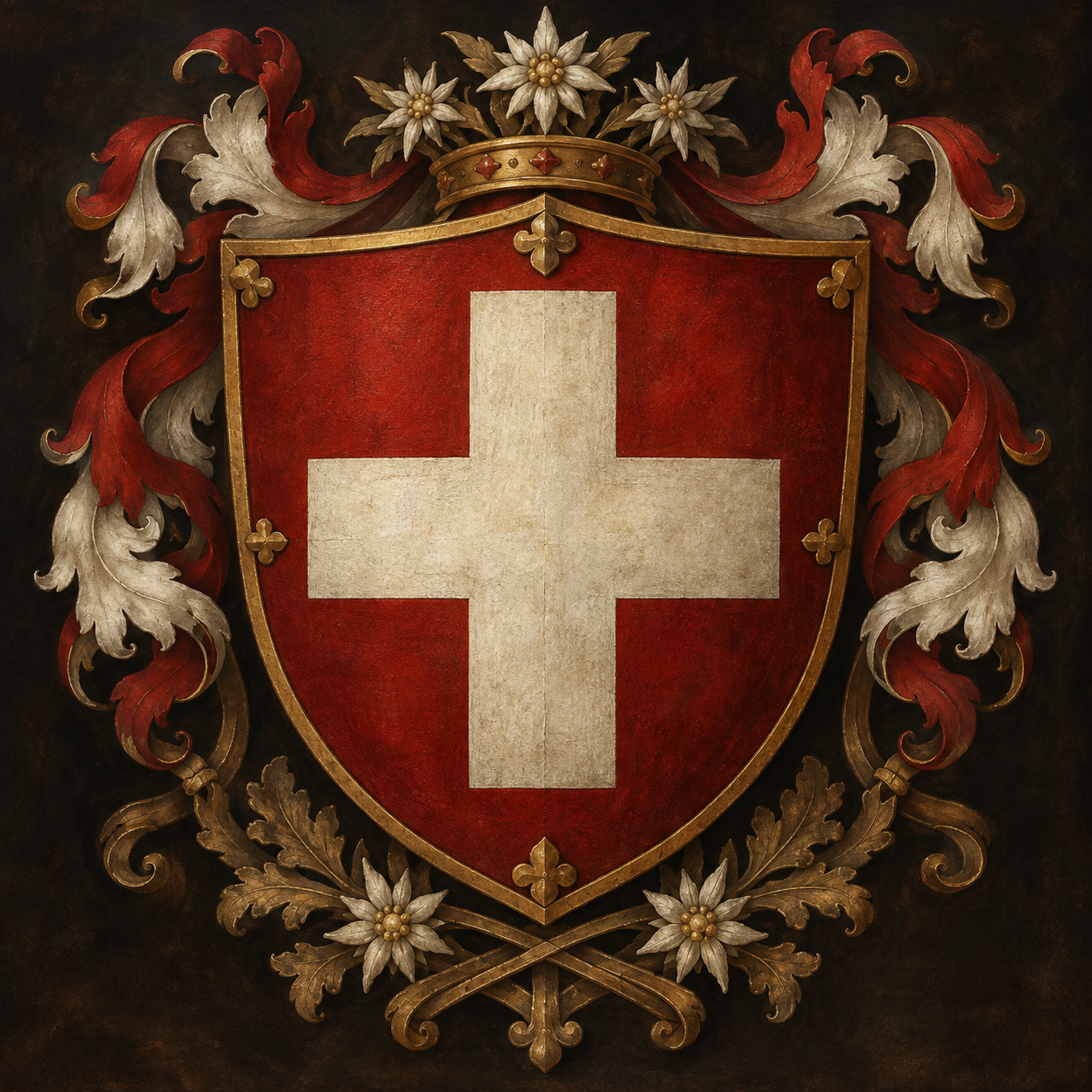
No Common Medieval National Arms
The places march principally under their individual banners. White crosses worn or displayed by confederate forces act as recognition marks.
The large shield near the top of this SpiralWorlds page is therefore a campaign emblem created for the website, not a claim that a single historical Swiss national coat of arms existed at this date.
Historical & Mythic Context
| Historical Foundation | SpiralWorlds Treatment |
|---|---|
| The Confederacy consists of eight principal places linked through overlapping alliances. | The political structure remains intact and provides the basis for local reputation, conflicting law and factional adventures. |
| The Old Zürich War ends in 1450. | Its political settlement remains historical while personal and supernatural consequences continue to affect play. |
| Appenzell is closely allied but lacks equal membership. | The unequal alliance remains an active political pressure. |
| The Abbey and City of St Gallen possess separate political relationships. | The distinction is preserved. |
| There is no single common confederate national coat of arms. | Individual places retain their heraldry. The page shield is a SpiralWorlds identity device. |
| Alpine folklore contains dragons, nightmare beings, winter figures, spirits and hunts. | Tatzlwyrms, Alps, Perchten, Frau Perchta and other beings are physically real. |
| Historical figures such as Paracelsus belong to later chronology. | Selected public-domain and historical NPC chronology is shifted where useful so key figures can be active in the campaign present. |
| Late-medieval learning circulates through urban and private networks. | Magic is studied as learned natural philosophy through schools, civic scholars, masters and private circles. |
Related SpiralWorlds Entries
The Eight Places
- Zürich — Powerful city place still living with the consequences of war.
- Bern — Major western confederate city-state and territorial power.
- Lucerne — Lake city and Alpine gateway.
- Uri — Mountain place controlling the northern Gotthard approach.
- Schwyz — Central Alpine political power.
- Unterwalden — One of the Eight Places, comprising Obwalden and Nidwalden.
- Glarus — Steep Alpine canton and eastern gateway.
- Zug — Small but strategically important confederate place.
Associated Lands & Nearby Regions
- Appenzell — Associated ally seeking greater equality.
- Basel — Rhine gateway and home of its own basilisk tradition.
- Lake Geneva — Western lake of trade, Geneva and Savoyard politics.
- The Alps — Greater mountain wilderness surrounding the Confederacy.
- The Empire — Wider Imperial political framework.
- Europe — Continue into the wider continent.
People
- William Tell — Marksman and living legend of Uri.
- Paracelsus — Swiss alchemist, physician and natural philosopher.
- Victor Frankenstein — Genevan natural philosopher from the western campaign sphere.
- Ami Perrin — Genevan political figure tied to the struggle against Savoyard influence.
Alpine Bestiary
- Tatzlwyrm — Signature Swiss Alpine monster.
- Barbegazi — Snow-dwellers of glaciers and frozen valleys.
- Alp — Nightmare predator of German-speaking Alpine settlements.
- Frost Drake — Ice-breathing threat to mountain roads.
- Perchten — Horned Alpine winter beings.
- Frau Perchta — Powerful judge of winter custom.
- Wild Hunt — Supernatural force that recognises no human frontier.
- Linnorm — Rare ancient dragon of the deep mountains.
- Dwarf — Living people of mines, guilds and mountain engineering networks.
- Basilisk — Best used as a Basel-specific supernatural threat.
- World Bestiary — Continue through the wider creature library.
Sources, Attribution and Licensing
Historical References
- Historical Dictionary of Switzerland — Eidgenossenschaft
- Historical Dictionary of Switzerland — Bundesbriefe
- Historical Dictionary of Switzerland — Zürich
- Historical Dictionary of Switzerland — Appenzell
- Historical Dictionary of Switzerland — St Gallen
- Historical Dictionary of Switzerland — Schaffhausen
- Historical Dictionary of Switzerland — Flags
- Historical Dictionary of Switzerland — Swiss Cross
Artwork
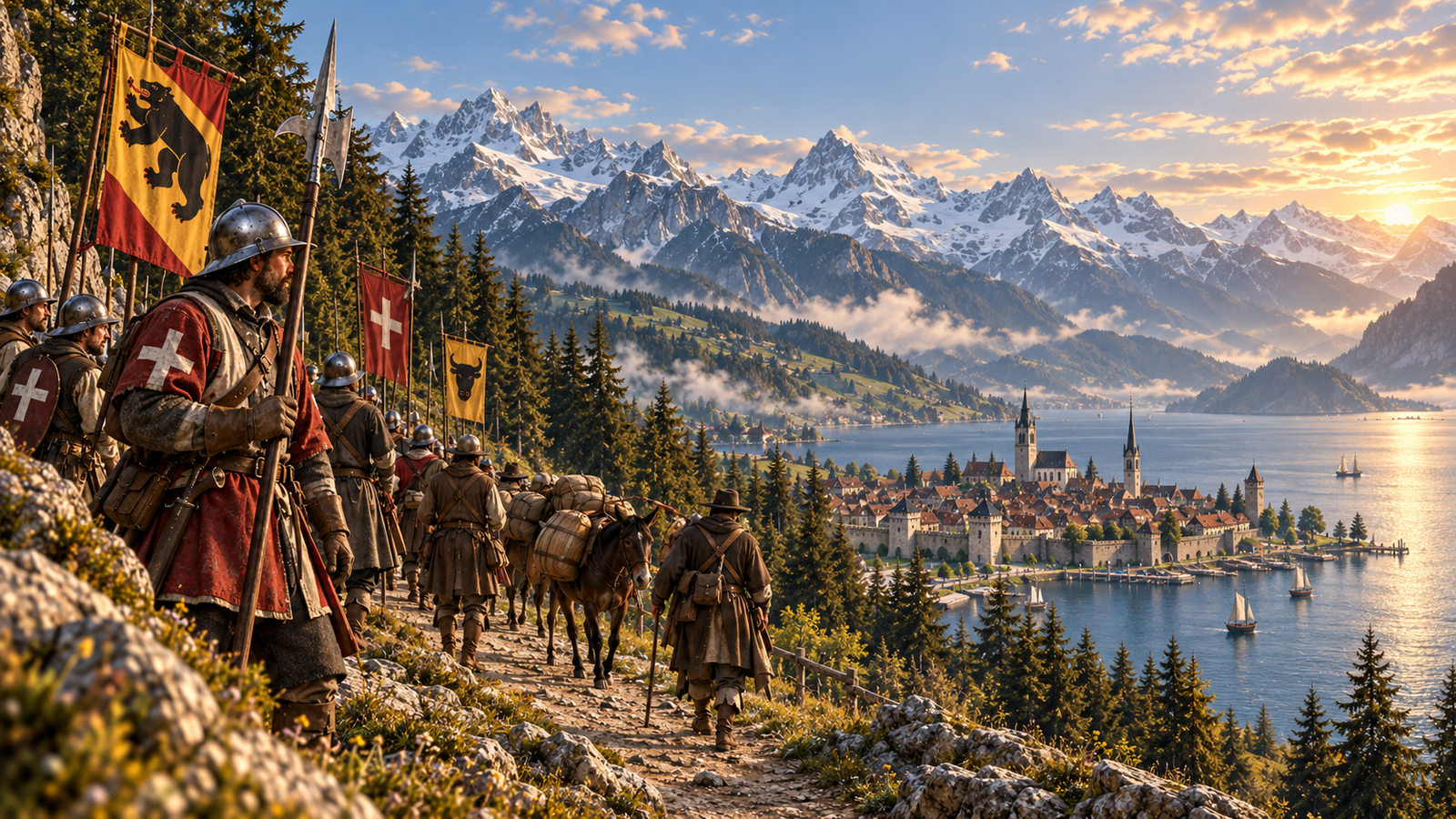
Swiss Confederacy Alpine hero illustration, heraldic campaign emblem and 1454 campaign map: SpiralWorlds, 2026.
SRD 5.2.1 Attribution
This work includes material from the System Reference Document 5.2.1 (“SRD 5.2.1”) by Wizards of the Coast LLC, available at D&D Beyond. The SRD 5.2.1 is licensed under the Creative Commons Attribution 4.0 International License.
Legacy Open Game Content
Mechanical rules material inside the Pathfinder 1e and D&D 3.5e mechanics panels is designated as Open Game Content and may be Used only under and in terms of the Open Game License version 1.0a reproduced below.
No other portion of this page is designated as Open Game Content. Artwork, presentation, historical discussion, adventure material, setting material, NPCs and SpiralWorlds editorial prose are excluded from that designation.
Open Game License v1.0a + applicable Section 15 notices
OPEN GAME LICENSE Version 1.0a
The following text is the property of Wizards of the Coast, Inc. and is Copyright 2000 Wizards of the Coast, Inc (“Wizards”). All Rights Reserved.
1. Definitions: (a) “Contributors” means the copyright and/or trademark owners who have contributed Open Game Content; (b) “Derivative Material” means copyrighted material including derivative works and translations (including into other computer languages), potation, modification, correction, addition, extension, upgrade, improvement, compilation, abridgment or other form in which an existing work may be recast, transformed or adapted; (c) “Distribute” means to reproduce, license, rent, lease, sell, broadcast, publicly display, transmit or otherwise distribute; (d) “Open Game Content” means the game mechanic and includes the methods, procedures, processes and routines to the extent such content does not embody the Product Identity and is an enhancement over the prior art and any additional content clearly identified as Open Game Content by the Contributor, and means any work covered by this License, including translations and derivative works under copyright law, but specifically excludes Product Identity; (e) “Product Identity” means product and product line names, logos and identifying marks including trade dress; artifacts; creatures characters; stories, storylines, plots, thematic elements, dialogue, incidents, language, artwork, symbols, designs, depictions, likenesses, formats, poses, concepts, themes and graphic, photographic and other visual or audio representations; names and descriptions of characters, spells, enchantments, personalities, teams, personas, likenesses and special abilities; places, locations, environments, creatures, equipment, magical or supernatural abilities or effects, logos, symbols, or graphic designs; and any other trademark or registered trademark clearly identified as Product identity by the owner of the Product Identity, and which specifically excludes the Open Game Content; (f) “Trademark” means the logos, names, mark, sign, motto, designs that are used by a Contributor to identify itself or its products or the associated products contributed to the Open Game License by the Contributor; (g) “Use”, “Used” or “Using” means to use, Distribute, copy, edit, format, modify, translate and otherwise create Derivative Material of Open Game Content; (h) “You” or “Your” means the licensee in terms of this agreement.
2. The License: This License applies to any Open Game Content that contains a notice indicating that the Open Game Content may only be Used under and in terms of this License. You must affix such a notice to any Open Game Content that you Use. No terms may be added to or subtracted from this License except as described by the License itself. No other terms or conditions may be applied to any Open Game Content distributed using this License.
3. Offer and Acceptance: By Using the Open Game Content You indicate Your acceptance of the terms of this License.
4. Grant and Consideration: In consideration for agreeing to use this License, the Contributors grant You a perpetual, worldwide, royalty-free, non-exclusive license with the exact terms of this License to Use, the Open Game Content.
5. Representation of Authority to Contribute: If You are contributing original material as Open Game Content, You represent that Your Contributions are Your original creation and/or You have sufficient rights to grant the rights conveyed by this License.
6. Notice of License Copyright: You must update the COPYRIGHT NOTICE portion of this License to include the exact text of the COPYRIGHT NOTICE of any Open Game Content You are copying, modifying or distributing, and You must add the title, the copyright date, and the copyright holder’s name to the COPYRIGHT NOTICE of any original Open Game Content you Distribute.
7. Use of Product Identity: You agree not to Use any Product Identity, including as an indication as to compatibility, except as expressly licensed in another, independent Agreement with the owner of each element of that Product Identity.
You agree not to indicate compatibility or co-adaptability with any Trademark or Registered Trademark in conjunction with a work containing Open Game Content except as expressly licensed in another, independent Agreement with the owner of such Trademark or Registered Trademark. The use of any Product Identity in Open Game Content does not constitute a challenge to the ownership of that Product Identity.
The owner of any Product Identity used in Open Game Content shall retain all rights, title and interest in and to that Product Identity.
8. Identification: If you distribute Open Game Content You must clearly indicate which portions of the work that you are distributing are Open Game Content.
9. Updating the License: Wizards or its designated Agents may publish updated versions of this License. You may use any authorized version of this License to copy, modify and distribute any Open Game Content originally distributed under any version of this License.
10. Copy of this License: You MUST include a copy of this License with every copy of the Open Game Content You Distribute.
11. Use of Contributor Credits: You may not market or advertise the Open Game Content using the name of any Contributor unless You have written permission from the Contributor to do so.
12. Inability to Comply: If it is impossible for You to comply with any of the terms of this License with respect to some or all of the Open Game Content due to statute, judicial order, or governmental regulation then You may not Use any Open Game Material so affected.
13. Termination: This License will terminate automatically if You fail to comply with all terms herein and fail to cure such breach within 30 days of becoming aware of the breach. All sublicenses shall survive the termination of this License.
14. Reformation: If any provision of this License is held to be unenforceable, such provision shall be reformed only to the extent necessary to make it enforceable.
15. COPYRIGHT NOTICE
Open Game License v 1.0a Copyright 2000, Wizards of the Coast, Inc.
System Reference Document. Copyright 2000, Wizards of the Coast, Inc.; Authors Jonathan Tweet, Monte Cook, Skip Williams, based on material by E. Gary Gygax and Dave Arneson.
Pathfinder Roleplaying Game Core Rulebook. © 2009, Paizo Publishing, LLC; Author: Jason Bulmahn, based on material by Jonathan Tweet, Monte Cook, and Skip Williams.
Pathfinder RPG GameMastery Guide. © 2010, Paizo Publishing, LLC; Authors: Cam Banks, Wolfgang Baur, Jason Bulmahn, Jim Butler, Eric Cagle, Graeme Davis, Adam Daigle, Joshua J. Frost, James Jacobs, Kenneth Hite, Steven Kenson, Robin Laws, Tito Leati, Rob McCreary, Hal Maclean, Colin McComb, Jason Nelson, David Noonan, Richard Pett, Rich Redman, Sean K Reynolds, F. Wesley Schneider, Amber Scott, Doug Seacat, Mike Selinker, Lisa Stevens, James L. Sutter, Russ Taylor, Penny Williams, Skip Williams, Teeuwynn Woodruff.
END OF LICENSE
Keep this reference growing
If this page helped with your reading or game, you can support its upkeep or explore the curated books.
Explore the Bookshop — epics, classics and stories behind imagined worlds.