
Canton of Glarus: Alpine Swiss Canton of Assembly, Valley Life, and Stone
Canton of Glarus: Alpine Swiss Canton of Assembly, Valley Life, and Stone
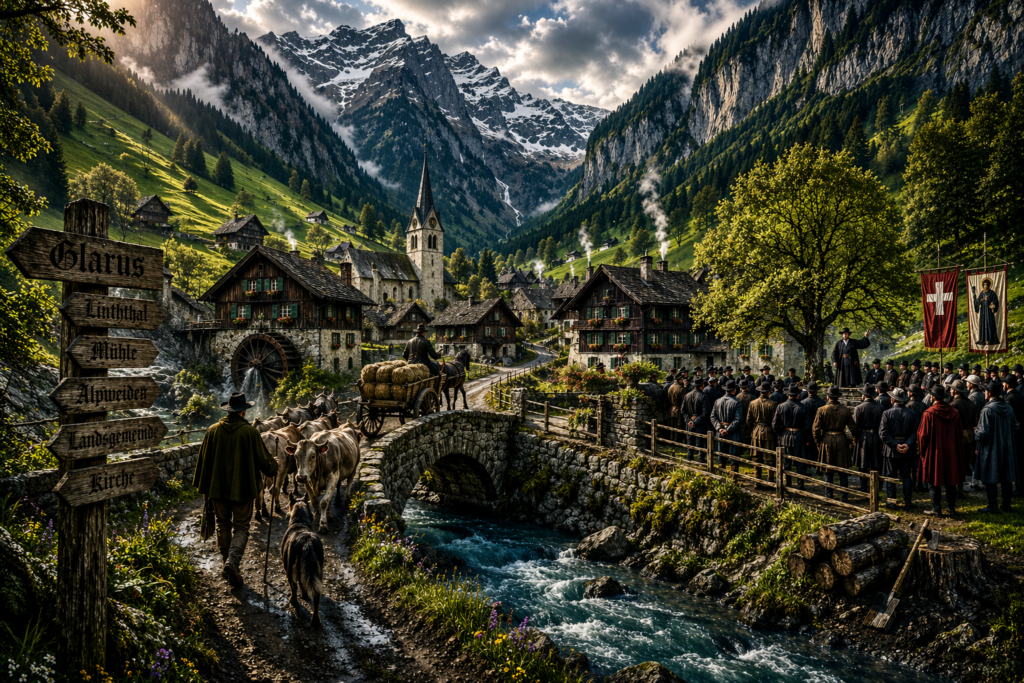
The Canton of Glarus is a narrow mountain country of steep pasture, dark pine, cold rivers, slate roofs, and villages pressed hard against the valley floor because the heights leave them little room to breathe. It lies in the upper Linth country among the confederate lands, where every road is constrained by slope and water, every settlement depends on discipline, and every season reminds the people that the mountains permit life here only on stern terms.
This is not a rich open land of broad fields and easy movement. Glarus is a country of enclosure. The valley narrows, the mountains crowd close, and the inhabited ground is always visibly limited. Meadows, orchards, grazing slopes, timber rights, mills, shrines, bridges, and clustered houses all compete for the same hard-won space. Beyond them rise the greater heights, which belong less to magistrates than to storms, herdsmen, quarrymen, hunters, and whatever older things the peaks and ravines still keep to themselves.
The town of Glarus stands as the gathering-place of the country rather than its master. That distinction matters. The canton does not feel like a realm ruled outward from one great city, but like a collection of valley communities forced by land, danger, and custom into common cause. Its true scale is measured not by urban grandeur but by assemblies, pasture rights, parish loyalties, bridge tolls, grazing disputes, and the shared burdens of surviving in a country where winter, flood, and rockfall are as politically real as any lord.
Layout, Roads, and Crossing the Canton
The Canton of Glarus is not a country that spreads. It narrows, climbs, divides, and constrains. Its shape is governed by the upper Linth valley and by the side-valleys, ravines, upland pastures, and mountain tracks that break away from it. To understand Glarus, one must understand that movement here is never casual. Roads do not go where men would most like them to go. They go where water, gradient, and stone reluctantly permit.
The main inhabited line of the canton runs along the valley floor and lower slopes, where settlement can gather near arable ground, mills, bridges, and the routes that bind one community to the next. Here lie the principal villages, market spaces, churches, and storehouses, all strung along the course of the river and the roads that follow it. The valley is the spine of the country, but not a broad one. Even its more settled stretches feel compressed. A village may stand only a little above the river, with pasture rising behind it and broken heights beyond. There is rarely much distance between cultivated ground and dangerous land.
The town of Glarus holds its place not because it dominates the land physically, but because it is where the country may still gather itself into civic shape. Other settlements matter for grazing, passage, local trade, and the control of approaches, but Glarus is where the canton most clearly becomes a public body rather than a mere chain of communities. Roads, disputes, obligations, and assemblies all tend toward it, even when the land itself resists easy centrality.
To cross the canton is to follow the valley unless one has strong reason, local guidance, and good weather to do otherwise. The principal routes are bound to river and slope. Bridges matter enormously. A damaged bridge can lengthen travel by hours, cut one side of a valley from the other, or force caravans and drovers onto worse ground. Fords exist, but they are seasonal and uncertain. In thaw, flood, or storm, water itself becomes one of the canton’s quietest but most dependable masters.
Side-roads and lesser tracks climb toward hamlets, pastures, chapels, timber works, charcoal clearings, and summer grazing grounds. These ways are narrower, rougher, and more local in character. A merchant may know the main road tolerably well and still find himself badly served once he leaves it. In Glarus, local knowledge is a form of power. The difference between a drover’s path, a herdsmen’s track, and a passable wagon road can decide whether a journey is merely slow or actively dangerous.
The upper country belongs to another rhythm. Above the more settled floor of the valley lie the seasonal lands: high pasture, alpine meadows, hunting ground, quarry faces, timber stands, and remote shelters used only part of the year. These places are economically necessary but never entirely domesticated. They sustain the canton with grazing, wood, stone, and mountain products, yet they also expose it. A path that is useful in summer may be treacherous in autumn and closed entirely in winter. A settlement that feels secure in clear weather may discover how exposed it truly is once snow, fog, or rockfall begin to govern movement.
Because of this, the canton is crossed not only by roads but by obligations. Herds must be driven. Timber must be brought down. Tolls must be collected. Bridges must be kept sound. Shrines and chapels must remain reachable enough to matter. Neighbours must know who clears a path, who mends a retaining wall, who holds the right to a pasture lane, and who answers when a route fails. In broad lowland realms these may seem local concerns. In Glarus they are part of the country’s structure.
Travel here has a visible hierarchy. The valley road belongs to carts, merchants, priests, magistrates, and anyone moving between the settled communities. The climbing tracks belong to shepherds, hunters, charcoal burners, messengers, and those with reason to go where ordinary travellers should not. The heights beyond belong, for part of the year, to no one securely at all. Men use them, mark them, and dispute them, but they are never wholly mastered.
Life, Custom, and Government in the Canton
Life in the Canton of Glarus is communal not from sentiment, but from necessity. The land allows little wasted independence. A household may keep its own roof, stores, beasts, and grudges, but no household survives long unless roads are kept open, bridges repaired, slopes watched, water managed, and pasture rights understood by neighbours who may be allies one season and adversaries the next. In easier lands such matters can remain local irritations. In Glarus they are part of daily survival.
The people of the canton live close to one another in clustered settlements because mountain country rewards concentration and punishes waste. Villages gather where the ground flattens enough to build, where water can be controlled, where fields can be enclosed, and where animals can be sheltered through the hard months. Houses are built for weather first and comfort second. Roofs matter. Stores matter. Timber rights matter. So do ovens, mills, shrines, and every agreement that allows a settlement to pass through winter without breaking under hunger, debt, or quarrel.
Common life is governed by labour that must be timely or becomes useless. Hay must be cut when weather permits, herds moved when the uplands open, timber brought down before the ways turn bad, and stores secured before snow or flood make delay costly. Such rhythms shape character as surely as law. Glarus breeds practicality, memory, and sharp attention to obligation. It has little patience for foolish display. A boastful man may be admired for courage, but not for long if he neglects a wall, misses a levy, lets a bridge rot, or disputes pasture rights without the strength to carry the matter through.
Its customs are therefore public in a hard rather than festive sense. Agreements are remembered. Boundaries are noticed. Usage matters. So do procession, oath, and witness. Men and women know who holds grazing rights, whose herd may pass first, which shrine must be kept, which household failed in its duty when the river rose, and which family still remembers an old insult from three winters ago. In a mountain country, memory is a practical faculty. To forget too much is to invite loss.
Government in Glarus feels close because it is close. Authority is not imagined as something wholly separate from the people who must live under it. The life of the canton is shaped by assembly, by neighbours meeting in public, by rights defended openly, and by the expectation that law should be heard among those who must bear its weight. This gives the country a severe political dignity. It does not feel courtly or remote. It feels exposed, answerable, and immediate. .
That closeness does not make Glarus gentle. It makes quarrels sharper. Disputes over passage, meadow, timber, dues, and common burden can harden quickly because no one is far away and no one can afford to pretend such things are trivial. A bad magistrate is not merely resented; he becomes dangerous. A selfish household is not merely disliked; it becomes a threat. Public life therefore has an edge to it. Men must speak plainly, remember accurately, and choose carefully when to yield and when to stand firm.
Religion is woven into the same fabric. Parish life matters because it orders time, obligation, burial, feast, tithe, and the visible structure of the community. Shrines, churches, chapels, and processions are not ornaments added to village life, but part of the frame that holds it together. They sanctify oaths, mark the turning of seasons, and give sacred shape to births, marriages, deaths, assemblies, and communal fears. In a land of storm, rockfall, flood, and narrow survival, piety easily takes on a practical tone. One prays not only from devotion, but because weather and mortality remain visibly near.
The notable people of Glarus are therefore not only magistrates and priests, but innkeepers on the main road, millers at contested streams, herdsmen trusted with common stock, headmen of respected households, ferrymen where bridges fail, shrine-keepers, and those old men and women whose memory of rights and boundaries is treated almost as an archive. In a great city such figures might disappear into the crowd. In Glarus they help hold the country together.
Dangers, Tensions, and What Goes Wrong
The Canton of Glarus does not need monsters to be dangerous, though it has room enough for them. The country is already full of pressures that can turn ordinary life into crisis with very little warning. A bridge goes down in thaw, and two communities are suddenly cut off from one another. A rockfall destroys a pasture lane, and old grazing rights become urgent quarrels. A winter store fails, and piety, charity, and resentment are tested at once. In a land this narrow, hardship does not spread gently. It tightens.
Weather is the first and most constant enemy. Flood, snow, fog, ice, and falling stone can close roads, isolate upland settlements, ruin hay stores, drown beasts, and leave whole communities one bad week away from hunger. The people of Glarus are used to such threats, but habit does not make them harmless. It only means the danger is expected. The land can still punish the prepared as easily as the careless.
Because movement is constrained, disruption becomes power. Anyone who controls a bridge, a chapel road, a ferry-point, a valley bottleneck, or a passable upland track controls more than access. He controls trade, news, tolls, herds, messengers, and the speed at which help may arrive. This makes small places important and small disputes dangerous. A blocked track can become a political act. A damaged bridge can become an accusation. A missing drover may matter more than a nobleman from elsewhere would ever guess.
The canton is also full of the ordinary tensions of communal life made harsher by proximity. Boundaries are remembered here. So are debts, insults, broken marriage bargains, disputed grazing claims, missed obligations, and every failure of shared burden. Men who might avoid one another in broader lands must still appear at assembly, cross the same bridge, trade at the same mill, and bring their dead to the same ground. That makes reconciliation valuable, but it also means that grudges can become structural. A quarrel in Glarus rarely remains private for long.
Custom itself can become a source of danger. Old rights are useful until times change. A track used for generations may no longer bear the traffic demanded of it. A parish boundary may divide a practical community in foolish ways. A shrine may stand where a road ought now to pass. A long-accepted privilege may seem intolerable when winter is hard and stores are low. Glarus is a place where people trust custom deeply, but that trust can turn brittle when need presses hard enough.
Authority is another fault line. Because public life is so close, bad rule is never abstract. A cowardly magistrate, a corrupt toll-keeper, a priest who serves one faction too openly, or a headman who lets his kin escape common burden can poison an entire valley. Yet the reverse is also true: an accusation of corruption may be only another weapon in a local struggle. In Glarus, justice must be done in public, and that means it is always entangled with pride, witness, and reputation.
The upper country adds a different danger. High pasture, timber ground, quarry faces, and seasonal shelters are necessary to life below, but they are never fully secure. Men disappear in mist. Herds are taken by weather, beasts, or thieves. Boundary markers vanish beneath snow or are moved by human hands. Remote shrines are neglected. Isolated huts become shelters for fugitives, smugglers, oath-breakers, or things older and less easily named. In a place where so much depends on the uplands, the wild is never far enough away to ignore.
For play, Glarus works best when its dangers arise from pressure rather than spectacle. A starving winter, a broken route, a disputed meadow, a dead ferryman, a missing herd-boy, an assembly turned ugly, a priest refusing burial, a snowfall trapping envoys on the wrong side of the valley, or a village refusing to yield an old right in the face of new necessity are enough to begin with. Once such pressures start to pull, larger troubles follow naturally: violence, sabotage, feud, heresy, smuggling, outlawry, false witness, and the sudden return of all the old memories a mountain people never truly forget.
That is how Glarus goes wrong. Not through extravagance, but through compression. Too little space. Too much memory. Too many obligations pressing on the same roads, the same bridges, the same fields, the same households. In such a country, trouble does not need to be invented. It only needs a season, a storm, and one man unwilling to yield.
It is small, but it does not feel small. It feels tight, stern, watchful, and politically alive: a mountain commonwealth under stone, held together by custom, necessity, and refusal.
For official modern information about the region, see the official Canton of Glarus website.