
Vehmic Court — The Secret Justice of Westphalia

Westphalia · Imperial justice · Sworn judges · Forbidden judgments
Three copies of the same summons appear before dawn: one nailed to a merchant’s door, one beneath a duke’s pillow and one laid on the grave of a man buried yesterday. All bear the seal of a Westphalian free court. Two may be lawful. The third names a dead man as witness—a summons that no lawful free court should have issued. Someone living wants his grave opened before the judges learn why. By sunset, the characters must decide whether to protect the accused, find the forger—or escort a witness to a court that no local ruler dares recognise.
At a Glance
| Name | Vehmic Court; the Vehm, Veme or Secret Court |
|---|---|
| Nature | A network of Westphalian free courts, sworn judges and messengers, not one centrally commanded brotherhood |
| Goal | Make even the powerful answer accusations when normal courts cannot or will not act |
| Authority | Imperial judicial privilege, fiercely disputed by territorial rulers and independent cities |
| Seats | The Freistühle of Westphalia, particularly around Dortmund and Arnsberg |
| Leadership | Stuhlherren hold seat rights; Freigrafen preside; sworn Freischöffen find the judgments |
| Sworn membership | Traditionally restricted to qualifying freeborn human men of recognised standing. Women and non-human peoples cannot become sworn judges; they may still be involved in cases under the court’s disputed jurisdiction. |
| Undead and supernatural beings | Never eligible for membership. Confirmed undead, demons, malign spirits and other manifest supernatural creatures are usually hunted, destroyed or banished, not admitted to the court as ordinary litigants. |
| Outlook | Usually Lawful Neutral, but corrupt or ruthless judges can be Lawful Evil |
| Reach | The Empire; real court sittings take place on Westphalian ground |
| Court emblem | A judicial sword entwined with a cord, recalling traditional symbols used at Westphalian free courts; the painted emblem is a modern campaign interpretation |
| Secret Circle sign | A crimson sword crossed with a silver key inside thorns, adopted by the fictional Circle of the Sword and Key |
| Strength and flaw | Secrets, lawful claims, loyal couriers / conflicting authority, forged writs and factional corruption |

What the Vehmic Court Wants
The Vehm claims the right to make the powerful answer. A widow whose husband was murdered by a lord’s retinue, a merchant ruined by an untouchable magistrate, or a town whose revenues have been stolen can seek a hearing beyond their own ruler. Such complaints reach a free court in Westphalia, where an imperial claim to justice may be stronger than the armed men who denied it at home.
That promise can also become a weapon. A sealed writ carries influence across borders. A dishonest creditor, terrified prince or compromised court officer can use that influence to settle a feud. Among the sworn judges are courageous people, careful lawyers, the frightened and the corrupt. The central conflict is who gets to define justice when everyone fears the judges.
The Vehm is a human brotherhood, not an assembly of supernatural judges. Its sworn officers are traditionally qualifying human men. Undead and manifest supernatural creatures are never admitted: once a creature’s nature is confirmed, the likely response is an armed hunt, destruction or banishment. An entity may be temporarily bound for investigation or to prevent greater harm, but this is custody of a threat, not recognition of a right to sit in judgment. Mere allegations of sorcery against a living human, or the presence of an elf or dwarf, do not by themselves establish that such a creature has been found.
A narrower human fraternity, the Circle of the Sword and Key, claims that old pacts explain where such creatures hide and how to destroy or imprison them. Its hunters pursue undead, demons, dangerous spirits and corrupted relics; they are not recruiting these beings or extending the privileges of a free court to them. Some Freischöffen know nothing of the Circle, while others condemn its secrecy and unsanctioned killings.
What Is Happening Right Now?
The Summons with Two Seals
In Soest, a summons bears the correct seal but names a judge who died months ago. A wealthy merchant claims it is a forgery; his unpaid workers insist someone has been suppressing their testimony. The characters can follow the courier, inspect the sealing wax or recover a missing page from the court register. Exposing the forgery will not settle the theft behind it.
The Weeping Gate near Essen
Salt water has begun to seep through a sealed door beneath a disused tollhouse. A secret warden insists an inhuman thing was chained there and must be destroyed if it breaks free; villagers say the seal also protects them from a powerful landholder’s broken oath. An elderly human diviner begs the hunters to check the living witnesses and the original writ before opening the gate. She does not propose putting the thing on trial; she fears the wardens have mistaken its prison for the source of the curse.
A Duke Refuses the Writ
In distant Bavaria-Landshut, a prince’s intermediary offers a fortune for old judicial correspondence. His rival says the same letters prove that soldiers acted under forged imperial orders. The party can give either claimant the evidence, produce it at a Westphalian hearing, or reveal that both men have something to hide.
Oaths, Shrines and the Reach of the Court
Who Can Swear the Sword-and-Cord Oath?
A Freischöffe must be a freeborn adult human man of recognised standing, vouched for by sworn men who will answer for his conduct. A duke’s son has no automatic right to the oath. Neither a human woman nor an elf, dwarf, halfling or other non-human can hold the sworn office, however powerful, learned or loyal. Women and non-humans may work with court officers as informants, petitioners, advocates or witnesses, but service never quietly turns them into judges. A sorcerer who is still a living human man is judged by his deeds and fitness for office, not treated as undead merely for possessing magic.
At an open-air Freistuhl, the initiate touches the judicial sword and its knotted cord before the witnesses, swearing to keep lawful deliberations, reject bribery and answer for false judgments. The oath is sacred but not tied to a single universal cult. In the northern lands some judges invoke Tyr as guardian of difficult justice; others seek the witness of Forseti, whose priests prize reconciliation. A local shrine may use another lawful patron. Priests bless oaths and inspect alleged curses, but they do not acquire a seat merely by officiating. Perjury before the gods carries a dreadful reputation even where no miracle follows.
Whose Law Does the Vehm Claim?
The strongest claim is over human defendants accused of grave wrongdoing within the Imperial peace, especially when ordinary justice has failed. A noble’s writ does not make the Court sovereign everywhere. Free cities, princes and rival human courts may resist even a properly sealed summons. Human women may come before the courts through local law or an advocate, but exclusion from the oath does not itself establish the same rules of jurisdiction for every woman.
Non-human peoples are not subjects of the Vehm merely because a courier can reach them. A dwarf in a recognised Imperial town may seek protection as a merchant or give sworn evidence under civic agreements; a dwarf within his own hold answers first to his people’s law. Elven envoys can reject an unlawful summons and demand negotiation under treaties. Human judges disagree over the standing of foreigners, servants and mixed-ancestry households; those disputes become real political conflicts, not an automatic licence to kill living neighbours.
Undead, demons and manifest malign spirits stand outside this ordinary legal dispute. Once identified, they are targets for destruction, banishment or secure containment, not petitioners, judges or treaty partners of the free courts. A forged accusation of monstrosity against a living person is itself a grave abuse. The Court’s most dangerous weakness is an officer who will not distinguish proof from fear.
Evidence When Magic Is Real
Seals can be copied by illusion, testimony bent by charms and corpses animated to mock the living. An honest Freigraf demands independent witnesses, the intact writ, the accused person’s identity and evidence of magical interference before accepting a confession or passing sentence. A divination is a clue, not an infallible verdict. The secret Circle prefers iron restraints, protective wards and expert hunters when an actual undead or supernatural threat is confirmed; even then its officers may mistake a curse’s prisoner for its author.
How the Court Delivers Judgment
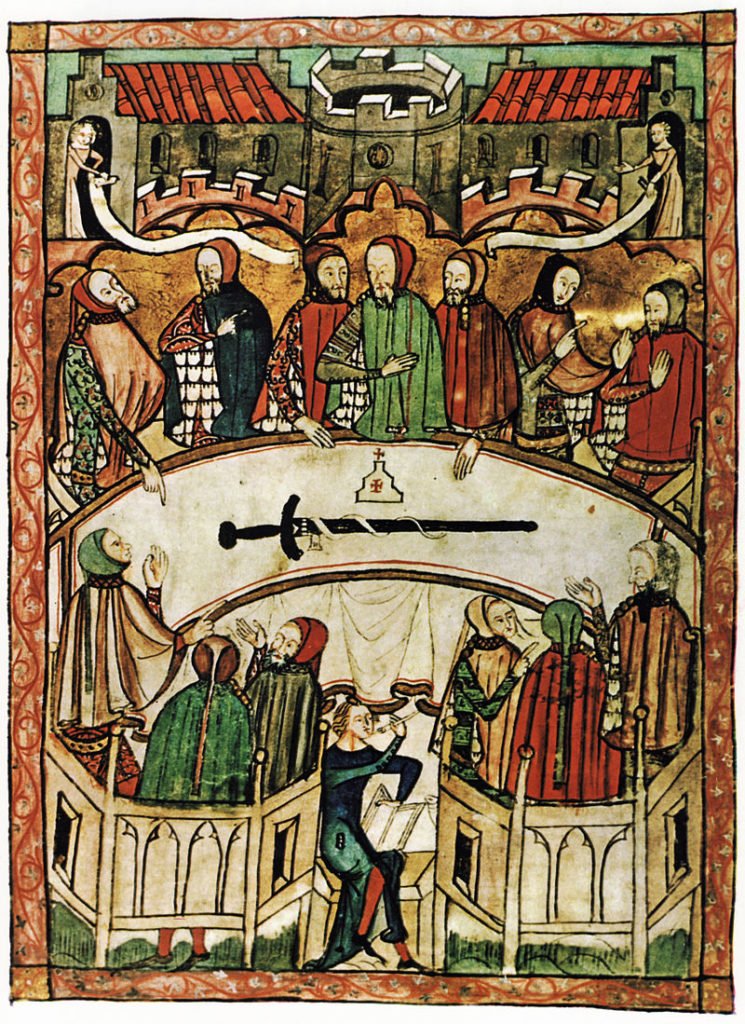
Not every judgment is delivered at midnight. The free courts often convene beneath the open sky in daylight. What makes certain proceedings secret is the sworn membership, confidential testimony and the ban on revealing deliberations—not a requirement for black robes or masked executioners.
- A complaint is brought: a petitioner claims a serious wrong or failure of justice. A local court may already have refused relief.
- The summons is served: a sealed document travels through sworn messengers, sometimes across several jurisdictions. Intercepting it may change the balance of power.
- The Freigraf oversees the hearing: the court sits at a Westphalian Freistuhl, a recognised free-court seat. Witnesses, seals and records matter.
- Freischöffen find the judgment: sworn assessors decide the case; a holder of the seat is not automatically the judge. Condemnation is possible, but enforcing a sentence can be harder than pronouncing it.
- The verdict spreads: a city may resist, a prince may bargain, or another court may contest the claim. The Circle’s occult judgments imitate this process without necessarily possessing lawful authority.
Characters can protect the accused, insist on witnesses, test an official seal, argue jurisdiction or expose a dishonest assessor. Refusing a summons is dangerous but should not force an immediate execution. A lawful judge can be persuaded, and a false one can be defeated through evidence.
People and Powers Across the Red Earth
The courts’ roots are in Westphalia, especially the judicial networks surrounding Dortmund and Arnsberg. Soest offers rich traders and contentious civic leaders; the Münster lands harbour several competing powers. Farther south, the Cologne electorate and the Rhine towns contest whose authority should prevail. The Vehm’s messengers may travel throughout the Empire, but a lawful free-court sitting is not simply moved to any convenient dungeon.
Allies and assets: loyal scribes, independent petitioners, occasional merchants of the Hanseatic League, quiet imperial officials and a disputed archive at Fulda. Opponents: territorial magistrates, forged-court syndicates, bought assessors, oath-breaking nobles and the Circle’s own extremists. A barrow-wight or wight may turn a dispute over inheritance into something far worse, but not every court case requires a monster.
What the Secret Rolls Conceal
The Circle tells of the Alte Schuld, an Ancient Debt binding promises made between mortal rulers and powers beyond the world. According to its legends, the Treaty of Blood-Salt was sworn beneath the Harz Mountains in 1311. A hidden archive records the Burning of Lichtenau in 1419, the Sigil Purge at Marburg in 1427, and the binding of the Mirror-Witch beneath Erfurt in 1433. The newest entry concerns the Weeping Gate near Essen in 1448.
Few outside the Circle have seen the rolls, and even sworn hunters quarrel over their authenticity. The names may conceal real threats, planted testimony or crimes committed by the Circle itself. An unaging judge, a blade of fallen-star metal, a drowned oracle’s last page and a bell that rings for false souls remain objects of fierce investigation; none is accepted as proof merely because a secret register says it is so.
The Court and Its Hidden Hierarchy
The free courts have no single masked master. Different seats owe duties to different patrons, and their sworn judges disagree bitterly. The Circle borrows the language of office to cloak ranks that the lawful courts do not acknowledge.
| Office or rank | Responsibility | Conflict or leverage |
|---|---|---|
| Stuhlherr — holder of the seat | Holds judicial rights associated with a court site and backs appointments | Powerful patron who may protect the court or bow to local pressure |
| Freigraf — free count | Presides over a court and its formal procedure | Responsible official who can authenticate, adjourn or challenge a hearing |
| Freischöffen — sworn assessors | Hear cases, find verdicts and may enforce authorised sentences | Hidden witnesses and judges; honest and corrupt members can belong to different seats |
| Couriers and clerks | Carry writs and preserve seals, rolls and testimony | Vulnerable messengers, record keepers and investigators |
| Zuhörer — the Listeners | Secret Circle initiates who observe people and relics; the lawful courts recognise no such office | Watchers who can be bribed, befriended or followed |
| Schwellenwacht — Threshold Watch | Circle guardians assigned to old pacts and closed places | Defenders whose orders may be based on a lie |
| Zungenlosen — the Tongueless | Circle messengers sworn to silence; lurid tales of literal mutilation remain rumours | Witnesses who communicate by signs, not mindless executioners |
| The Midnight Seat | A legendary final voice when the Circle cannot agree; denied by many members | Possibly a bound spirit falsely posing as a judge, a forged vote or a political myth. If the spirit is real, the Court would consider it an abomination to expose and destroy. |
People Adventurers May Actually Meet
| Person | What they want | What the party can change |
|---|---|---|
| Elias of Soest, sworn judge | Prove that the forged writ did not come from his court | Recover the missing register page; win an impartial hearing for the accused |
| Mother Annelind, blind diviner | Keep the Weeping Gate sealed until the human witnesses and the original warrant are checked; she is an adviser, never a sworn judge | Establish the correct sequence of her visions before she condemns the wrong person |
| The Black Stuhlherr of Münster | Save the Circle’s secrecy even at the cost of innocent lives | Discover that his iron gloves may be worn by several claimants |
| Gerhard Vale, travelling courier | Deliver a summons intact and return alive | Trace two incompatible instructions back to their authors |
| The absent Midnight Judge | Unknown; its signature appears only in the Circle’s closed rolls | Reveal whether the last vote is a bound power or an ordinary lie |
The living human figures can become allies, employers, witnesses, rivals or antagonists depending on the characters’ choices. If the Midnight Judge proves to be an actual spirit, it is an infiltrator or captive, not a lawful member: discovery would bring the Vehm’s hunters against it.
What the Characters Can Do
| Adventure opening | Decision | Consequence |
|---|---|---|
| A summons at the inn | Protect a witness on the road to Westphalia or surrender them to a local ruler | One court becomes a valuable ally; a powerful household seeks revenge |
| The false Free Judge | Expose a forged verdict or quietly use it to catch the greater conspirator | The court’s reputation, a family’s safety and the characters’ own standing hang in the balance |
| The door beneath the tollhouse | Confirm what is imprisoned and help the wardens destroy or rebind it without endangering innocent villagers | The human conspirator behind the broken oath is exposed—or escapes while the hunters fight the wrong enemy |
| The sword-and-key oath | Accept the Circle’s initiation and its restrictions or remain outsiders | Access and influence increase at a real cost to personal freedom |
Joining: only a qualifying freeborn adult human man of recognised good standing may seek a sponsor and take the sworn judicial oath; service as a courier or witness never guarantees admission. Women and non-human peoples may assist, petition or resist but cannot become sworn members under the traditional rule. Undead and supernatural creatures are expressly forbidden and would normally be hunted or destroyed rather than initiated. Opposing: find the false seal, corrupt official or unjust human sentence; opposition to an officer does not require war with every Westphalian court. Reforming: expose forged writs and hold the Circle’s human hunters accountable when they execute innocents or fabricate evidence. No faction of the Vehm proposes welcoming undead into its ranks.
Encounter-Ready Member — Four Editions
This original compact game profile represents an armed field assessor carrying a court summons, not every historical judge. Treat witnesses and officials as characters with choices before drawing swords.
Vehmic Field Assessor — D&D 5.5e / 2024
Medium Humanoid (Human), Lawful Neutral (or Lawful Evil)
| Armor Class | 15 (studded leather) | Initiative | +3 (13) |
|---|---|---|---|
| Hit Points | 45 (6d8 + 18) | Speed | 30 ft. |
| Challenge | 1 (200 XP) | Proficiency Bonus | +2 |
Saving Throws Dex +5, Wis +4
Skills Insight +4, Investigation +4, Perception +4, Stealth +5
Senses Passive Perception 14
Languages Common (Imperial trade tongue) and Westphalian German
Gear Studded leather, shortsword, light crossbow, 20 bolts, authenticated court writ
Traits
Sworn Investigator. The assessor has Advantage on Intelligence (Investigation) checks made to recognise forged judicial seals, altered warrants or tampered court records.
Actions
Multiattack. The assessor makes two Shortsword attacks.
Shortsword. Melee Attack Roll: +5, reach 5 ft. Hit: 6 (1d6 + 3) Piercing damage.
Light Crossbow. Ranged Attack Roll: +5, range 80/320 ft. Hit: 7 (1d8 + 3) Piercing damage. The assessor attacks with the crossbow only once per action.
Bonus Actions
Order to Hold (1/Short Rest). The assessor chooses one ally within 30 feet that can hear it. That ally can immediately move up to half its Speed without provoking Opportunity Attacks from one creature the ally can see.
Tactics
The assessor presents a summons and interviews witnesses before resorting to violence. If shown proof that the court seal was forged, an honest assessor stops the arrest and seeks the real author of the writ.
Vehmic Field Assessor — D&D 5e / 2014
Medium humanoid (human), lawful neutral (or lawful evil)
| Armor Class | 15 (studded leather) | Hit Points | 45 (6d8 + 18) |
|---|---|---|---|
| Speed | 30 ft. | Challenge | 1 (200 XP) |
Saving Throws Dex +5, Wis +4
Skills Insight +4, Investigation +4, Perception +4, Stealth +5
Senses passive Perception 14
Languages Common (Imperial trade tongue) and Westphalian German
Traits
Sworn Investigator. The assessor has advantage on Intelligence (Investigation) checks to identify forged judicial seals, altered warrants or tampered court records.
Actions
Multiattack. The assessor makes two shortsword attacks.
Shortsword. Melee Weapon Attack: +5 to hit, reach 5 ft., one target. Hit: 6 (1d6 + 3) piercing damage.
Light Crossbow. Ranged Weapon Attack: +5 to hit, range 80/320 ft., one target. Hit: 7 (1d8 + 3) piercing damage. Loading prevents multiple crossbow attacks with one action.
Bonus Actions
Order to Hold (Recharge 5–6). The assessor chooses an ally it can see within 30 feet that can hear it. The ally can use its reaction to move up to half its speed without provoking opportunity attacks from one creature it can see.
Tactics
The assessor questions suspects, secures testimony and withdraws when presented with convincing evidence of a forged summons. Corrupt assessors may deliberately disregard that evidence.
Vehmic Field Assessor — Pathfinder 1e
Human rogue 3 (CR 2; XP 600)
LN Medium humanoid (human)
Init +7; Senses Perception +9
Defense
| AC | 16, touch 13, flat-footed 13 (+3 armor, +3 Dex) |
|---|---|
| hp | 20 (3d8 + 6, including favored-class bonuses) |
| Saving Throws | Fort +2; Ref +6; Will +3 |
| Defensive Abilities | evasion; trap sense +1 against traps |
Offense
Speed 30 ft.
Melee shortsword +5 (1d6+1/19–20)
Ranged light crossbow +5 (1d8/19–20; range increment 80 ft.)
Special Attacks sneak attack +2d6 (when the target is denied its Dex bonus to AC or is flanked)
Statistics
Base Atk +2; CMB +3; CMD 16
Feats Alertness, Improved Initiative, Weapon Finesse
Skills Acrobatics +9, Bluff +6, Diplomacy +6, Disable Device +10, Knowledge (local) +8, Perception +9, Sense Motive +9, Stealth +9
Languages Common (Imperial trade tongue) and Westphalian German
SQ rogue talent (fast stealth), trapfinding +1
Combat Gear shortsword, light crossbow with 20 bolts, studded leather armor, seal case, court writ and lockpicks
Tactics
Before Combat Verifies the target’s identity and demands testimony or surrender.
During Combat Uses cover, flanking and mobility to deliver sneak attacks; avoids open duels and reloads the light crossbow between shots.
Morale Withdraws if the warrant is discredited or defeat would endanger an essential witness.
Vehmic Field Assessor — D&D 3.5e
Human rogue 2 (CR 2)
LN Medium humanoid (human)
Init +7; Senses Listen +9, Spot +9
Defense
| AC | 15, touch 13, flat-footed 12 (+2 armor, +3 Dex) |
|---|---|
| hp | 13 (2d6 + 4) |
| Saving Throws | Fort +2; Ref +6; Will +2 |
| Defensive Abilities | evasion |
Offense
Speed 30 ft.
Melee shortsword +2 (1d6+1/19–20)
Ranged light crossbow +4 (1d8/19–20; range increment 80 ft.)
Special Attacks sneak attack +1d6 when a foe is flanked or denied its Dex bonus to AC
Statistics
Base Atk +1; Grapple +2
Feats Alertness, Improved Initiative
Skills Bluff +5, Disable Device +7, Gather Information +5, Hide +8, Listen +9, Move Silently +8, Search +7, Sense Motive +7, Spot +9
Languages Common (Imperial trade tongue) and Westphalian German
Special Qualities trapfinding
Possessions leather armor, shortsword, light crossbow with 20 bolts, legal seal and summons parchment
Tactics
Before Combat Identifies itself as an officer of a free court and seeks witnesses.
During Combat Uses ambush, cover and an ally’s flank to apply sneak attack; reloads between crossbow shots rather than treating it as a multiattack weapon.
Morale Preserves the court writ and retreats when outmatched, especially if the evidence calls the judgment into question.
Historical Grounding and Further Reading
Westphalian free courts are documented from the thirteenth century; their wide influence increased during the fourteenth and fifteenth. Historically a Stuhlherr held court rights, the Freigraf presided, and sworn Freischöffen found verdicts. Hearings could take place outdoors in daylight, and formal capital sentences were much more common than executions. A foundation by Charlemagne is a later legend, not established history. The Circle of the Sword and Key, its occult ranks and the named supernatural cases are original elements of this fantasy setting, not assertions about documented medieval courts.
Research: Eberhard Fricke, Vemegerichtsbarkeit, Historisches Lexikon Bayerns; 1911 Encyclopaedia Britannica, Fehmic Courts. Continue into the Factions archive, the Empire and Dortmund.
Keep this reference growing
If this page helped with your reading or game, you can support its upkeep or explore the curated books.
Explore the Bookshop — epics, classics and stories behind imagined worlds.