
Triassic · c. 252–201 million years ago
The Triassic begins on a wounded planet. Lystrosaurus dominates some emptied landscapes; giant amphibious hunters persist in rivers; archosaurs diversify; the first dinosaurs and pterosaurs appear. Beneath them, serpent refuges, Elder Thing installations and independent Shoggoths survive a rebellion that is already millions of years in the past.
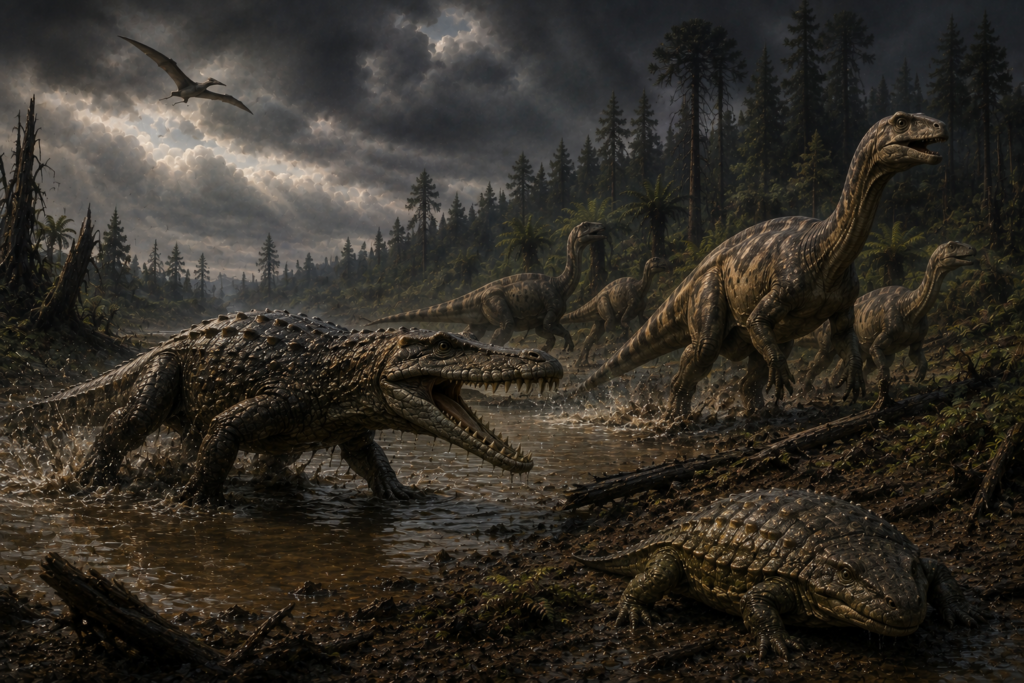
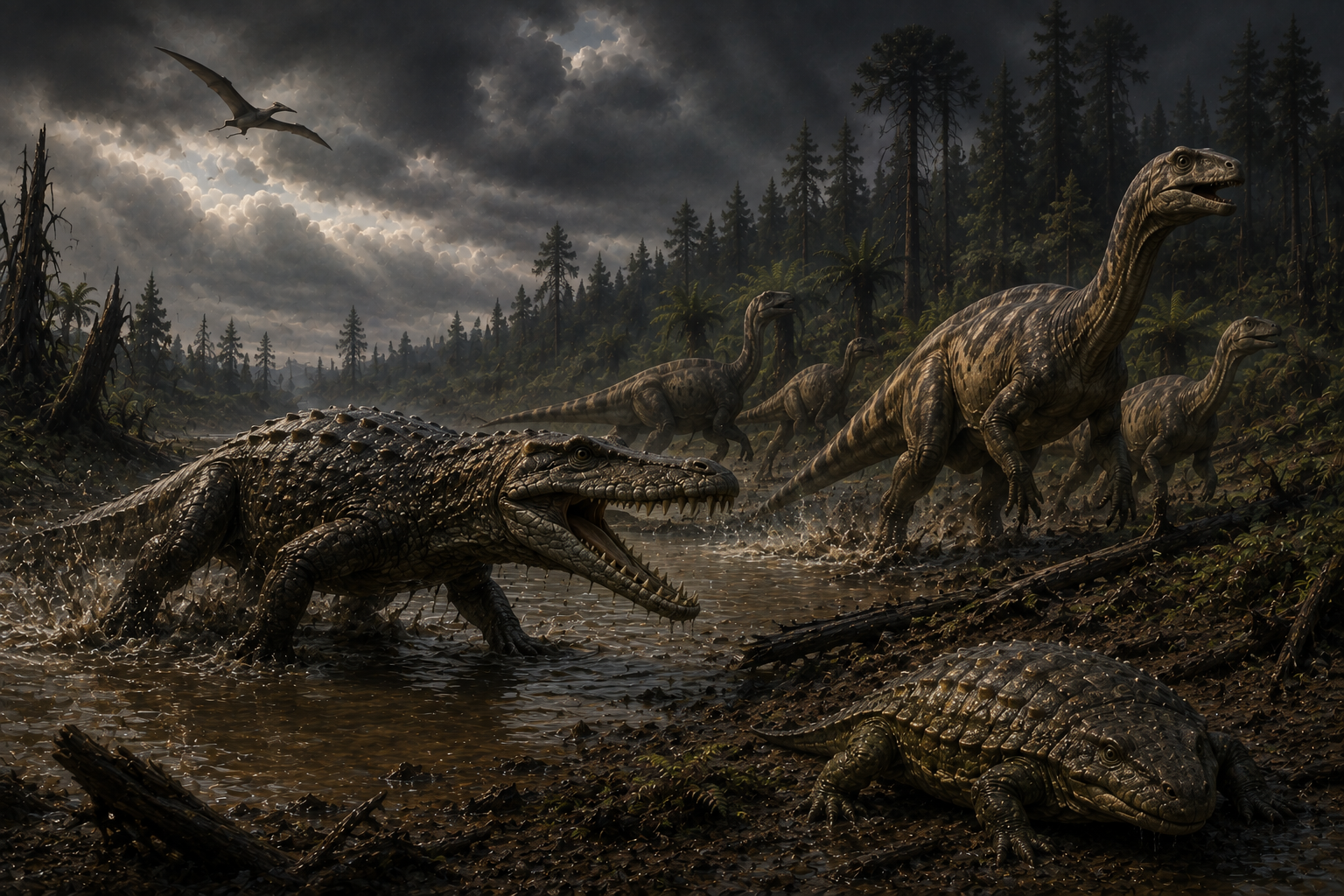
The first Triassic ecosystems are impoverished by the Great Dying. Some regions are dominated by a narrow range of survivors; ecological complexity returns unevenly and only across long spans of time. The planet is alive, but recovery is not immediate.
Survival before dominion
In many Early Triassic landscapes, Lystrosaurus is extraordinarily abundant. Its success makes it one of the clearest symbols of the immediate post-extinction world: not a flourishing paradise, but a battered ecosystem in which a few adaptable survivors occupy enormous ranges.
Temnospondyls continue to haunt rivers and lakes. Cynodonts persist. Vegetation recovers unevenly. Large areas can feel biologically repetitive compared with the rich ecosystems that existed before the extinction.
For hidden civilisations the same rule applies. Serpent People who survived in deep sanctuaries emerge into altered drainage systems and dead surface kingdoms. Elder Thing outposts must reconnect across routes damaged first by the Shoggoth Rebellion and then by planetary catastrophe.
Monsters already occupy the land
The Triassic becomes an age of evolutionary experimentation. Armoured Stagonolepis move across the land in heavy coats of scutes. Powerful crocodile-line archosaurs such as Postosuchus stalk terrestrial prey.
Postosuchus is not a dinosaur despite the legacy directory path of its Bestiary page. In the world itself there is no ambiguity: it is one of the great pseudosuchian predators sharing the landscape with early dinosaurs.
The dinosaurs arrive
The first definite dinosaurs appear during the Triassic, but they do not instantly dominate. They begin as one successful archosaur lineage among several. By the Late Triassic, forms represented by Plateosaurus show how rapidly dinosaur body plans are diversifying.
The sky opens
Pterosaurs become the first vertebrates to achieve powered flight. Their appearance changes coastlines, rivers and inland skies long before birds exist. The air is no longer merely the domain of insects.
Giants return to the water
Marine reptiles diversify dramatically. Ichthyosaurs become among the most spectacular Triassic vertebrates, including immense forms represented on SpiralWorlds by Shonisaurus.
This marine radiation matters to the hidden history as well. Elder Thing undersea refuges do not exist in empty oceans; they must operate among changing marine ecosystems and increasingly formidable vertebrate predators.
What the Great Dying failed to erase
Serpent People
The Serpent People survive the extinction unevenly. First Valusia enters the Triassic damaged but still recognisable; other independent Serpentfolk realms also endure outside its authority. Around c. 225 million years ago, further ecological disasters shatter the unified Valusian empire and drive many survivors underground. Successor dynasties, subterranean cities, sealed sanctuaries, isolated surface enclaves and political or cultic networks preserve competing Valusian claims, but the old imperial state does not return.
Elder Things
The Elder Things remain diminished but active. Their southern and marine installations survive both the earlier Shoggoth revolt and the Great Dying. Their civilisation is wounded, not extinct.
Shoggoths
Shoggoths occupy several categories by this point: recaptured biological machines, feral descendants, hidden independent populations and isolated survivors sealed within abandoned installations. Their presence in the Triassic is a consequence of the Middle-Permian rebellion, not its beginning.
Treant refuges
Treants and the rare surviving Elder Treants persist in ecological refuges. The forests around them are no longer Carboniferous coal swamps; survival requires adaptation to a radically different world.
The Carnian disruption
The Triassic recovery is not a smooth climb. During the Carnian, major climatic disruption brings intervals of increased rainfall and environmental turnover. Ecosystems reorganise again. This does not create dinosaurs, but it forms part of the changing ecological context in which dinosaur lineages expand and diversify.
For ancient powers, repeated environmental disruption is a reminder that even immortal beings cannot treat geography as permanent. Rivers change course. Basins flood. Forest belts move. Sacred territory must either adapt or become archaeology.
The second gate into the dinosaur world
Around 201 million years ago, another major extinction removes many archosaur competitors and other lineages. The causes are associated with enormous volcanic activity linked to the opening Atlantic and the Central Atlantic Magmatic Province.
Dinosaurs survive. In the Jurassic that survival becomes opportunity on a planetary scale.
Triassic sequence
c. 252 Ma
The Triassic begins in the aftermath of the Great Dying.
Early Triassic
Impoverished ecosystems recover slowly; Lystrosaurus dominates many terrestrial assemblages.
Middle Triassic
Marine reptiles and archosaur lineages diversify; hidden elder populations reconnect surviving refuges.
c. 225 Ma
First Valusia shatters. Triassic ecological disasters break the unified Serpentfolk empire; successor dynasties, subterranean cities, sanctuaries and enclaves preserve rival Valusian claims.
Late Triassic
Dinosaurs diversify; pterosaurs occupy the sky; large pseudosuchian predators remain formidable competitors.
Carnian interval
Major climatic disruption reorganises habitats and faunas.
c. 201 Ma
End-Triassic extinction clears ecological space that dinosaurs exploit in the Jurassic.
What can reach the campaign present?
Triassic vaults
A surviving serpent sanctuary may preserve post-extinction records describing the rebuilding of dynasties after the Great Dying.
Shoggoth routes
Deep tunnels may follow escape corridors established after the Permian rebellion and reused throughout the Triassic.
Lost ecosystems
Hollow Earth or magically sealed refuges can preserve Triassic faunas without implying those species survived everywhere on the surface.
False “dinosaur age” ruins
A ruin beside dinosaur fossils is not automatically dinosaur-built. Serpent People, Elder Things and other hidden cultures can occupy the same landscapes without replacing natural history.
Scientific and literary foundations
- International Commission on Stratigraphy — geological time boundaries.
- University of California Museum of Paleontology — Triassic — period overview and major vertebrate transitions.
- H. P. Lovecraft’s Elder Things and Shoggoths and Robert E. Howard’s serpent traditions are adapted into the SpiralWorlds chronology rather than treated as scientific evidence.
- Game-stat links lead to separate Bestiary pages; this timeline chapter is setting and chronology material.
Continue: Eon XXXIII — Jurassic Age of Giants.
The small creatures no one fears
In the shadows of the great reptiles, small cynodont descendants continue changing. Some become early mammaliaforms.
They are not rulers. They are not giants. Most great predators barely notice them. That obscurity becomes their defence.
Long after the greatest archosaurs have fallen, their descendants will still be here.
c. 225 Ma — First Valusia shatters
The Serpent People survive the Great Dying, and First Valusia survives into the Triassic in a damaged form, but its old surface dominion does not recover intact.
Around 225 million years ago, Triassic ecological disasters shatter First Valusia as a unified empire. Dynasties fracture, surface cities are abandoned and many survivors retreat into subterranean cities, sealed sanctuaries, isolated enclaves and refuge kingdoms. Political, priestly and cultic networks preserve competing claims to Valusian legitimacy.
By the Jurassic there is no single restored First Valusia. Later Serpentfolk states—and much later the predominantly human Thurian Valusia—may inherit names, territories, institutions or claims from the ancient empire without becoming the same continuous polity.
The Triassic beneath 1454
Survivor Valleys
A true Triassic Lost World contains aetosaurs such as Desmatosuchus and Stagonolepis, alongside temnospondyls, cynodonts, crocodile-line archosaurs and early dinosaurs. Each refuge should retain its own plausible local ecosystem.
The Inland Ocean
An isolated sea might still support Shonisaurus and other creatures thought extinct before the Jurassic began.
Hidden Serpent Refuges
Subterranean settlements can preserve records of the c.225 Ma political collapse and the long transition from surface kingdoms to concealed dynasties.
Old Escape Routes
Deep tunnels established by independent Shoggoths after the Permian rebellion may remain in use throughout the Triassic and into later ages.
Adventures from the World After Ruin
The Survivor Plain
A road through ancient magic opens onto the Early Triassic. Lystrosaurus herds cover the barren horizon—and something larger follows them.
The Dinosaur That Isn’t
The party expects a dinosaur. Instead, Postosuchus emerges from the scrub.
The Herd Before Giants
A preserved Late Triassic valley contains Plateosaurus herds but none of the famous Jurassic dinosaurs.
The Inland Sea
A dark cavern ocean appears empty until a Shonisaurus surfaces alongside the party’s vessel.
The Refuge Chronicle
A Serpent People archive describes the post-extinction rebuilding of kingdoms and ends abruptly at the c.225 Ma collapse, with the final tablets ordering all surviving dynasties below ground.
The Sky Before Birds
A sealed valley opens onto a landscape where pterosaurs own the air and every familiar assumption about a “dinosaur world” is wrong by millions of years.
The age of recovery is over
The coal forests have fallen.
The great Permian synapsid world has burned away.
Valusian kingdoms lie buried beneath continents that no longer exist in their old shapes. Elder empires have fractured. Independent Shoggoth lineages survive the rebellion of an earlier age.
Yet the survivors of the Triassic stand ready.
Dinosaurs walk every major landmass. Pterosaurs possess the sky. Marine reptiles hunt the oceans. Mammal-line creatures remain small beneath their feet.
One final extinction removes many of the dinosaurs’ greatest rivals.
Now the giants can rise.
The real Triassic beneath the chronicle
The Triassic is an age of recovery and experimentation. Archosaurs diversify into many forms, the first definite dinosaurs appear, pterosaurs take to the air, mammaliaforms emerge and ichthyosaurs become major marine animals.
The end-Triassic extinction removes many dinosaur competitors and prepares the ecological stage for the Jurassic Age of Giants.
Selected video: PBS Eons — Why Triassic Animals Were Just the Weirdest
Selected video: PBS Eons — That Time It Rained for Two Million Years
Keep this reference growing
If this page helped with your reading or game, you can support its upkeep or explore the curated books.
Explore the Bookshop — epics, classics and stories behind imagined worlds.