Permian · c. 299–252 million years ago
Pangaea hardens beneath a harsher climate. Synapsid predators spread across the dry land, Serpent kingdoms claim ancient territories, Treants retreat into refuges—and in the Middle Permian the Shoggoths rise against the Elder Things. The age ends in the Great Dying.
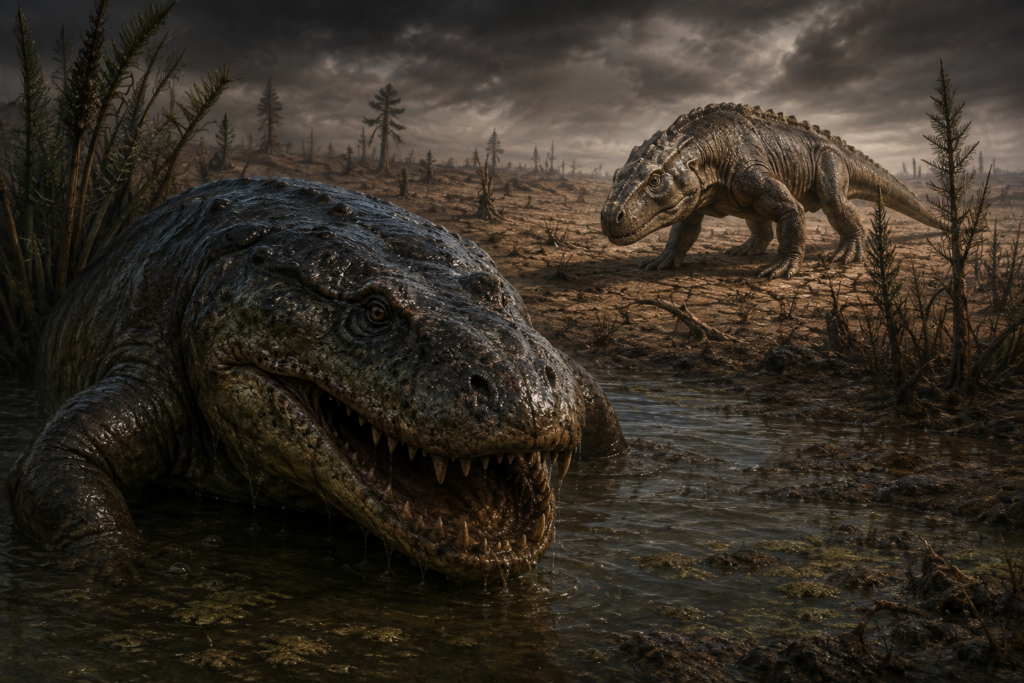
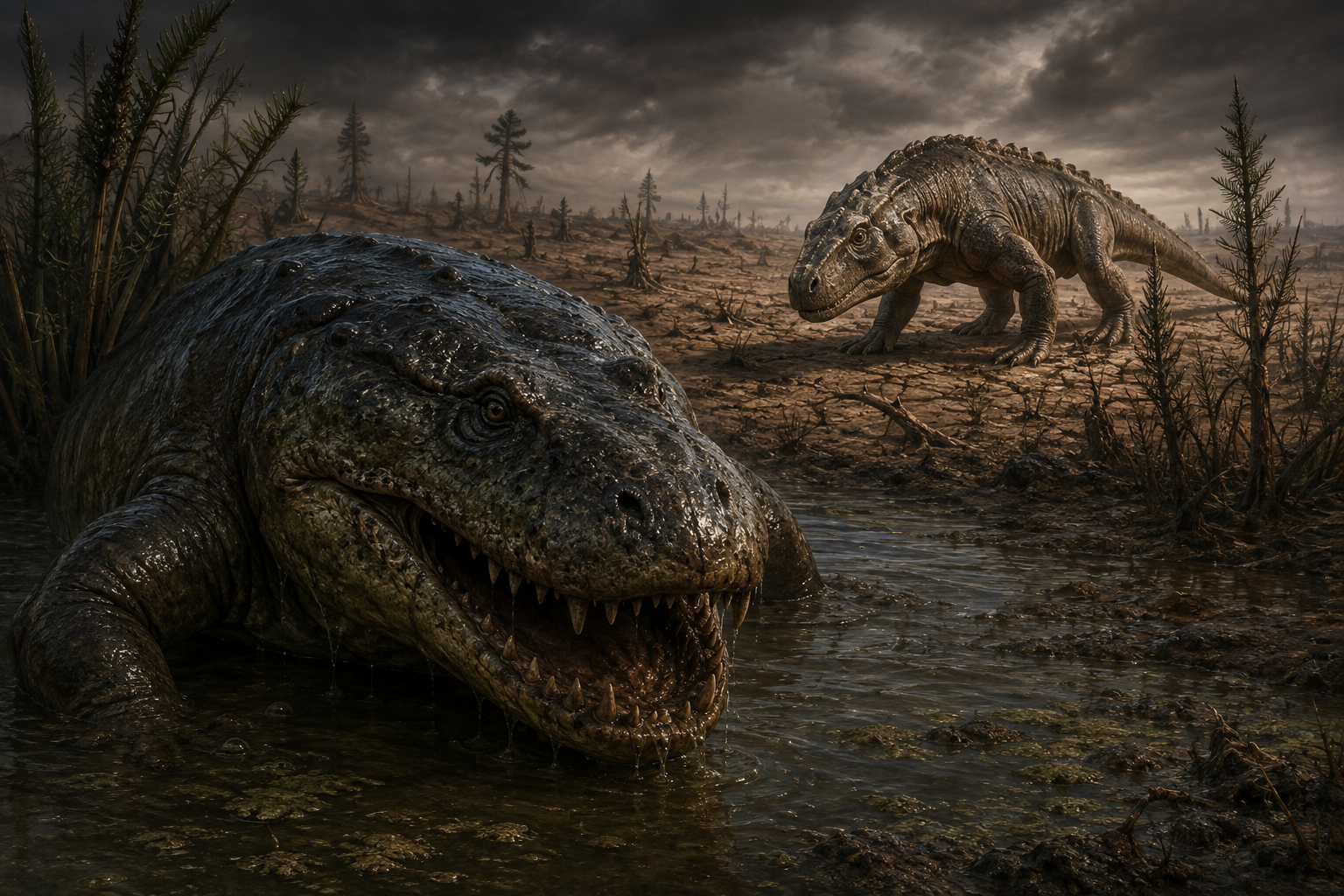
The Permian opens on a world becoming more continental, seasonal and dry. Wetlands persist beside rivers and lakes, but far from the sea the interior of Pangaea becomes increasingly harsh. Creatures that can reproduce and travel away from permanent water gain advantages the old swamp specialists do not possess.
Rivers keep their monsters; the dry land changes hands
Large temnospondyls still wait in channels and lake margins. The rivers remain dangerous, but the great evolutionary expansion is happening beyond them.
Synapsids before mammals
Synapsids flourish across the increasingly dry landscape. The famous sail-backed Dimetrodon is not a dinosaur. Sphenacodon is another formidable early synapsid predator. Later therapsids become increasingly important, and among them lie lineages that will eventually lead toward mammals.
A spiral jaw beneath the sea
Helicoprion hunts with its extraordinary tooth whorl. It requires no curse, mutation spell or elder experiment: the real Permian world is already stranger than many later legends.
First Valusia before mankind
The Serpent People are an indigenous Earth people whose history predates First Valusia. Around c. 275 million years ago, First Valusia rises on Permian Pangaea as the greatest Serpentfolk imperial power of its age. It is powerful but never species-wide: independent Serpentfolk kingdoms, cultures and communities remain outside its authority.
The Valusian emperor is supreme sovereign over a layered imperial monarchy. The crown directly governs the heartland, strategic corridors and major sacred or magical sites while subordinate kingdoms, tributary cities, client rulers and conquered provinces retain differing degrees of local law and autonomy. Ancient houses, imperial officials, priesthoods, magical orders and provincial rulers compete beneath the strong crown.
Serpent priests do not create the reptiles of Earth. Native scaled life continues through natural evolution. First Valusia instead builds political authority through conquest, tribute, unequal treaties, clients, trade and sacred claims. The Great Dying devastates its territories but does not by itself end every Valusian institution. The final shattering of the unified empire occurs around c. 225 million years ago during Triassic ecological disasters; later dynasties and much younger Valusian claimants inherit fragments of its legitimacy rather than the same uninterrupted state.
The Shoggoth Rebellion — Middle Permian
The Elder Things arrived on an already living Archean Earth billions of years earlier. Their earliest manipulation of native microorganisms was scientific; over vast spans of time that work developed into practical biotechnology, then proto-Shoggoths and finally fully adaptive Shoggoths by the late Precambrian.
For ages the Shoggoths remain instruments, workers and living machines. By the Middle Permian, that relationship breaks.
The servants revolt
The Shoggoths rebel against their makers in a conflict that tears through Elder Thing installations, transport routes and biological infrastructure. This is not the extinction of the Elder Things and not the destruction of every Shoggoth. It is a civilisational wound.
Southern and undersea Elder Thing installations survive. Some Shoggoth populations are destroyed or brought back under control; others escape into deep oceans, buried complexes and environments where later peoples will encounter them without understanding the rebellion that made them independent.
The rebellion is therefore part of the causal chain leading forward. The Elder Things enter the later Permian already diminished and forced to rely more heavily on defended refuges. When the planet itself begins to fail, their capacity to respond is not what it once was.
Treants in a harsher world
The oldest Elder Treants and later Treants do not vanish when the Carboniferous coal forests fragment. They survive unevenly in refuges, wetter belts, uplands and hidden valleys.
The earlier conflicts associated with Zuggtmoy have already destroyed many ancient living pillars. The Permian therefore contains scattered green sanctuaries rather than a single plant dominion. Some refuges are defended; some corrupted; some simply forgotten beneath the later deserts of Pangaea.
The Great Dying
Toward the end of the Permian, the world begins to fail on a planetary scale. Enormous volcanism associated with the Siberian Traps drives profound climatic and chemical disruption. Temperatures rise. Ecosystems destabilise. Oceans warm and lose oxygen. Forest systems collapse across large regions.
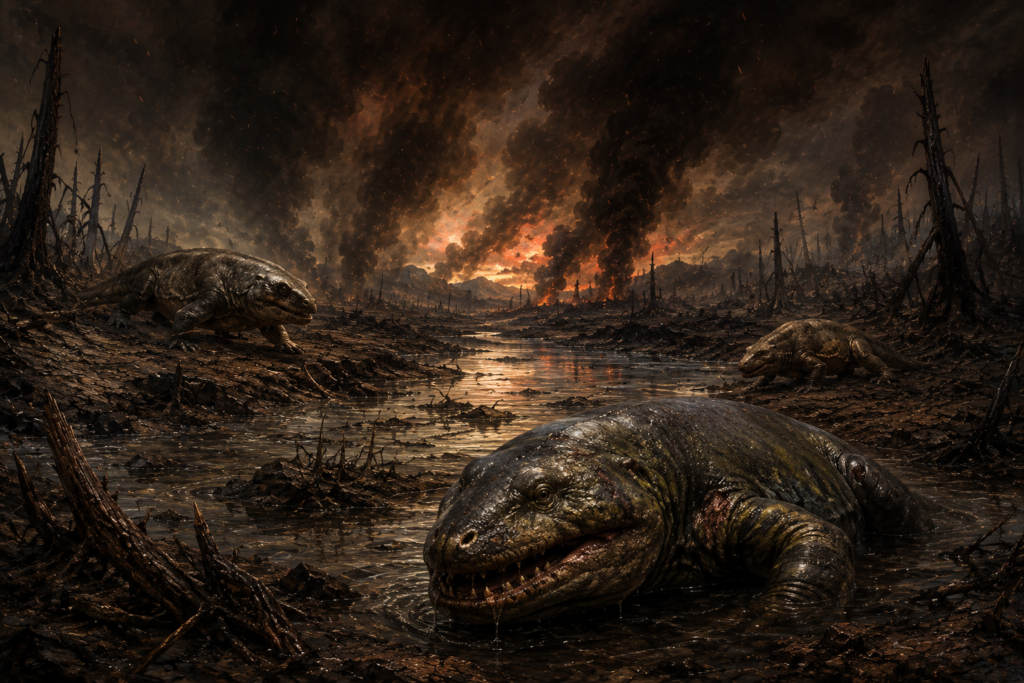
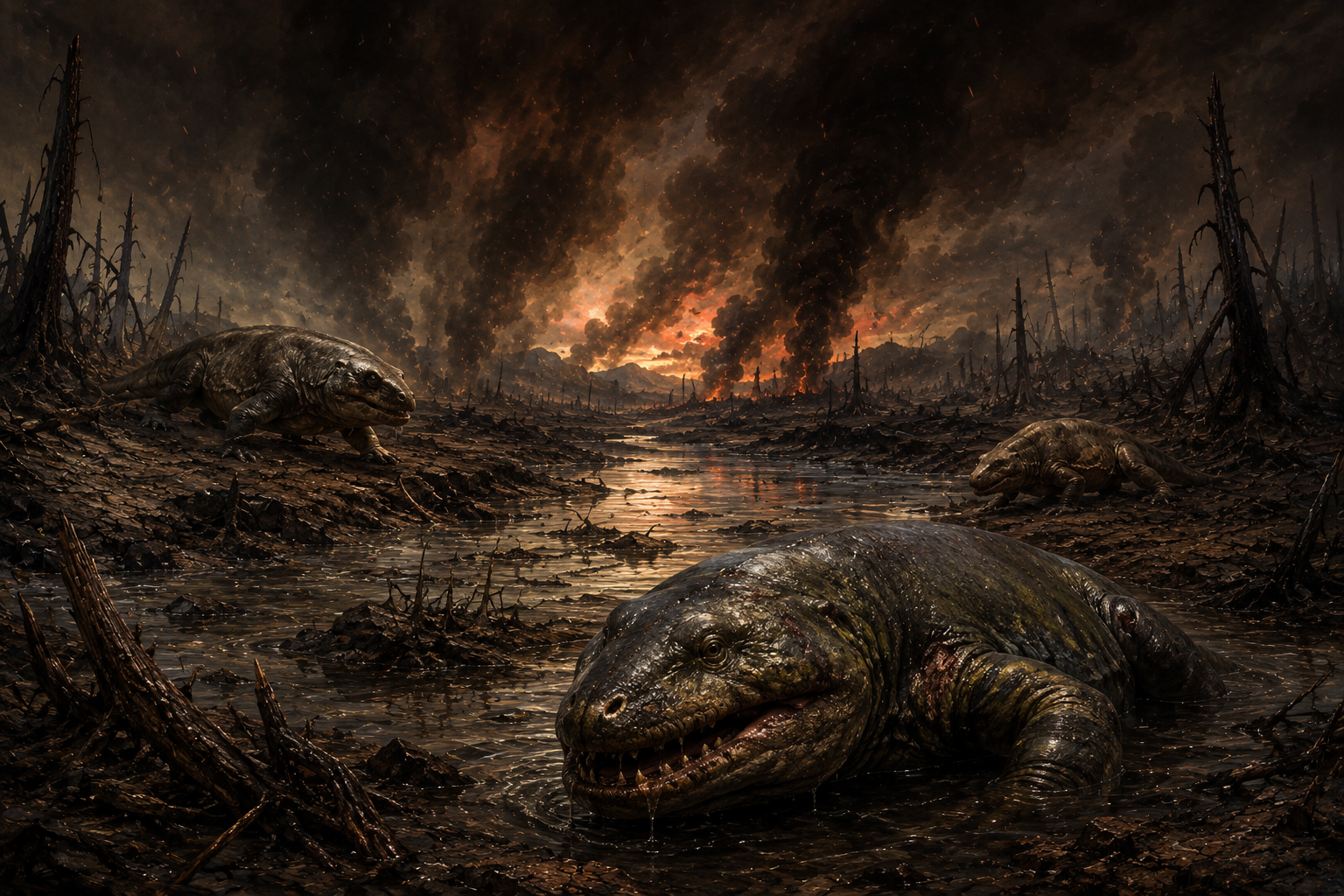
The destruction reaches from plankton and reefs to large terrestrial predators. Trilobites disappear forever. Many established food webs are broken beyond recovery. On land, drought, vegetation loss and unstable climate erase habitats that had supported mature Permian communities.
Supernatural civilisation is not exempt. Serpent surface cities lose rivers, forests and prey routes. Temples are sealed. Archives descend underground. Elder Thing installations disappear beneath ash, desert, collapsing coastlines and hostile seas. Treant refuges burn, dry out or become isolated islands of survival.
Permian sequence
c. 299 Ma
Permian begins; Pangaea continues assembling and continental interiors become increasingly seasonal.
Early Permian
Synapsids diversify across dry-land habitats; serpent realms expand and reuse older sacred claims.
c. 275 Ma
First Valusia rises. The Valusian crown becomes the dominant Serpentfolk imperial power of the age, ruling a layered empire of heartland territory, subordinate kingdoms, tributary cities, client rulers and provinces while independent Serpentfolk states remain outside its authority.
Middle Permian
Shoggoth Rebellion. Elder Thing power is badly damaged but not destroyed.
Late Permian
Therapsid faunas dominate many regions; hidden plant and elder refuges persist unevenly.
c. 252 Ma
The Great Dying collapses ecosystems and civilisations across land and sea.
Aftermath
The survivors enter a Triassic world that remains ecologically wounded for millions of years.
What can still exist in 1454?
Buried Elder infrastructure
A Permian complex may already be damaged by the Shoggoth Rebellion before later geological burial. Its “ruin” can therefore contain two different catastrophes.
Serpent archives
Deep sanctuaries can preserve dynastic records from before the Great Dying, making later serpent claims to ancient sovereignty uncomfortably literal.
Green refuges
Treants or an Elder Treant can remember the Permian climate and identify modern mountains as the eroded remains of landscapes no human history records.
Independent Shoggoths
Some Shoggoths encountered in later eras descend from populations that escaped during the Middle-Permian rebellion rather than from later Elder Thing control.
Scientific and literary foundations
- International Commission on Stratigraphy — geological time boundaries.
- University of California Museum of Paleontology — Permian — environments and life of the period.
- Natural History Museum — Permian extinction — overview of the end-Permian crisis and leading causes.
- H. P. Lovecraft’s Elder Things and Shoggoths, and Robert E. Howard’s serpent-people traditions, are adapted into the independent SpiralWorlds deep-time chronology.
- Game-stat links lead to separate Bestiary pages; this timeline chapter contains setting and chronology rather than reproduced stat blocks.
The Permian beneath 1454
Synapsid Bone Fields
Ancient quarries contain predators and herbivores unlike both modern mammals and later dinosaurs. A bone bed can reveal how completely the living world changed before the first dinosaur appeared.
The Spiral Tooth
A fossilised Helicoprion tooth whorl may be mistaken for an artefact until its biological origin is recognised.
The Death Layer
Some strata preserve an abrupt boundary between a living world and near-emptiness. Magic caught within such horizons may still carry the memory of planetary death.
Maps of Pangaea
Ancient Serpent People archives contain maps whose continents no longer resemble modern Earth.
Shoggoth Vaults
A sealed Elder Thing facility may hold evidence of the Middle-Permian rebellion—or a Shoggoth that never returned to obedience.
Refuges Before the Fire
Treant sanctuaries may preserve pollen, seeds, fungal scars and living witnesses from ecosystems destroyed before the Great Dying.
Adventures from the Drying World
The Spiral Jaw
Fishermen recover a fresh Helicoprion tooth whorl from a sea in which the creature should have been extinct for hundreds of millions of years.
The First Valusia
A Serpentfolk noble produces a land treaty written when Pangaea was still one continent and demands that the agreement be honoured.
The Death Layer
A mine reaches the Permian–Triassic boundary. Every living thing carried across the exposed rock begins to suffocate.
The Disobedient Servant
An Elder Thing vault opens and releases a Shoggoth that still behaves as if the Middle-Permian rebellion is underway.
The Broken Archive
A serpent sanctuary contains records from before the Great Dying, but half the chambers were deliberately sealed during the extinction. Something inside was considered worse than planetary collapse.
The Last Green Hold
A Treant refuge survives beneath Permian strata. Its guardians remember the Great Dying as lived catastrophe and regard modern surface civilisation as impossibly young.
The Great Dying does not spare immortals
Serpent cities lose the rivers, forests and prey routes upon which they were built. Dynasties abandon surface capitals. Temples are sealed. Archives vanish into caverns.
Elder installations are buried beneath ash, desert and flooded coast. Even beings capable of living for ages discover that immortality does not preserve an empire when the world supporting it has ceased to exist.
Life survives, but survival is not victory. For millions of years afterwards, Earth remains wounded.
The real Permian beneath the chronicle
The Permian spans roughly 299–252 million years ago. Synapsids become increasingly important on land while large amphibious tetrapods remain major freshwater predators. Pangaea creates enormous and often dry continental interiors.
The period ends with the Great Dying, associated principally with enormous Siberian volcanism, severe warming and catastrophic changes to marine and terrestrial ecosystems. Supernatural wars and civilisations unfold within that extinction history.
Keep this reference growing
If this page helped with your reading or game, you can support its upkeep or explore the curated books.
Explore the Bookshop — epics, classics and stories behind imagined worlds.