
Blur
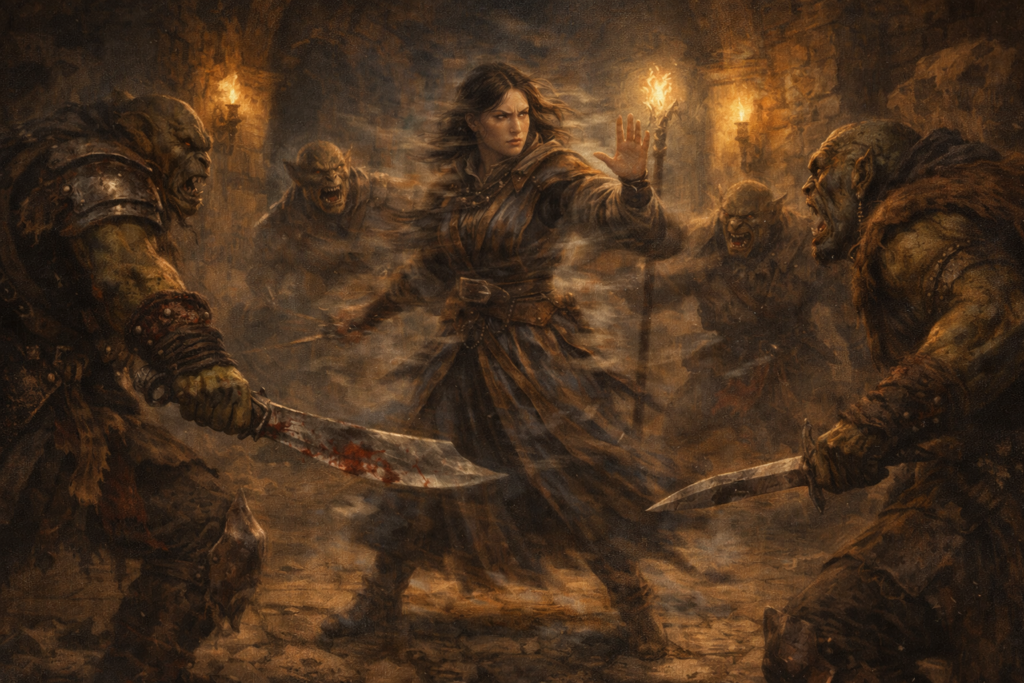
Blur makes attacks harder to land as your outline wavers. Fifth edition gives attackers disadvantage while you concentrate. Pathfinder and 3.5e instead grant a touched creature concealment with a 20% miss chance. The spell does not hide your location.
Blur at a Glance
| D&D 2024 / 2014 | 2nd-level Illusion; Action; Self; Concentration, up to 1 minute; disadvantage on incoming attack rolls. |
|---|---|
| Pathfinder / 3.5e | 2nd-level Illusion (glamer); standard action; Touch; 1 minute per caster level; 20% miss chance. |
| Main limit | It protects against attacks, not effects resolved only by saving throws. |
| Countermeasures | Use the edition’s sight and illusion rules; see the individual panels. |
Spell Rules by Edition
Blur — D&D 2024
Level and school: 2nd-level Illusion
Core spell lists: Sorcerer, Wizard
Casting time: Action
Range: Self
Components: V
Duration: Concentration, up to 1 minute
Attack / save: None
Your blurred body gives creatures Disadvantage on attack rolls against you. An attacker is immune if it perceives you with Blindsight or Truesight. The spell changes neither your Armour Class nor saving throws. No higher-slot increase is listed.
Blur — D&D 2014
Level and school: 2nd-level Illusion
Core spell lists: Sorcerer, Wizard
Casting time: 1 action
Range: Self
Components: V
Duration: Concentration, up to 1 minute
Attack / save: None
Creatures have disadvantage on attack rolls against you while your body shifts and wavers. An attacker ignores the effect if it does not rely on sight, such as through blindsight, or can see through illusions, such as through truesight. No higher-slot increase is listed. Additional class features, including Artificer spellcasting, may grant access.
Blur — Pathfinder 1e
School: Illusion (glamer)
Level: Alchemist, Arcanist, Bard, Investigator, Magus, Medium, Mesmerist, Occultist, Psychic, Red Mantis Assassin, Skald, Sorcerer, Spiritualist, Summoner (including unchained), Wizard: all 2
Casting time: 1 standard action
Components: V
Range: Touch
Target: Creature touched
Duration: 1 minute per caster level (dismissible)
Saving throw: Will negates (harmless)
Spell resistance: Yes (harmless)
The subject gains concealment with a 20% miss chance as its outline wavers. See Invisibility does not defeat this effect; True Seeing does. A foe unable to see the subject ignores Blur, while the usual penalties for attacking an unseen creature still apply. The spell does not require ongoing concentration.
Blur — D&D 3.5e
The subject’s outline appears blurred, shifting and wavering.
This material is Open Game Content, and is licensed for public use under the terms of the Open Game License v1.0a.
Illusion (Glamer)
Level Bard 2, Sorcerer/Wizard 2
Components V
Casting Time 1 standard action
Range Touch
Target Creature touched
Duration 1 min./level (D)
Saving Throw Will negates (harmless)
Spell Resistance Yes (harmless)
- This distortion grants the subject concealment (20% miss chance).
- A see invisibility spell does not counteract the blur effect, but a true seeing spell does.
- Opponents that cannot see the subject ignore the spell’s effect (though fighting an unseen opponent carries penalties of its own).
What Changed Between Editions?
2024 names Blindsight and Truesight as the exceptions. 2014 uses broader wording for attackers that do not rely on sight or can see through illusions. Pathfinder and 3.5e allow a touched ally as the target, last by caster level and use a 20% miss chance rather than disadvantage.
Using Blur in Play
Survive repeated attacks
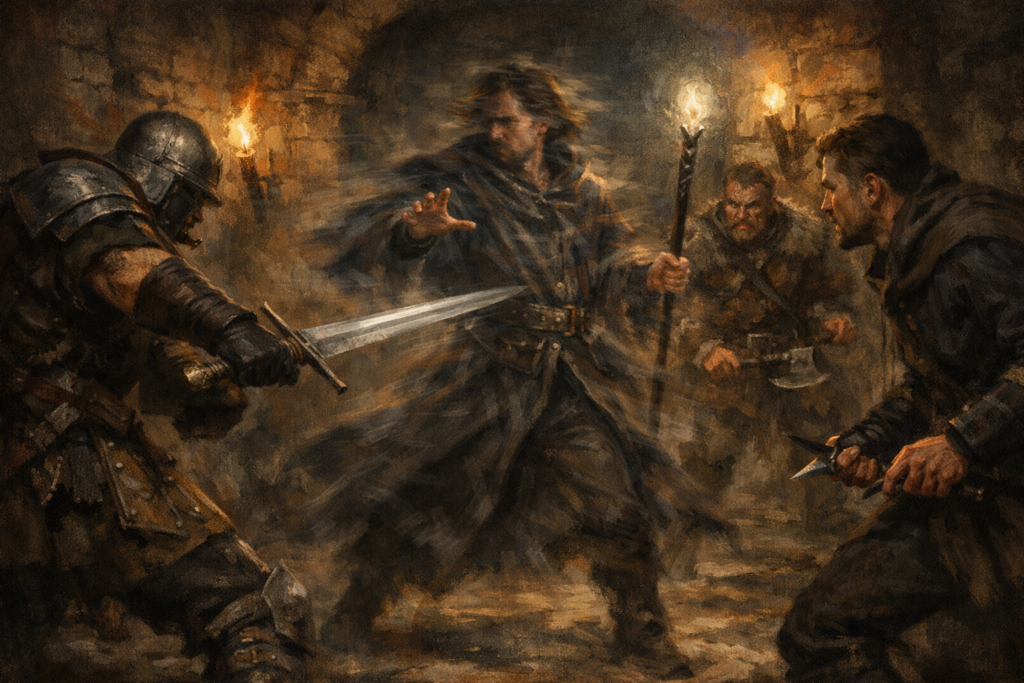
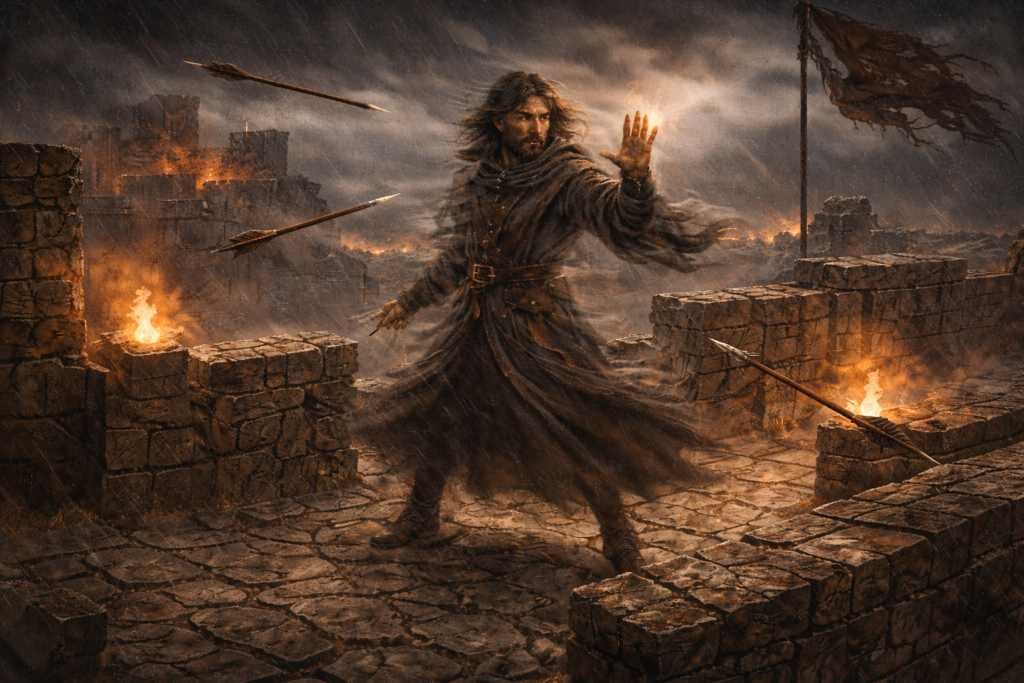
Cast before crossing a hall covered by archers or holding a narrow stair against several foes. You remain visible and vulnerable to spells that call only for saves. Cover and a route out still matter.
Weigh the concentration cost
In fifth edition, maintaining Blur means giving up another Concentration spell. Choose it when surviving incoming attacks matters more than keeping your other spell running. The older touch versions can protect a companion without that ongoing cost.
Keep sight rules clear
See Invisibility does not remove the older versions’ blur; True Seeing does. Check a creature’s actual senses before applying the modern disadvantage.
Blur in the World
Also called Veil of the Unfixed. A duellist’s blade passes through the edge of a wavering silhouette; a hunted mage uses that brief uncertainty to reach the next doorway. Shield can add a separate defence, while Mirror Image creates false targets. Invisibility conceals the creature from ordinary sight. Each has different limits; in fifth edition, one caster cannot maintain Blur and Invisibility together.
Sources and Licensing
D&D 2024 · D&D 2014 · Pathfinder 1e · D&D 3.5e.
The fifth-edition summaries include material from System Reference Documents 5.2.1 and 5.1 by Wizards of the Coast LLC, available from the official SRD resource, under CC BY 4.0. The summaries are reformatted and paraphrased. Pathfinder and 3.5e mechanics are Open Game Content under the Open Game License v1.0a. Artwork and original setting prose are excluded from that designation.
Open Game License v1.0a and copyright notices
OPEN GAME LICENSE Version 1.0a
The following text is the property of Wizards of the Coast, Inc. and is Copyright 2000 Wizards of the Coast, Inc (“Wizards”). All Rights Reserved.
1. Definitions: (a) “Contributors” means the copyright and/or trademark owners who have contributed Open Game Content; (b) “Derivative Material” means copyrighted material including derivative works and translations (including into other computer languages), potation, modification, correction, addition, extension, upgrade, improvement, compilation, abridgment or other form in which an existing work may be recast, transformed or adapted; (c) “Distribute” means to reproduce, license, rent, lease, sell, broadcast, publicly display, transmit or otherwise distribute; (d) “Open Game Content” means the game mechanic and includes the methods, procedures, processes and routines to the extent such content does not embody the Product Identity and is an enhancement over the prior art and any additional content clearly identified as Open Game Content by the Contributor, and means any work covered by this License, including translations and derivative works under copyright law, but specifically excludes Product Identity. (e) “Product Identity” means product and product line names, logos and identifying marks including trade dress; artifacts; creatures characters; stories, storylines, plots, thematic elements, dialogue, incidents, language, artwork, symbols, designs, depictions, likenesses, formats, poses, concepts, themes and graphic, photographic and other visual or audio representations; names and descriptions of characters, spells, enchantments, personalities, teams, personas, likenesses and special abilities; places, locations, environments, creatures, equipment, magical or supernatural abilities or effects, logos, symbols, or graphic designs; and any other trademark or registered trademark clearly identified as Product identity by the owner of the Product Identity, and which specifically excludes the Open Game Content; (f) “Trademark” means the logos, names, mark, sign, motto, designs that are used by a Contributor to identify itself or its products or the associated products contributed to the Open Game License by the Contributor (g) “Use”, “Used” or “Using” means to use, Distribute, copy, edit, format, modify, translate and otherwise create Derivative Material of Open Game Content. (h) “You” or “Your” means the licensee in terms of this agreement.
2. The License: This License applies to any Open Game Content that contains a notice indicating that the Open Game Content may only be Used under and in terms of this License. You must affix such a notice to any Open Game Content that you Use. No terms may be added to or subtracted from this License except as described by the License itself. No other terms or conditions may be applied to any Open Game Content distributed using this License.
3. Offer and Acceptance: By Using the Open Game Content You indicate Your acceptance of the terms of this License.
4. Grant and Consideration: In consideration for agreeing to use this License, the Contributors grant You a perpetual, worldwide, royalty-free, non-exclusive license with the exact terms of this License to Use, the Open Game Content.
5. Representation of Authority to Contribute: If You are contributing original material as Open Game Content, You represent that Your Contributions are Your original creation and/or You have sufficient rights to grant the rights conveyed by this License.
6. Notice of License Copyright: You must update the COPYRIGHT NOTICE portion of this License to include the exact text of the COPYRIGHT NOTICE of any Open Game Content You are copying, modifying or distributing, and You must add the title, the copyright date, and the copyright holder’s name to the COPYRIGHT NOTICE of any original Open Game Content you Distribute.
7. Use of Product Identity: You agree not to Use any Product Identity, including as an indication as to compatibility, except as expressly licensed in another, independent Agreement with the owner of each element of that Product Identity. You agree not to indicate compatibility or co-adaptability with any Trademark or Registered Trademark in conjunction with a work containing Open Game Content except as expressly licensed in another, independent Agreement with the owner of such Trademark or Registered Trademark. The use of any Product Identity in Open Game Content does not constitute a challenge to the ownership of that Product Identity. The owner of any Product Identity used in Open Game Content shall retain all rights, title and interest in and to that Product Identity.
8. Identification: If you distribute Open Game Content You must clearly indicate which portions of the work that you are distributing are Open Game Content.
9. Updating the License: Wizards or its designated Agents may publish updated versions of this License. You may use any authorized version of this License to copy, modify and distribute any Open Game Content originally distributed under any version of this License.
10. Copy of this License: You MUST include a copy of this License with every copy of the Open Game Content You Distribute.
11. Use of Contributor Credits: You may not market or advertise the Open Game Content using the name of any Contributor unless You have written permission from the Contributor to do so.
12. Inability to Comply: If it is impossible for You to comply with some or all of the terms of this License with respect to some or all of the Open Game Content due to statute, judicial order, or governmental regulation then You may not Use any Open Game Material so affected.
13. Termination: This License will terminate automatically if You fail to comply with all terms herein and fail to cure such breach within 30 days of becoming aware of the breach. All sublicenses shall survive the termination of this License.
14. Reformation: If any provision of this License is held to be unenforceable, such provision shall be reformed only to the extent necessary to make it enforceable.
15. COPYRIGHT NOTICE
Open Game License v 1.0a Copyright 2000, Wizards of the Coast, Inc.
System Reference Document Copyright 2000-2003, Wizards of the Coast, Inc.; Authors Jonathan Tweet, Monte Cook, Skip Williams, Rich Baker, Andy Collins, David Noonan, Rich Redman, Bruce R. Cordell, John D. Rateliff, Thomas Reid, James Wyatt, based on original material by E. Gary Gygax and Dave Arneson.
Pathfinder Roleplaying Game Core Rulebook. Copyright 2009, Paizo Publishing, LLC; Author: Jason Bulmahn, based on material by Jonathan Tweet, Monte Cook, and Skip Williams.
The Hypertext d20 SRD Copyright 2004, Jans W Carton; transferred to BoLS Interactive, 2016.
Keep this reference growing
If this page helped with your reading or game, you can support its upkeep or explore the curated books.
Explore the Bookshop — epics, classics and stories behind imagined worlds.