
The City of the Lost Children
A working river town where music and dancing are forbidden.
Calenberg · Welf lands · The Weser
Hameln at a Glance
| Also called | Hamelin; Hamelen in older records. |
|---|---|
| Where | A walled town on the Weser, southwest of Hanover, between the river and the wooded Weser hills. |
| Standing | A Welf town in the Calenberg sphere; important rights remain pledged to Hildesheim’s sacred lordship. |
| Daily government | Burgomasters, town council, guild masters and watch. Music and dancing are forbidden throughout the town. |
| Livelihoods | River carriage, grain, flour, millstones, timber, cloth and markets; a member of the Hanseatic League. |
| Arrival | The Fish Gate landing for river travellers; the western approaches for wagons; the eastern road for the hills. |
| A useful first stop | The Millstone for secure lodging, the Rope End for river news, or the market for work and supplies. |
| Immediate trouble | Two missing mill apprentices, rats moving to unheard music, and a new trail towards the children lost in 1284. |
A Working Town with an Unfinished Loss
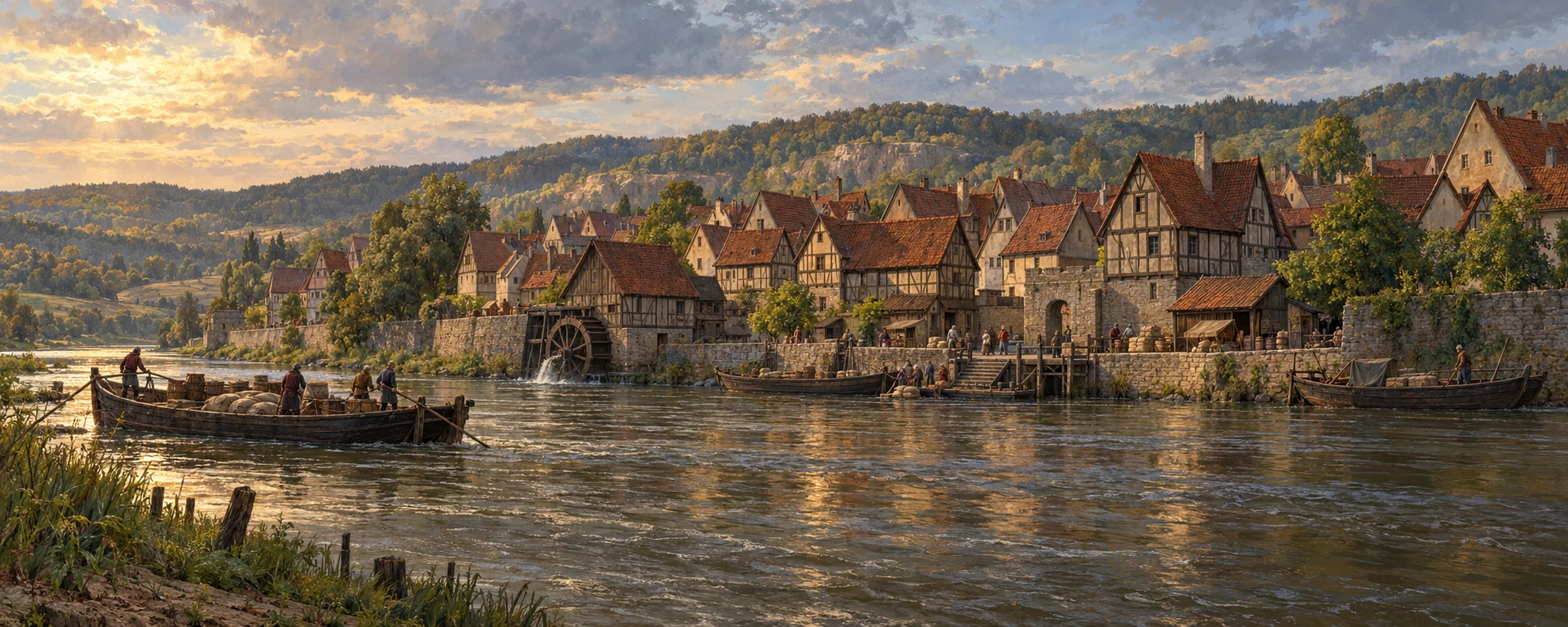
Hameln lives by the Weser and remembers the children who never came home. Bargemen shout for a tow at the landing, millhands carry flour through the Fish Gate, and apprentices hurry bread across the market before the bell. A visitor can earn good coin unloading a barge, buy a sound horse or spend a comfortable evening over roast fish and beer. The old disappearance has not stopped the town from living.
A visitor who unpacks a flute is stopped before the first note. The eastern road leaves the houses for fields and wooded hills. Somewhere beyond it, 130 children walked out of the world. Their families’ descendants still keep their names, while the stranger who led them away has found reasons to return.
Hameln sits among the competing Welf lands of Brunswick–Lüneburg. Its council runs the town, its mills feed the valley, and its river workers know more about the passages beneath the walls than any distant prince.
Music and Dance Are Forbidden
Music and dancing are banned throughout Hameln. Since the children vanished in 1284, the council has forbidden instrumental music, singing, whistled tunes and dancing within the walls, in private houses as well as public places. Weddings have feasts and spoken toasts; inns have conversation and dice, but no musicians or dancers. Instruments may be carried through town wrapped and silent.
Gatekeepers warn newcomers. Innkeepers stop a song or a dance before it begins; the watch ends performances and holds the instruments until their owners leave town. Deliberate or repeated defiance brings a fine and a hearing before a magistrate. Ordinary speech, work calls, warning bells and unpitched signals remain part of daily life. The law commemorates the lost children and makes any returning melody an immediate alarm.
What Is Happening Right Now?
The Pfortmühle has stopped for an hour, and everyone can hear what its wheel usually conceals. Two apprentices sent into a blocked watercourse have not returned. Their rope has come back cut cleanly. Beneath the grating, someone is tapping the same three notes on a pipe. Millwright Greta Voss has barred the sluice handle and wants rescuers with lamps, ropes and the sense to keep an escape route open. Grain carts are already backing up outside.
At the granaries, rats gather in orderly rows and leave the sacks untouched. Workers who try to drive them out find the animals reassembling at another door. A well-dressed stranger has offered to clear the warehouses, but insists on speaking to someone who can promise more than money. His name is Nicholas of Cologne, the Pied Piper.
Meanwhile, a copying clerk has received an old account of the disappearance from Lüneburg. One name in its margin does not appear among Hameln’s 130: Johann Linde. The clerk is looking for someone willing to carry a copy to the eastern gate, where a child in unfamiliar clothes has been seen asking for a street that no longer exists.
Streets, Mills and the Eastern Hills
The Market and the Kophus
The town hall, called the kophus in the merchants’ tongue, shelters trading places as well as councillors. Public scales, bread benches, meat stalls and hired porters make the market a useful first stop. A buyer can compare a millstone, inspect a packhorse or find a boatmaster seeking guards. Competition for reliable hands becomes fierce when several barges arrive together.
Osterstraße carries carts between workshops, merchant yards and the eastern approach. Behind the timber houses, covered courts hold barrels, drying cloth and the carts their owners cannot leave in the street. The best gossip travels with the bread sellers, who enter houses whose front doors remain closed to strangers.
The Fish Gate and the Hamelner Loch
Outside the Fischpforte, crews unload vessels before negotiating the notorious Hamelner Loch, the difficult passage through the river weir. Cargo and boats need experienced hands, ropes and patience. A crew that treats it as an ordinary stretch of open water can lose its livelihood in minutes.
The Pfortmühle stands near the gate, fed by channels whose grilles catch branches, torn sacks and whatever the river brings down. Flood-marked openings beneath the quay lead into older watercourses. Their danger is practical as well as supernatural: a sluice opened above can fill a passage faster than a person can crawl back out. Working channels, neglected warehouse drains and smugglers’ routes connect only in particular places; the whole town does not sit above one convenient dry sewer.
The Sacred Precinct
The old precinct contains shrines, a school, copyists’ rooms and storehouses. Its keepers maintain lists of the lost and offer quiet rooms to frightened families. Small gifts left beside the memorial include carved toys, lengths of red wool and bread baked to a grandmother’s recipe. These offerings belong to households, not to the Piper.
Walls, Towers and the Hill of Loss
The Haspelmath tower and the tower used for powder stores are working parts of the defences. From the wall a watchman can see carts on the approaches and smoke rising over the outer smallholdings. Beyond the eastern gate, fields give way to quarry tracks and wooded slopes. Drovers know the dry paths; a stranger after rain can follow a cart rut into an abandoned cutting.
Local families disagree about the exact place where the children’s procession vanished. Some name a track beyond the fields, others a farther slope. The Piper’s prepared crossings matter more than any single cleft: a hillside that is solid stone by daylight may admit a procession when his returning melody reaches its final bar.
Inns, Taverns and Lodgings
Every inn observes the town’s ban on music and dancing. Hosts warn travelling performers at the door; even a private wedding feast must go without songs or a dance. Storytelling, spoken toasts and games supply the evening’s entertainment.
The Millstone — Comfortable Rooms off Osterstraße
Reputable; moderate to dear. Host Henneke Brandes offers clean shared chambers, two private rooms, hot pottage, river fish and a locked wagon yard. He serves merchants and travelling craft masters, charges openly for fodder, and keeps a lantern burning over the yard gate. Guests who need a trustworthy porter should ask his sister Alke, who manages the stable hands and knows which boat crews actually pay their labourers. Armed quarrels end with everyone involved outside the door.
The Rope End — Cheap Food beside the Fish Gate
Shabby but honest; inexpensive. Barke, a retired towman, serves bean stew, dark bread and small beer to porters, millhands and boat crews. Sleeping space is a common loft; valuables stay with their owners and there is no secure stable. Wet ropes dry over the rafters. The noise makes quiet conversation difficult, but a party can learn which landing has work, whose rope failed at the weir and whether anyone has heard music below the mill. Barke refuses payment for a meal brought to a family waiting for a missing worker.
The Brass Cup — Wine, Dice and Expensive Mistakes
Respectable frontage; poor value and unsafe company. On a lane behind the market, Ilsabe Korte rents curtained alcoves and sells wine at prices visitors are expected not to question. Agents and prosperous gamblers favour it. Her servants remember faces and repeat private conversations to customers who pay better. A guest who accepts credit soon discovers charges for candles, service and broken cups. Nobody is compelled to gamble, but the friendly stranger offering to cover a losing stake works with the house.
The Lost Children and the Silver Pipe
On 26 June 1284, the town records that 130 children followed a stranger in coloured clothes through the eastern gate and vanished beyond the hills. Generations of searching have produced written laments, accusations and routes that lead nowhere. The oldest surviving accounts dwell on the children, the musician and the departure; the famous rat-catching bargain belongs to later tellings.
In Hameln’s present danger, the Piper is real. Human-born and bound to a Fey bargain, Nicholas uses his silver instrument to command vermin and draw listeners towards prepared thresholds. He wants witnesses, control of the crossings and promises whose cost becomes clear too late. He speaks courteously and keeps the flute wrapped until his followers have cleared a route. When he plays, he openly defies the town’s law. The watch tries to stop him, but fear and his enchantments can break its cordon.
The children remain alive beyond a crossing into the Fey World, in a summer country whose seasons barely pass. Johann Linde, the 131st follower, keeps their names in a register. Rescuers need a return route as well as a way in: simply smashing the Piper’s flute while a threshold is open may strand the people they came to save.
The drains are part of the approach, not the whole mystery. Hired wererats move messages and prepare grilles; rat swarms drive workers from stores. The territorial Rat King follows its own interests beneath the Piper’s uneasy bargain. Treating every river worker as an accomplice only gives the actual agents more room to operate.
Confronting Nicholas: his four-edition NPC entry contains his CR 17 statistics, followers, prepared crossings and flute counterplay. Saving an apprentice or exposing a courier does not require fighting him. A direct assault on the Piper is a much more dangerous undertaking.
People and Powers
Greta Voss, millwright. Practical, soot-streaked and furious at having sent apprentices into a passage she thought safe. She knows the working sluices, lends proper tools to competent rescuers and insists on someone remaining above to guard the mechanism. A replacement hinge she did not fit is her first evidence of interference.
Hinrik Sasse, copying clerk. He can compare household names, recognise an older hand and explain why Johann’s marginal entry matters. He will provide a copy rather than surrender the only surviving record. His younger cousin works at the granaries; his concern is no longer antiquarian.
Marta Rott, called Grey Tail. The Piper’s wererat guildmistress recruits human smugglers as well as fellow lycanthropes. She wants secure passages and room for her people, not Nicholas’s rule over the entire city. Threats to her own followers can divide the alliance; indiscriminate attacks on the drains strengthen it.
The council and the Welf courts. Burgomasters and guilds govern daily life. William the Victorious’s Calenberg court is an influential neighbour, while Bernhard of Brunswick–Lüneburg administers Hildesheim’s sacred lordship. Welf princes pledged important Hameln rights to Hildesheim in 1433; those claims have not disappeared. In a crisis the council can supply guards, labour and stores, but cannot promise away every right attached to the river.
Help, Work and Magic
Hire river pilots at the landing and carters through the market. A pilot’s fee rises with dangerous water; a cheap novice can cost far more than an experienced boatman. Millworkers can supply rope, lamps, wedges and knowledge of a particular channel. Greta’s cooperation makes a drainage rescue safer than entering an unfamiliar hole with weapons drawn.
The sacred precinct provides ordinary care, ritual counsel and supervised access to surviving records. Its healers can treat injured workers and help frightened children rest. It has no public stock of charms guaranteed to defeat Nicholas. Those preparing to oppose his music should study Silence and his actual abilities, arrange a way to communicate without speech, and protect the people who must hold the exit.
Honest work is readily found shifting grain, repairing river fittings and escorting a family or cargo through the hills. Successful rescuers earn something more useful than a vague promise of gratitude: millworkers willing to stop a wheel, a host who keeps a room ready, and witnesses who will speak when the Piper makes his next offer.
Dangers and Things Worth Doing
The Apprentices beneath the Wheel
The two missing workers are trapped beyond a grille altered from below. One is hurt; the other keeps the tapping going. First secure the sluice above, then follow the rope and make room to turn an injured person through the opening. A brass token caught in the new hinge identifies one of Nicholas’s courier routes. The rescue can succeed without pursuing the gang into deeper passages.
A Barge across the Weir
A snapped hauling rope leaves a laden boat slewing across the Hamelner Loch. One crewman clings to a mooring, another is trapped beneath shifted sacks, and the boat is blocking the only working passage. River workers need hands on the bank and someone willing to board. The cargo is ordinary grain. A successful rescue wins reliable pilots and a river town’s very public goodwill.
The Child at the Eastern Gate
A girl in old-fashioned clothes gives the name of a father whose house vanished generations ago. A man wearing a watchman’s coat offers to take her somewhere quiet; his boots are wet with drain water and no guard at the gate recognises him. Protecting her can reveal a courier route and a living connection to the lost children. The Piper is waiting for news of which adults heard her story.
The Returning Melody
On the anniversary of the disappearance, Nicholas intends to bring his captives close enough for the town to see them and demand authority over its crossings. The party can seek Johann’s register, turn Grey Tail or the Rat King against him, find the counter-melody, or secure the children’s way home while others occupy the Piper. A counter-melody must be learned and rehearsed outside the walls; playing it in Hameln risks arrest even when the purpose is rescue. His preparations create several points of entry; no single stolen document or defeated guard settles the whole affair.
Arriving, Leaving and Staying Safe
By river: arrange unloading and a pilot before attempting the weir passage. Fast water, darkness and an impatient crew are a dangerous combination. Bargemen may take passengers, but a sleeping berth aboard a working boat is not a private cabin.
By road: the western approaches lead to the river crossing; eastern tracks enter the Weser hills and connect with the routes towards the Leine country and Calenberg. In rain, use a guide who knows the particular track. Quarry paths can end at a cutting rather than the next village.
In town: keep instruments wrapped and silent. Music, singing, whistled tunes and dancing are forbidden, including in inns and private rooms. The watch also handles theft, fighting and suspicious entries at the gates. Trade dues and particular warrants can involve the council, Welf officers or Hildesheim. Displaying the right noble badge does not entitle a traveller to seize a mill or open its sluice. Ask a working master before entering machinery or channels.
When the music starts: get children and bystanders away from the player, keep the exit clear and avoid dividing rescuers across an unknown threshold. Ear protection is sensible preparation, not a substitute for checking the Piper’s rules. His instrument, an audible melody and prepared crossings are concrete weaknesses that informed opponents can exploit.
The Shape of Hameln’s History
Hameln grew around a Weser crossing, a sacred estate and a market settlement, and was recognised as a town by the opening of the thirteenth century. Its river position, trade in millstones and longstanding milling rights mattered more than any extraordinary number of mills. Civic privileges developed amid struggles between neighbouring sacred lordships and the rising Welf power.
The loss of 1284 did not end ordinary history. Barges continued to arrive, guilds prospered and failed, and newcomers bought houses from families whose ancestors had lost children. Hameln joined the Hanseatic trading community in 1426 without becoming an independent city-state. The Welf pledge of rights to Hildesheim in 1433 added another claim to a town whose council still needed grain unloaded and streets kept safe.
Sources and Historical Background
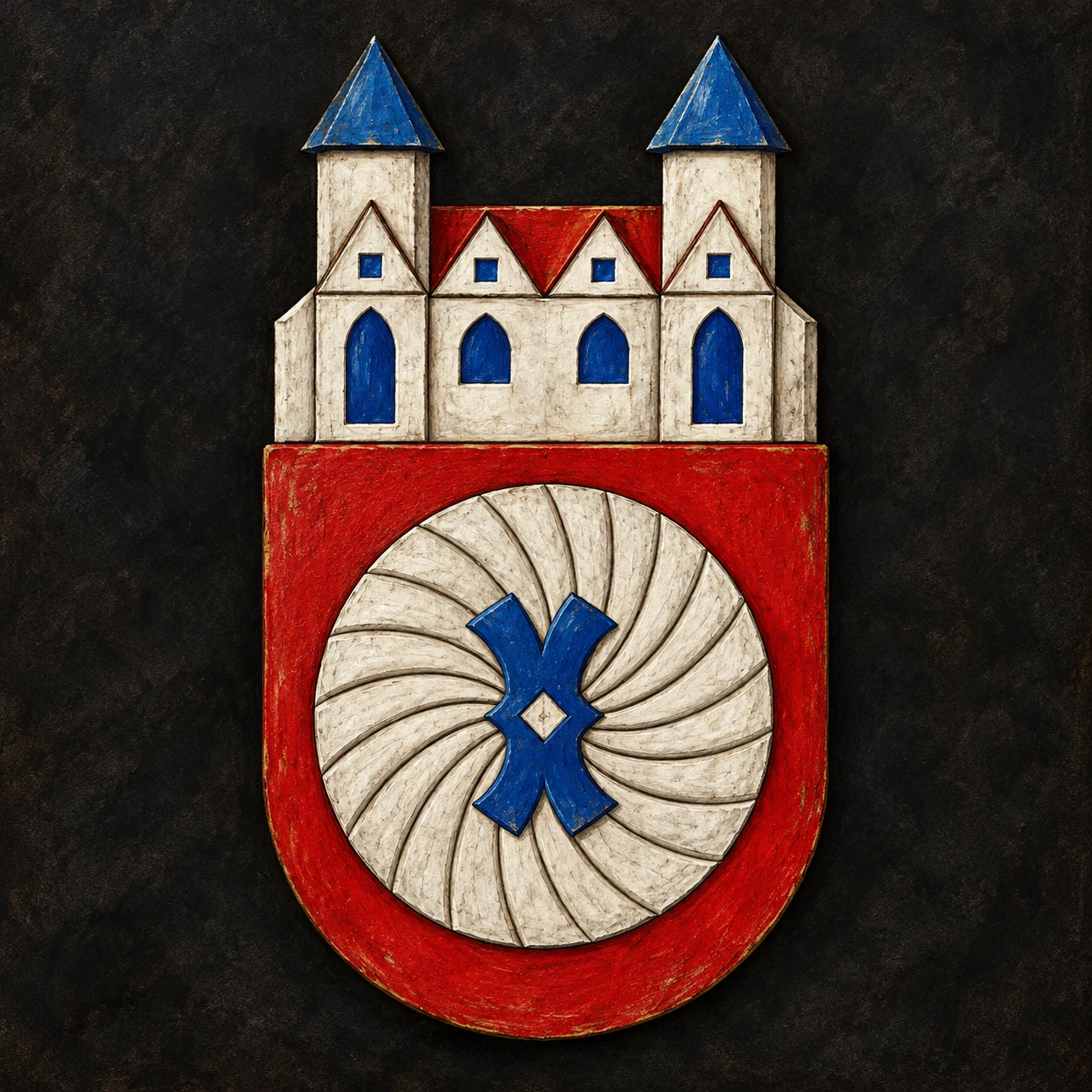
Heraldry: the City of Hameln’s arms and flag record. The painted campaign emblem adapts the later civic design, with a polytheistic architectural crest.
Town history and places: the City of Hameln’s chronology and historic town walk; the Haspelmath and powder-tower records. The city’s documented later architecture is distinct from the earlier town depicted here.
The lost-children tradition: Museum Hameln and the city’s chronology. The 1433 pledge and subsequent rights are recorded in the Lower Saxony state archive: the pledge and Hameln documents, 1433–1456.
The supernatural events, the surviving captives, the town-wide ban on music and dancing, and the named hostelries and their keepers belong to the campaign setting. The sacred precinct follows the setting’s polytheistic history. The river-town painting is an original artistic reconstruction, not a surveyed historical view.
Keep this reference growing
If this page helped with your reading or game, you can support its upkeep or explore the curated books.
Explore the Bookshop — epics, classics and stories behind imagined worlds.