
Southern Ocean
At a Glance
| Campaign present | 1454 CE |
|---|---|
| Great water | Southern Ocean, encircling Antarctica |
| Connecting oceans | Southern Atlantic, Indian and Pacific |
| Principal passages | The seas south of South America, Africa, Terra Australis and Aotearoa |
| Character | Immense swell, powerful west-to-east current, bitter weather and distant ice |
| Landfall | Scattered islands and isolated stretches of Antarctic coast; very few safe places for repair |
| Dangers | Capsize, broken spars, exposure, drifting ice, freezing spray and currents that carry a disabled vessel far from rescue |
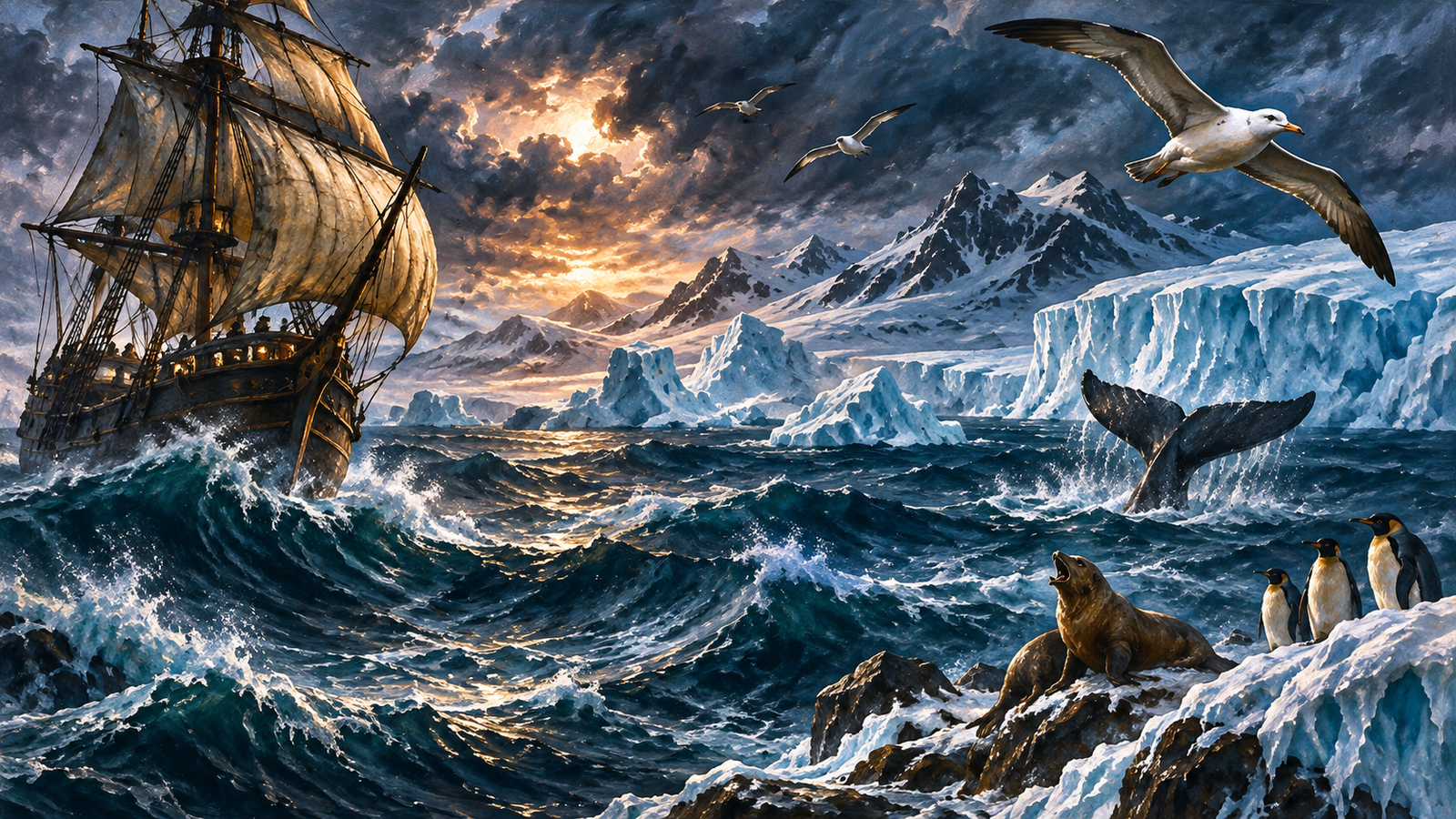
There is no harbour in sight when the sea begins to change. The waves lengthen, the wind rises and the ship’s timbers creak under water that seems to run without end. Men work the sails with cold hands while the lookout scans a horizon free of land. Only seabirds and the occasional dark back of a whale break the surface. Every person aboard knows that a lost mast here may be worse than an enemy ship.
The Southern Ocean rings the frozen continent. Strong prevailing winds drive the sea eastward through latitudes where few great land masses interrupt it. It is a world of moving water and moving ice; even a well-provisioned expedition cannot treat it like a coastal crossing.
What Is Happening Right Now?
The lone boat in the swell
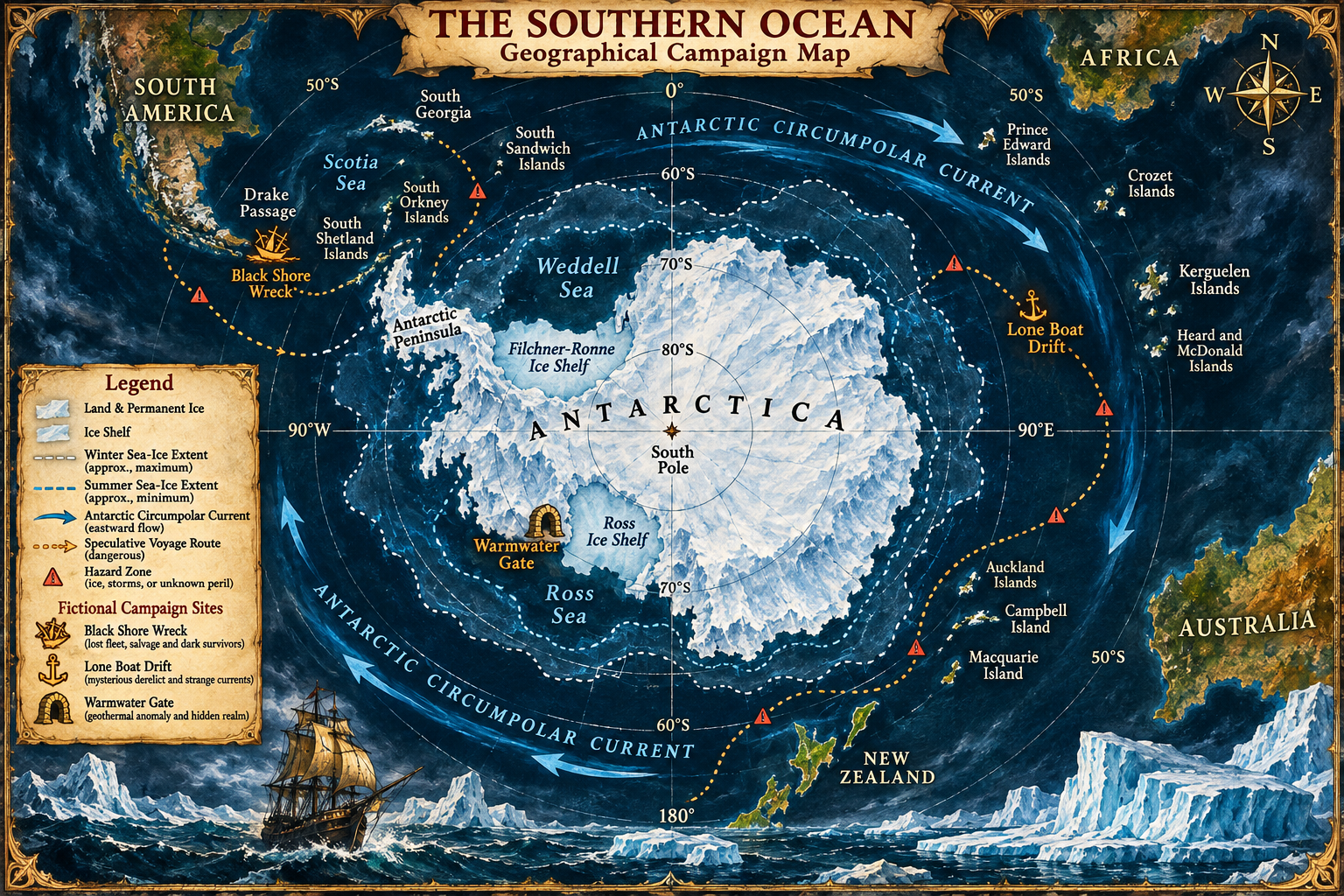
A vessel caught in the high southern westerlies finds a small boat drifting half full of water. There is no ship nearby and no oar aboard, only a length of unfamiliar cord and two sealed food jars. Someone made a deliberate effort to keep the food dry. The boat may have come from an isolated landing or a larger vessel that has already gone down. Following its probable drift risks taking the rescuers farther into the fiercest water.
A wreck against the black shore
The survivors of a shattered expedition have reached a rocky island on the northern edge of the polar water. They have firewood for only two more nights. Wreckage offers timber, iron and a few damaged casks, but the next gale will sweep the landing. A rescue party must find a safe approach while the survivors decide whether to shelter on the island’s exposed upper ground or attempt a voyage in their crippled boat.
The ice that opens below
Near an Antarctic ice shelf, hunters of the cold sea notice a repeating warm current rising from beneath a wall of blue ice. A dangerous opening has formed where the shelf meets the water. Strange metal fragments wash out at intervals, suggesting a concealed passage deeper into the Shrouded Dominion. Each attempt to approach is interrupted by moving bergs, and the warm water has attracted a predator.
One sea around a continent
The Antarctic Circumpolar Current sweeps eastward round the southern world. It passes south of the great continents and moves the waters of the Atlantic, Indian and Pacific into contact. The size and force of this circulation are felt most clearly by crews attempting to work against it. A seemingly small failure of steering can carry a disabled ship far from its intended course.
Storms have room to grow. A ship can spend days meeting swell that was raised by weather nowhere near the vessel. Waves strike from directions that change with the wind. Ice adds hazards unseen in warmer seas: floating fragments can damage a hull, and a field of broken bergs closes an otherwise open route.
Islands and the Antarctic approaches
An island shelter may be a bare cliff with a single difficult beach. Some shores support seabirds and seals but provide no fresh firewood, good anchorage or place to repair a mast. The sight of land should not be mistaken for rescue.
Farther south, the ice-covered coast of Antarctica, the Shrouded Dominion brings another set of perils: towering ice faces, strange inland mountains, geothermal openings and the possibility that something has survived beneath the continental ice. Those mysteries belong to the land; the ocean remains the dangerous approach that keeps them isolated.
The Sea of Silence and other names used by travellers in the Dominion do not erase the physical coastline or the actual weather around it. A chart that leads someone toward an ancient opening must still lead them past the bergs.
Stories carried into the southern waters
The crews crossing toward Antarctica bring the stories of their homelands. The names spoken on ships approaching the Southern Ocean come from the people who crew them, from the islands and continents where those voyages began.
On waka passages out of Aotearoa, voyagers remember Te Parata, the terrifying ocean being whose breathing draws the sea inward to make a whirlpool. An account of the Mata-atua voyage tells how the ocean opened its throat and the crew survived through the knowledge and action of their tohunga. Men who carry that story into colder southern water know a dangerous current can be both a physical peril and the presence of a being. The steersman has never seen that whirlpool himself, but when the current seizes the stern he remembers exactly how near the old waka came to being swallowed.
The black water nearest the Shrouded Dominion feeds vast swarms of krill, pursued by whales and seabirds along the edge of the drifting ice. A lookout who sees birds gathering can learn where the open leads lie; a sailor who mistakes a calm lead for a safe anchorage may be trapped when the pack turns with the wind. Along this coast the animals often know where the living water lies before a human chart does.
The lives of the cold water
Seabirds follow the productive waters and seals use ice and coastal haul-outs. Whales travel through the region. The small life of the sea feeds the large, even where the surface appears empty. Not every dark shape in rough water is a monster. The Animal Bestiary covers whales, orcas and other real marine life, which sailors must distinguish from the creatures of the deep. A crew that panics at an ordinary whale may miss the breaking ice that threatens its ship.
There are depths in which marine powers may travel without crossing any human ship’s route. The hidden kingdom below the water has its own interests, and a vessel carrying an artefact recovered from beneath polar ice might meet something capable of following it for a thousand miles.
A kraken can be a nightmare here, but the storm itself needs no magical explanation. The Southern Ocean is dangerous even when no supernatural enemy is present.
What can carry a crew this far south?
The open southern sea calls for a sound, well-stored sailing ship and people accustomed to heavy swell. Small rowing craft are for a sheltered landing or a desperate transfer, not a dependable ocean crossing. The closest coast may offer no timber, food or harbour in which to replace a broken mast.
A rare submersible or diving bell can approach a wreck or ice-shelf opening from below, but neither removes the need for a surface support vessel and safe recovery. Ship Combat governs battle between vessels; the ice and weather can defeat ships before an enemy ever fires.
Survival between landfalls
Cold and wet clothing exhaust a crew. Freezing spray loads rigging and decks with weight. Damaged spars must be secured before they bring down others. A vessel forced to run before a gale may end up farther from help than when the storm began. In open polar water, the nearest suitable landfall may be impossible to approach from the present wind direction.
There is little room for improvising supplies after departure. Spare timber, rope, sailcloth, fuel, water, dry rations and a navigator experienced in heavy southern seas all matter. Ships bound for this water must carry what an ordinary harbour could normally provide.
Southern Ocean Hazards — Game Rules
A broken steering line, an unseen floe or a giant following wave can end an expedition before any enemy arrives. Use the normal rules for weather, cold, swimming and ships. The encounters below describe specific dangerous moments at sea.
Southern Ocean Hazards — D&D 2024
Ordinary conditions. Use the 2024 Dungeon Master’s Guide rules for extreme cold, strong winds, poor visibility, swimming, falling and exhaustion. These local hazards do not replace ship combat or an existing vessel’s rules.
Breaking sea. When a large wave smashes across an exposed deck, each unsecured creature there makes a DC 15 Strength saving throw. On a failure the creature takes 2d6 Bludgeoning damage, falls Prone and is driven up to 10 feet towards the lee rail. A secured safety line prevents being swept overboard; a creature driven over an unprotected edge falls into the sea.
Hidden floe. A lookout who succeeds on a DC 15 Wisdom (Perception) check spots a mass of ice in time to warn the helmsman. The helmsman must then succeed on a DC 15 Dexterity check using suitable water vehicles proficiency to steer clear. On a failure, the vessel strikes the ice: resolve damage using that vessel’s statistics and the circumstances of the collision.
Ice-slick deck. A crew member running across a heavily iced deck makes a DC 13 Dexterity saving throw or falls Prone. Removing ice, using a secured rope or moving cautiously avoids the saving throw.
Southern Ocean Hazards — D&D 2014
Ordinary conditions. Apply the 2014 Dungeon Master’s Guide rules for extreme cold, strong winds, visibility, swimming, falling and exhaustion. The following events are encounter hazards rather than substitute ship statistics.
Breaking sea. Each unsecured creature on an exposed deck caught by a crashing wave makes a DC 15 Strength saving throw. Failure deals 2d6 bludgeoning damage, knocks it prone and pushes it up to 10 feet towards the lee rail. A safety rope prevents being washed overboard; an open edge may allow the pushed creature to fall into the water.
Hidden floe. A successful DC 15 Wisdom (Perception) check detects the ice in time. The helmsman can then make a DC 15 Dexterity check, adding water vehicles proficiency if proficient, to avoid impact. On failure the vessel collides; determine the consequences using the ship’s game statistics.
Ice-slick deck. Running on a deck glazed with ice requires a DC 13 Dexterity saving throw. Failure knocks the creature prone. A safety line, deliberate clearing or careful progress removes the immediate hazard.
Southern Ocean Hazards — Pathfinder 1e
Ordinary conditions. Follow the Pathfinder Roleplaying Game environmental rules for cold dangers, wind, visibility, swimming and falling. Use the established vehicle and ship rules for any damage to the hull.
Breaking sea. A tremendous wave strikes the deck. Every unsecured creature exposed to it makes a DC 15 Reflex save; failure causes 2d6 bludgeoning damage, knocks the creature prone and washes it up to 10 feet towards the lee rail. A properly attached safety line prevents a fall into the sea.
Hidden floe. A lookout must succeed on a DC 15 Perception check to spot ice before the ship closes with it. A helmsman then makes a DC 15 Profession (sailor) check to alter course safely. Failure leads to a collision; apply ship damage and movement rules appropriate to the vessel.
Ice-slick deck. A creature that hurries over an iced deck makes a DC 13 Acrobatics check or falls prone. Slow movement and secured ropes avoid the check.
Southern Ocean Hazards — D&D 3.5e
Ordinary conditions. Use the Dungeon Master’s Guide rules for cold dangers, strong winds, weather, swimming, falling and fatigue. Vessel damage and steering follow the campaign’s applicable ship rules.
Breaking sea. A heavy wave breaks over the exposed deck. Each unsecured creature caught in it makes a DC 15 Reflex save; failure deals 2d6 bludgeoning damage, knocks it prone and washes it 10 feet towards the lee rail. A secure safety line prevents being lost overboard.
Hidden floe. A DC 15 Spot check notices the floe in time; the helmsman must then succeed on a DC 15 Profession (sailor) check to steer around it. Failure means the hull strikes ice. Apply appropriate vessel damage from the ship rules.
Ice-slick deck. A creature moving quickly over an iced deck makes a DC 13 Balance check or falls prone. Moving with a secured line or first clearing a path avoids the check.
The roads out
Northward lie the approaches to South America, Oceania and the sea routes of Africa. Southward lies Antarctica. Continue through the Oceans hub; consult Aquatic Terrain for water and cold-weather encounters.
The last icebound landfalls connect to Antarctica, where ice cliffs conceal ancient passages into the Deep Earth.
Sources
- Ngāti Pūkenga, Mata-atua voyaging account — Te Parata and the Mata-atua voyage.
- British Antarctic Survey, Southern Ocean.
- Discovering Antarctica, Coast and Adjacent Seas — circumpolar circulation.
- NOAA, Roaring Forties.
Keep this reference growing
If this page helped with your reading or game, you can support its upkeep or explore the curated books.
Explore the Bookshop — epics, classics and stories behind imagined worlds.