
Submersible — The Experimental Undersea Vessel
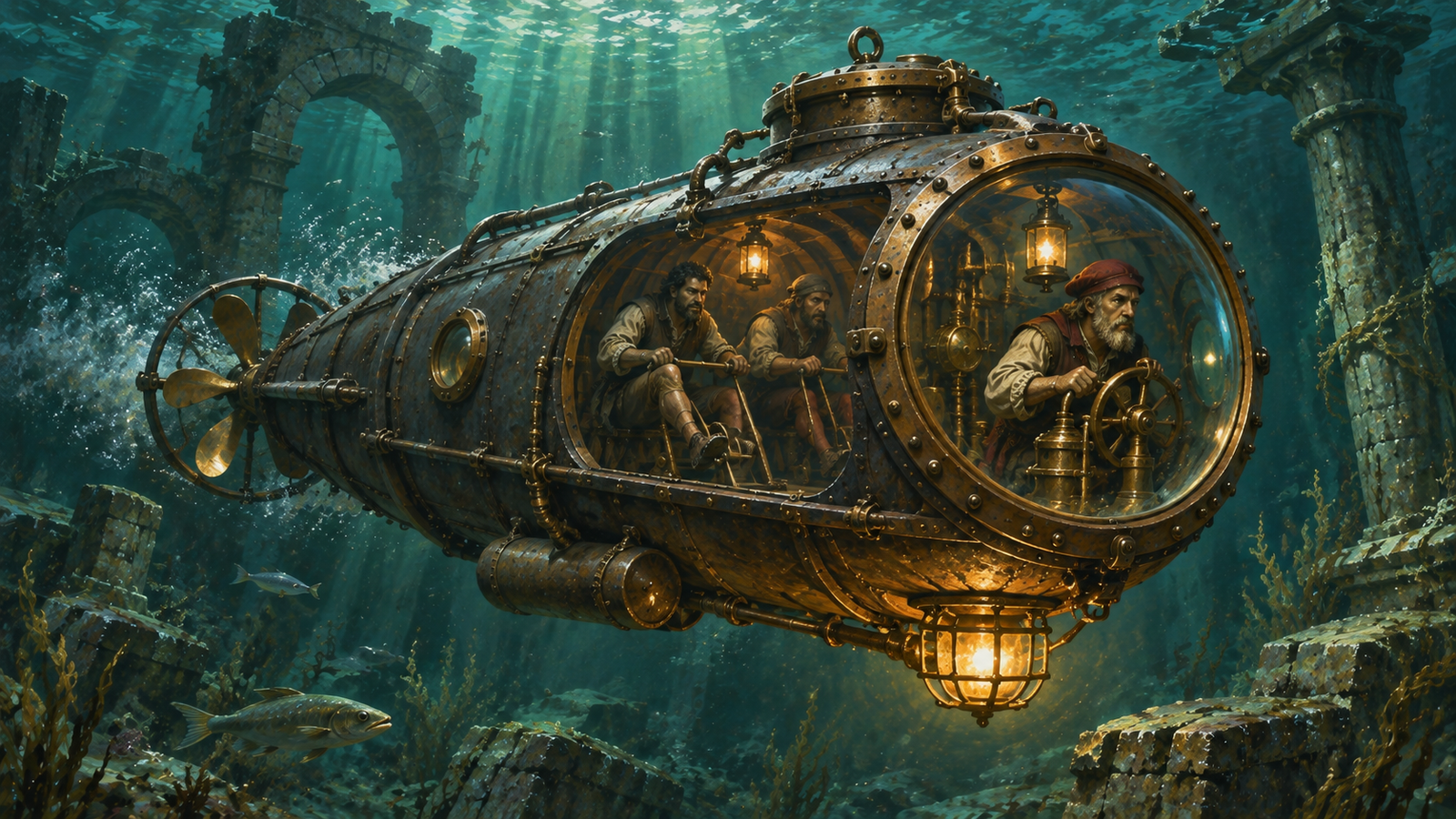
At a Glance
- Type
- Experimental, fully enclosed human-powered undersea vessel
- Construction
- Tubular riveted steel shell with forward viewing port
- Propulsion
- Two pedal operators driving a stern screw
- Helm
- Third operator controls depth and direction with levers
- Complement
- Three working crew; five Medium occupants at maximum
- Travel
- 20 ft. per round horizontally; 30 ft. descending; 10 ft. ascending
- Rated Depth
- 225 feet in the original experimental design
- Endurance
- Two hours of air for three people, shorter with passengers
- Weaknesses
- Leak, jammed screw, broken rudder, depleted air and pressure damage
The brass lamp beneath the bow cuts a narrow path through the green darkness. Inside the steel tube, two sailors labour at the pedals while the pilot grips a pair of levers. Ahead, the wreck of a war galley hangs between two submerged rocks, its stern higher than its bow. The screw begins to shudder. Something long and pale has caught in the blades, and the last patch of sunlight is already far above.
The submersible is a dangerous invention of the workshops of 1454, a sealed iron fish whose movement comes from people rather than wind, oars or a friendly current. It is built to reach the places a rope-suspended diving bell cannot approach: beneath a reef, through a drowned arcade, or along the seaward foundations of an enemy harbour. The promise of hidden travel tempts princes and treasure hunters. Those who have sailed inside one speak first of the stale air, not the treasure.
A Steel Hull and a Human Engine
The elongated hull is assembled from thin steel plates riveted to a ribbed frame. A hatch in the roof gives access while the vessel is at the surface. The narrow forward window is made from thick glass and secured within a reinforced ring. Behind it the pilot works three sets of controls: direction, descent and ascent. Two companions drive pedals linked through gearing to a screw at the stern.
Under way. The operators turn the screw by repeated pedal strokes. On a long journey they tire just as rowers do, but cannot stop for much-needed air unless they surface. A brightly burning magical lamp in a protective cage beneath the bow may show obstacles, while also announcing the vessel’s presence to anything living in the dark.
Ballast and depth. The pilot adjusts the craft’s trim to dive or rise. The experimental hull is rated for no more than 225 feet. Beyond that depth, fastenings, glass and seals may buckle. A working pressure regulator does not create fresh air: the crew must keep track of how long they have been submerged.
Space. There is room for three operators and up to two additional passengers, not a troop complement or merchant cargo. More people consume the shared air faster. Heavy objects brought aboard must be secured so they cannot roll into the pedals or jam the steering levers.
Returning to the surface. The vessel rises more slowly than it dives, and a broken ascent control may leave it unable to surface. A trapped crew may try to signal a nearby ship by ringing the hull or flashing its forward lamp, but its sealed hatch cannot safely be opened in deep water.
Unseen Voyages and Hazards
An undersea craft might carry messages through a blockade or inspect the hull of a ship without warning its crew. Such secrecy has a price. A tide that seems gentle from above can push a slow, pedal-driven tube against jagged stone. A bent propeller may leave it drifting, and even a successful mission can become fatal if the crew misjudge its air reserve.
The Broken Screw. An artificer offers the party a reward to inspect a wreck beneath a harbour chain. The submersible reaches the wreck, but its screw catches a line of black kelp that moves against the current. The pilot has eighty minutes of air remaining, and someone inside the wreck is hammering on its hull.
The Passenger Who Never Breathed. A noble pays to ride beneath the harbour walls with a sealed chest. During descent, the pilot notices that the passenger’s breath never clouds the cold viewing port. If the chest is opened, the ship’s air begins to vanish faster than the crew can account for.
Law. Harbours have rules about armed vessels, customs and salvage. A hidden machine can avoid the customary inspection of a ship at anchor, making it as attractive to smugglers as to explorers. A ruler who discovers one beneath his sea walls may treat the craft as an instrument of war.
Submersible — Vehicle Rules
Submersible — D&D 2024
Experimental Waterborne Vehicle (Setting Statistics). This is a complete specialised vehicle adapted for play, not an official ship in the published equipment table.
| Property | Value |
|---|---|
| Cost | 4,500 GP |
| Speed | 2 mph under steady pedalling; 20 ft. horizontally per round |
| Vertical movement | 30 ft. per round descending; 10 ft. ascending |
| Crew | 3 (one pilot, two pedal operators) |
| Passengers | 2 additional Medium creatures |
| Cargo | Only gear secured within the occupied compartment |
| AC | 19 (riveted steel shell) |
| HP | 90 |
| Damage Threshold | 10 |
| Maximum depth | 225 ft. |
| Air reserve | 360 creature-minutes; 120 min for three, 72 min for five |
Pilot and crew. The pilot uses a Utilize action to adjust depth or heading, while each pedal operator spends a Utilize action to propel the vessel that round. If either pedal operator stops, horizontal speed is halved; if both stop, the craft cannot move horizontally under its own power. In a hazardous manoeuvre, the pilot makes a DC 15 Dexterity check using Water Vehicles proficiency.
Damage and pressure. A jammed screw halts horizontal propulsion until freed. At 0 HP, the hull floods and the occupants face normal underwater breathing hazards. Exceeding 225 ft. triggers a DC 15 Dexterity check using Water Vehicles proficiency each round; failure causes 2d10 bludgeoning damage to the hull. The pilot can ascend normally while the craft remains operable. These depth rules are specific to this setting vehicle.
Rules framework: D&D 2024 Basic Rules — Waterborne Vehicles; custom submersible statistics.
Submersible — D&D 2014
Experimental water vehicle, setting profile. Cost 4,500 gp; AC 19; 90 HP; damage threshold 10; travel speed 2 mph (20 ft. per round horizontally); descend 30 ft. per round; ascend 10 ft. per round; crew 3; two additional passengers; maximum depth 225 ft.; air reserve 360 creature-minutes.
Operation. One pilot operates the controls and two crewmen pedal. The pilot uses an action to steer or change depth; each pedaller contributes an action per round. With one pedal operator, forward movement is halved; with none, it stops. A difficult manoeuvre requires a DC 15 Dexterity (water vehicles) check, if the pilot has that proficiency.
Damage. At 0 hit points, the hull floods. Beyond the rated depth the pilot makes a DC 15 Dexterity check using water-vehicle proficiency each round, or the hull takes 2d10 bludgeoning damage. A broken screw or steering mechanism is handled as a damaged object; until repaired, it cannot carry out its normal function. Air lasts two hours for a three-person crew or 72 minutes for five people.
Rules framework: Dungeon Master’s Guide (2014), Airborne and Waterborne Vehicles, and the 2014 ability-check and object rules. This particular vessel is a complete custom equipment profile.
Submersible — Pathfinder 1e
Submersible — Large water vehicle (original setting design). Squares 3 (5 ft. by 15 ft.; 6 ft. high); Cost 4,500 gp.
Defense
AC 9; Hardness 10; hp 90 (broken 44); Base Save +0.
Offense
Maximum Speed 20 ft. forward, 30 ft. descending, 10 ft. ascending; Acceleration 10 ft.; CMB +1; CMD 11; Ramming Damage 1d8. Ramming below water is hazardous to the sealed hull and is not its normal use.
Description
Propulsion muscle (pushed; 2 Medium pedal operators using a stern screw); Driving Check Profession (sailor), DC 5 in ordinary conditions or DC 20 in combat under the vehicle rules; Forward Facing bow; Driving Device steering and ballast levers; Driving Space forward square; Crew 2 (in addition to the driver); Decks 1 sealed compartment; Occupants 5 total; Air 360 creature-minutes; Rated Depth 225 ft.
Special. The pilot must maintain a valid driving action while the two pedallers work. Without both operators, maximum horizontal speed is 10 ft. with one or 0 ft. with none. A jammed screw stops forward propulsion. At 0 hp the vessel becomes wrecked and floods; apply Pathfinder’s sinking and drowning rules. Beyond 225 ft., a failed DC 20 Profession (sailor) check during a drive action deals 2d10 damage to the hull (hardness does not reduce this internal pressure damage). These are setting-specific rules for this custom vehicle, not a Paizo-published Submersible block.
Vehicle framework: Pathfinder Ultimate Combat — Vehicle Statistics, Driving and Damage.
Submersible — D&D 3.5e
Third-party experimental equipment (Ultimate Equipment Guide II, Mongoose Publishing, 2005); Cost 4,500 gp; Weight 1,250 lb.; Crew 3; Maximum Occupancy five Medium creatures; Maximum Depth 225 feet; Air two hours for its three-person crew.
Movement. Two crew members turn pedals powering a screw at the stern. A third uses steering and ballast levers. The original supplemental speeds are 20 ft. horizontally per round, 30 ft. descending and 10 ft. ascending. There is no sail or oar propulsion.
Construction. Thin steel plates form a tubular hull, sealed by a hatch in the roof. A thick forward glass port provides sight and a protective cage beneath the bow can hold an everburning torch or sunrod for underwater light.
Operating and damage. The pilot can use Profession (sailor) for difficult controls or conditions. The equipment description does not supply core vehicle AC, hardness, hp, CMB or CMD, nor a universal collision attack. Resolve struck plates, glass and fittings using 3.5e object and environmental rules. At its depth limit or when the breathable air is gone, the crew must return to the surface; a damaged hatch or screw may prevent safe escape.
Supplement: Greg Lynch and J. C. Alvarez, Ultimate Equipment Guide II (Mongoose Publishing, 2005); core rules: D&D 3.5e SRD — Objects.
Underwater Craft and Sources
Compare this self-propelled craft with the Diving Bell, the surface Keelboat and the Drag Anchor, or return to the Vehicles catalogue.
Original design and price: Greg Lynch and J. C. Alvarez, Ultimate Equipment Guide II (Mongoose Publishing, 2005). The 2024, 2014 and Pathfinder 1e profiles are setting conversions, not official printed vehicles. The former picture showed Cornelis Drebbel, who lived much later than the default setting’s 1454 date, and has been removed from the page.
Keep this reference growing
If this page helped with your reading or game, you can support its upkeep or explore the curated books.
Explore the Bookshop — epics, classics and stories behind imagined worlds.