
Bavaria-Landshut — The Rich Duke’s Isar Realm
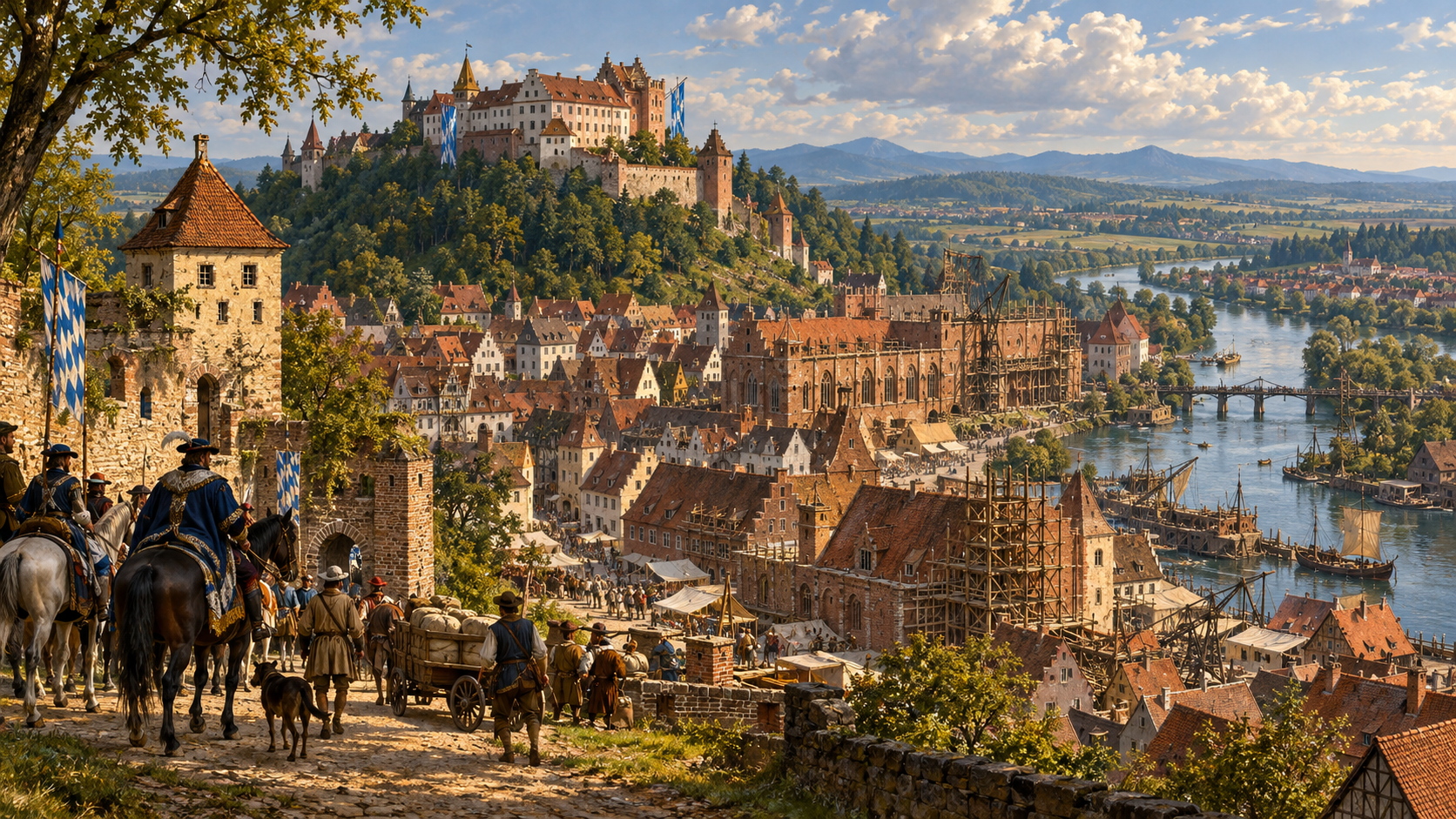
The duke’s coffers are full, his borders are wider than they were a decade ago, and a single sealed claim from the old Ingolstadt lands may be worth a fortune—or a life.
Bavaria-Landshut at a Glance
| Campaign Present | 1454 |
|---|---|
| Realm | Independent Wittelsbach duchy within the Holy Roman Empire; not a province of Munich |
| Capital | Landshut, on the Isar |
| Duke | Ludwig IX the Rich (Louis IX), reigning since 1450 |
| Dynasty | House of Wittelsbach, Landshut branch |
| Strongholds | Trausnitz Castle, Burghausen Castle and Ingolstadt |
| Government | Ducal council, estate officers, judges, town magistrates and bailiffs |
| Languages | Bavarian German and written Latin; travelling merchants bring other tongues |
| Trade | Grain, river tolls, salt carriage, iron, cloth, livestock and mountain mining |
| Political Rival | Bavaria-Munich under Albrecht III |
| Adventuring Dangers | Inheritance disputes, contested writs, toll fraud, secret orders and river spirits |
The Isar Realm of the Rich Duke
From Trausnitz Castle, high above the market streets of Landshut, Duke Ludwig IX rules one of the wealthiest courts in the southern Empire. Merchants bring iron, grain, hides and salt through his walled towns, while bargemen count the toll stations along the rivers. Nobles arrive with marriage contracts, contested estates and demands for armed support. Since the extinction of the Ingolstadt ducal branch, Landshut’s officers have claimed a broad and sometimes scattered new inheritance.
Wealth has not brought quiet. A wax seal can determine ownership of a village; a mine’s accounts can reveal fraud; a false safe-conduct can send a merchant into a rival lord’s prison. Old family arguments have become valuable to spies. On the wilder roads, forest pacts and river spirits make demands that no duke has ever recorded.
What Is Happening Right Now?
The Ingolstadt Inheritance Remains Bitter
When the Bavaria-Ingolstadt line ended in 1447, both Landshut and Munich had claims. The Treaty of Erding in 1450 confirmed Landshut’s possession of almost the entire Ingolstadt inheritance, with limited territorial and financial concessions to Munich. Some creditors and noble families still contest debts, land rights and the custody of earlier charters. Legal messengers travel under guard; a missing archive may matter more than a battle.
Ludwig Counts His Riches
Ludwig IX commands full ducal authority in Landshut, but relies on stewards, collectors, captains and judges to exercise it. He rewards useful service and resents attempts to bypass his household. For a petitioner, a witness and an intact account book are worth more than an impressive sword.
Munich Maintains Its Own Court
Albrecht III remains the reigning duke of Bavaria-Munich. The adult prince Albert IV, active in the campaign as envoy and political patron, may send agents to investigate disputed claims. His ambitions do not make him ruler of Landshut, and a Munich warrant is not automatically valid in this duchy.
The Unwelcome Smiths
Disputes over levies, guild privilege and ducal authority have estranged some dwarven craft and merchant households. A few have departed; others negotiate through allies or conceal valuable records. A corrupt toll officer can turn a genuine legal complaint into a dangerous matter of loyalty.
Places Adventurers Can Reach
Landshut — The Ducal Capital
Market stalls, brick-built town houses, river yards and busy craftsmen fill the Isar town beneath the castle hill. Great masonry works rise near its centre, but the completed towering spire familiar to later travellers does not exist in 1454. Scaffolds and supply yards conceal opportunities for theft, clandestine meetings and strange discoveries beneath old foundations.
Trausnitz Castle — Seat of the Duke
The fortified hilltop residence dominates Landshut. Guards control the approaches; chamberlains, storekeepers and clerks command the rooms within. A minstrel, physician, smith or envoy may be admitted by invitation, but an armed stranger cannot simply approach the duke. Documents held in the ducal archives can decide the fortunes of entire households.
Burghausen Castle — The Southern Fortress
The great ridge fortress above the Salzach protects a major crossing and guards a valuable flank of the duchy. It has strong fifteenth-century defences, but many of the features built later under George the Rich are not yet present. A courier intercepted between the two ducal residences could threaten the safety of an entire household.
Ingolstadt — The Newly Inherited Stronghold
This fortified Danube town has come largely under Landshut’s control. Merchants and magistrates still remember older privileges, while clerks must interpret orders bearing new ducal seals. Hidden operatives of the Bavarian Illuminati seek occult and political records among the inherited archives. They are a secret faction, not servants officially appointed by Ludwig IX.
Rattenberg and Kitzbühel — Mountain Riches
Mining districts and upland routes contribute to Landshut’s prosperity. Transport requires guides, guarded wagons and agreements with distant local officers. In the Alpine wilderness, winter weather and creatures in old galleries may defeat the best-laid trade plans.
The Isar, Mills and Border Roads
Bridge keepers, ferry crews and millers know the crossings. River floods can isolate villages; smugglers move at night; some pools are watched by spirits that accept offerings more readily than the duke’s coin.
People Adventurers May Actually Meet
Ludwig IX — The Rich Duke
The duke is proud of his treasury and the reach of his laws. Characters who produce proof of fraud against his officers may earn his patronage; those who come without witnesses or introductions will be received by lesser officials first.
Amalia of Saxony — Duchess of Bavaria-Landshut
Amalia, the duke’s consort, maintains courtly relationships and her own household access. A discreet appeal through an attendant may open doors where a public accusation would fail, especially in matters of family honour or a broken alliance.
Albert IV — The Munich Envoy
In this campaign Albert is an adult Wittelsbach prince, ambitious and active at the Munich court. His interest in disputed lands may bring him—or his representatives—into Landshut’s orbit. He must negotiate here, not command as duke.
Stewards, Bailiffs, Guild Elders and Mine Officers
Most travellers never meet a duke. They meet the castle steward who grants a hearing, the toll clerk who blocks a cart, the guild master who can recommend a smith or the mine official who knows why iron shipments have stopped. Give these officials debts, loyalties and the power to help or hinder the company.
Factions, Courts and Rival Authorities
- The Landshut ducal household: Ludwig’s councillors, captains and legal officers enforce writs, defend estates and collect revenues.
- The Munich Wittelsbach household: a related but separate authority, negotiating the aftermath of the Ingolstadt inheritance.
- Town councils and merchant guilds: defenders of chartered privileges, prices, market rules and reliable carriage.
- Dwarven artisans and mining households: skilled families divided over whether to seek ducal protection or leave the jurisdiction.
- The Bavarian Illuminati: covert scholars and conspirators active in the setting, with particular interest in Ingolstadt’s records.
- Independent neighbours: Regensburg, the Freising territory and other lords retain jurisdictions not absorbed by Landshut.
Magic, Markets and Services
Ordinary needs. Inns, river craft, stables, coopers, smiths, healers, scribes, brokers and caravan guards can be found in the larger towns. Remote mines or winter roads demand specialist guides, supplies and written arrangements.
Rare arts. An alchemist or experienced practitioner may appraise an unusual metal or identify a charm; exceptional spellcasting requires patronage, secrecy or an obligation rather than being freely stocked at a stall.
Old pacts. River keepers and woodland communities maintain shrines and bargains with powers beyond the duke’s law. The history of a water crossing may explain why the first coin cast into a river is not always a toll.
Creatures. Travellers tell of Wolpertingers in remote forests, nixies in dangerous Isar pools and Tatzlwyrms in rocky mountain passages. These are distinct adventure threats rather than common inhabitants of every village.
Dangers and Adventure Hooks
| d6 | Trouble in the Rich Duke’s Lands |
|---|---|
| 1 | The Erding Ledger. A lost book records a debt the 1450 settlement did not extinguish. A Munich envoy, a Landshut bailiff and an aggrieved widow all claim it. |
| 2 | Three Seals at Trausnitz. Contradictory orders arrive bearing the duke’s device. The guard captain intends to imprison the courier until the party finds the genuine original. |
| 3 | The Smiths’ Petition. A dwarven master has proof of an unlawful double levy. Someone has stolen his tools and is threatening the witnesses before the court hearing. |
| 4 | The Buried Chamber. Builders beneath the unfinished monumental brickworks discover a sealed passage; the foreman wants a quiet investigation before work stops. |
| 5 | The Ingolstadt Cipher. An Illuminati courier disappears with papers that could incriminate patrons in both Bavarian courts and reveal the location of a forbidden ritual. |
| 6 | The Mine Without an Echo. Ore convoys from the mountain districts have stopped. A greedy toll agent is a plausible suspect, but something older moves beneath a collapsed gallery. |
Travel, Laws and Practical Play
The Isar links Landshut to other Bavarian river routes, while Ingolstadt lies beside the Danube and Burghausen toward the Salzach. Southern mining possessions are distant, not a compact ring around Landshut. Writs must be carried, ferries paid, winter roads assessed and each border’s authority understood.
| Journey | Tabletop Guide | Common Trouble |
|---|---|---|
| Landshut to Munich | Two to four days by laden wagon; couriers can travel faster | Rival ducal authority and bridge dues |
| Landshut to Ingolstadt | Several days on the road | Inherited estate claims and officials |
| Landshut to Burghausen | Several days south-east | Fortress inspection and river crossings |
| South to the mountain mines | Longer expeditions dependent on season and the chosen valley | Snow, steep paths, guides and older dangers |
When a Seal Is Not Enough
Keep charters, toll receipts and letters of safe-conduct. A Landshut officer’s authority can be challenged in an imperial city, the lands of another duke or a privileged estate. Officials investigate violence, forgery and dangerous unsanctioned magic; witnesses and proper procedure matter.
The Duchy’s Travellers
Human farmers and retainers share the roads with dwarven specialists, halfling merchant households, gnomish wanderers and rare envoys from more secluded peoples. Their protections depend on patronage and local charter. No ducal census can account for every hidden settlement.
Inheritance and History
1204 — The Foundation
Landshut town and Trausnitz Castle were established around the Isar crossing under Duke Ludwig I, forming the seat of a developing Wittelsbach centre.
1392 — The Ducal Partition
Bavaria-Munich, Bavaria-Landshut and Bavaria-Ingolstadt emerged as competing branches of a divided dynasty. Their family ties did not merge their treasuries or jurisdictions.
1447 — The Ingolstadt Succession
The death of Ludwig VII opened an inheritance dispute, and Landshut secured most of the extinct branch’s lands.
1450 — The Erding Settlement
The treaty confirmed Ludwig IX’s extensive possessions while allocating limited estates and financial concessions to Albrecht III of Munich. It also bound Landshut to obligations inherited from the former duchy.
A Future Court Celebration
The famous great wedding associated with the later Landshut court belongs to a later historical period. It has not happened in the campaign present; dynastic plans in this year are still subject to change.
Map and Regional Road Guide
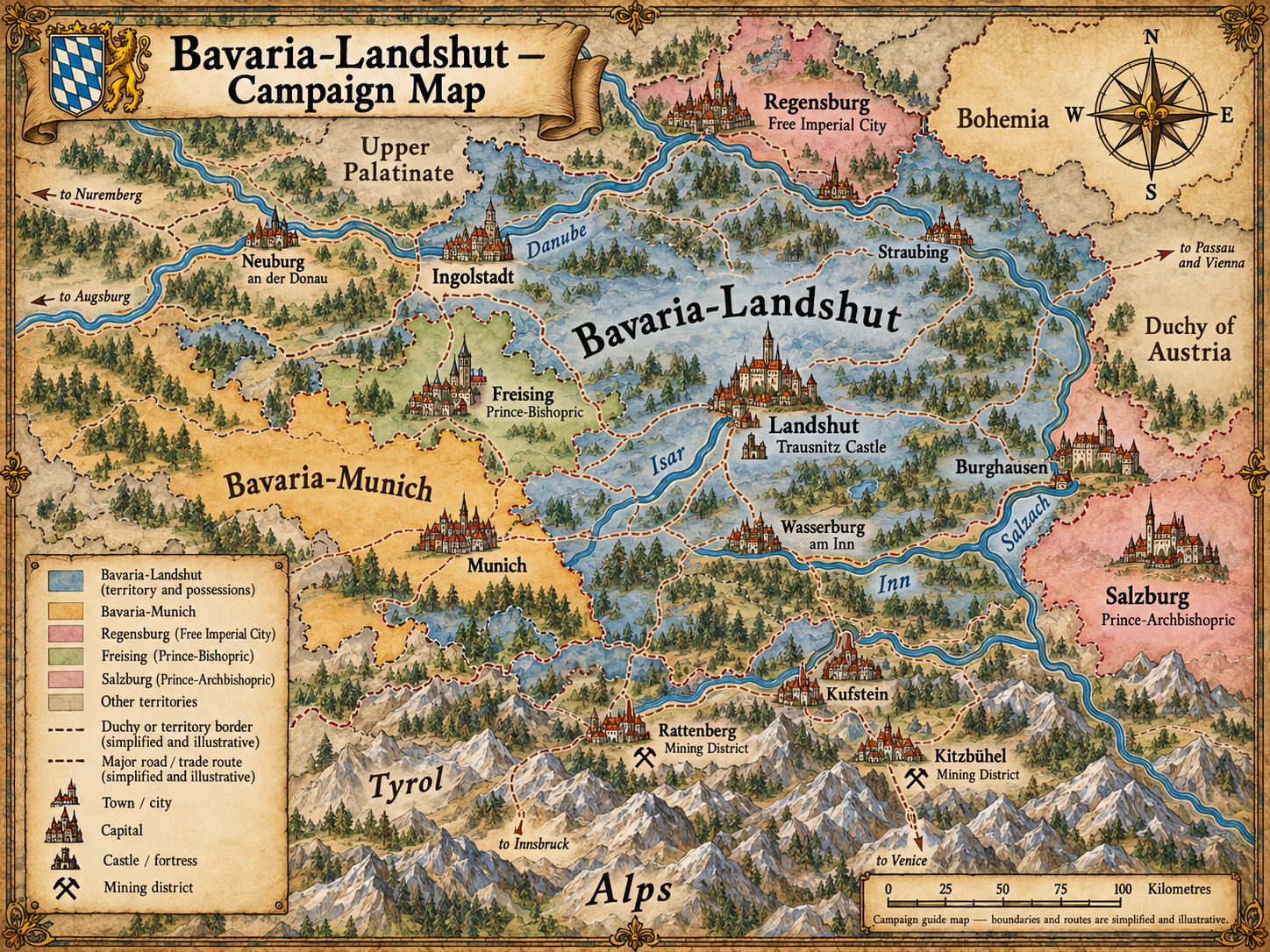
Landshut and its hilltop fortress stand on the Isar, while Ingolstadt lies on the Danube and Burghausen guards the Salzach. Most of the former Bavaria-Ingolstadt inheritance came under Landshut after the 1450 Treaty of Erding; neighbouring jurisdictions such as Regensburg and Freising maintained separate rights. The map compresses scattered lands into a readable campaign aid; consult the wider Bavarian duchies guide and the historical treaty source below when exact territorial claims matter.
Sources, Images and Historical Background
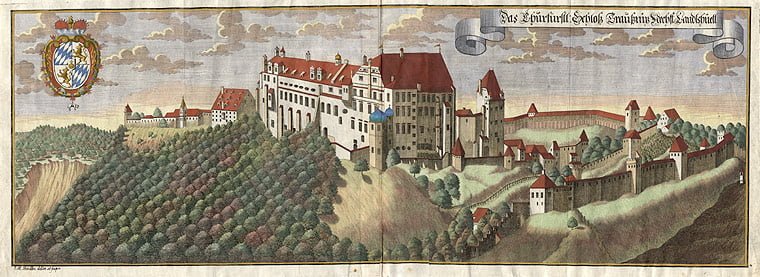
Bernhard Glasauer, Erdinger Vertrag, 16. Dezember 1450, Historisches Lexikon Bayerns, documents the inheritance settlement. Castle context comes from Trausnitz Castle and the Bavarian Palace Administration’s Burghausen Castle history. The painted campaign shield appears beside At a Glance; the later historical engraving of Trausnitz is preserved here for architectural context. The covert Illuminati, non-human communities, regional monsters and individual adventure incidents belong to the fantasy setting.
Keep this reference growing
If this page helped with your reading or game, you can support its upkeep or explore the curated books.
Explore the Bookshop — epics, classics and stories behind imagined worlds.